

The Pandavas’ departure after the dice game poses a difficult ethical question: why submit to exile when the contest was compromised, the court had failed, and immediate resistance was within reach? The episode tests whether dharma means obedience to a visible obligation, resistance to injustice, protection of social order, or some uneasy combination of all three.
The supplied DharmaRenaissance Blog account presents the decision as neither passive submission nor approval of the wager. Read closely, its argument is about disciplined power: the Pandavas accept a painful constraint while preserving their claim to justice, preparing for possible conflict, and preventing anger from deciding when force should be used.
A tainted wager creates a double bind
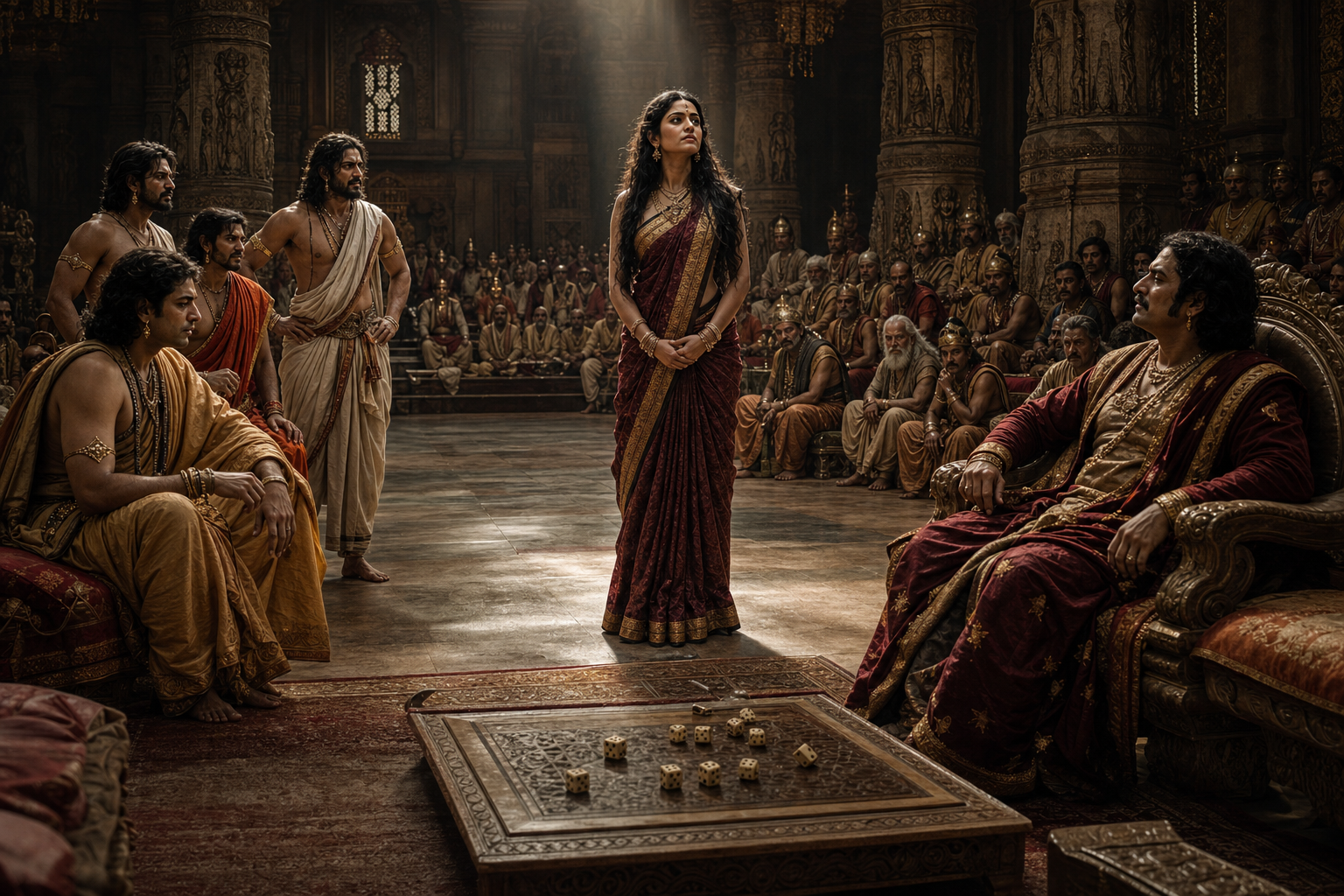
According to the source article, the dice game was morally compromised by Shakuni’s skill, Duryodhana’s envy, Dhritarashtra’s weakness, and the silence of elders who should have defended justice. Draupadi sharpened the crisis by asking whether Yudhishthira could stake her after he had already lost himself. The assembly’s inability to answer clearly exposed more than a disputed wager: it revealed an institution unable to apply its own ethical principles.
This makes the exile more complicated than compliance with a fair agreement. The Pandavas faced two dangerous choices. An attack in the royal court might have answered humiliation immediately, but the source argues that it could also have been portrayed as a rebellion by princes who had lost a wager. Accepting exile, however, risked making an unjust proceeding appear legitimate.
Yudhishthira’s response separates outward compliance from moral endorsement. In the article’s interpretation, he honors the declared condition without treating deceit, humiliation, or institutional paralysis as righteous. That distinction protects a future claim to rule based on restraint and trust rather than military ability alone. It also shows why dharma cannot be reduced either to literal rule-following or to the conviction that a just grievance licenses every available response.
Competing voices keep dharma from becoming a slogan

The episode’s ethical depth comes from disagreement within the Pandava household. The source associates Yudhishthira with fidelity to obligation and concern for the wider order. Bhima’s anger expresses the demand that wrongdoing face consequences. Draupadi refuses to let endurance erase the injury done to her, while Arjuna and the twins embody forms of disciplined capacity that remain available even when immediate retaliation is rejected.
None of these positions is sufficient by itself. Yudhishthira’s restraint, detached from Draupadi’s demand for justice, could deteriorate into accommodation with wrongdoing. Bhima’s indignation, detached from judgment about timing and consequences, could turn righteous anger into uncontrolled violence. Draupadi’s presence therefore prevents exile from being romanticized as serene suffering: the moral wound remains open, and the eventual response must address it.
This tension also clarifies the relationship between rajadharma and kshatra dharma in the source’s reading. The ruler must consider public trust and political order, while the warrior must remain capable of protecting justice. Restraint does not cancel courage, and courage does not eliminate accountability. Dharma lies in governing power so that force serves restoration rather than impulse.
Exile changes waiting into preparation

The source depicts the forest years as an interval in which time reveals character. The Pandavas fulfill the imposed conditions, live among sages, protect others, and deepen their discipline. Meanwhile, the Kauravas’ possession of power does not resolve the original injustice; in the article’s interpretation, their conduct makes the contrast between the rival claims increasingly visible.
The account identifies several forms of preparation within exile: Arjuna seeks divine weapons, Bhima undergoes encounters in the forest, Yudhishthira participates in dialogues with sages, and Draupadi preserves the memory of what the court allowed to happen. These strands give waiting an active structure. Martial capacity grows, ethical reflection deepens, and the demand for justice is not permitted to disappear.
The political effect is equally important to the article’s thesis. Immediate violence at Hastinapura could have produced civil conflict before motives, alliances, and responsibility were clear. By completing the exile, the Pandavas could return as dispossessed heirs who had fulfilled the conditions placed upon them. Their restraint thus becomes evidence supporting their legitimacy rather than proof that the original wrong was acceptable.
This is why the source describes the Pandavas as renouncing premature war, not war in every circumstance. It points to Krishna’s later diplomacy, including willingness to pursue peace through a minimal territorial concession, as evidence that armed conflict was not treated as the first remedy. Within this framework, force becomes morally intelligible only after patience, counsel, fulfilled obligations, and attempts at settlement have failed.
When restraint serves justice, and when it does not
The exile should not be converted into a universal command to endure abuse. The source’s own reasoning supplies limits to such a reading. Restraint is defensible here because it preserves a public claim to justice, avoids an impulsive conflict, creates space for preparation, and retains an eventual path toward remedy. It would mean something different if it required silence about Draupadi’s humiliation or permanent abandonment of the Pandavas’ responsibilities.
A useful distinction emerges between patience that disciplines action and patience that excuses adharma. The former asks whether immediate retaliation will restore order, whether the injured are still being heard, whether capacity for protection is being strengthened, and whether peaceful remedies remain possible. The latter postpones responsibility without an ethical purpose or endpoint.
The episode also complicates the idea of legitimacy. Possession of the throne does not settle who deserves to rule, just as suffering does not automatically make every later action righteous. In the article’s account, the Pandavas must continue governing their motives during exile and negotiation. Their cause depends not only on what was done to them but also on what they choose to become in response.
Key takeaways
- The Pandavas’ compliance with exile can be read as fulfillment of a declared obligation without moral approval of the compromised dice game.
- Draupadi’s protest and Bhima’s anger keep restraint accountable to justice, while Yudhishthira’s caution keeps punishment accountable to order.
- The forest period functions as active preparation through discipline, reflection, protection, and the preservation of the Pandavas’ claim.
- In the source’s interpretation, force becomes dharmically defensible only after premature retaliation is refused and peaceful remedies have been pursued.
For readers applying this episode beyond the epic, the continuing challenge is to build forms of restraint that protect the injured, expose institutional failure, and prepare effective remedies. Power governed by dharma must remain patient enough to judge wisely and resolute enough to act when patience would otherwise become complicity.