
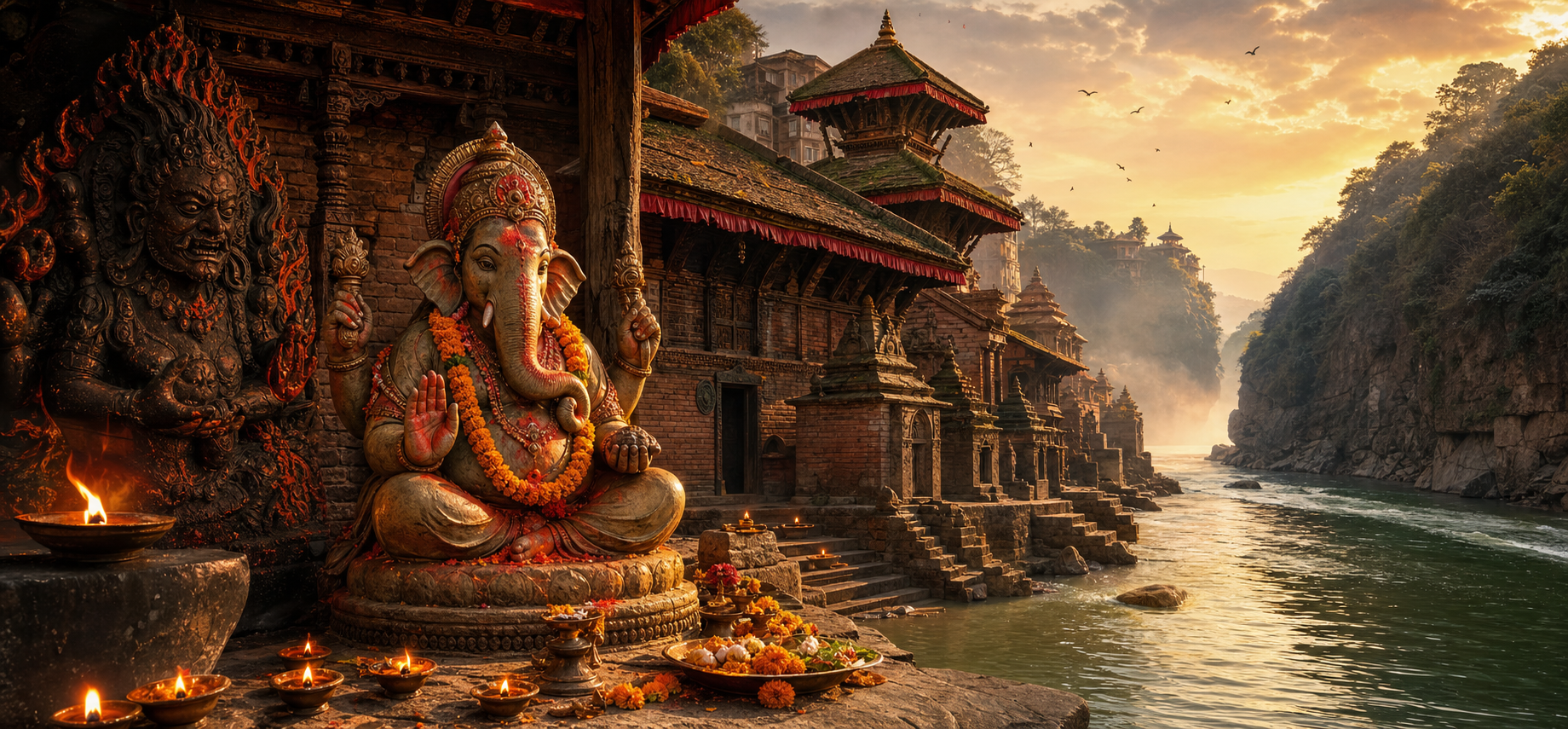
At Jal Vinayak, removing an obstacle is imagined as more than easing a difficult beginning. The account supplied for this article places Ganesh beside Chobhar’s gorge and the Bagmati River and associates him with Vighnantaka Bhairava, bringing auspicious guidance, fierce protection and the dynamics of passage into one sacred setting.
Reading these elements together reveals a layered tradition: geography gives theology a physical form, the deity pairing distinguishes different responses to obstruction, and oral memory connects Chobhar with Shreekhandapur. The available material is one interpretive DharmaRenaissance article that itself draws on local oral accounts, so its specific claims are attributed here rather than presented as independently verified history.
Chobhar turns obstacle removal into sacred geography
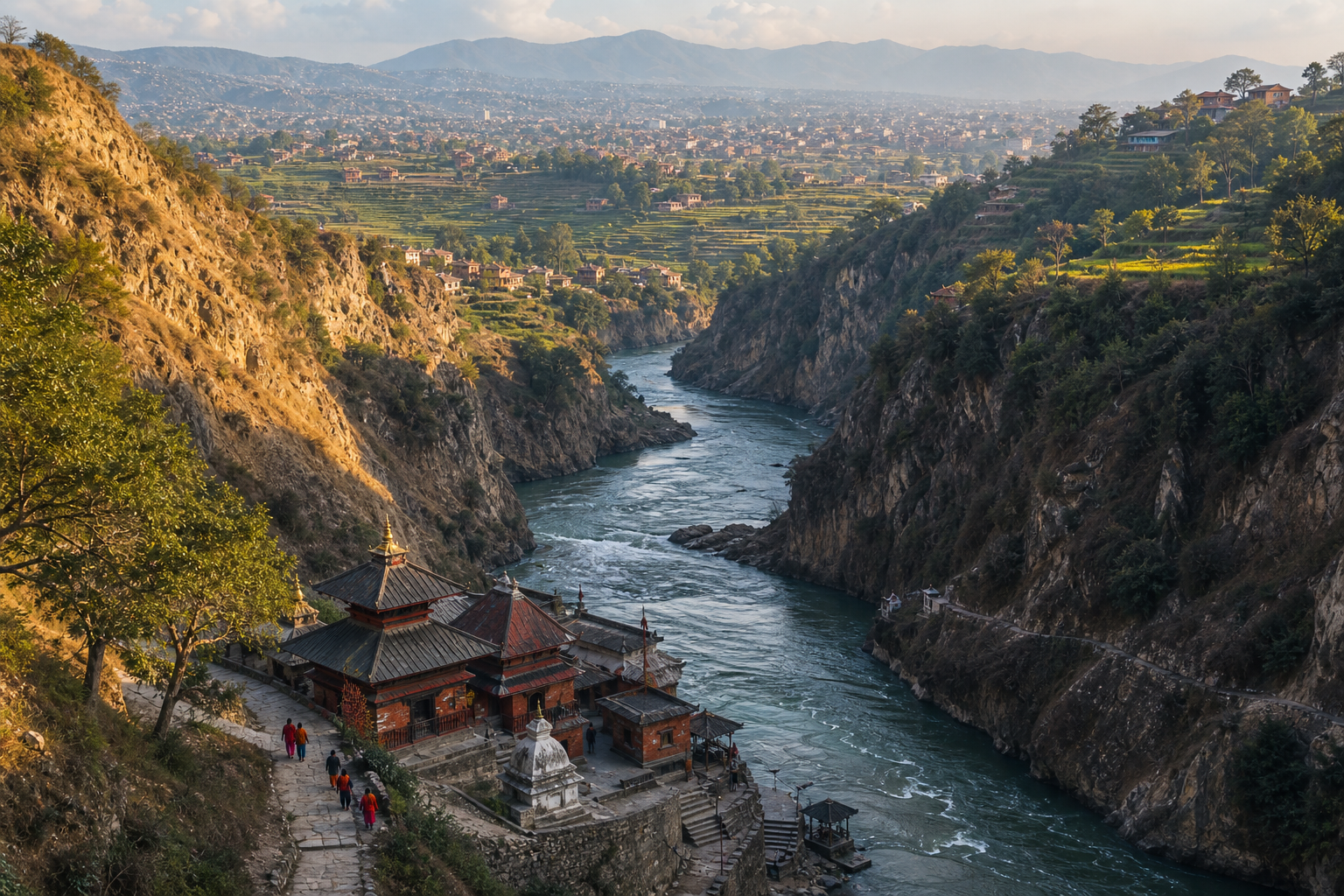
According to DharmaRenaissance, Jal Vinayak, also called Jal Binayak, is an important Vinayak shrine of Kathmandu Valley. The article places it within a traditional group of four shrines comprising Jal Binayak, Chandra Binayak, Surya Binayak and Ashok Binayak. In that account, Ganesh worship does not concern private devotion alone. The shrines help orient and protect the valley’s inhabited world, giving worship a geographical and civic dimension.
Jal Vinayak’s Chobhar location supplies the tradition with its defining image of transition. The source situates the shrine near the gorge through which the waters of the valley’s ancient lake are said to have drained. In the sacred narrative it recounts, the Bodhisattva Manjushri cuts an opening that enables the valley to become habitable. The story therefore joins rupture and settlement: an enclosed world must be opened before an inhabited one can emerge.
The important point is not to turn a sacred narrative into an unsupported geological claim. Within the tradition’s own symbolic geography, however, the terrain becomes a language for understanding Ganesh. Water can nourish, cleanse and sustain, but it can also overwhelm or conceal. A gorge is simultaneously a wound in the landscape and a route of release. Ganesh consequently appears not only as the deity invoked at an ordinary beginning, but as the power presiding over a difficult passage from containment to movement and from disorder to inhabitable form.
This reading also establishes the limits of the evidence. The supplied source does not give a construction chronology or a philological history of the shrine’s name. What it supports is an interpretation of religious meaning: at Jal Vinayak, the physical setting is part of the theology rather than incidental scenery.
Ganesh and Bhairava answer different kinds of obstruction
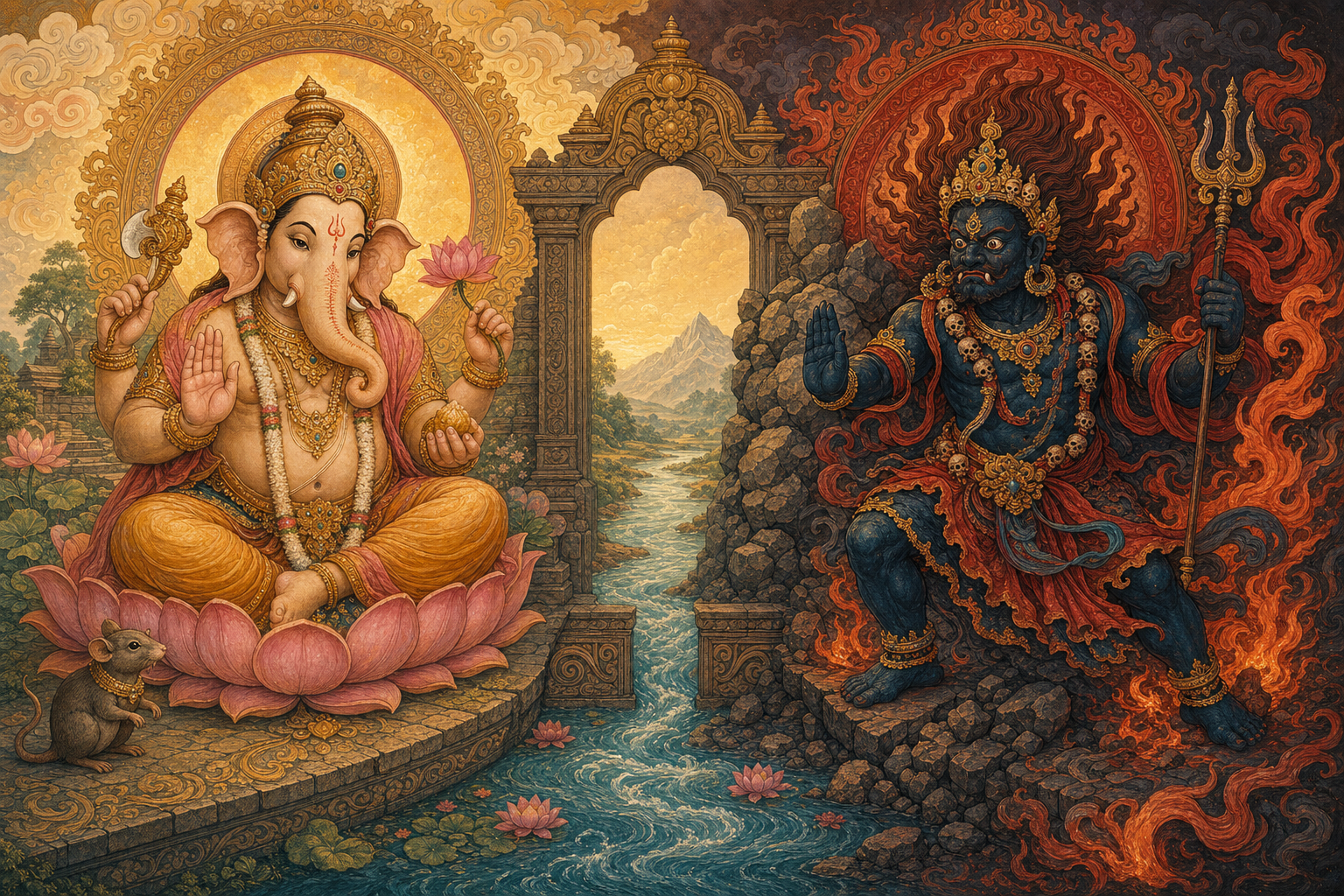
The association with Vighnantaka Bhairava adds a fiercer register to the shrine’s familiar Ganesh devotion. As the source explains, vighna denotes an obstacle, hindrance or interruption. Ganesh is widely approached as the governor of beginnings and remover of impediments. Bhairava, a formidable manifestation of Shiva, is presented in the article as a guardian associated with time, purification, sacred boundaries and the destruction of forces that obstruct spiritual or social order.
The pairing is most useful when it is not reduced to a contest between a gentle god and an angry one. Some obstacles call for understanding, patience, discrimination and a better route forward. These correspond to the Ganesh dimension emphasized by the source. Other obstacles, such as destructive pride, entrenched fear or attachment to confusion, may require decisive separation. Vighnantaka Bhairava represents that uncompromising protective response.
This distinction does not make severity inherently sacred. In the article’s interpretation, Bhairava’s fierceness has meaning only when ordered toward protection, truth and liberation from bondage. Ganesh’s accessibility likewise should not be mistaken for theological simplicity. The source places him within broader regional and Tantric understandings of Ganapati as a guardian of thresholds, a power of mantra and a guide through both worldly and spiritual transitions.
Chobhar’s gorge makes the complementarity visible. A passage can be created through intelligent navigation, but an enclosure may also need to be cut open. The Ganesh-Bhairava association holds both possibilities together: wisdom that finds a way and clarity that removes what cannot be carried forward.
Kvena and Kwenawasi memory links two settlements
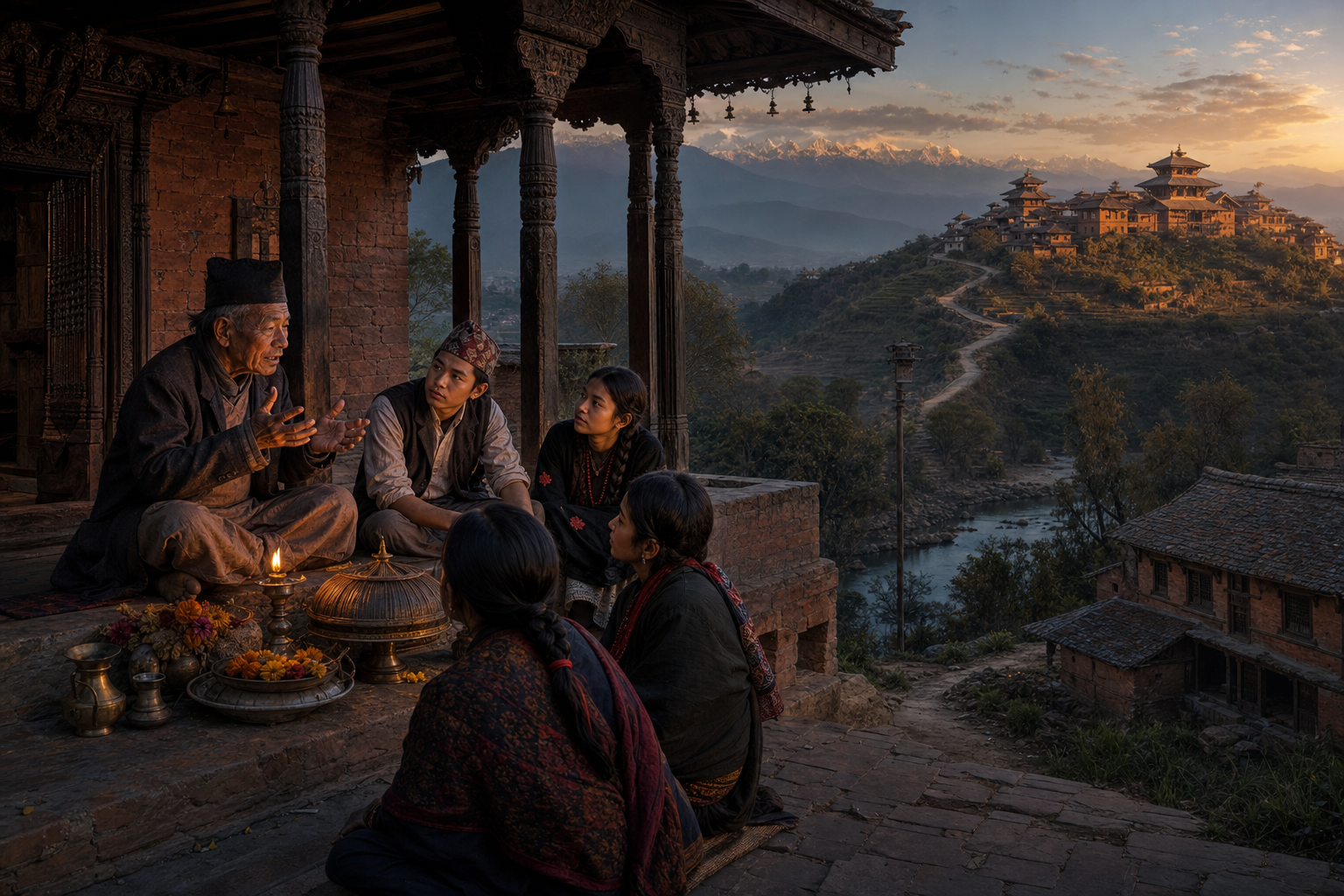
The names Kvena and Kwenawasi introduce another layer of the tradition. DharmaRenaissance reports an oral account from Shreekhandapur concerning Kwenawasi Ganesh Than, a place where water is believed never to dry and which is described in the story as an entrance to the underworld. These claims belong to sacred memory and should be understood in that register.
In the reported legend, a Tantric practitioner from Chobhar tests the deity’s power and interprets the image through a paradox of scale. Its larger dimension signifies the immensity of heaven and the underworld, while its smaller dimension evokes the minute subtlety of creation. The narrative then says that the image was taken to Chobhar and became connected with the temple tradition there, although Shreekhandapur continued to honour Kwenawasi Ganesh at its own shrine.
An oral narrative of this kind cannot, by itself, establish the date of an image’s movement or settle questions of original ownership. Its religious importance does not depend solely on performing that historical function. As the source observes, devotees from Shreekhandapur continue to visit Chobhar. The story can therefore be read as a charter of relationship: it preserves the distinct identity of each place while maintaining pilgrimage, obligation and shared reverence between them.
Read alongside the Chobhar landscape, the legend’s contrast between vastness and minuteness gains additional significance. The shrine connects cosmic expanses with a particular image, and the transformation of an entire valley with one narrow opening. That parallel is an interpretive connection rather than a separate historical claim, but it helps explain why scale, descent, water and passage recur throughout the tradition.
A Newar sacred landscape holds several levels of meaning
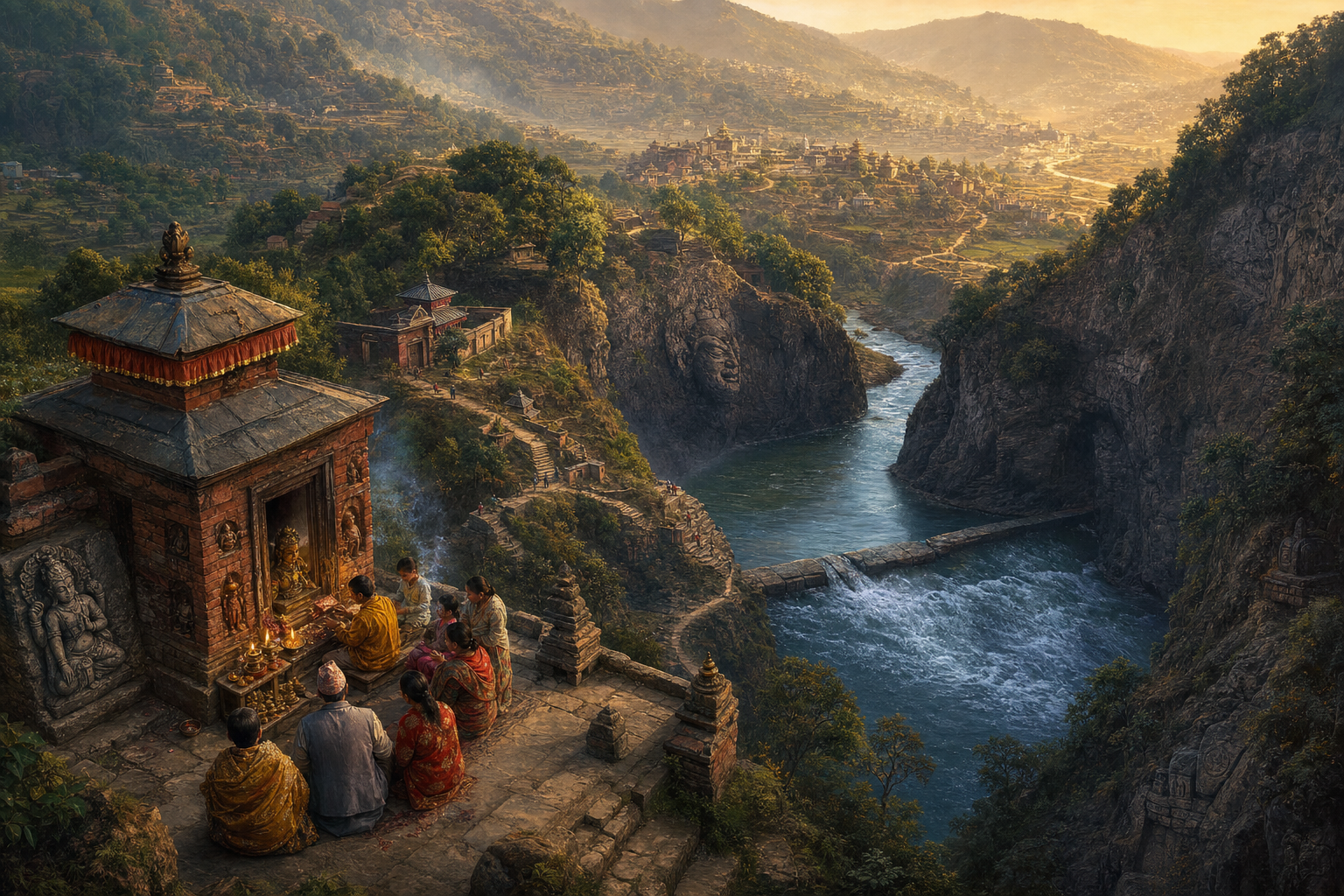
The source presents the Manjushri narrative as part of a landscape remembered through both Hindu and Buddhist imagination. Its emphasis is not that the traditions become identical, but that the same place can carry complementary accounts of opening, transformation and settlement. Jal Vinayak thus belongs to a religious geography in which shared places can sustain more than one devotional vocabulary.
Bhairava’s role is similarly grounded in the life of Kathmandu Valley rather than confined to abstract theology. DharmaRenaissance points to Bhairava masks, processions, temples and guardian images in Newar religious culture, interpreting the deity as a civic protector and witness as well as a fearsome form of Shiva. The fierce countenance communicates vigilance against disorder; it need not be read as approval of violence.
The resulting tradition operates at three connected levels. Personally, it distinguishes obstacles that require patient intelligence from those that require disciplined severance. Civically, it places Ganesh and Bhairava within the protection and orientation of settlements. Cosmologically, it associates the shrine with water, the underworld, the opening of the valley and the movement from an enclosed condition into habitable order.
This layered reading also prevents two common simplifications. Ganesh is not confined to the role of a benign dispenser of success, while Bhairava is not reduced to menace. Both are threshold powers, approached through different but compatible modes. Based on the supplied evidence, however, the safest description is an interpretive tradition surrounding an associated image, landscape and body of oral memory, not a fully documented institutional history with a settled chronology.
Key takeaways for interpreting the tradition
- Read the landscape, deity association and oral narrative together; none conveys the tradition’s full meaning in isolation.
- Understand Ganesh and Vighnantaka Bhairava as complementary responses to obstruction: discerning guidance and protective severance.
- Treat the Shreekhandapur account as religious and social memory unless additional evidence is produced for its historical particulars.
- Keep the scale of each conclusion proportionate to the source: the material supports theological and cultural interpretation more strongly than precise claims about provenance or chronology.
A fuller study could compare oral versions from Chobhar and Shreekhandapur, document current ritual practice, and examine relevant images and records where available. Until then, the most responsible reading keeps devotion and historical caution together, approaching Jal Vinayak as a threshold where water, settlement, memory and two modes of overcoming obstruction meet.