
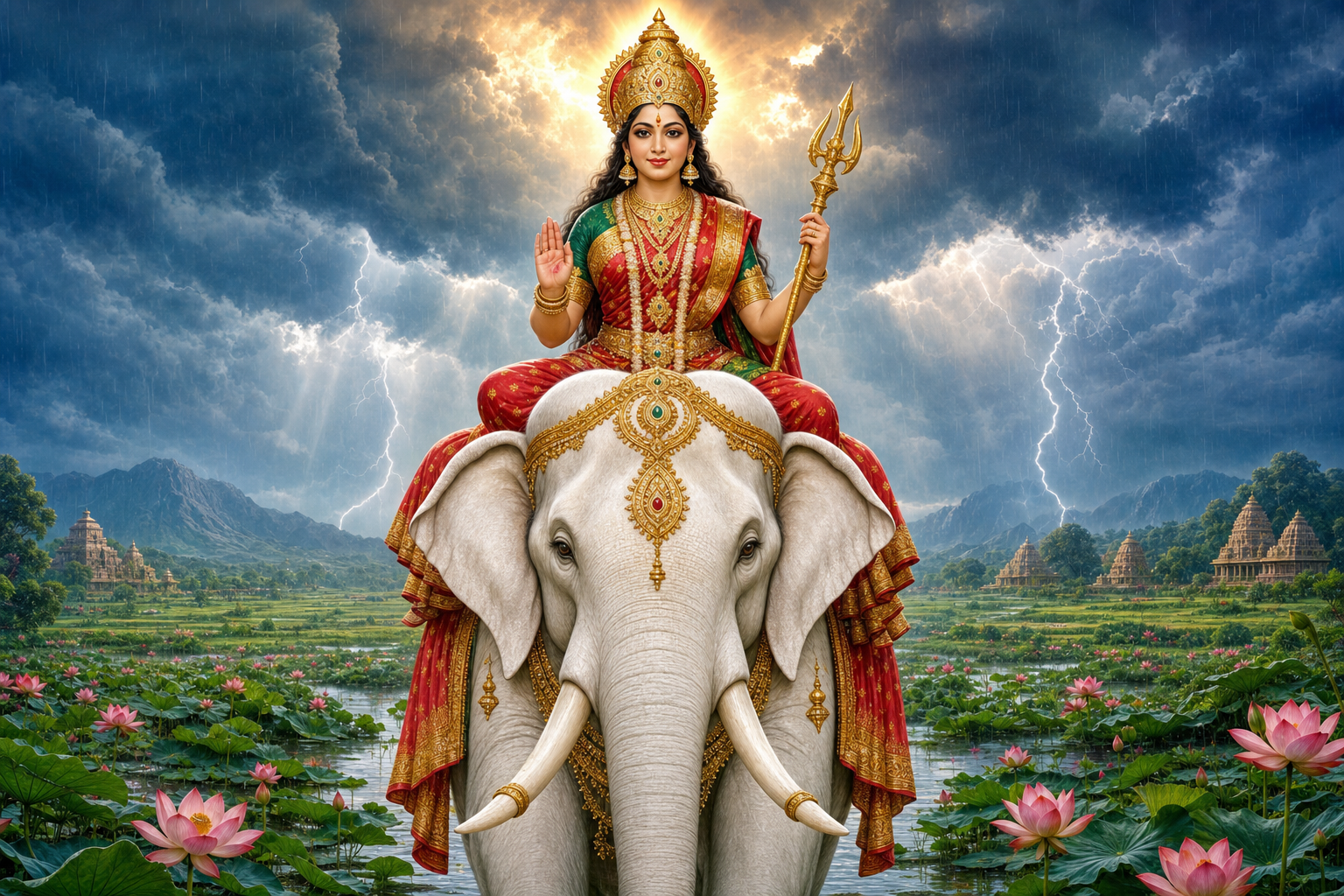
Indrani’s image is best understood as a coordinated visual statement, not as a collection of royal accessories. Her elephant, thunderbolt, crown, gestures, and place among the Matrikas connect celestial sovereignty with protection, nourishment, discipline, and the active power of Shakti.
Only one source article was supplied for this synthesis. Its details are therefore presented as that article’s account rather than as independently corroborated claims. The discussion below connects its theological, visual, and architectural strands to show how a viewer can move from identifying Indrani to interpreting what her image communicates.
Indrani is an embodiment of authority, not merely a consort
The supplied DharmaRenaissance Blog account identifies the goddess by several names: Indrani, Shachi, Aindri, Mahendri, and Poulomi. Each name places a different emphasis on her identity. Aindri presents her as the feminine power of Indra, while Poulomi refers to the Puranic lineage in which she is the daughter of the asura Puloman. The article interprets that lineage as an example of conflict being integrated into a larger dharmic order.
This framing prevents Indrani from being reduced to the wife of a prominent male deity. The source instead places the relationship within the broader Hindu idea that divine authority and its Shakti are inseparable. Indra represents celestial kingship and command; Indrani makes that authority active, relational, protective, and auspicious. Their pairing is therefore presented as metaphysical as well as marital.
The article traces a movement from a queenly feminine presence in Vedic literature to a more elaborated identity in Puranic, Agamic, sculptural, and goddess traditions. Across those settings, her defining theme remains disciplined power. Her dignity is not passive, and her beauty is not simply ornamental: both belong to a visual language of legitimate sovereignty.
Elephant, vajra, and crown form a single symbolic system
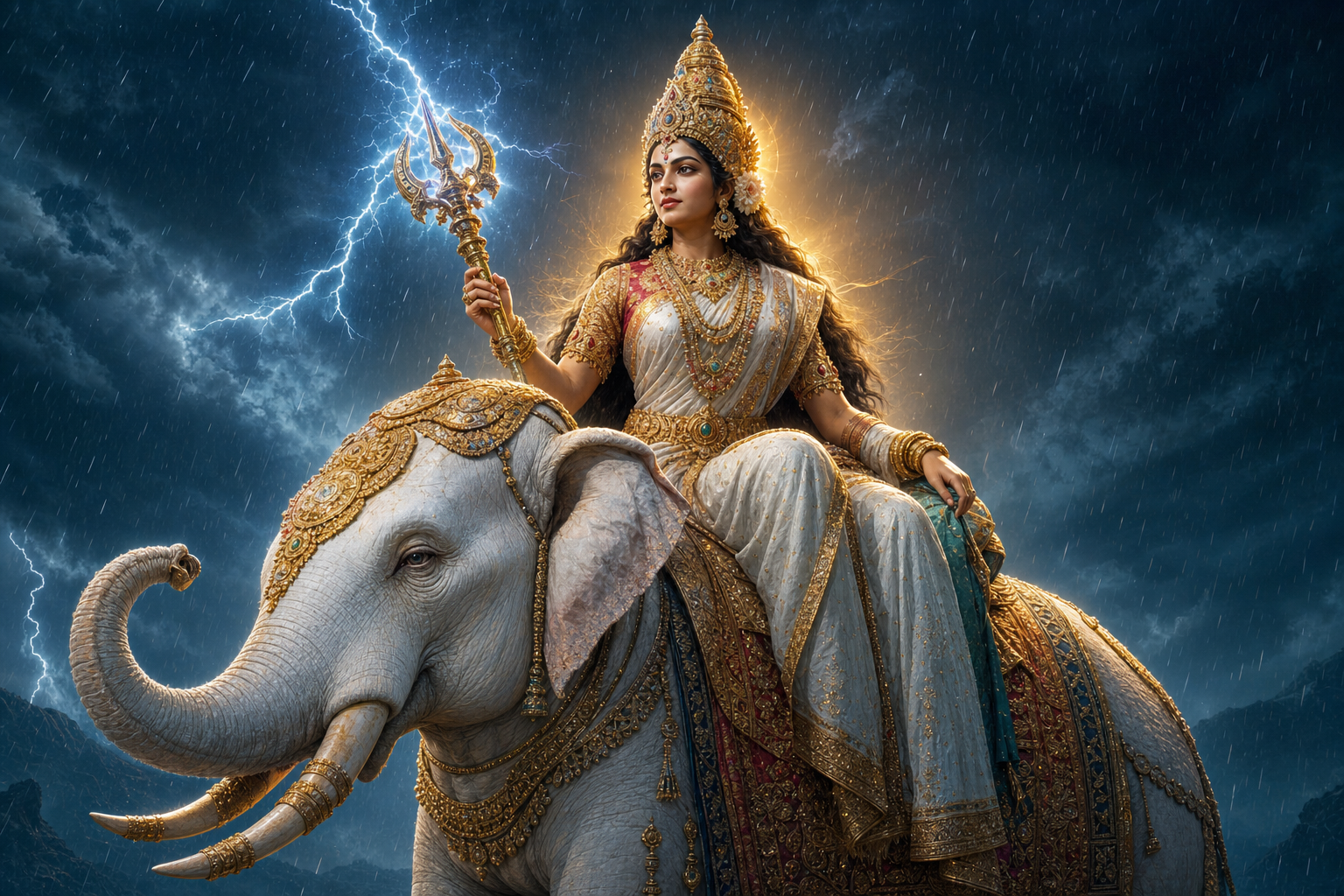
The elephant is the most immediate clue to Indrani’s identity. The source associates it with Airavata, Indra’s royal elephant, and explains its symbolism through majesty, memory, stabilizing strength, fertility, rain-bearing clouds, and authority. This range of meanings joins political and natural order. Indrani’s sovereignty is connected not only with rank in heaven but also with the rain and abundance upon which life depends.
The monsoon connection gives the image an important social dimension. The source describes Indra as the wielder of the thunderbolt and releaser of waters, while Indrani expresses the nourishing aspect of that power. Read together, elephant and rain imagery connect the celestial court with agriculture, food, prosperity, and household continuity. Authority becomes meaningful because it sustains life.
The vajra adds a complementary meaning. According to the article, Indrani’s possession of Indra’s characteristic thunderbolt marks her as a bearer of his active power. The weapon signifies firmness, clarity, irresistible force, and the removal of obstruction. Within the source’s dharmic interpretation, this is directed power rather than violence without purpose: it confronts ignorance, arrogance, drought, and disorder.
Her crown, ornaments, posture, and radiant coloring complete the system. The source mentions golden, red, and other bright celestial tones. Gold communicates auspicious splendor and sovereignty, while red suggests vitality, protection, and active Shakti. A composed posture restrains this energy through order; the crown declares participation in celestial rule; abundant ornament signals auspicious fullness. The result is an image of power under conscious governance.
Other reported attributes extend the same logic. A lotus can indicate purity and spiritual emergence, a goad can signify direction and disciplined control, and a noose can represent the restraint of harmful tendencies. Abhaya mudra offers fearlessness, while varada mudra conveys blessing. None of these elements operates in isolation: together they portray a goddess who can guide, restrain, protect, and nourish.
The Matrika setting changes how the image should be read
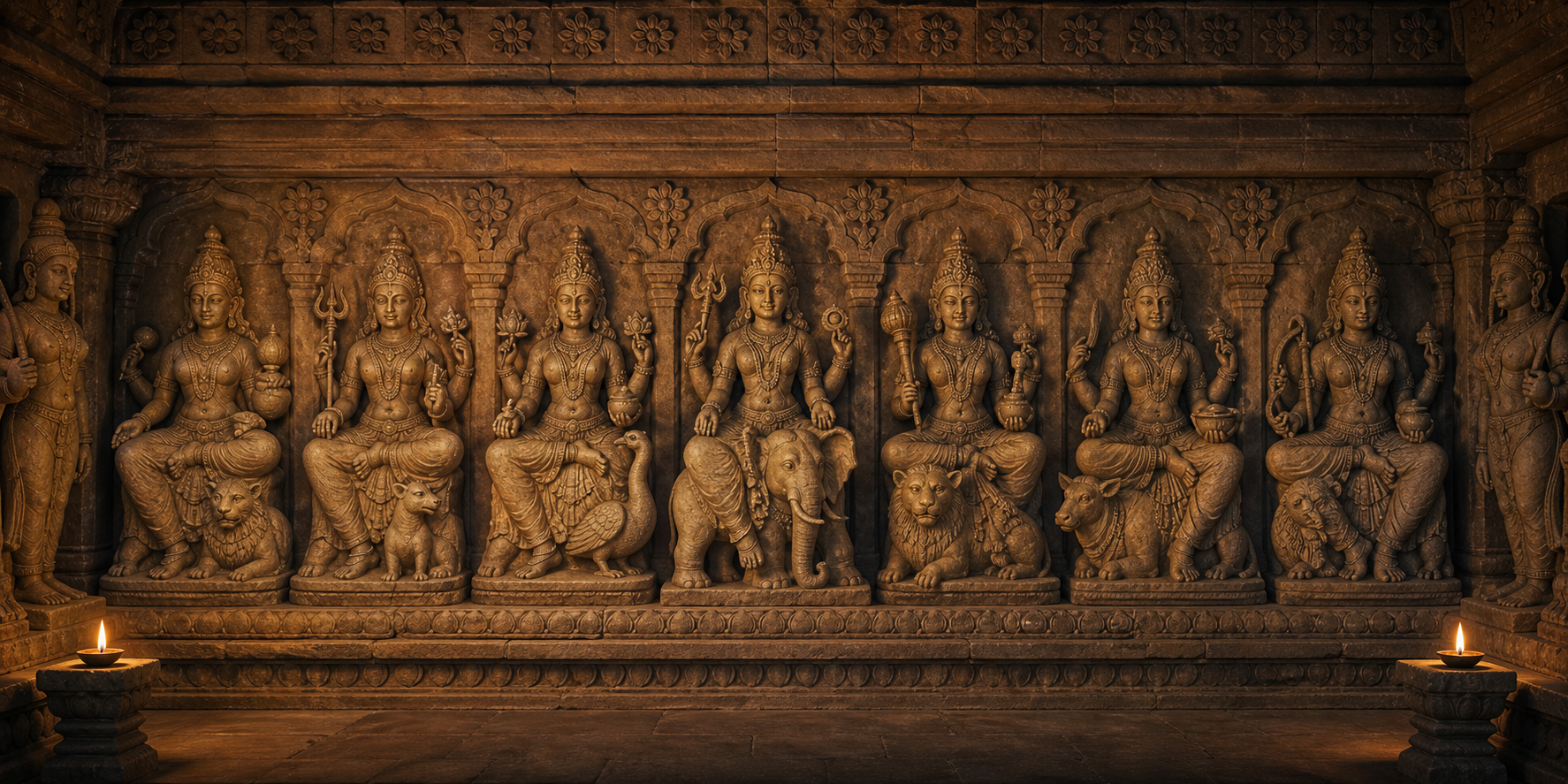
Indrani’s identity as Aindri or Mahendri among the Matrikas shifts the emphasis from celestial queenship to collective protection. The source places her in Saptamatrika and Ashtamatrika groupings alongside such figures as Brahmani, Vaishnavi, Maheshvari, Kaumari, Varahi, and Chamunda. It also notes that Narasimhi or other forms may appear according to textual and regional variation.
In this setting, the goddesses are not presented as decorative attendants. The article describes them as maternal, martial, protective, and cosmic powers who confront disorder and guard sacred space. Indrani consequently carries two mutually reinforcing identities: she is the dignified feminine power of a divine king and one member of a coordinated assembly of protective Shaktis.
Architectural location contributes to that meaning. The source reports that Matrika panels occur in Shaiva, Shakta, and early medieval temple contexts in different parts of India, sometimes near thresholds, outer walls, subsidiary shrines, or other protective zones. Such placement turns iconography into spatial theology. The figures do not merely depict protection; their position allows them to mark and guard the transition into sacred space.
This context is especially important when an individual sculpture lacks a surviving label. A regal goddess on an elephant may suggest Indrani, but her position within a Matrika sequence strengthens the identification and clarifies why her martial and maternal features appear together.
Identification should proceed from attributes to relationships
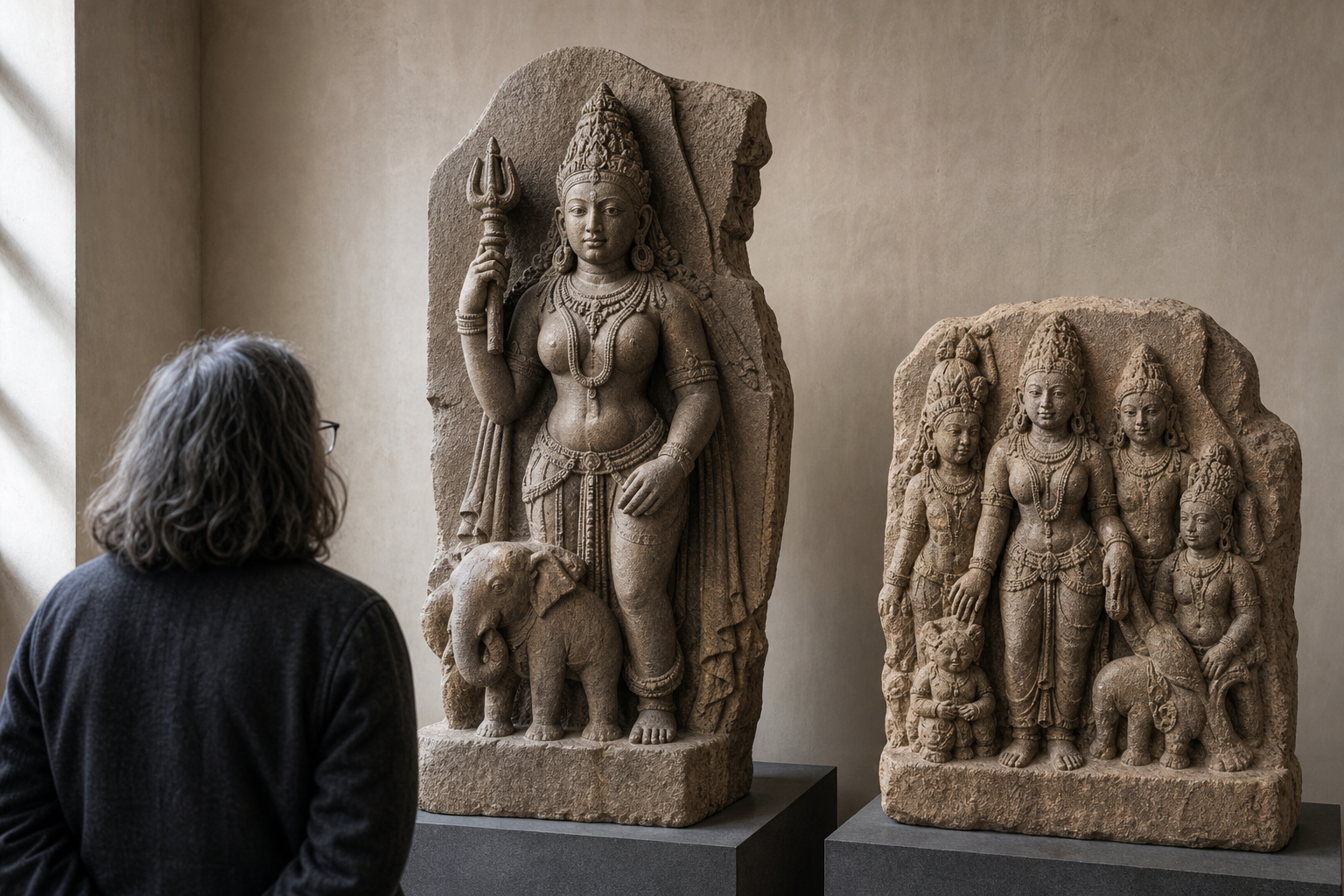
The source proposes a practical vocabulary for reading Hindu sculpture: vahana or vehicle, ayudha or attribute, mudra or gesture, hairstyle, ornaments, posture, and position within a group. For Indrani, the elephant and vajra provide the strongest reported clues. Crowned bearing, rich ornament, and placement among other Matrikas support the identification.
The number of arms should be treated as a variable rather than a decisive test. The article notes that Indrani may have two, four, or more arms depending on the textual, regional, and sculptural tradition. Two-armed images can foreground queenly dignity and accessibility, whereas additional arms express several divine capacities at once, including protection, blessing, restraint, and strength.
Once the figure has been identified, interpretation should examine relationships among the signs. Elephant plus vajra joins nourishing rain with force. Crown plus composed posture joins rank with self-command. Protective gestures plus Matrika placement joins personal blessing with the defense of a larger sacred order. This relational reading is more reliable than assigning a fixed meaning to each object without considering the full image.
Condition and context also matter when viewing a weathered panel, museum object, photograph, or shrine image. A missing hand may once have held an attribute, while separation from a larger ensemble may conceal the figure’s Matrika identity. The source’s visual framework encourages careful observation before theological interpretation, especially when only part of the original sculptural program survives.
Key takeaways
- Indrani’s alternate names connect queenly dignity, Indra’s active Shakti, and a complex Puranic lineage.
- The elephant and vajra are the principal reported identifiers, linking sovereignty with rain, fertility, decisive force, and the removal of disorder.
- Crown, ornament, color, posture, and mudras distinguish her authority as governed, auspicious, and protective rather than merely coercive.
- Her place among the Matrikas gives the image a collective, martial, maternal, and architectural function.
- A sound reading considers vehicle, attributes, gestures, number of arms, group position, and surviving physical context together.
Future encounters with Indrani images can begin with the elephant and thunderbolt, but they need not end at identification. Attention to setting, gesture, and the relationship among attributes can keep revealing how sacred art connects authority with nourishment, ethical restraint, and protective feminine power.