

In Hindu thought, cosmic harmony is not a mood created by imagining a peaceful universe. It is a disciplined relationship between how a person knows, breathes, acts, and attends, and the order understood to sustain life.
This perspective gives Hindu bliss, or Ānanda, a meaning deeper than pleasure. The source material connects metaphysics, ethical conduct, yoga, sacred sound, temple worship, and the symbolism of cosmic dance. Read together, these elements show that harmony is not one technique or sensation: it is the gradual integration of consciousness with conduct.
Key takeaways
- Ānanda signifies a depth of being rather than a temporary emotional high.
- Harmony with the cosmos is expressed through dharma, truthfulness, restraint, compassion, gratitude, and responsible action.
- Breath, mantra, meditation, and sacred sound gather scattered attention into greater steadiness.
- The language of vibration is best treated as a spiritual and contemplative framework, not as a simplified claim about modern physics.
- Temple ritual and the image of Shiva as Nataraja present harmony as still awareness within a changing world, not escape from change.
Bliss emerges as fragmentation subsides

The decisive distinction is between pleasure that depends on circumstances and bliss understood as intrinsic to reality. The source article invokes the Vedantic formulation sat-cit-ānanda, presenting Brahman through existence, consciousness, and bliss. Within that framework, Ānanda is not acquired as an external reward. It becomes apparent as ignorance, agitation, and restrictive identification loosen their hold.
The account of the five sheaths, or pañca kośa, in the Taittirīya Upanishad supplies a complementary map. Human experience is described through physical, vital, mental, intellectual, and bliss-associated dimensions, culminating in the ānandamaya kośa. The practical implication is not that bodily or emotional life should be despised. It is that identity need not remain confined to the most changeable layer of experience.
This distinction also clarifies why equanimity matters. The source connects the Bhagavad Gita’s samatvam with action that is no longer governed by obsessive attachment to results. Equanimity does not make a person passive; it reduces the inner turbulence produced by fear, vanity, craving, aversion, and comparison. Bliss, in this view, is compatible with demanding action because its basis is steadiness rather than favorable outcomes.
The three guṇas offer a vocabulary for understanding that refinement. The article associates tamas with dullness and confusion, rajas with restless movement and agitation, and sattva with clarity and balance. A sattvic mind is not the final metaphysical goal, but it is portrayed as a clearer instrument of perception. Food, company, speech, study, worship, work, sleep, and intention therefore matter because ordinary habits can either intensify fragmentation or support lucidity.
Cosmic harmony is ethical before it is acoustic

Modern language about aligning one’s vibration can easily become vague or self-centered. The source gives the phrase a more demanding foundation by connecting it to ṛta, the Vedic idea of cosmic order, and to the later language of dharma. Harmony is consequently not measured only by how serene a practitioner feels. It must also appear in truthful conduct, restraint, compassion, gratitude, discipline, and reverence.
This ethical dimension prevents spiritual practice from becoming a private search for pleasant states. A person may experience calm during meditation yet remain driven by greed, harsh speech, or irresponsible action afterward. Within the framework presented by the source, such a division indicates incomplete alignment: consciousness, intention, speech, and behavior have not yet formed a coherent whole.
Dharma also extends harmony beyond the isolated individual. The article relates sustaining order to personal responsibility, social concord, ecological reverence, and spiritual development. Cosmic harmony is therefore lived through relationships and obligations as well as contemplation. The universe is not treated merely as scenery for individual awakening; the practitioner belongs to an ordered field of life and must act accordingly.
This is where the Bhagavad Gita’s account of disciplined action complements the Upanishadic language of realization. Inner freedom and outward responsibility do not compete. Detachment from the fruits of action can make conduct steadier because attention shifts from egoic reward toward the quality and rightness of the action itself. Harmony becomes a way of participating in the world without being psychologically consumed by every result.
Breath and sacred sound train coherent attention

The source treats breath and sound as practical bridges between philosophy and experience. In yogic language, prāṇa is the vital force associated with embodied and mental life, while prāṇāyāma disciplines the breath to support steadiness. The article points to the familiar relationship between emotional states and breathing patterns: fear, anger, grief, and calm do not ordinarily share the same rhythm. Deliberate regulation of breath can therefore become a way of preparing attention for meditation.
Sacred sound works through a related principle of collection. Repetition in japa gives dispersed mental energy a recurring focus, fostering ekāgratā, or one-pointedness. The article emphasizes that mantra is not simply an encouraging sentence repeated for reassurance. It is approached as a sacred sound-form whose practice involves attention, repetition, reverence, pronunciation, ethical preparation, and, in traditional settings, transmission through lineage.
Om occupies a distinctive place in this contemplative landscape. As reported in the source’s discussion of the Māṇḍūkya Upanishad, Om serves as a symbol encompassing waking, dreaming, deep sleep, and turīya, the fourth state. Chanting is thus more than vocal performance: the sound becomes a map through which the practitioner examines the changing conditions of consciousness and the possibility of awareness beyond them.
Nāda Yoga broadens this movement from audible practice toward subtle attention. External forms such as mantra, bhajan, temple music, and Vedic chanting can orient the senses, while the tradition’s account of internal sound points toward absorption less dependent on ordinary sensory objects. Across these practices, sound is valuable not because noise itself is spiritual, but because ordered rhythm can educate attention.
The source also supplies an important boundary: the word “vibration” is a contemporary way of approaching older teachings about energy, sound, rhythm, and consciousness, not a license to equate spiritual concepts casually with modern physics. The most defensible meaning is experiential and disciplinary. Breath, rhythm, repetition, intention, and attention influence the practitioner’s inner condition; claims beyond that should not be smuggled in under scientific vocabulary.
Ritual and cosmic dance bring harmony into lived form
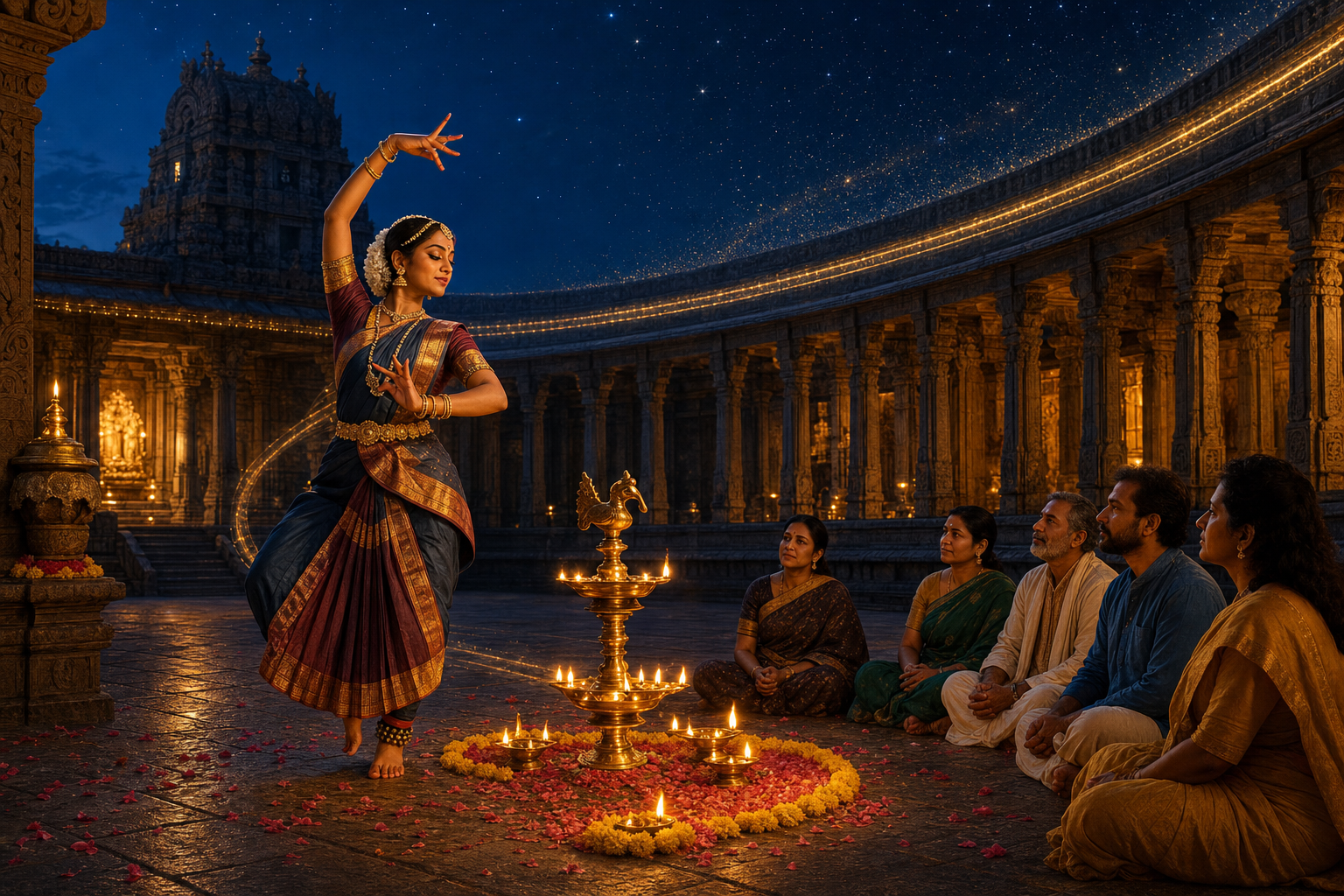
Hindu temple practice extends the search for harmony through the senses instead of demanding their simple rejection. In the source’s account, movement from the temple’s outer space toward the garbhagṛha, or sanctum, mirrors an inward journey. Bells, lamps, incense, flowers, water, mantra, food offerings, and circumambulation redirect sensory activity toward reverence. The senses remain active, but their orientation changes.
This ritual pattern reveals an important synthesis. Meditation gathers the mind, ethical conduct orders action, and worship gives embodied expression to devotion. None is presented as a complete substitute for the others. A coherent spiritual life joins inward awareness to outward form, allowing philosophy to shape habits and allowing disciplined habits to support contemplation.
The image of Shiva as Nataraja gives this integrated vision its most dynamic symbol in the source material. The cosmic dance encompasses creation, preservation, dissolution, concealment, and grace. Reality is portrayed not as motionless uniformity but as a living process in which forms continually arise and pass away. Bliss consequently cannot mean freezing life into a permanently comfortable condition.
The deeper aspiration is to discover a serene center within movement. That ideal connects Nataraja’s dance with equanimous action, regulated breath, gathered attention, and the Upanishadic movement from changing experience toward a more fundamental awareness. Cosmic harmony is not the elimination of contrast or difficulty. It is the capacity to meet change without allowing every change to shatter the integrity of consciousness.
The path ahead, on this account, is not to chase an increasingly unusual sensation. It is to make alignment more complete: clearer attention, more measured breath, more responsible action, more reverent use of the senses, and less dependence on circumstances for inner stability. Hindu bliss becomes credible when it is visible as coherence across the whole of life.