
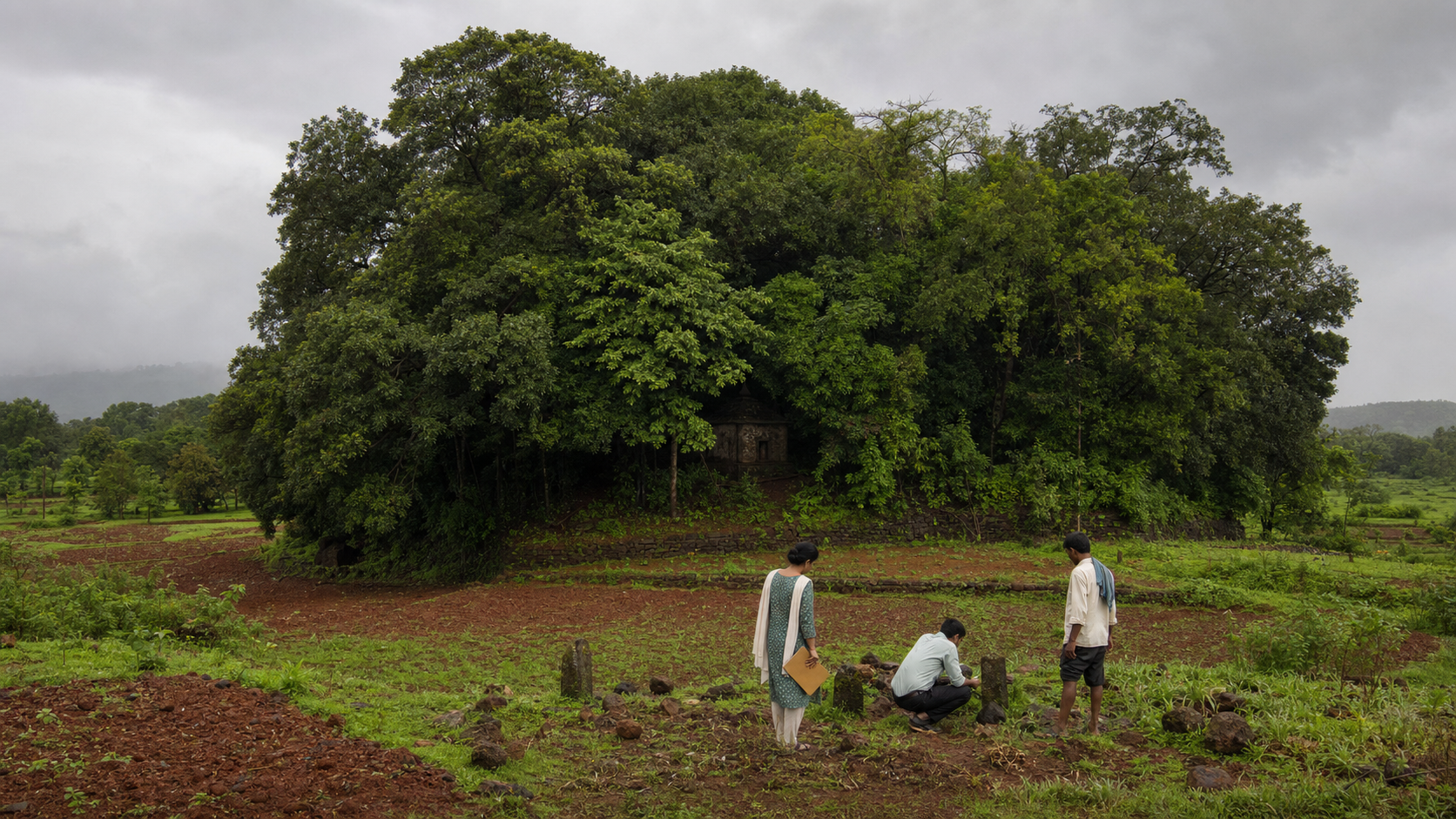
Maharashtra’s inquiry into the alleged transfer of Konkan Devrai land to the State is not yet proof that an unlawful transfer occurred. The available report presents a preliminary dispute: Maharashtra Mandir Mahasangh objected to revenue-department actions said to affect thousands of acres, and the State ordered an inquiry.
The central question is larger than whose name appears in a register. A credible review must determine what kind of land each parcel historically was, how its records changed, whether the required process was followed, and how any correction would affect religious practice, community stewardship and ecological protection.
The allegation and the established facts must remain separate
According to the supplied DharmaRenaissance Blog report, the controversy concerns alleged changes placing Devrai forest land in the State’s name. The report attributes the objection to Maharashtra Mandir Mahasangh and says the Maharashtra Government responded by ordering an inquiry. It does not present a completed investigation or a final adjudication of ownership.
That distinction should govern public discussion. An entry naming the government may result from several kinds of administrative action, including a mutation, survey correction, classification change, acquisition, forest proceeding or statutory vesting. These mechanisms do not all have the same legal effect. In general, a mutation records a change for revenue administration but does not, by itself, settle every dispute about title.
The inquiry therefore needs parcel-level answers. Investigators must identify what changed, when it changed, which authority approved it, which provision was invoked and whether affected parties received notice or an opportunity to be heard. Without that chain, both a claim of illegal appropriation and a blanket defence of the entries would be premature.
A Devrai combines land, worship and conservation

The report describes a Devrai as more than a wooded plot. It is a sacred grove sustained through local religious norms, village memory, customary restraint and reverence for a deity or sacred presence. Practices discouraging felling, hunting, extraction and unnecessary disturbance can operate as an inherited conservation system even where no modern protected-area regime applies.
This overlapping character explains why a single administrative label may be inadequate. A grove can have ecological importance without being temple property, and religious significance without having an identical title history to another grove. The report notes that Devrai parcels may appear in records as private land, trust property, forest, government land or village commons. The name Devrai describes a cultural and ecological relationship; it does not automatically establish one uniform legal category.
The ecological interest is nevertheless concrete. As reported in the source, sacred groves may retain native vegetation, moisture, soil stability, pollinator habitat, springs or seasonal water flows within otherwise altered landscapes. Their religious rules can thus produce public environmental benefits. A title inquiry that ignores those functions could resolve a register while leaving the grove itself more vulnerable.
The religious interest also requires precision. Some land may have been dedicated to a deity, temple or trust; some may instead have been protected through community custom. Those possibilities call for different evidence and potentially different remedies. Treating every grove as temple-owned would be as unreliable as treating every government entry as conclusive.
A credible inquiry must reconstruct each parcel’s history

The report identifies the documentary foundation for such a reconstruction: village 7/12 extracts, mutation registers, property cards where applicable, old survey and forest maps, village forms, temple or trust papers, inam records and earlier gazette references. These materials should be read as a sequence rather than as isolated documents. The important issue is not merely the current entry, but the authority and reasoning behind every consequential change.
Comparison across villages and talukas would also help distinguish an individual clerical error from a repeated administrative pattern. The source raises possibilities such as outdated classifications, overlapping forest and revenue jurisdictions, survey errors and misunderstanding of customary use. These are hypotheses for examination, not findings. A pattern should be inferred only after similarly situated parcels and their underlying orders have been compared.
Documentary gaps should not make local knowledge irrelevant. Oral histories, customary boundaries, festivals, ritual obligations and testimony from village elders may explain why a particular grove was protected or associated with a local institution. Such evidence cannot automatically override a valid legal record, but it can guide investigators toward missing documents, historical names and overlooked relationships between a grove and its community.
The final report should distinguish among verified title, administrative classification, present possession, customary management and ecological condition. Publishing those findings separately would prevent one conclusion from being stretched beyond what the evidence establishes.
Key takeaways
- The reported land transfer remains an allegation under inquiry, not a concluded finding of illegality.
- A State entry, mutation, forest classification and legally established title are related questions but are not necessarily interchangeable.
- Devrai lands may have different ownership histories even when they share sacred and ecological functions.
- The review should reconcile current records with historical orders, maps, trust or inam documents and relevant community evidence.
- Any remedy should correct defective entries without weakening the grove’s religious use or ecological protection.
Protection should not wait for every title question to close
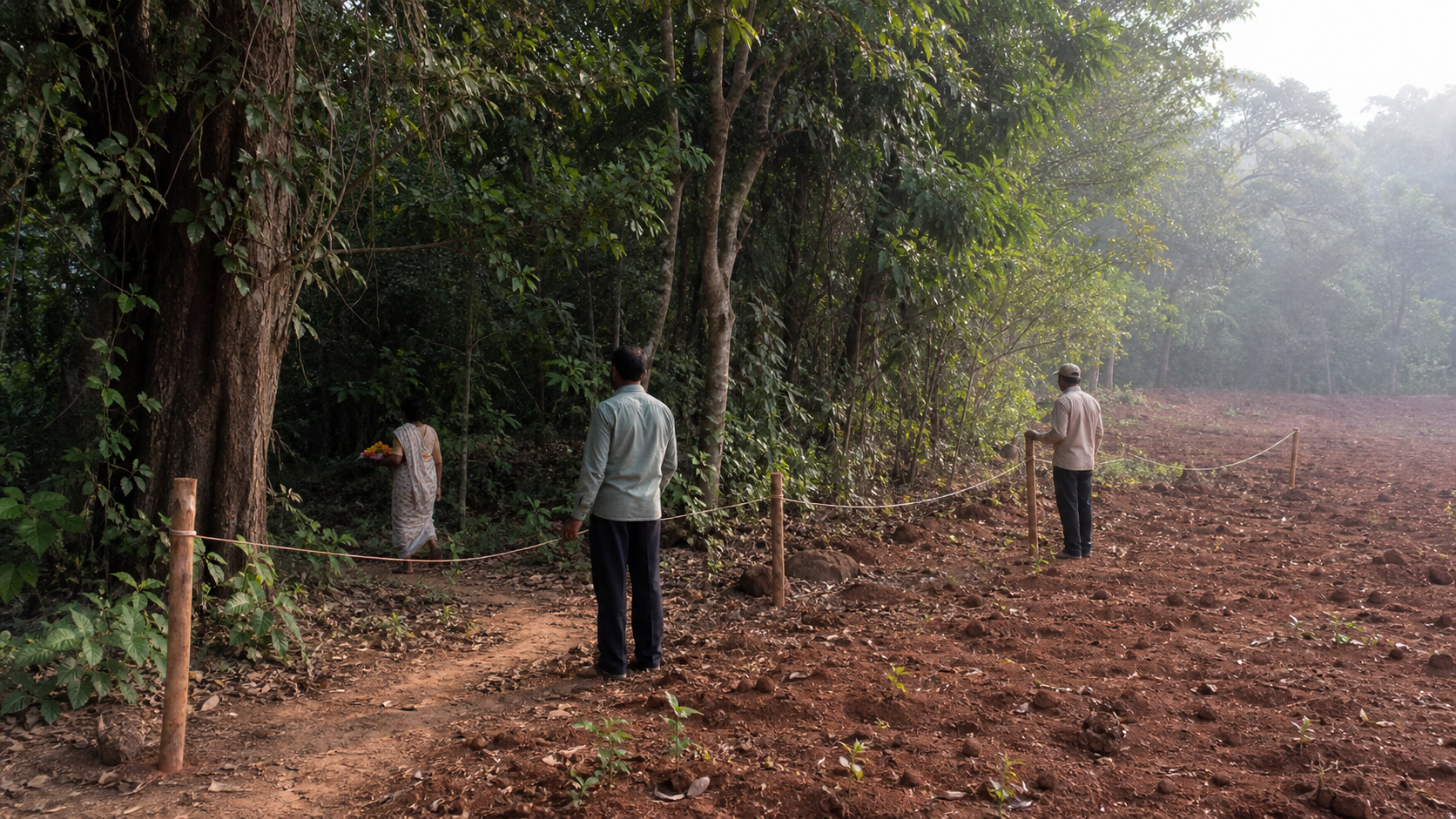
Because land proceedings can be lengthy, proportionate interim safeguards deserve consideration wherever a grove faces a credible risk of irreversible change. Maintaining the physical character of disputed land while records are examined would not predetermine ownership; it would preserve the subject of the inquiry. Any restrictions, however, should be issued through lawful, parcel-specific orders rather than through an undefined regional presumption.
The eventual remedy should follow the evidence. An unauthorized entry may require correction and restoration of the affected institution’s rights. A lawful State entry may still require an explicit conservation and community-access framework. Ambiguous cases may need further adjudication rather than an administrative shortcut. In each scenario, transparency matters: the authority, documents, reasoning and available route of challenge should be clear to affected communities.
The inquiry can become a durable model if it produces more than a verdict on disputed entries. A parcel-level public record connecting legal status, customary stewardship and ecological safeguards would give Konkan’s sacred groves protection that survives future changes in officials, surveys and land-use pressure.