

Women’s entrepreneurship belongs at the centre of the Viksit Bharat discussion because enterprise affects far more than individual income. It shapes who owns productive assets, gains financial experience, makes commercial decisions, creates employment and participates in institution-building.
A Mumbai felicitation programme described by DharmaRenaissance Blog brings these connections into focus. Its larger value lies in the question it raises: what must follow public recognition if women-led businesses are to progress from promising ventures to durable engines of national prosperity?
Recognition changes who is seen as an economic builder
The DharmaRenaissance report describes a World Hindu Economic Forum programme in Mumbai organised around the theme “Celebrating Women Entrepreneurship — From Sankalp to Samriddhi.” It says the gathering brought women entrepreneurs together with industry representatives, policymakers and public figures. The post also says Organiser reported on the event on June 28, 2026.
According to the article, Mumbai Mayor Ritu Tawde attended as chief guest and Ravikant Mishra, Secretary of the World Hindu Economic Forum and Hindu Economic Forum, presided. Tawde reportedly connected the awardees’ achievements with women’s self-reliance, entrepreneurship and equal opportunity. Her presence gave the programme a public-institutional character, although a ceremony by itself cannot establish how far the underlying business environment has changed.
The important shift is conceptual. Women are being presented not merely as recipients of development programmes but as owners, employers and decision-makers whose enterprises can contribute to urban growth and wider prosperity. The event’s progression from resolve to prosperity also treats commercial ambition as a disciplined process rather than an isolated success story.
The report links this economic framing with the Nari Shakti Vandan Adhiniyam. It identifies the measure with the Constitution (One Hundred and Sixth Amendment) Act, 2023, and notes its provision for one-third reservation for women in the Lok Sabha and State Legislative Assemblies, subject to the constitutional process involving census and delimitation. That qualification matters: the article emphasises the measure’s symbolic place in public discourse without suggesting that all of its electoral effects have already been realised.
Political representation and entrepreneurship are distinct domains, but they share a question of agency. In each, meaningful participation requires more than visibility. It requires recognised authority, the capacity to make decisions and a formal place within the institutions where resources are allocated.
Key takeaways
- Public recognition can help recast women’s entrepreneurship as an economic-development priority rather than a peripheral welfare issue.
- Durable empowerment depends on aligning formal ownership, decision-making authority and financial capability.
- Starting a business and scaling one are different challenges; growth requires capital, reliable payments, compliance support, market access and credible networks.
- A Dharmic account of prosperity is economically relevant when it produces ethical conduct, trustworthy institutions and benefits extending beyond the founder.
The decisive divide is between participation and ownership
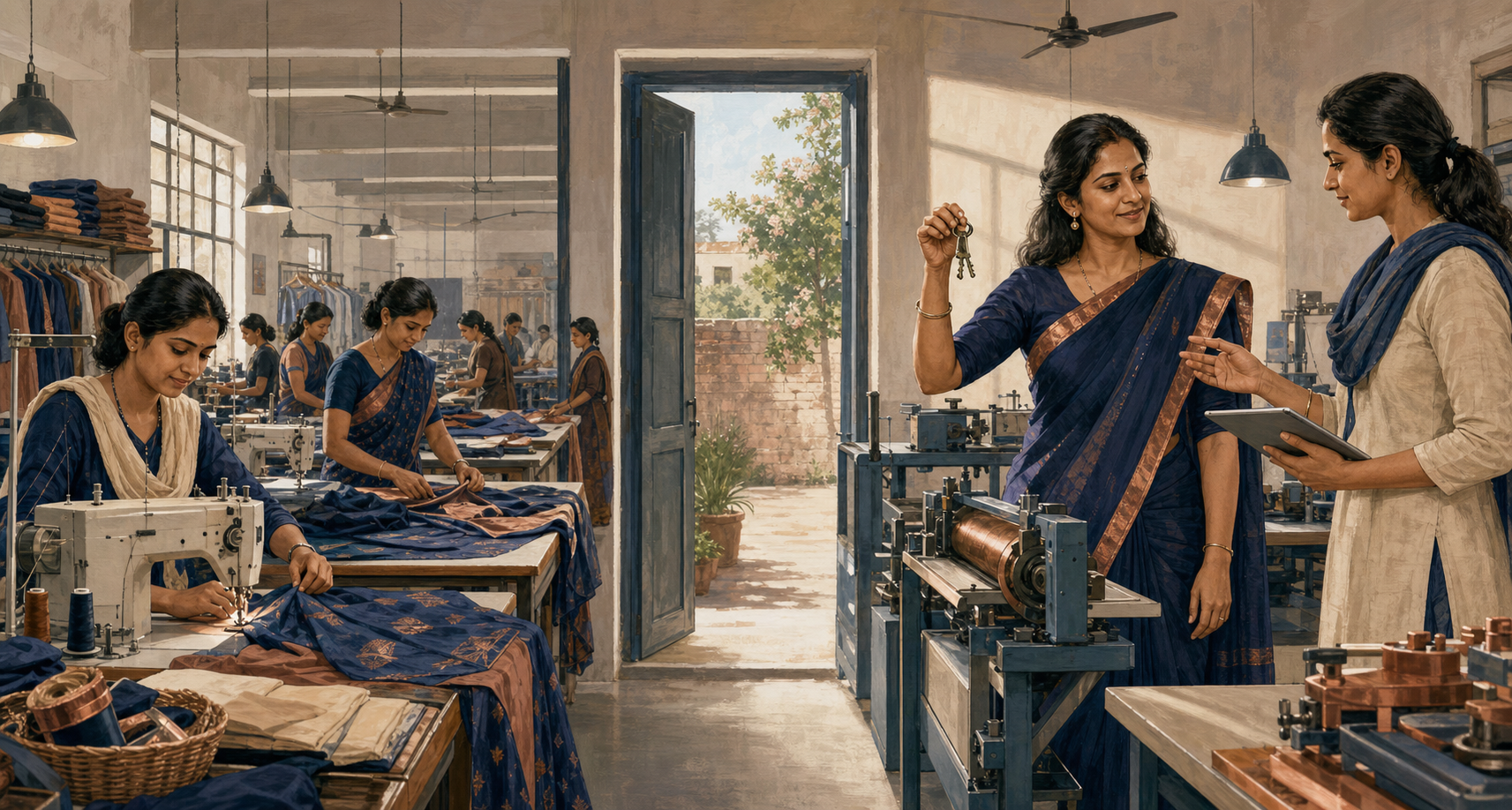
The source highlights a frequently obscured distinction: women may work extensively in family enterprises without being formally identified as partners, directors or decision-makers. Economic activity is therefore not automatically equivalent to economic agency. A person can contribute labour, knowledge and customer relationships while remaining absent from the records that establish ownership and authority.
Formal ownership is not a ceremonial label. In ordinary business practice, it affects who can demonstrate a stake in the enterprise, develop an institutional financial history, participate in major decisions and share in the value created over time. Financial literacy strengthens that position by enabling an owner to understand borrowing costs, cash flow, contracts, taxation and risk. The article’s emphasis on aligning ownership, authority and financial literacy offers a more demanding test of empowerment than simply counting how many women work in a business.
A second divide separates business formation from business growth. The report portrays Mumbai as a place where formal finance, informal commerce, family businesses, startups and service-sector activity coexist. Yet it also identifies uneven access to credibility, capital and institutional recognition. A market may contain abundant commercial opportunity while still imposing unequal costs on those trying to enter established networks.
The barriers identified in the article include property-linked collateral, risk capital, male-dominated networks, care responsibilities, travel for market expansion and limited attention from institutional buyers. These constraints can reinforce one another. Restricted mobility may weaken access to networks; weak networks can limit buyer discovery; limited sales can make lenders more cautious; and scarce working capital can prevent a firm from accepting larger orders.
This makes women’s entrepreneurship both a cultural and a technical subject. Family support and social legitimacy matter, but so do bookkeeping, credit history, contracts, digital capability, logistics and regulatory knowledge. Recognition can influence attitudes toward women’s ambition, risk-taking and leadership. It becomes economically consequential when that change in attitude is matched by access to the systems needed to build a resilient firm.
Policy entry points must connect to a scale-up system

The DharmaRenaissance article places Startup India, Stand-Up India, the Pradhan Mantri Mudra Yojana, Udyam registration, digital payments infrastructure and government-backed skilling within a policy environment increasingly oriented toward entrepreneurship. It does not provide outcome data with which to compare their reach or effectiveness, so their presence should be read as evidence of available policy pathways, not proof that the barriers facing women-led enterprises have been resolved.
The next challenge is to connect those entry points into a coherent growth journey. A founder may need working capital before she needs expansion finance, timely settlement of invoices before another loan, and reliable accounts before approaching a major buyer. Compliance knowledge, packaging standards, intellectual-property awareness, e-commerce logistics and export preparation become relevant at different stages. Generic encouragement cannot substitute for assistance matched to the firm’s sector and level of maturity.
The source accordingly points beyond one-time grants toward recurring problem-solving networks. Banks, investors, industry bodies, chambers of commerce and community organisations can serve different functions: credit facilitation, mentoring, buyer introductions, legal awareness, branding assistance and peer learning. Their value should be judged by whether entrepreneurs can solve practical problems more quickly and on fairer terms.
Procurement deserves particular attention within this chain. Institutional buyers can provide credibility and repeat demand, but delayed payment can place acute pressure on a smaller supplier’s cash flow. Access to buyers is therefore incomplete without clear contracts, predictable payment practices and financing mechanisms that bridge the period between delivery and settlement.
Felicitation events occupy the visibility end of this ecosystem. They can create public records of achievement, introduce founders to networks and give families and communities examples of credible women-led enterprise. Their long-term significance depends on whether those connections lead to finance, customers, professional advice, capable hires and opportunities to enter larger supply chains.
Dharmic prosperity needs an institutional test

The source situates entrepreneurship within a wider Dharmic understanding of livelihood, discipline, service, generosity and social duty, referring broadly to ethical reflections preserved in Hindu, Buddhist, Jain and Sikh traditions. In this framing, prosperity is not morally neutral accumulation. Its quality depends on how wealth is created, how obligations are honoured and how economic gains affect the surrounding community.
The article’s discussion of Lakshmi presents abundance as auspicious when accompanied by order, discipline, generosity and dharma. Applied to contemporary enterprise, that idea directs attention to conduct: honest service to customers, fair treatment of workers, dependable contracts and responsible reinvestment. A business becomes socially valuable not because of the identity of its owner alone, but because it creates trustworthy relationships.
This ethical framing should not become a stereotype that expects women to be inherently more self-sacrificing or socially responsible than men. The report itself cautions against romanticising women while noting that control over income and assets can carry benefits into household stability, education, nutrition and health. The sounder conclusion is that women must have the same scope to create wealth and should be assessed by the same standards of responsibility applied to all entrepreneurs.
A credible Viksit Bharat scorecard would consequently look beyond the number of enterprises launched or entrepreneurs honoured. It would examine whether women obtain formal ownership, usable credit, timely payment, repeat customers, professional capabilities and genuine authority over business decisions. It would also consider whether growing firms create fair work, honour commitments and strengthen the communities in which they operate.
The next phase should connect public recognition with durable institutions that help women-led firms move from local credibility to sustainable scale. When ownership, finance, markets, skills and ethical accountability reinforce one another, women’s entrepreneurship becomes not merely a symbol of Viksit Bharat but part of its working economic architecture.