
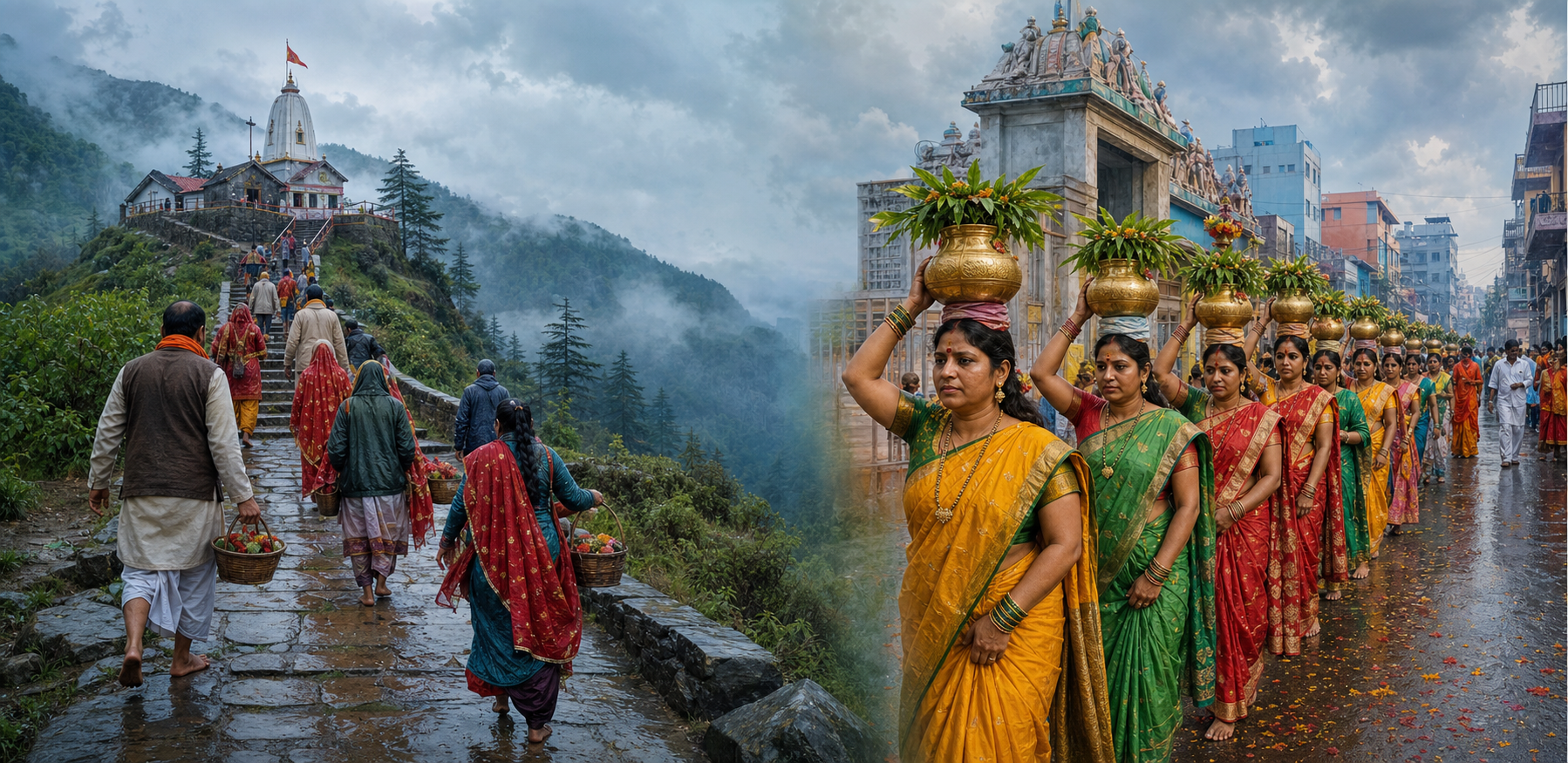
Mata Chintpurni’s Shravan mela in Himachal Pradesh and Bonalu at Hyderabad’s Balkampet Yellamma Temple offer two sharply different expressions of regional Shakti devotion. One is organized around a monsoon journey to a hill shrine; the other brings food offerings, processional forms, and neighborhood participation into a major city.
Read together, the two DharmaRenaissance reports show how a shared orientation toward the Divine Mother acquires distinct calendars, ritual objects, landscapes, and forms of public responsibility. The comparison also gives prospective pilgrims a more reliable way to interpret the provisional 2026 dates and prepare for each setting.
Key takeaways
- The Chintpurni report associates its principal monsoon pilgrimage season with Shravan Shukla Paksha and Shravan Ashtami, while the Balkampet report places Bonalu within Ashada Masam of the Telugu calendar.
- Chintpurni offerings emphasize arrival at the Goddess’s shrine with votive objects; at Bonalu, women carry a prepared food offering whose pot, ingredients, leaves, and lamp form an integrated ritual statement.
- Landscape changes the pilgrimage: Chintpurni requires movement through a monsoon hill environment, whereas Balkampet turns temple approaches and surrounding urban streets into festival space.
- Both reports treat date confirmation, orderly queues, safety, cleanliness, and cooperation with local authorities as integral to responsible devotion.
Two calendars frame the seasonal turn toward Shakti
The two festivals occupy a broadly similar July-August seasonal setting, but they should not be collapsed into a single pan-Indian schedule. The Chintpurni article explains that Hindu calendar traditions do not all calculate Shravan observances in the same way. It cites contemporary listings that place a broader Shravan period from July 30 to August 28 in 2026, while a supplied calendar note places the opening of Shravan Shukla Paksha, and thus the reported start of the Chintpurni mela, on August 13. It describes the principal Ashtami observance only as falling around the eighth day of that bright fortnight rather than asserting a final civil-calendar date.
The same report says the official Mata Shri Chintpurni Devi Ji temple website characterizes Sawan Ashtami as a ten-day mela held in July-August. It also situates the observance within a larger shrine calendar that includes Chaitra and Ashwin or Asuj fairs associated with Navratri, monthly Sankranti observances, and a New Year event. Shravan Ashtami is therefore better understood as the focal point of an extended pilgrimage period than as an isolated appointment.
The Balkampet article places Bonalu during Ashada Masam in the Telugu calendar and reports Sunday, August 9, as the temple’s 2026 festival date. It further explains that the Balkampet observance is commonly related to the wider Hyderabad Bonalu sequence and traditionally follows the major celebrations at Secunderabad’s Ujjaini Mahankali temple. That relationship matters because Bonalu operates through a citywide ritual calendar even as individual temples retain their own schedules and local character.
These reports do not provide independently verified final timetables. Both advise checking temple or government announcements closer to the events. The useful lesson is that a lunar observance, a regional month, a multi-day fair, and a temple’s main celebration can each generate a different date. Pilgrims should identify which of those dates a notice actually describes before booking travel.
Offerings make regional theology visible
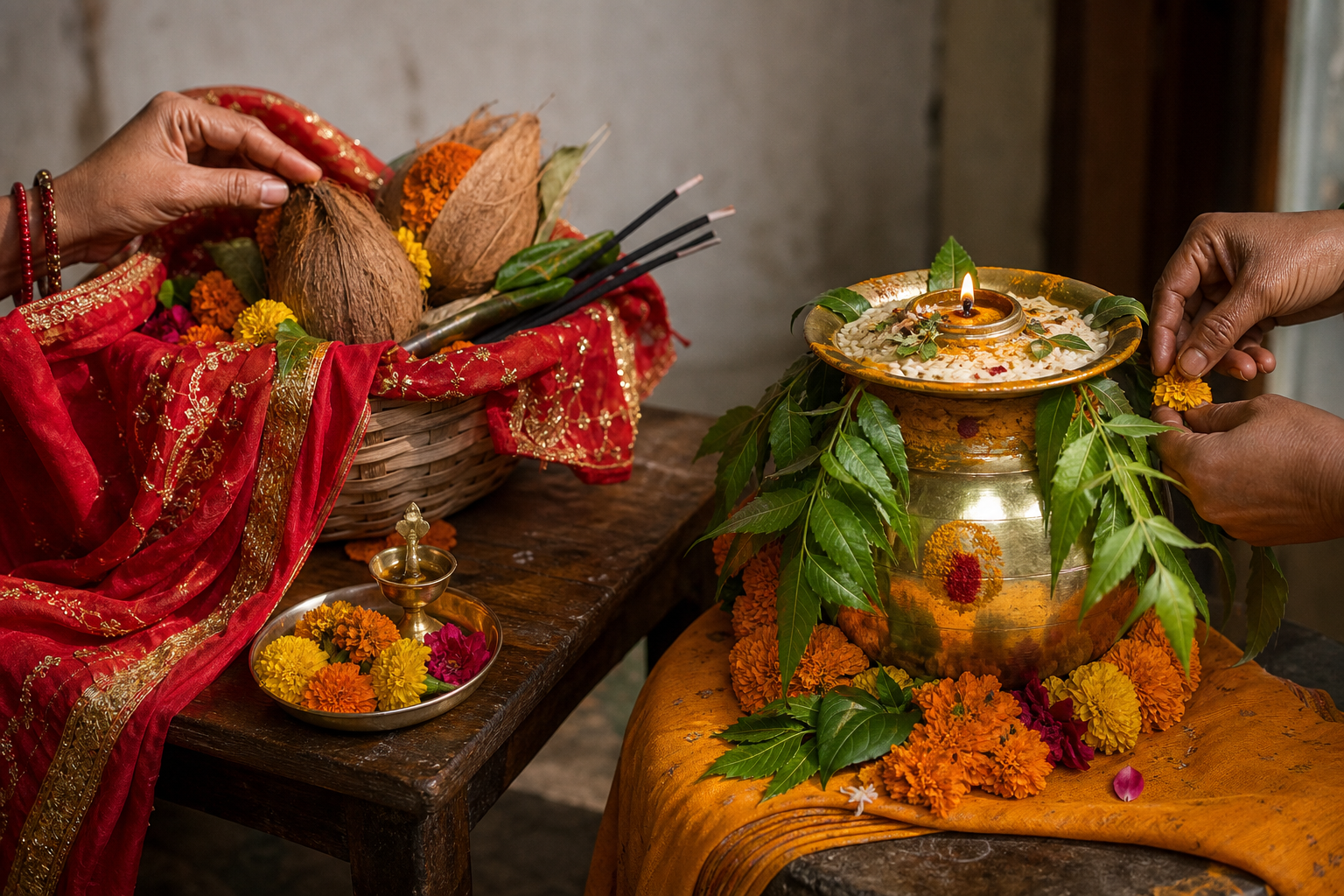
Both traditions approach Devi through tangible acts of gratitude and dependence, but their ritual vocabularies differ. The Chintpurni guide describes pilgrims bringing coconuts, red flags, chunni, flowers, sweets, supari, and sacred thread. Its interpretation connects the coconut with surrender, the flag with Shakti and publicly expressed devotion, and sweets with gratitude. It also notes traditional accounts of Karah and chattar offerings on the eighth day, including descriptions of a canopy adorned with small bells.
Those objects accompany requests directed to Mata Chintpurni, whose name the article interprets through chinta, or worry, and fulfilment. The shrine’s devotional identity is also connected in the report with Maa Chinnamastika or Chinnamasta. Drawing on the official temple narrative, the article relates this form to Parvati’s compassionate self-offering in response to Jaya and Vijaya. Within the source’s theological reading, the pilgrim is not merely seeking a favorable transaction but placing anxiety, need, and vulnerability before an active and protective Mother.
At Bonalu, the central offering is not a collection of votive items but the bonam, a prepared offering that the Balkampet report says traditionally combines rice, milk, and jaggery. Women carry decorated pots marked with turmeric and vermilion and accompanied by neem leaves and a lamp. The article interprets the vessel as a container of nourishment and embodied devotion, the food as sustenance and auspicious sweetness, neem as protective and healing, and the lamp as a sign of divine presence.
The contrast reveals complementary forms of ritual agency. Chintpurni’s described practice centers on carrying petitions and symbols to a destination shrine. Bonalu foregrounds the household preparation and public carrying of nourishment, with women visibly leading the core offering. In each case, devotion is communicated through color, food, texture, movement, and disciplined bodily action rather than through doctrine alone.
The Balkampet source also discusses Ghatam and Pothuraju as elements of the wider Bonalu culture. It describes Ghatam as a decorated vessel representing the Goddess and Pothuraju as her energetic guardian or brother figure. Because the article presents these as features of the broader Hyderabad-Secunderabad tradition, they should not be mistaken for a guaranteed program at every temple or for a finalized Balkampet schedule.
The route itself shapes the pilgrimage
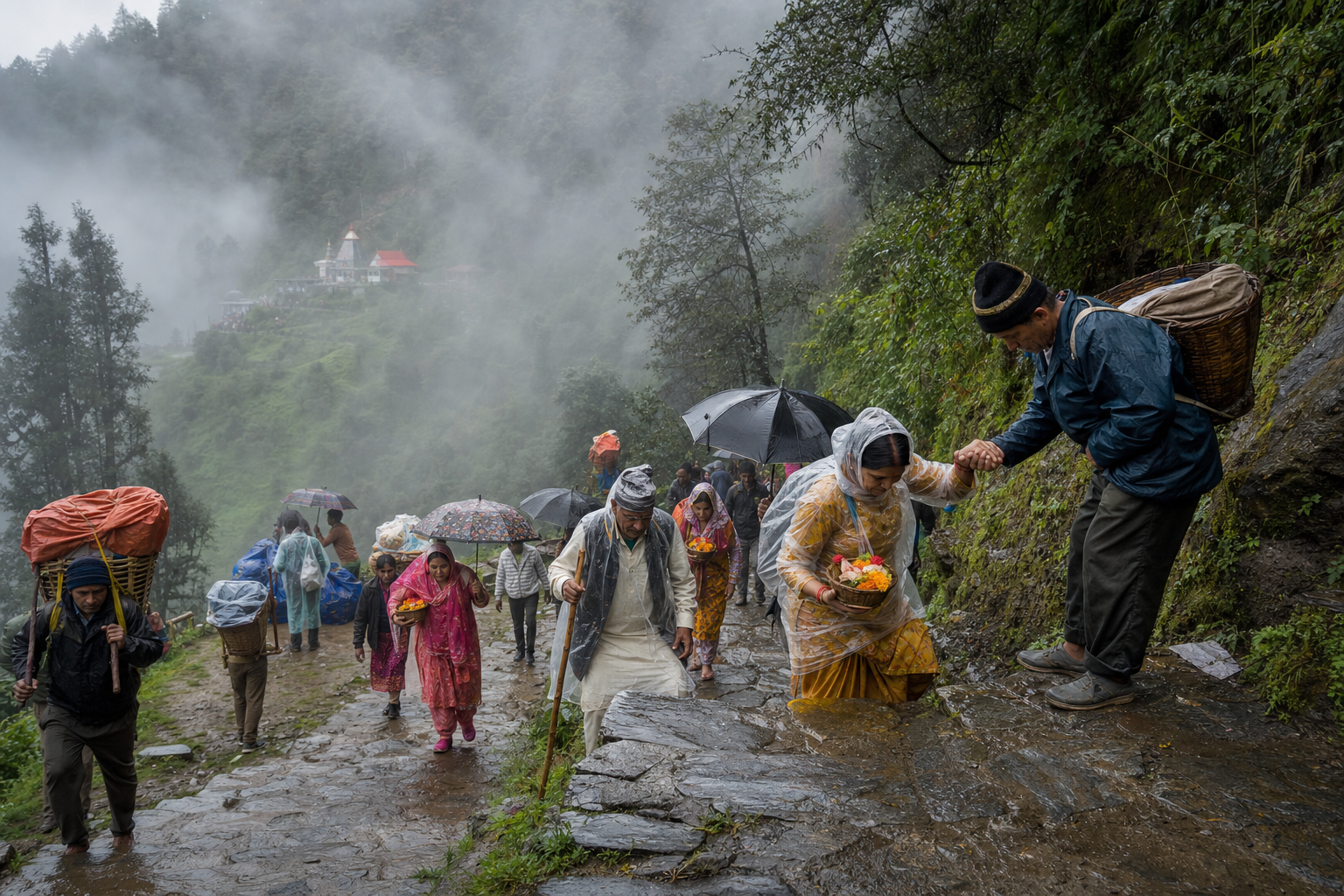
The Chintpurni report locates the temple on a spur of the Chintpurni hill range near Bharwain and describes approaches through Una, Hoshiarpur, and Kangra. Its account emphasizes winding roads, market lanes, rest points, queues, and the collective movement of families, priests, volunteers, traders, and officials. In this setting, pilgrimage begins well before the sanctum: the ascent, delay, weather, and dependence upon other people become part of the devotional discipline.
Shravan’s monsoon setting heightens that character. According to the report, rain can affect roads, walking surfaces, queue shelters, and journey times even as it gives the hills their seasonal greenery. Rain protection, footwear suited to wet ground, light luggage, water, necessary medicines, and realistic expectations about waiting are therefore not peripheral travel tips. They enable pilgrims to move without creating avoidable risks for themselves or others.
Balkampet presents almost the reverse spatial pattern. The Yellamma temple is described by its source as being near Ameerpet in Hyderabad, within an urban network of neighborhoods rather than at the end of a hill route. During Bonalu, drums, offerings, songs, processions, and crowds extend worship beyond the temple boundary. Instead of withdrawing from the city, the festival temporarily makes ordinary streets part of its sacred geography.
The temple itself adds a downward movement to that urban pilgrimage. The Balkampet report associates the presiding form with a bhoogarbha swayambhu vigraham situated below ground level. It also describes a sacred well whose water devotees receive as theertham and regard as healing. The source interprets descent toward the deity as an act of humility and the well as a sign of cleansing and renewal. Local accounts cited by the article trace the shrine’s continuity as far back as the fifteenth century and identify 1919 with its renovated form; these are reported traditions rather than dates independently established by the present synthesis.
Place consequently does more than provide a backdrop. At Chintpurni, distance, ascent, and monsoon conditions intensify the sense of reaching the Mother. At Balkampet, sacred depth is encountered inside a dense modern city, while the surrounding public realm becomes a stage for regional memory and belonging.
Care and governance belong to the sacred experience
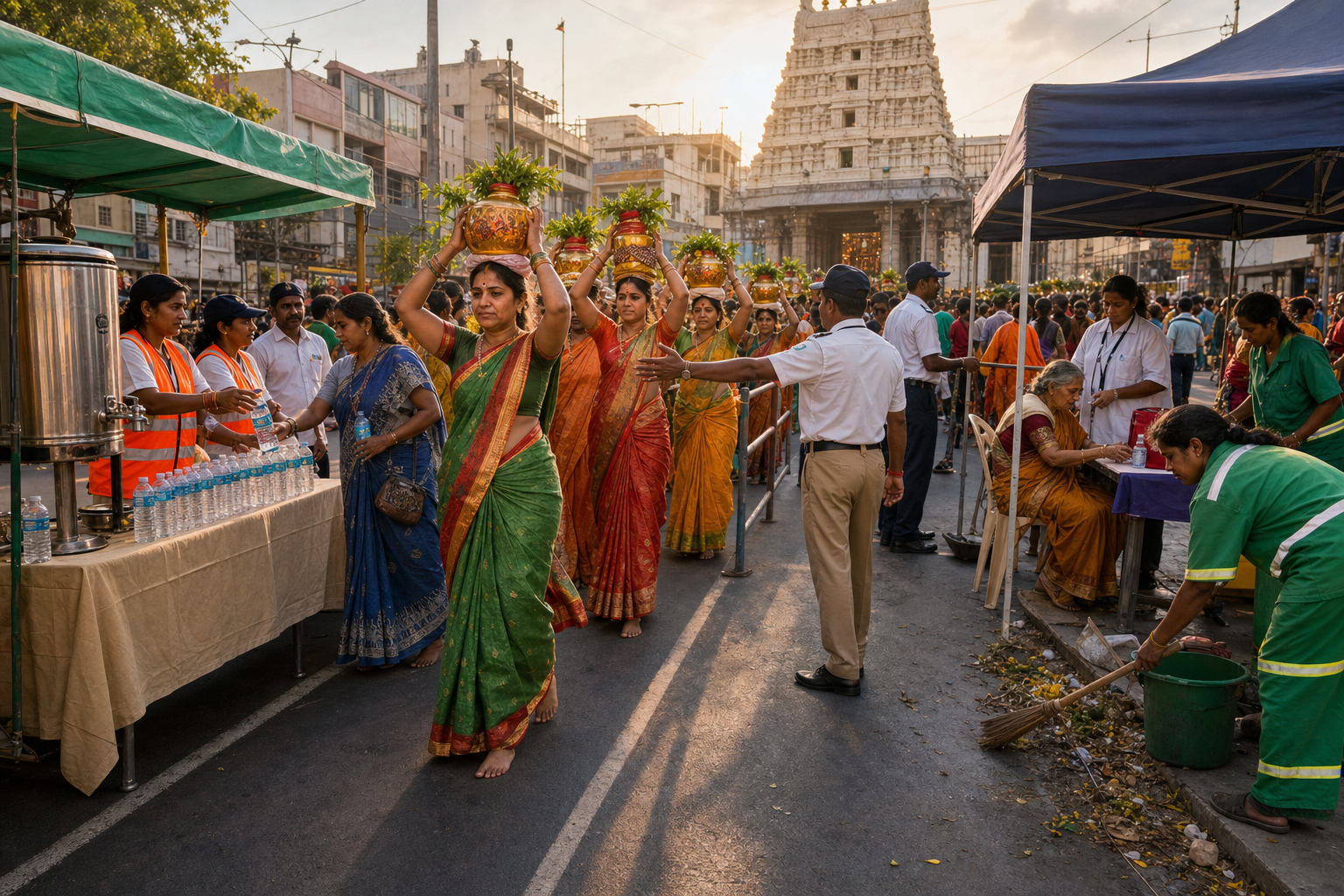
Neither report treats devotion as detached from administration. The Chintpurni article describes the fair as dependent on roads, sanitation, drinking water, medical support, accommodation, parking, police, volunteers, food service, and managed queues. It also notes a historical movement from older district arrangements toward more formal temple-trust administration. Its broader argument is significant: governance serves a dharmic purpose when it protects pilgrims and preserves dignified access to worship.
The Balkampet report similarly places temple staff, police, municipal workers, volunteers, residents, and devotees inside one field of responsibility. It says Telangana has recognized Bonalu as a state festival, increasing its public visibility and administrative support, while household vows and neighborhood participation remain central. That combination illustrates how official recognition can assist a living tradition without replacing the intimate act at its ritual heart.
Practical preparation should follow the different pressures identified by the sources. Chintpurni pilgrims need to account especially for hill-road traffic, limited parking, accommodation demand, long queues, and wet weather. Visitors to Balkampet need to anticipate dense urban crowds, local traffic changes, designated offering areas, and temple rules governing what may be carried. Both reports recommend early arrival, hydration, patience, and additional planning for older people and children.
The shared ethical principle is restraint. Queue discipline, clear pathways, careful disposal of waste, compliance with safety directions, and consideration for slower pilgrims are practical forms of seva. They also prevent an individual desire for rapid darshan from diminishing another devotee’s access or safety.
For 2026, the most responsible pilgrimage will begin with a final check of official dates, local advisories, weather, access rules, and offering procedures. Such preparation leaves room for regional differences while allowing both the hill shrine and the city festival to be encountered on their own terms.
References
- DharmaRenaissance Blog — Mata Chintpurni Mela 2026: Powerful Dates, Rituals, History and Pilgrim Guide
- DharmaRenaissance Blog — Powerful Bonalu 2026 at Balkampet Yellamma Temple: A Sacred Hyderabad Guide