
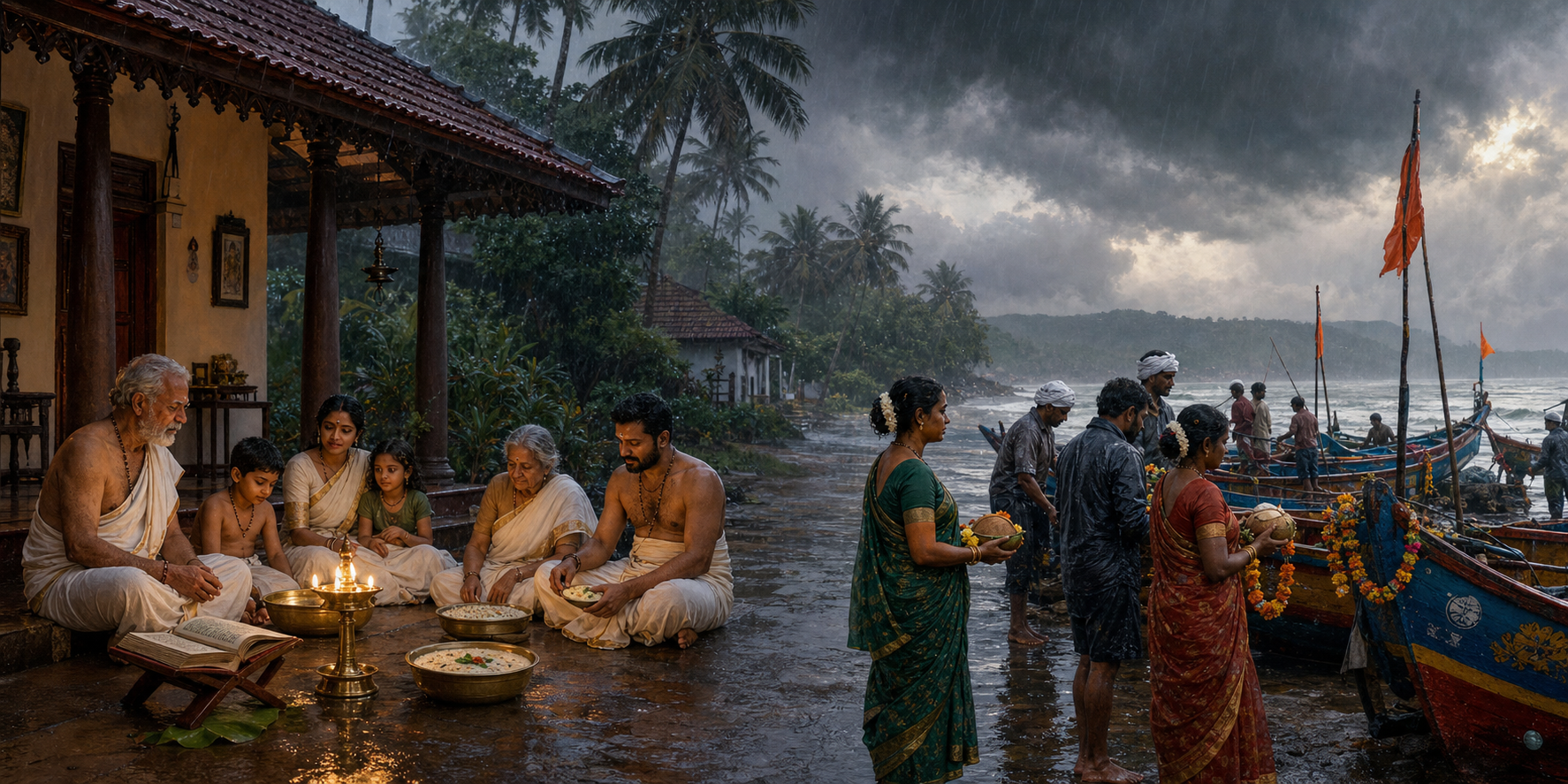
The monsoon does not create one uniform sacred season across India. In the two regional accounts considered here, rain calls forth different duties: Kerala households turn toward scripture, ancestors and seasonal care, while fishing communities in coastal Maharashtra ceremonially face the sea before renewing their livelihood.
Read together, Karkidaka Masam and Narali Purnima show how regional traditions translate climate into ethical practice. Their rituals differ in calendar, scale and social setting, but both help communities respond to vulnerability through gratitude, restraint and preparation.
Key takeaways
- The same monsoon season can support a month of household discipline in Kerala and a full-moon maritime observance in Maharashtra.
- Karkidakam is situated in the Malayalam solar calendar, whereas Narali Purnima is observed on a lunar tithi in Shravan.
- Ramayana recitation, ancestor offerings, coconuts and decorated boats serve different purposes, yet each makes dependence and responsibility ritually visible.
- Contemporary observance remains strongest when inherited customs are followed alongside local ritual guidance, qualified health advice, weather warnings and conservation rules.
One monsoon, two systems of sacred time
The article on Karkidaka Masam reports that the 2026 month runs from July 17 through August 16. It identifies Karkidakam as the twelfth and final month of the Malayalam calendar, following Midhunam and preceding Chingam. Its position at the end of the year helps explain the emphasis on completion, correction and preparation before a new beginning.
The Narali Purnima account, by contrast, places that observance on Friday, August 28, 2026. It occurs on Shravan Purnima, a lunar full moon that also carries other meanings in different communities, including Raksha Bandhan and Upakarma. Narali Purnima is therefore not another name for the Kerala observance, nor do the reported 2026 dates coincide. The traditions belong to separate regional calendars and ritual worlds within the wider monsoon season.
This distinction is important because sacred calendars do more than label the weather. A solar month can frame an extended discipline, while a lunar tithi can concentrate a community’s attention on one ceremonial transition. Neither pattern needs to be treated as the standard against which the other is measured. Their difference demonstrates how regional practice connects celestial reckoning with the needs of a particular place.
Kerala turns a difficult month toward inward repair
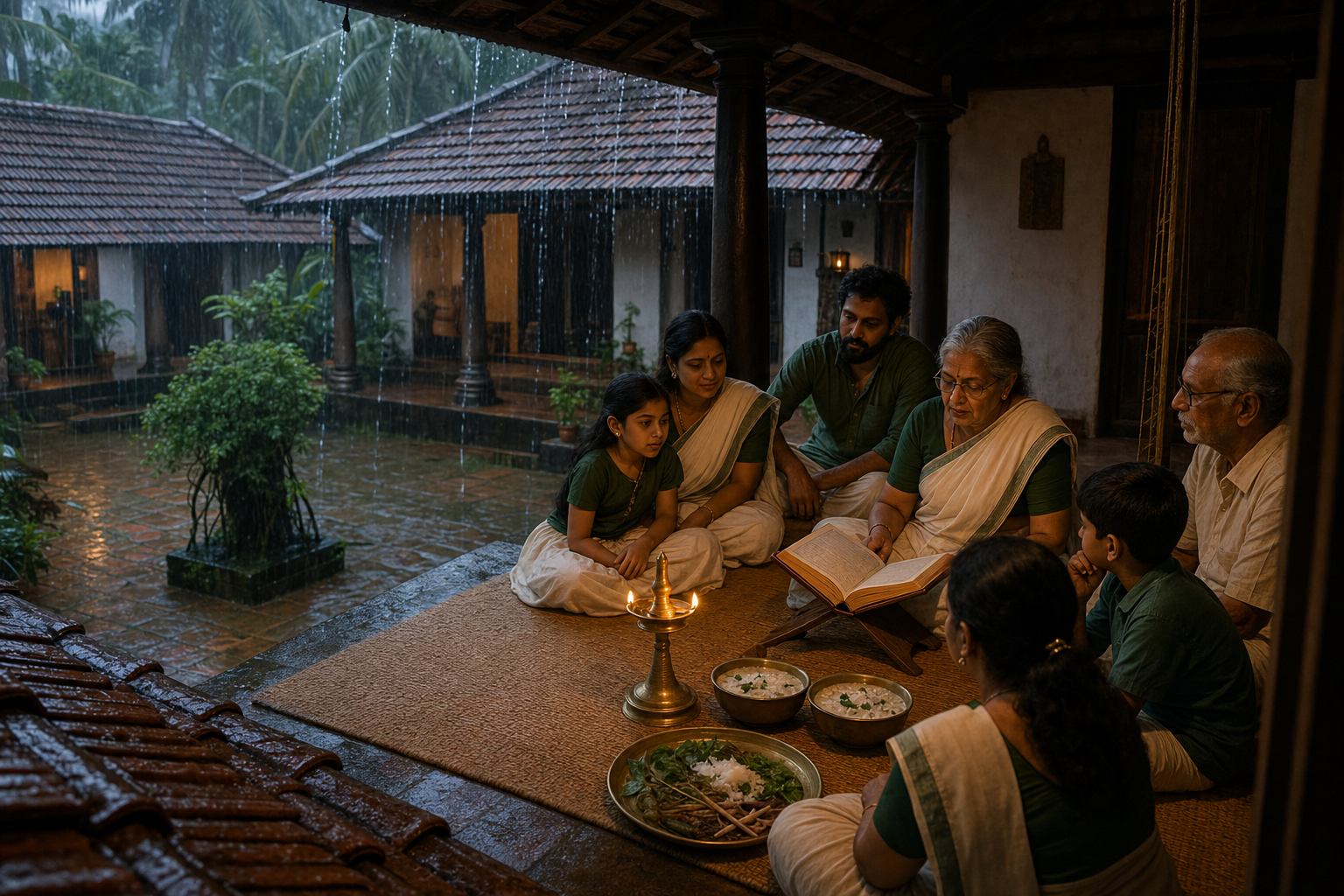
The Karkidaka Masam article describes heavy rain as a historical challenge to agriculture, travel, household finances and health. Kerala tradition, in this account, did not deny those pressures. It organized the period around practices that could give hardship a disciplined form.
The best-known practice is sustained Ramayana recitation, which gives Karkidakam its widely used name, Ramayana Masam. The source particularly associates the month with the Malayalam Adhyatma Ramayanam Kilippattu, traditionally linked with Thunchaththu Ezhuthachan. Reading and listening bring questions of duty, loss, courage, leadership and restoration into the rhythm of household life. Scripture consequently functions not only as a revered text but also as a shared vocabulary for examining conduct under pressure.
Ancestral remembrance gives the month another direction. According to the source, Karkidaka Vavu Bali is performed on the Karkidakam new moon, with families gathering at sacred water bodies for offerings that may include rice, sesame, water and darbha grass according to local custom. The article clarifies that bali in this setting means an offering. It also advises consulting regional panchangam traditions or temple authorities for exact timing and procedure rather than treating a general calendar date as complete ritual guidance.
Seasonal care completes this pattern of repair. The source discusses Karkidaka Kanji, a porridge whose ingredients vary by household and region, as well as a broader cultural association with regulated food and Ayurvedic routines. It explicitly places medical decisions under the guidance of qualified practitioners. The significance of these customs therefore lies less in making universal health promises than in acknowledging that climate can require changes in daily discipline.
The reported tendency to defer weddings, housewarmings and other major celebrations should be read in the same context. Karkidakam is not portrayed as spiritually empty. Its constructive work is quieter: settling obligations, remembering forebears and preparing body, mind and household for Chingam.
Coastal Maharashtra approaches the sea with gratitude
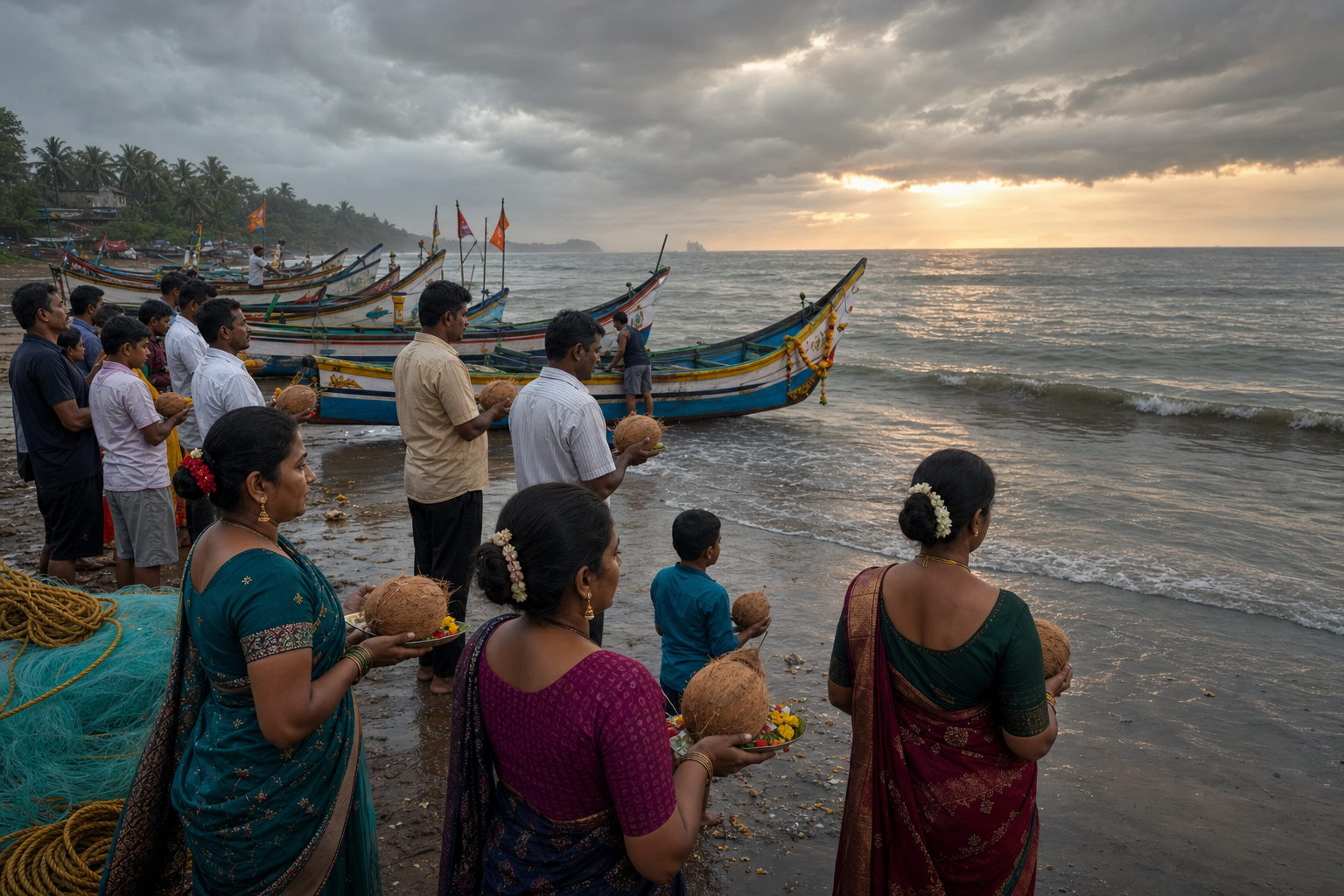
Narali Purnima directs monsoon consciousness outward, toward the waters on which fishing communities depend. The source describes an offering of coconut to the sea, accompanied by prayers to Varuna for protection, calm conditions, safe voyages and prosperity. The coconut gives the festival its name: the article explains that naral means coconut in Marathi, while Purnima denotes the full moon.
The observance joins prayer to the material world of work. Boats may be cleaned and decorated with flowers, flags, paint or traditional motifs. In the source’s interpretation, honoring a vessel acknowledges that it carries not merely equipment but also livelihood, inherited knowledge and human risk. The ritual thus places economic activity inside a relationship of responsibility rather than presenting the sea as a passive supply of resources.
The account especially associates Narali Purnima with Koli communities in Mumbai, the Konkan and nearby coastal settlements. Traditional clothing, music, dance, processions and shared food make the occasion a public expression of occupational and regional identity. Narali Bhat, a sweet coconut-and-rice preparation described by the source, brings the principal offering into domestic and communal memory through taste.
The festival is also reported as a transition toward renewed engagement with the sea after the most intense rains. That ritual transition should not be mistaken for operational permission to fish regardless of conditions. The source notes that actual schedules are also governed by weather advisories, conservation requirements, local regulation and market circumstances. Ceremony establishes an ethical posture toward work; practical judgment still determines whether work can proceed safely and lawfully.
Regional difference reveals a shared grammar of dependence
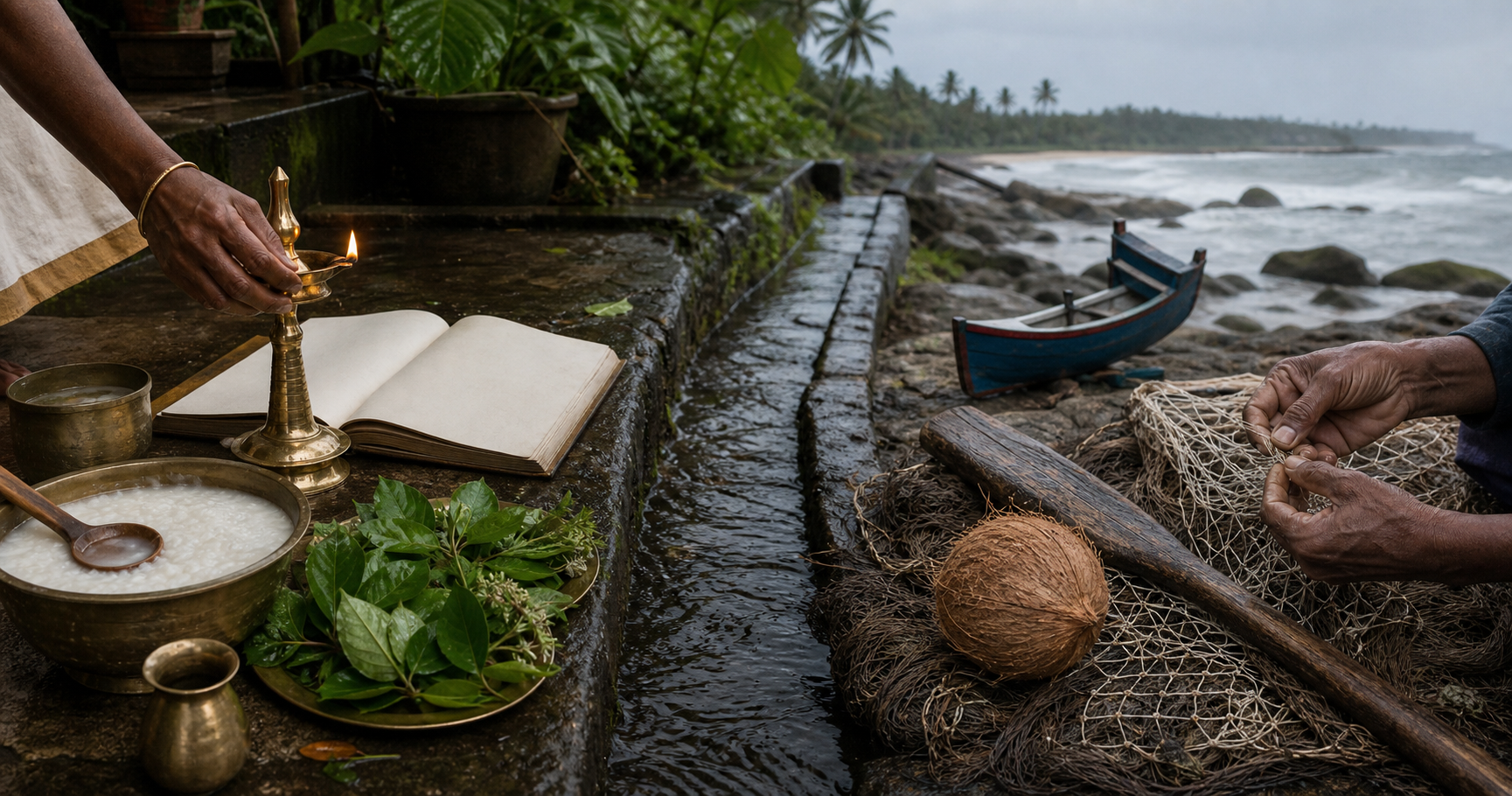
The contrast between the two traditions is as instructive as their similarities. Karkidakam extends across a month and concentrates attention on reading, ancestors, restraint and household well-being. Narali Purnima gathers a coastal community around a full-moon offering, its boats and the resumption of maritime labor. One gives the new moon a role in remembering the dead; the other uses the full moon to address the sea that sustains the living.
Water itself carries different meanings. In Karkidaka Vavu Bali, riverbanks, seashores and other sacred waters provide settings for maintaining ancestral relationships. On Narali Purnima, the sea is directly approached as a source of nourishment and danger. These meanings should not be collapsed into a generic festival of nature. The rites have different objects, participants and obligations.
They are related more deeply by method. Each tradition first acknowledges that individual effort is insufficient. Each then embodies gratitude in repeated actions, whether through recitation and offerings or through prayer and the honoring of boats. Finally, each places a boundary around action: Karkidakam favors moderation and preparation, while Narali Purnima teaches that a return to the sea should begin with humility.
This shared structure also explains why the traditions can remain relevant without being reduced to modern slogans. The Narali Purnima source connects reverence for the sea with concerns such as marine pollution, waste and pressure on fish populations. The Karkidakam source relates seasonal discipline to health and household resilience while preserving the need for professional advice. Ritual reverence does not by itself resolve environmental or medical questions, but it can supply a moral language for taking them seriously.
The continuing value of regional monsoon traditions lies in preserving this union of place, memory and responsibility. Their future need not depend on making them uniform; it depends on allowing each tradition to address the real relationships of dependence from which it arose.
References
- DharmaRenaissance Blog — Karkidaka Masam 2026: Powerful Dates, Ramayana Rituals, and Kerala Traditions
- DharmaRenaissance Blog — Narali Purnima 2026: Powerful Coastal Rituals, Meaning, Date and Traditions