
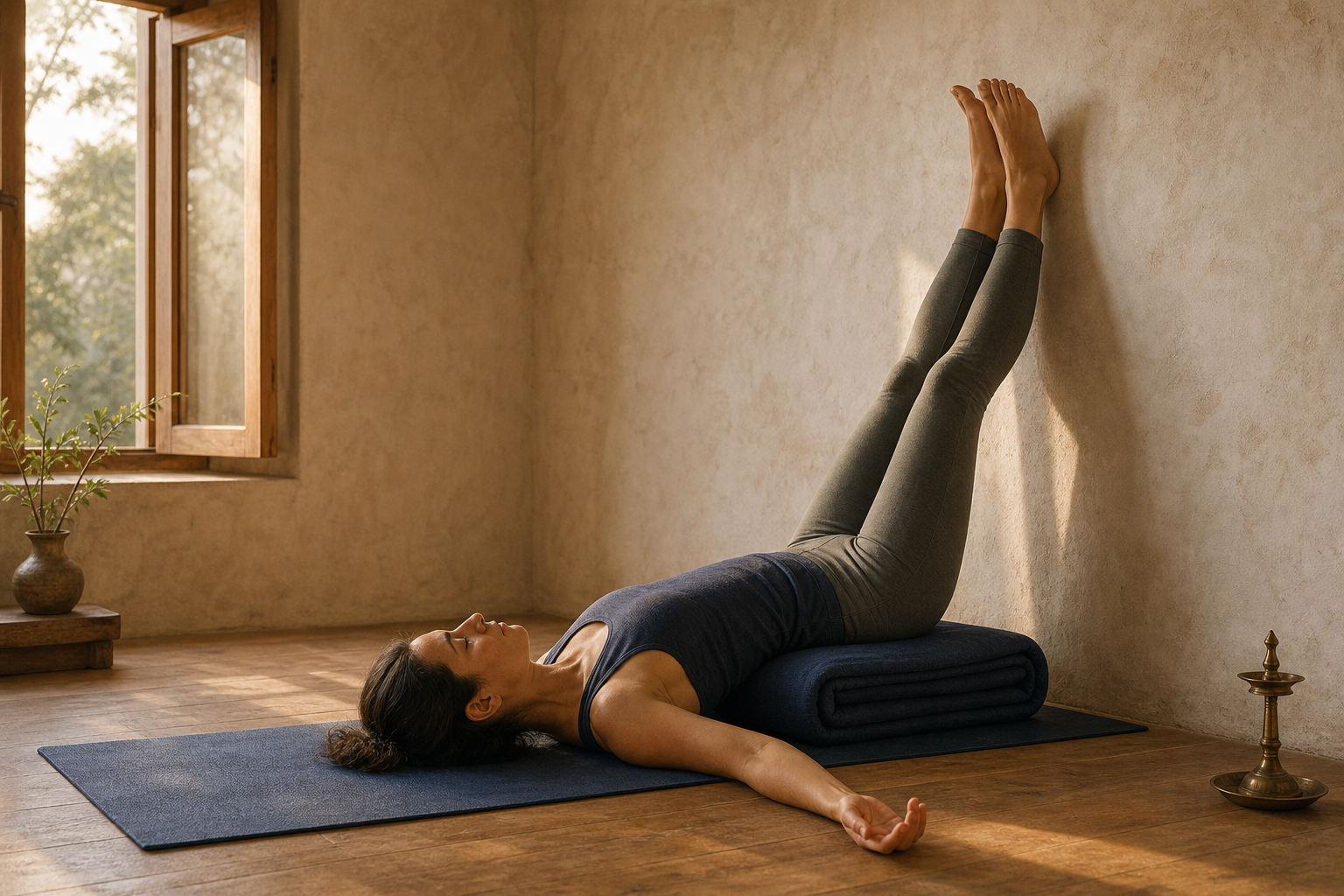
Viparita Karani Mudra stands at the meeting point of physical inversion, contemplative discipline, and the symbolic physiology of Hatha Yoga. Its familiar legs-up-the-wall form can encourage quiet rest, but that modern practice does not exhaust the meaning of the classical mudra.
A useful understanding therefore separates three related questions: what is being reversed, how the restorative and classical forms differ, and how traditional claims can be respected without turning symbolic language into unsupported medical promises.
Reversal means more than placing the legs overhead
The DharmaRenaissance account explains viparita as reversed or contrary to the customary order, karani as an action or method, and mudra as a seal. Read together, the name describes a method for reversing not only the body’s position but also the habitual direction of attention and vital expenditure.
This distinction places the practice within a wider yogic understanding of the body. The source presents the body as a sacred field and an instrument of sadhana, rather than merely a mechanism to be manipulated. Inversion becomes meaningful when posture, breath, concentration, and energetic intention operate together. Without those dimensions, the external shape may remain beneficial as a resting position, but it does not necessarily function as a classical mudra.
The same framework helps interpret the traditional statement that Viparita Karani can “conquer time and death.” The source explicitly cautions against reading this as a promise of literal physical immortality. It instead connects time and death with decay, distraction, unconscious habit, and the gradual dissipation of vitality. Reversal, in this reading, is a discipline of interrupting those tendencies and recollecting awareness.
The restorative posture and classical mudra are related, not identical
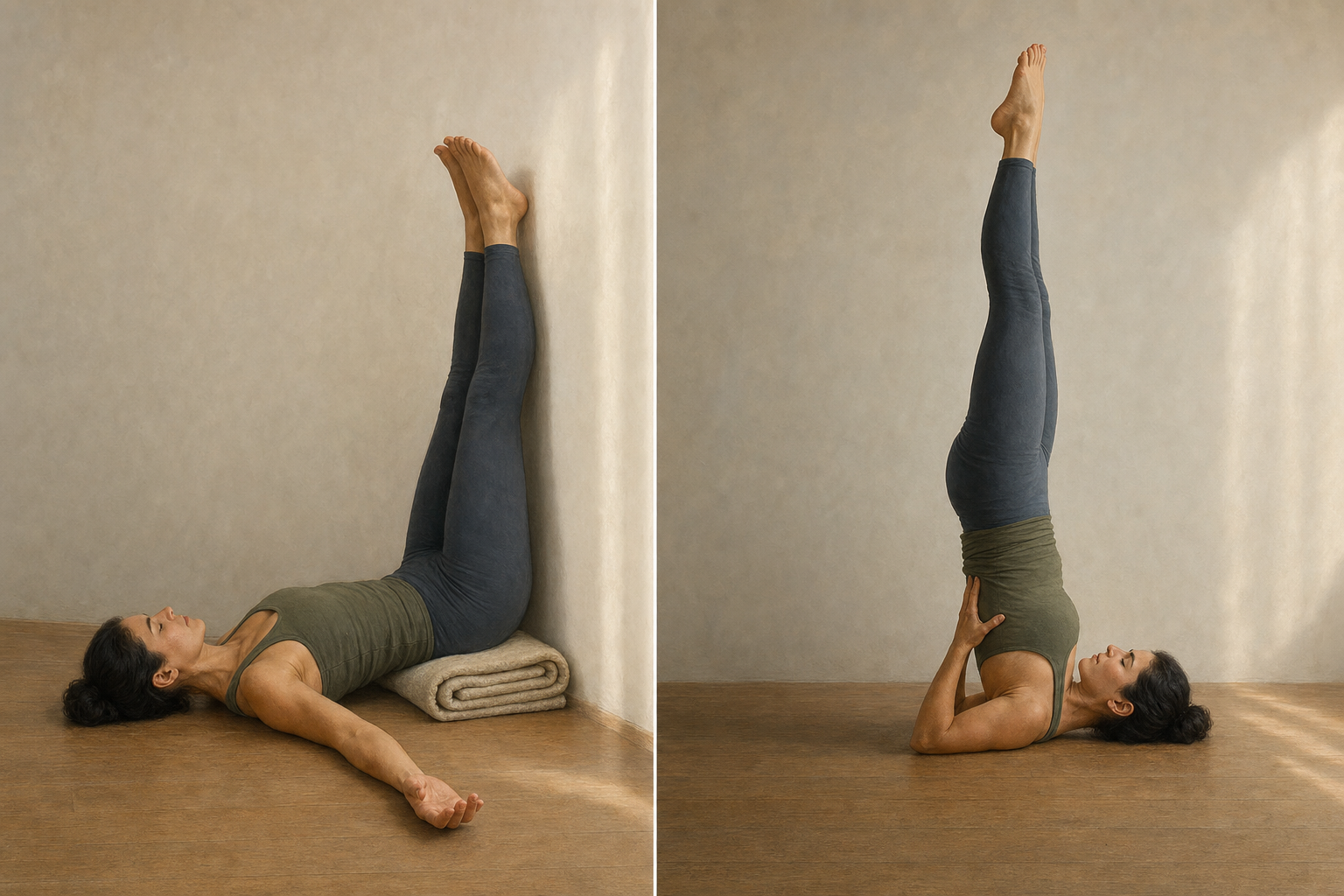
In contemporary yoga settings, Viparita Karani commonly refers to a supported posture in which the spine rests on the floor and the legs extend upward against a wall. The source associates this variation with relaxation, relief from fatigue, and gentle circulation. Because the wall carries the legs and the rest of the body can release unnecessary effort, the position can provide a simple setting for slower breathing and reduced sensory activity.
The classical mudra described by the source is more active. The pelvis may be elevated and supported by the hands or suitable props, producing a mild shoulder-supported inversion. That arrangement demands more preparation and introduces greater responsibility for the neck, shoulders, and throat. It should not be treated as the automatic next stage of the wall-supported posture.
The difference is chiefly one of purpose and integration. The restorative variation emphasizes ease and stillness. The classical practice adds a deliberate energetic orientation in which breath and attention participate in the reversal. Both may have a place, but naming the distinction prevents a gentle relaxation pose from being burdened with every esoteric claim attached to the traditional mudra.
Sun, moon, and nectar form a symbolic map

The DharmaRenaissance article locates Viparita Karani within a subtle map of nadis, chakras, prana, apana, bindu, and amrita. In the account it presents, a cooling lunar principle is associated with the upper body, while a heating solar principle is associated with the lower region and digestive fire. Nectar descending from the lunar centre is said to be consumed by that fire; inversion symbolically reverses the loss.
This imagery should neither be presented as ordinary anatomy nor dismissed simply because it is not anatomical language. The source treats it as a layered teaching. Nectar can signify conserved vitality, mental coolness, meditative absorption, or the subtle contentment that appears when attention is no longer scattered. The solar fire can represent metabolism at one level and, at another, the ceaseless consumption of energy through restless desire and unregulated living.
Holding these levels apart is important. Traditional imagery supplies a contemplative framework for practice; it does not by itself establish a modern biological mechanism. Conversely, translating every symbol into a bodily process can strip the teaching of its psychological and spiritual force. The more careful interpretation allows symbolic physiology and contemporary observation to illuminate different aspects of the same practice without pretending that they are interchangeable.
The source also describes prana as more than respiration: it is the vital organizing force of the body-mind, with breath serving as one of its most visible expressions. The mudra is traditionally understood to collect this force and orient it toward the central channel, or sushumna nadi. In contemporary terms, the quieter experience of the supported form may be explained more modestly by reduced muscular work, slower breathing, and diminished sensory demand. The reported feeling of parasympathetic calm should be understood as a practitioner experience, not as proof that the posture treats a medical condition.
Practice should be governed by preparedness
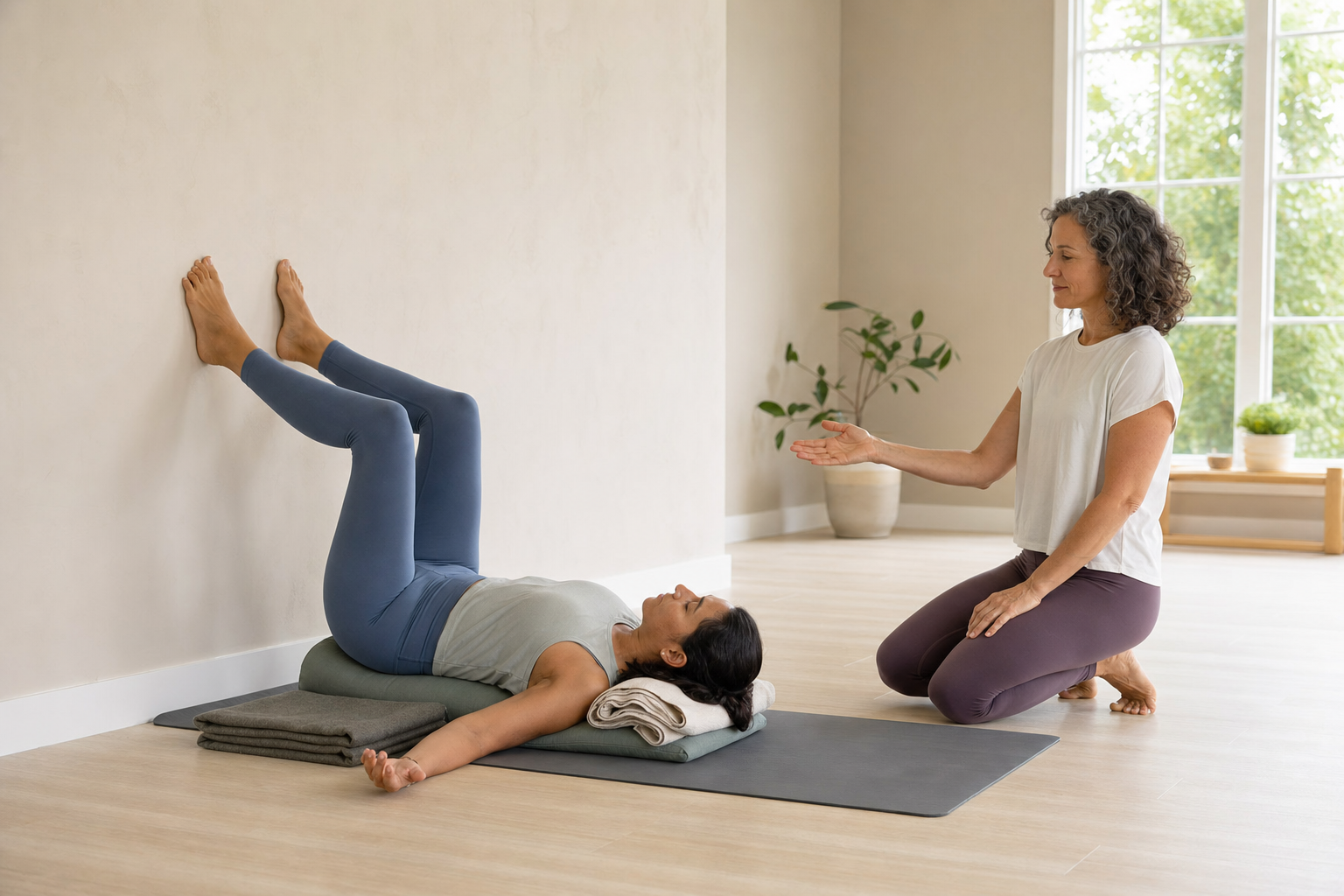
The wall-supported variation described by the source offers the clearest entry point for a gentle practice:
- Rest the spine on the floor with the hips comfortably near a wall.
- Allow the legs to extend upward and be supported by the wall rather than held through muscular effort.
- If it is comfortable, place a folded blanket or bolster beneath the pelvis; support should simplify the posture rather than intensify it.
- Rest the arms beside the body or across the abdomen, then soften the eyes and release the jaw.
- Let the breath become slow and natural while attention settles inward.
This sequence describes the restorative arrangement, not the full classical mudra. The source warns against forcing the neck, compressing the throat, or imitating an advanced position without training. Raising the pelvis into a shoulder-supported inversion calls for greater steadiness and appropriate guidance.
The governing traditional principle is adhikara, or fitness and preparedness for a practice. Capacity is not measured by how dramatic an inversion appears. It is shown by the ability to maintain ease, stable attention, and intelligent restraint. A supported version can therefore be the complete and appropriate practice for one person, while a more active form may belong within another practitioner’s guided training.
Key takeaways
- Viparita Karani reverses the body’s orientation, but its classical purpose also includes redirecting attention and conserving prana.
- The legs-up-the-wall posture is a gentle restorative variation; it should not be treated as identical to the more active classical mudra.
- The imagery of sun, moon, and nectar belongs to a symbolic yogic physiology and should not be converted into unverified medical claims.
- Preparation, comfort, and inward steadiness matter more than the height or difficulty of the inversion.
The most constructive next step is a modest one: establish the supported form with unforced breathing and clear attention, and approach any more active inversion only when training and individual preparedness make it appropriate.