
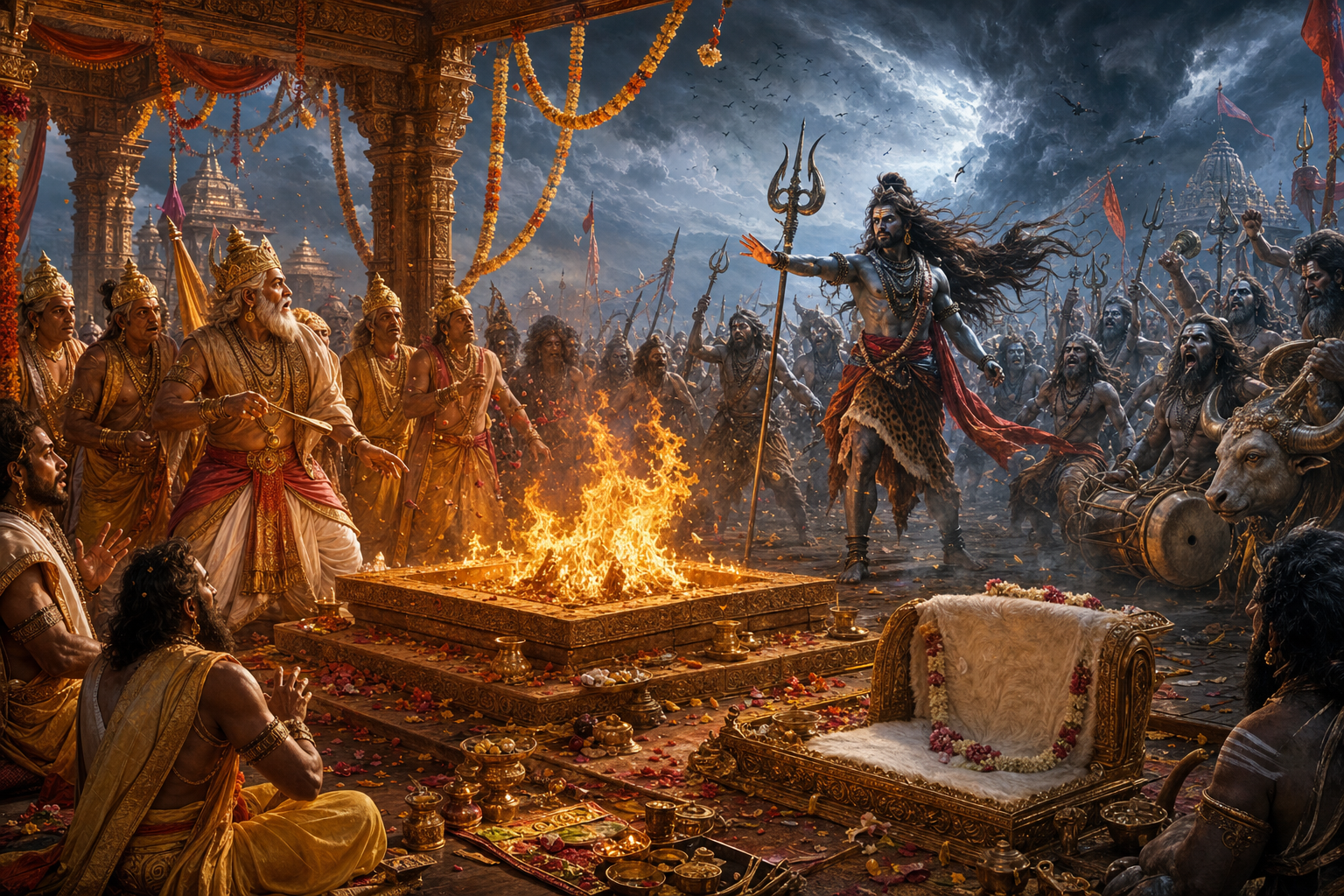
The Daksha Yajna episode asks a sharper question than why a sacrifice was destroyed: what remains of sacred ritual after contempt has entered its center? In the supplied DharmaRenaissance account, Daksha’s deliberate exclusion of Shiva, his treatment of Sati, and the arrival of Virabhadra and Rudra-like ganas form a single moral sequence. The ceremony retains its outward grandeur even as its inner legitimacy collapses.
Reading the episode through that sequence clarifies why the ganas are more than a fearsome army, why their attack is not a rejection of yajna, and why the narrative ultimately moves beyond loss. Its central contrast is between sacrificial form aligned with dharma and ritual authority captured by pride.
A sacrifice fractured before it was destroyed

Yajna commonly refers to a sacrificial rite in which offerings, sacred fire, recitation, intention, and properly ordered participation belong to one religious act. The source describes Daksha as a powerful progenitor and ritual authority who arranges a grand sacrifice but intentionally excludes Shiva. In its theological reading, this omission is more than a failure of etiquette because Shiva represents dissolution, transcendence, tapas, and supreme consciousness. A ceremony claiming to express sacred order therefore begins by denying a principle essential to that order.
Sati’s arrival makes the contradiction visible. According to the account, she attends despite Shiva’s caution and encounters continued contempt for her husband rather than familial dignity or reconciliation. Her anguish arises not only from personal humiliation but from seeing adharma protected by ceremonial prestige. The source notes that traditions describe her self-immolation with theological variation, so the episode should not be reduced to one unqualified narrative formula.
The sequence offers three connected measures of ritual integrity: the relationships a rite sustains, the intention guiding it, and the divine reality it acknowledges. Daksha’s ceremony fails all three before any gana enters the arena. Its destruction consequently reveals an existing disorder rather than creating one. Ritual expertise, the episode suggests, cannot compensate for contempt, and institutional standing cannot turn exclusion into reverence.
Why Rudra’s ganas enter the ritual arena
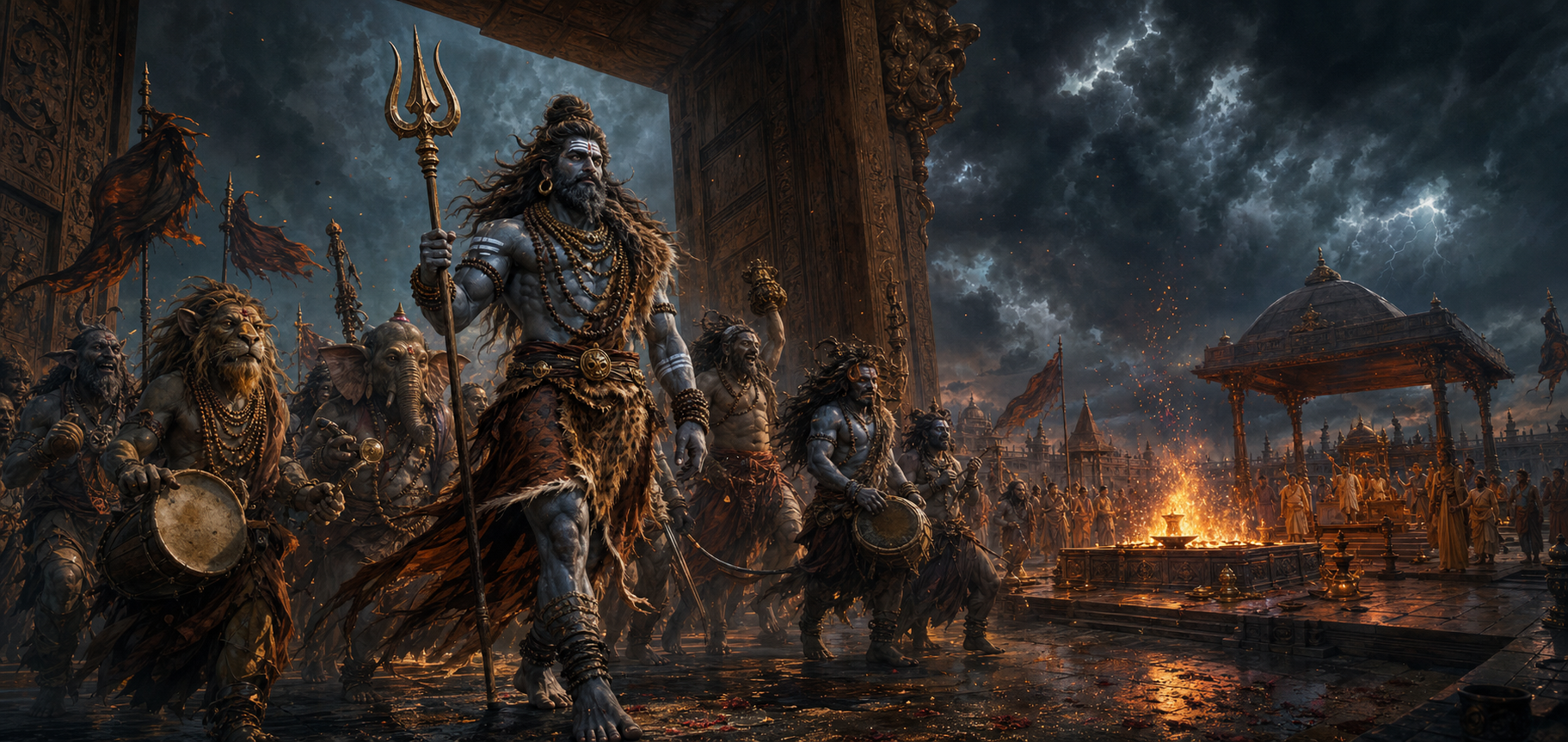
After Sati’s death, the source presents Shiva’s grief as becoming cosmic fury. Virabhadra emerges as its warrior manifestation, often pictured as arising from Shiva’s matted locks or concentrated wrath, while hosts of ganas, bhutas, pramathas, and other fierce beings accompany him. They do not arrive as ordinary participants seeking recognition within Daksha’s hierarchy. They embody a sacred power that the hierarchy tried to exclude.
The description of these beings as Rudra-like is crucial. The essay characterizes Rudra as fierce and storm-like but also ascetic, healing, and compassionate. Destruction and restoration are therefore not unrelated functions: the force that terrifies can also remove what prevents healing. This paradox keeps the ganas from being read simply as villains or as an undisciplined mob. Their severity serves a corrective role within the narrative’s moral world.
The ganas also occupy boundaries between the formal and the ecstatic, the socially ordered and the wild, and the familiar and the unsettling. Their presence around Shiva indicates that sacred reality is not exhausted by respectable appearances or controlled by rank. When they confront Daksha’s assembly, the encounter dramatizes a conflict between a ritual establishment claiming completeness and divine energies that expose the limits of that claim.
That theological function should not be converted into a general license for human violence. Mythic divine action operates within a cosmic narrative and is not automatically a behavioral prescription. The episode’s practical demand falls first upon pride, false authority, and spiritual blindness, not upon opponents whom a reader might wish to punish.
The destruction defends yajna from hollow ritualism
The source depicts the sacrificial arena as a place of priests, deities, offerings, fires, chants, and social hierarchy. Virabhadra and the ganas disturb its rites, overcome its defenders, punish participants, and shatter its confidence. Taken in isolation, those actions might appear hostile to sacrifice. Within the full arc, however, their target is not yajna as a sacred principle but a particular yajna emptied of humility and disfigured by exclusion.
This distinction protects ritual rather than diminishing it. The story refuses to equate ceremonial scale with spiritual validity, priestly or administrative office with wisdom, or offerings with reverence. Daksha treats ritual authority as a possession confirming his superiority. The Rudra-like intervention makes that claim untenable and subjects the sacrificer himself to the order he presumed to control.
The episode can therefore be read as an argument for accountability within sacred practice. Form matters, but form must remain joined to right intention, truthful conduct, and recognition of the divine beyond personal preference. A rite becomes unstable when its visible order conceals a moral fracture. The ganas give that hidden instability a visible and terrifying form.
The source also proposes a broader dharmic resonance, associating Hindu, Buddhist, Jain, and Sikh traditions with commitments to inner discipline, ethical conduct, humility, and the overcoming of ego. That comparison is most useful as an ethical connection, not as a claim that these traditions hold identical doctrines. The Daksha narrative remains distinctly Shaiva even when its warning about pride travels beyond that setting.
Punishment becomes transformation rather than the final word
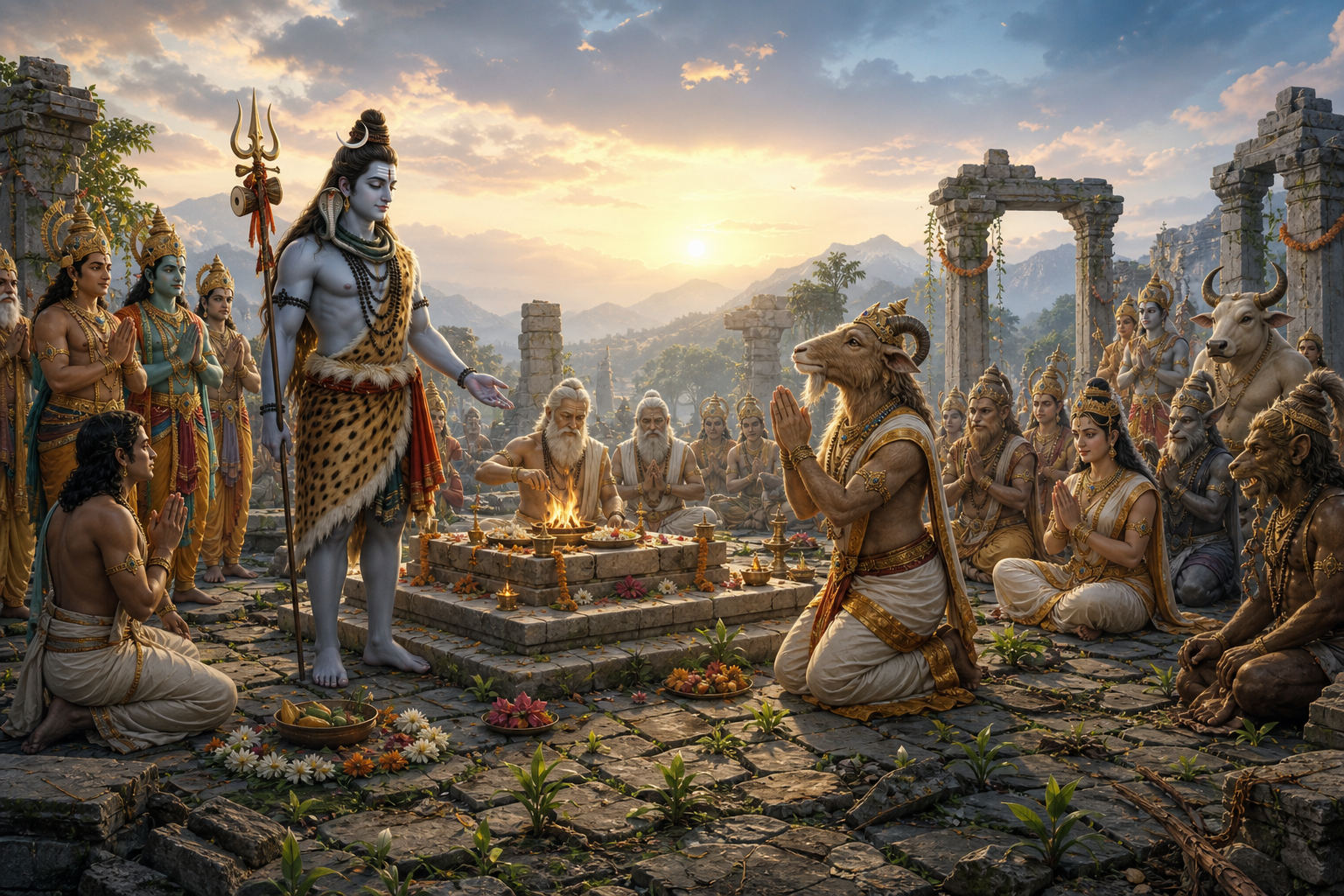
Daksha’s beheading is the episode’s starkest image of consequence. The source associates the head with identity, command, speech, judgment, and pride. Its removal can thus be read as the dismantling of the arrogant self that presided over the defective sacrifice. In many tellings referenced by the essay, Daksha is later restored with a goat’s head. The account links that animal to sacrificial symbolism, making his altered body a lasting mark of the ritual order he mishandled.
Restoration prevents the punishment from becoming mere vengeance. Daksha survives, but he does not simply resume his former position unchanged. Consequence becomes the condition of transformation. The story’s justice is fierce because the disorder is profound, yet its ultimate purpose is the recovery of balance rather than endless retaliation.
Sati’s role deepens this movement. The source treats her as an active moral presence whose protest exposes the emptiness of Daksha’s conduct. As Shiva’s consort, she represents Shakti, the living power through which consciousness manifests; dishonoring Shiva is therefore inseparable from dishonoring sacred feminine power. Her death marks the rupture of that relationship within the ritual world. Narrative symbolism, however, should not be flattened into an endorsement of self-harm or treated as a general prescription.
The later rebirth of Sati as Parvati places destruction inside a longer movement toward tapas, reunion, and renewed harmony. Shiva’s fury clears away a false order, but dissolution is not the narrative’s final achievement. Daksha’s altered restoration and Sati’s return both show that sacred correction reaches completion through change, renewed relationship, and a more truthful order.
Key takeaways
- Daksha’s sacrifice is presented as inwardly broken by pride and exclusion before the ganas physically disrupt it.
- Virabhadra and Shiva’s retinue express Rudra’s paradoxical power: terrifying in correction yet directed toward restored balance.
- The attack distinguishes opposition to hollow ritualism from opposition to yajna itself.
- Daksha’s beheading and goat-headed restoration turn punishment into a visible transformation of the sacrificer.
- The movement from Sati to Parvati places grief and dissolution within a wider arc of renewal.
Further study can compare the distinct scriptural tellings without forcing their variations into a single seamless version. The enduring question remains consistent: whether ritual authority is serving dharma, or whether dharma has been reduced to a stage for authority.