
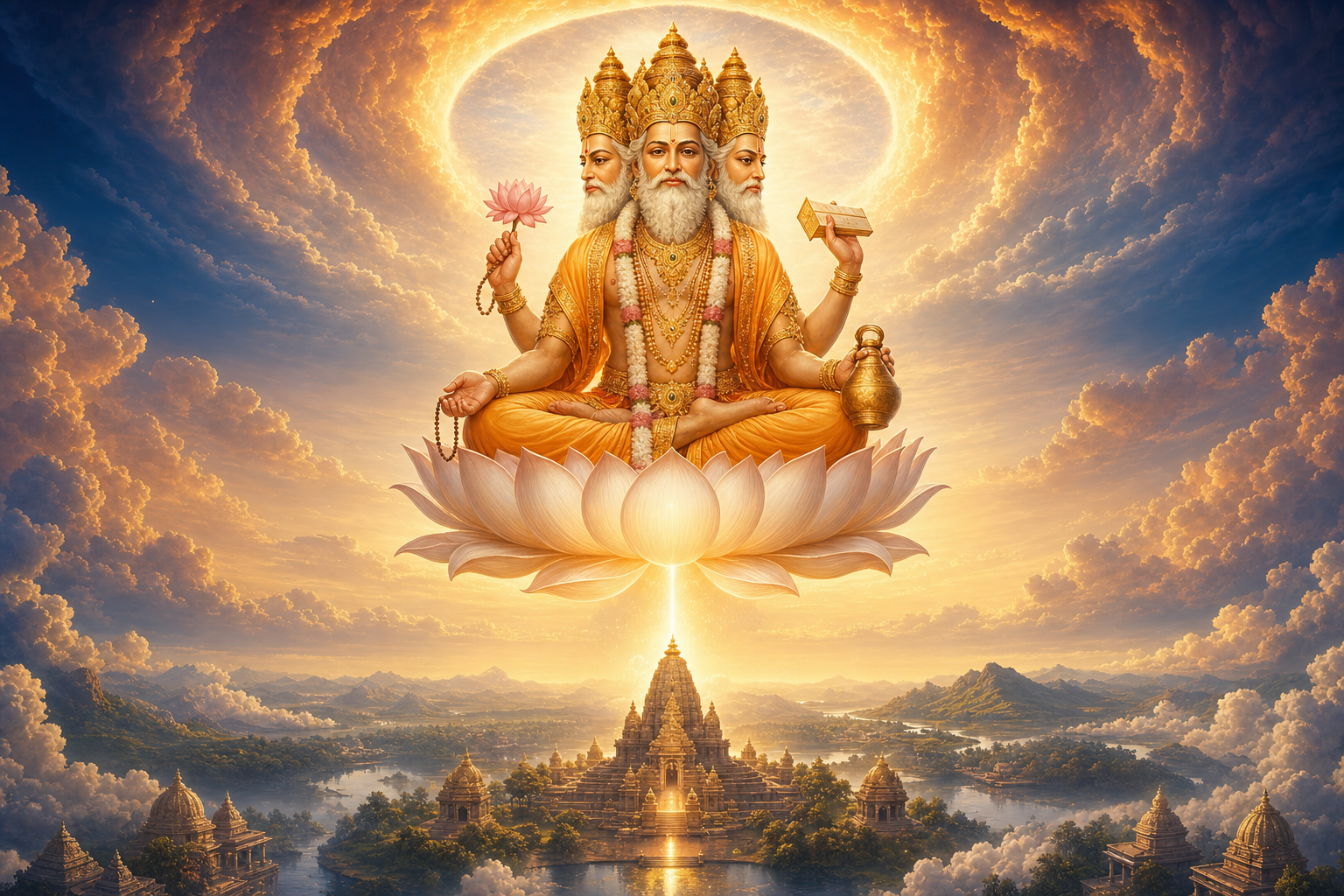
The upward direction is easy to mistake for one more coordinate. In the account examined here, however, it completes a sacred map of the cosmos. Brahma’s association with the zenith connects directional guardianship with creation, knowledge, temple form, and the human capacity for inner elevation.
The source presents this association as characteristic of many later ritual and architectural traditions, not as an invariable arrangement across every text, region, or lineage. That qualification is important: Brahma as Urdhva Dikpala is best understood as a meaningful strand within a varied sacred geography.
Key takeaways
- Urdhva denotes the upward direction or zenith, while Dikpala refers to a guardian of a direction.
- The ten-direction scheme expands the familiar eight-direction arrangement by adding the upward and downward axes.
- Brahma’s creative and knowledge-bearing symbolism makes him a fitting guardian of ascent, order, and expanded awareness.
- Temple architecture turns this vertical symbolism into an experience through the sanctum, superstructure, ritual orientation, and upward movement of the gaze.
From compass points to a complete sacred cosmos
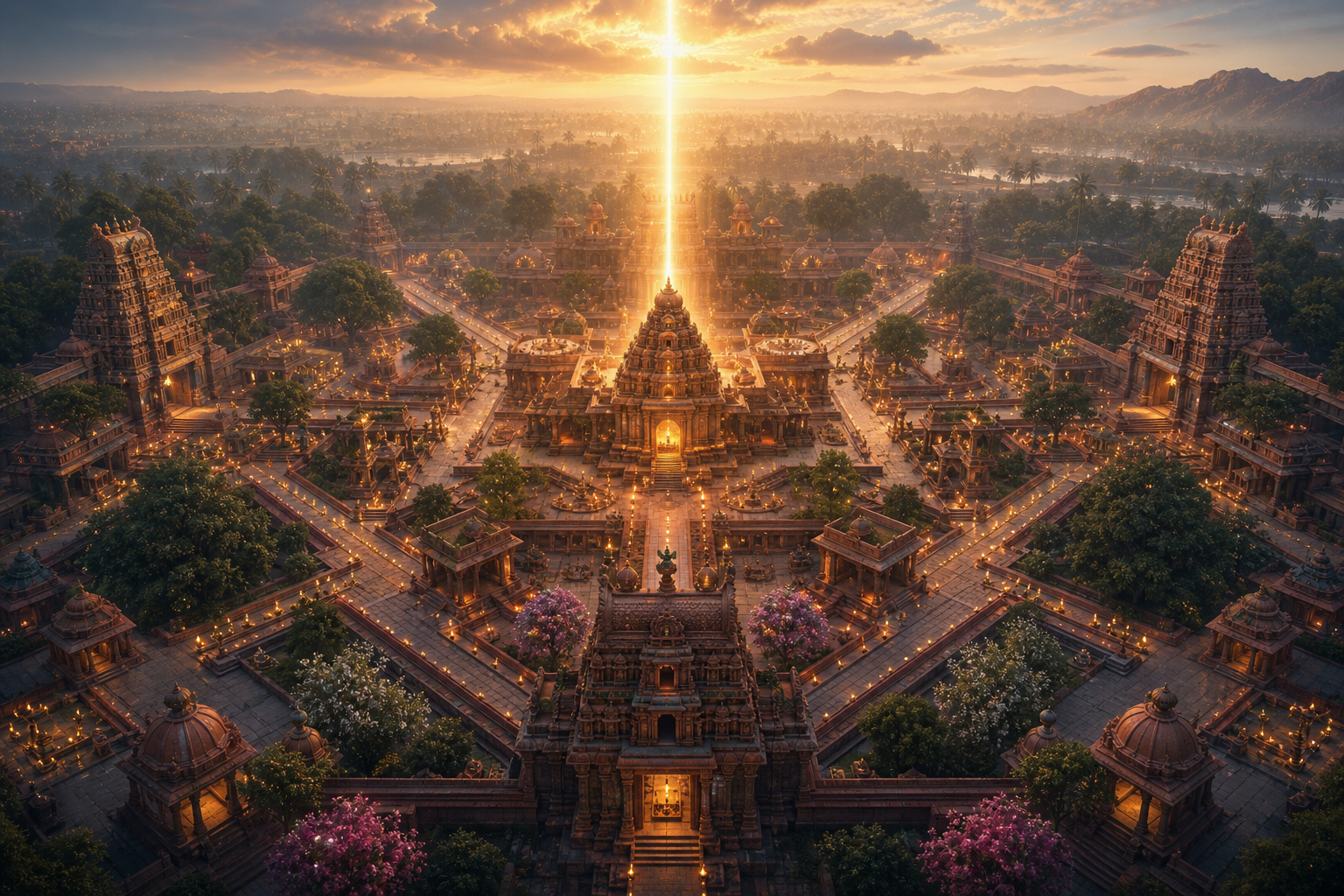
A Dikpala system does more than assign deities to points on a compass. As the DharmaRenaissance Blog article explains, directions can carry ritual functions, theological associations, and ethical meaning. Space consequently becomes an ordered field within which worship, architecture, and human action can be aligned.
The article gives a widely known eight-guardian arrangement: Indra in the east, Agni in the southeast, Yama in the south, Nirrti in the southwest, Varuna in the west, Vayu in the northwest, Kubera in the north, and Ishana in the northeast. The ten-direction model adds zenith and nadir, enclosing sacred space vertically as well as horizontally.
This enlargement changes the conceptual picture. The eight horizontal directions organize movement across the inhabited plane; the added vertical axis asks how earthly life relates to what lies above and below it. According to the source, Brahma is often connected with the upward direction, whereas the downward guardian may be identified with Ananta, Vishnu, or another cosmic principle depending on ritual, textual, and regional context. The variation cautions against presenting a single list as universal.
The resulting map can be read as a mandala rather than a neutral grid. Its purpose is not merely to locate divine figures but to place the worshipper inside a cosmos structured by relationship, responsibility, and order. The upward direction is therefore both spatial and interpretive: it marks the zenith while opening a vertical dimension of meaning beyond ordinary horizontal concerns.
Why Brahma is associated with the zenith
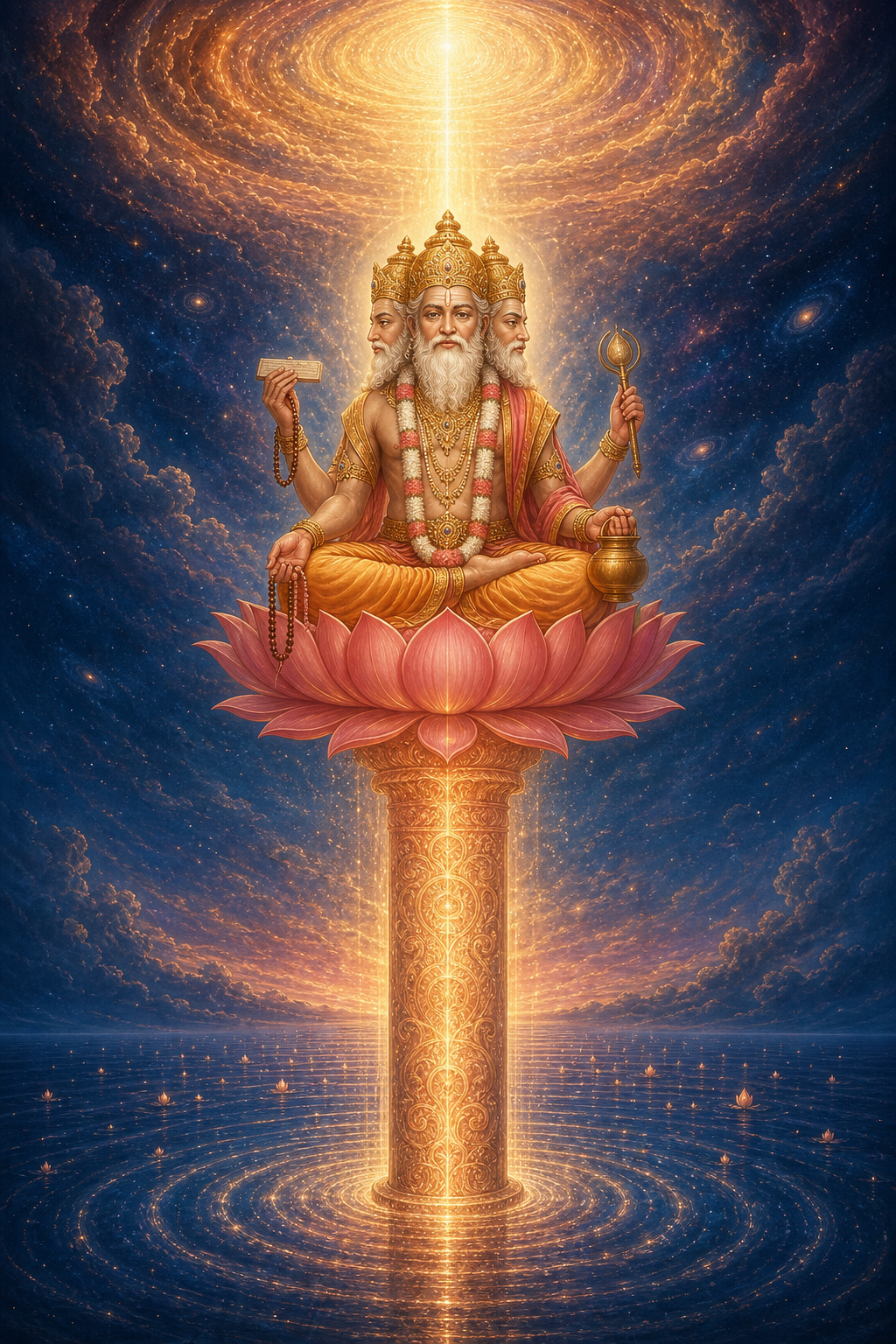
The source connects Brahma with creation, sacred knowledge, ordering intelligence, and the manifestation of names and forms. These qualities explain the association more fully than physical height alone. Upwardness suggests expansion and refinement, while Brahma represents the intelligence through which possibility takes ordered form.
Brahma’s four faces deepen that symbolism. The article notes that they are commonly interpreted as facing the four directions and are also associated in many explanations with the Vedas. Within this reading, creation is not random production. It is an all-sided act informed by knowledge, proportion, and intelligible order.
As Urdhva Dikpala, Brahma can consequently signify a movement from ignorance toward knowledge, fragmentation toward integration, and mere existence toward purposeful life. This is a symbolic ascent rather than a simple hierarchy among deities. Brahma’s suitability arises from the function attributed to him: he guards the dimension in which consciousness, learning, and creative responsibility are imagined as rising.
The article also places this symbolism against the scale of cyclic cosmology. Its reference to Brahma’s day and night emphasizes the immensity of cosmic time and the relative smallness of immediate human anxieties. In that setting, looking upward can produce humility as well as aspiration: human creativity matters, but it operates within an order far larger than the individual.
How temple architecture gives upwardness a form
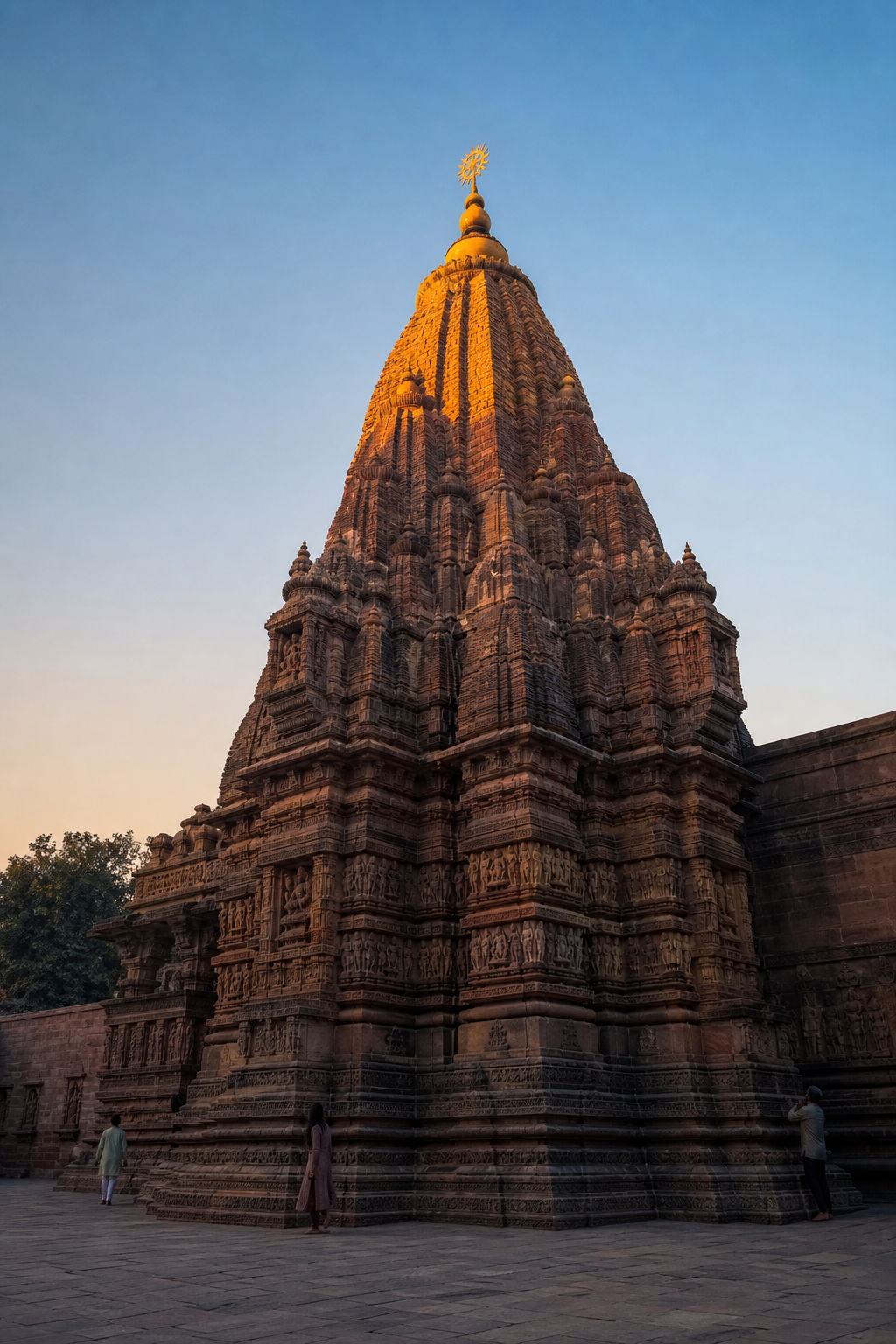
Temple architecture is where cosmological direction becomes bodily experience. The source describes Hindu temples as sacred bodies and cosmic diagrams rather than merely as halls for assembly. It associates directional guardians with boundaries, gateways, walls, corners, and rites of protection, while the Vastu Purusha Mandala organizes the built space according to divine principles.
The vertical axis adds another layer. From the garbhagriha, or sanctum, the temple rises toward the shikhara or vimana. The source interprets this upward thrust as a theological expression of movement from the earthly toward the celestial. Within that architectural language, Brahma’s guardianship belongs to the temple’s ascent: the zenith becomes a meeting point between constructed form and transcendent aspiration.
This symbolism is produced collaboratively. As the article observes, the architect establishes orientation and proportion, the sculptor embodies divine principles, the priest consecrates and serves the sacred space, and the devotee encounters it through movement, sight, sound, fragrance, and attention. The upward axis links these activities without reducing them to the same task.
A temple can therefore be read in two directions at once. Its plan orders the worshipper’s place within a protected field, while its rising form redirects attention beyond that field. The same movement can then be internalized: disciplined human life becomes temple-like when thought, speech, and action are deliberately oriented toward a higher standard.
The ethical test of spiritual ascent
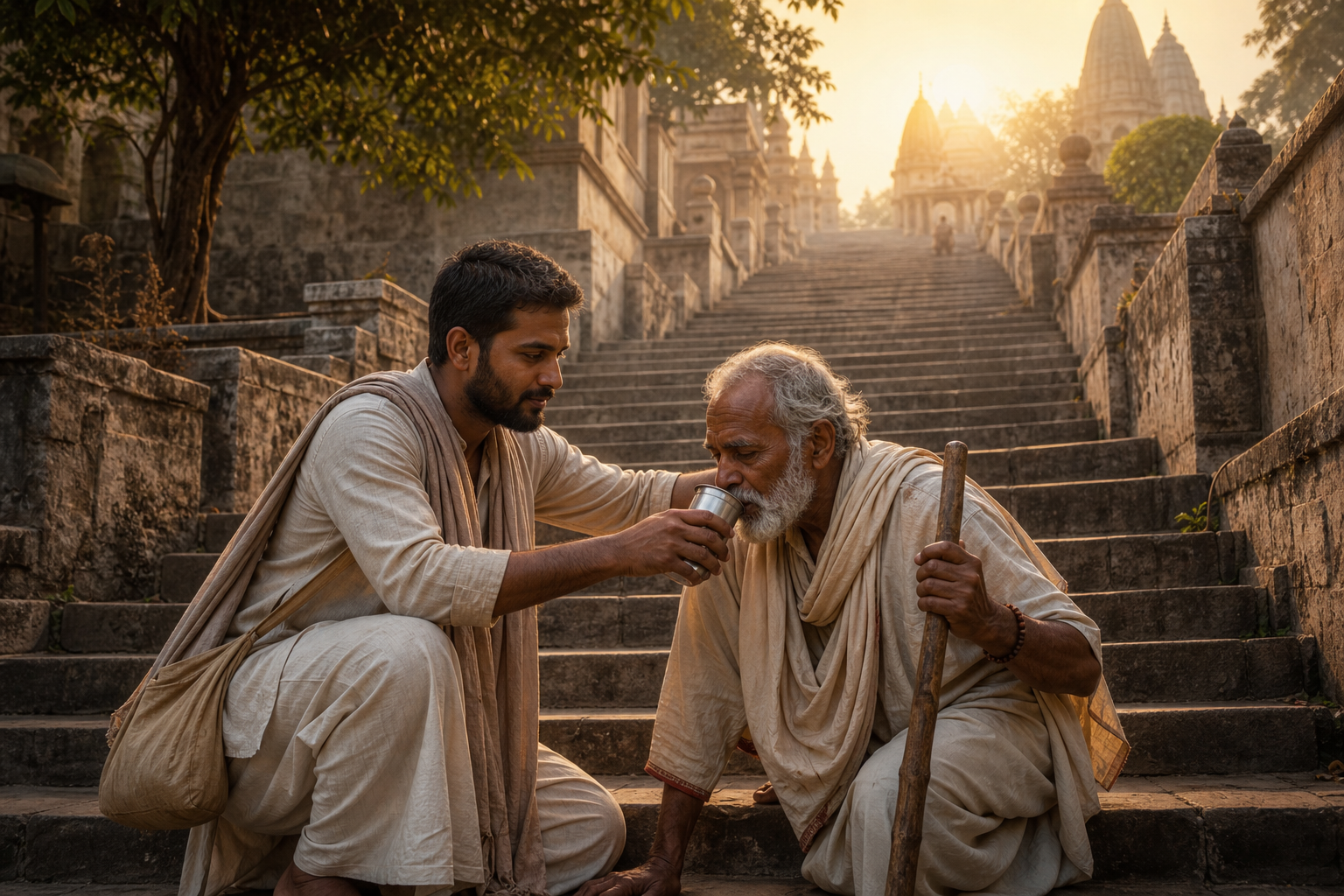
Upward symbolism can become vague unless it changes how creativity and knowledge are used. The source supplies a practical ethical test: knowledge should not harden into arrogance, creativity into vanity, or power into disorder. Because Brahma represents ordered manifestation, devotion to the upward guardian implies responsibility for what human beings bring into existence.
This interpretation extends beyond making physical objects. Families, institutions, arts, sciences, scriptures, temples, and communities are all forms of human creation in the article’s account. Their worth depends not only on novelty or scale but on whether they sustain harmony rather than deepen fragmentation. The sacred zenith thus becomes a standard by which constructive activity can be judged.
The source further proposes upward movement as a shared metaphor across Hindu, Buddhist, Jain, and Sikh life, while acknowledging their differences in theology, metaphysics, ritual, and historical development. That comparison is most useful as a civilizational analogy, not a claim of doctrinal sameness. It points to recurring commitments such as discipline, ethical transformation, learning, restraint, compassion, and freedom from narrow ego-centered existence.
Future study of particular ritual manuals, regional temple programs, and living practices could show more precisely where Brahma’s zenith guardianship is invoked and how its meaning changes across contexts. Such comparison would preserve the plurality of dharmic traditions while sharpening understanding of the vertical imagination they place before the devotee.