

A thread tied during a vrata can bind together prayer, memory and responsibility, but its meaning depends on the observance around it. The Gujarati sibling rite of Vir Pasli and the Vishnu-centered Ananta Vrata both employ a sanctified thread, yet they direct the devotee toward different relationships and commitments.
Read together, the two observances offer a useful way to understand protective-thread vratas without reducing them to interchangeable versions of Raksha Bandhan. Their shared material reveals a common ritual method; their different calendars, deities and vows preserve the identities of particular regions and lineages.
One ritual material, two forms of obligation
Both source accounts place an ordinary thread within a sequence of purification, prayer, offering and intentional tying. This context is essential. The material is not presented as meaningful in isolation: it becomes a ritual bearer of a sankalpa, or consciously undertaken resolve.
In the DharmaRenaissance account of Vir Pasli, a sister ties a protective thread on her brother’s wrist while praying for his well-being. The brother’s response is an affirmation of responsibility toward her. The article interprets the exchange most fully as reciprocal care rather than as a declaration of male authority: both siblings are called to protect the relationship from neglect, distance and disrespect.
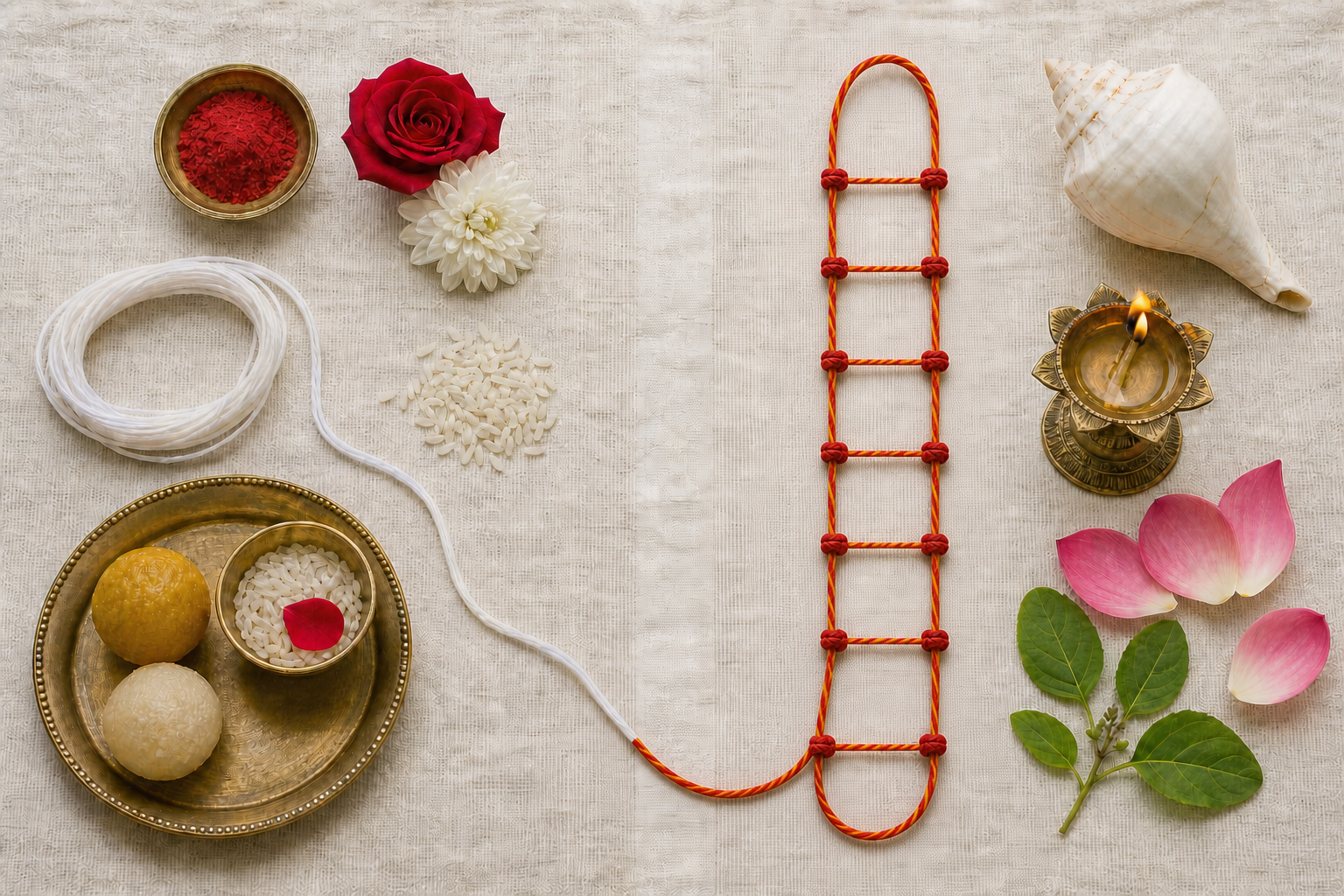
The DharmaRenaissance account of Anant Chaturdashi describes a different symbolic center. Its Ananta Sutra, or Ananta Daram, is worshipped in connection with Lord Anantha Padmanabha Swamy, the form of Vishnu associated with eternity. The source reports that the thread commonly has fourteen knots and that, in many regional traditions, men tie it on the right arm and women on the left. Interpretations of the knots vary: the article relates them to the fourteen worlds, the vrata’s fourteen-year discipline in some traditions, or repeated points of sacred remembrance.
The comparison shows why the broad label “protective thread” is useful but incomplete. Vir Pasli turns protection toward a sibling relationship. The Ananta Sutra connects personal and household stability with devotion to the eternal preserver. In both cases, the thread makes an otherwise invisible obligation visible and wearable.
Where Vir Pasli and Ananta Vrata converge and differ
| Dimension | Vir Pasli | Ananta Vrata |
|---|---|---|
| Sacred setting | A regional Gujarati observance in Shravan | A Vishnu-centered vrata on Bhadrapada Shukla Chaturdashi |
| Central relationship | The bond and mutual duties of sister and brother | Devotion to Anantha Padmanabha Swamy and the pursuit of household and spiritual steadiness |
| Thread form | A raksha thread tied by a sister on her brother’s wrist | An Ananta Sutra commonly prepared with fourteen knots |
| Reported duration | A recurring household observance shaped by family custom | In some traditions, a commitment continued for fourteen consecutive years |
| Nearby public festival | Shares protective symbolism with Raksha Bandhan but has a distinct regional schedule | Coincides with the concluding Ganesh Visarjan of the ten-day Ganesh festival |
These distinctions prevent two common misunderstandings. Vir Pasli is not simply another name for Raksha Bandhan: the source locates it on a Saturday or, in some family traditions, a Sunday in Shravan rather than on Shravan Purnima. Anant Chaturdashi, meanwhile, should not be identified only with the public farewell to Ganesha. Its quieter vrata dimension is dedicated to Vishnu as Ananta.
The two observances nevertheless share a recognizable domestic pattern. A worship space is prepared, a lamp and offerings accompany prayer, and the thread is sanctified before it is worn. Through touch and repetition, an abstract value becomes a household action: affection becomes duty in Vir Pasli, while the desire for stability becomes disciplined remembrance in the Ananta Vrata.
Calendar precision belongs to living tradition

The dates reported for 2026 illustrate why protective-thread vratas cannot always be scheduled from a generic civil calendar. The Vir Pasli source identifies August 15, August 16 and August 22 as relevant possibilities. It associates them respectively with households following the first Saturday, first Sunday or second Saturday custom in Shravan. The article advises devotees to confirm the observance through family elders, a local priest or the regional panchang followed by the household.
The Anant Chaturdashi source reports Friday, September 25, 2026, as the commonly cited date in India. It also cautions that Bhadrapada Shukla Chaturdashi is determined by lunar tithi, so local sunrise and panchang calculations may affect the applicable worship period. Devotees outside India are therefore advised in that account to consult a reliable local temple calendar or regional panchang.
This variation is not evidence that the observances lack coherence. It reflects different ways sacred time is inherited and calculated. Vir Pasli is especially dependent on regional weekday and household conventions, while Anant Chaturdashi is anchored to a named tithi. Treating one scheduling method as universal would erase precisely the lineage-specific knowledge that keeps each vrata recognizable.
The same care applies to ritual details. The number of knots, the arm on which a thread is worn, fasting practice, food rules and forms of offering should not be transferred automatically from one vrata to another. A family wishing to preserve either observance is better served by identifying its own tradition first than by constructing a hybrid ceremony from surface similarities.
Key takeaways
- A sacred thread receives its ritual meaning from the vow, worship and ethical conduct surrounding it.
- Vir Pasli centers sibling kinship, whereas the Ananta Sutra expresses devotion to Vishnu and a commitment to enduring steadiness.
- Similar ritual materials do not make the two vratas calendrically or theologically interchangeable.
- Reported 2026 dates should be confirmed against family custom and an appropriate local panchang.
- The strongest contemporary reading of protection is reciprocal: it includes reliability, dignity, humility and sustained care.
From a tied thread to sustained conduct
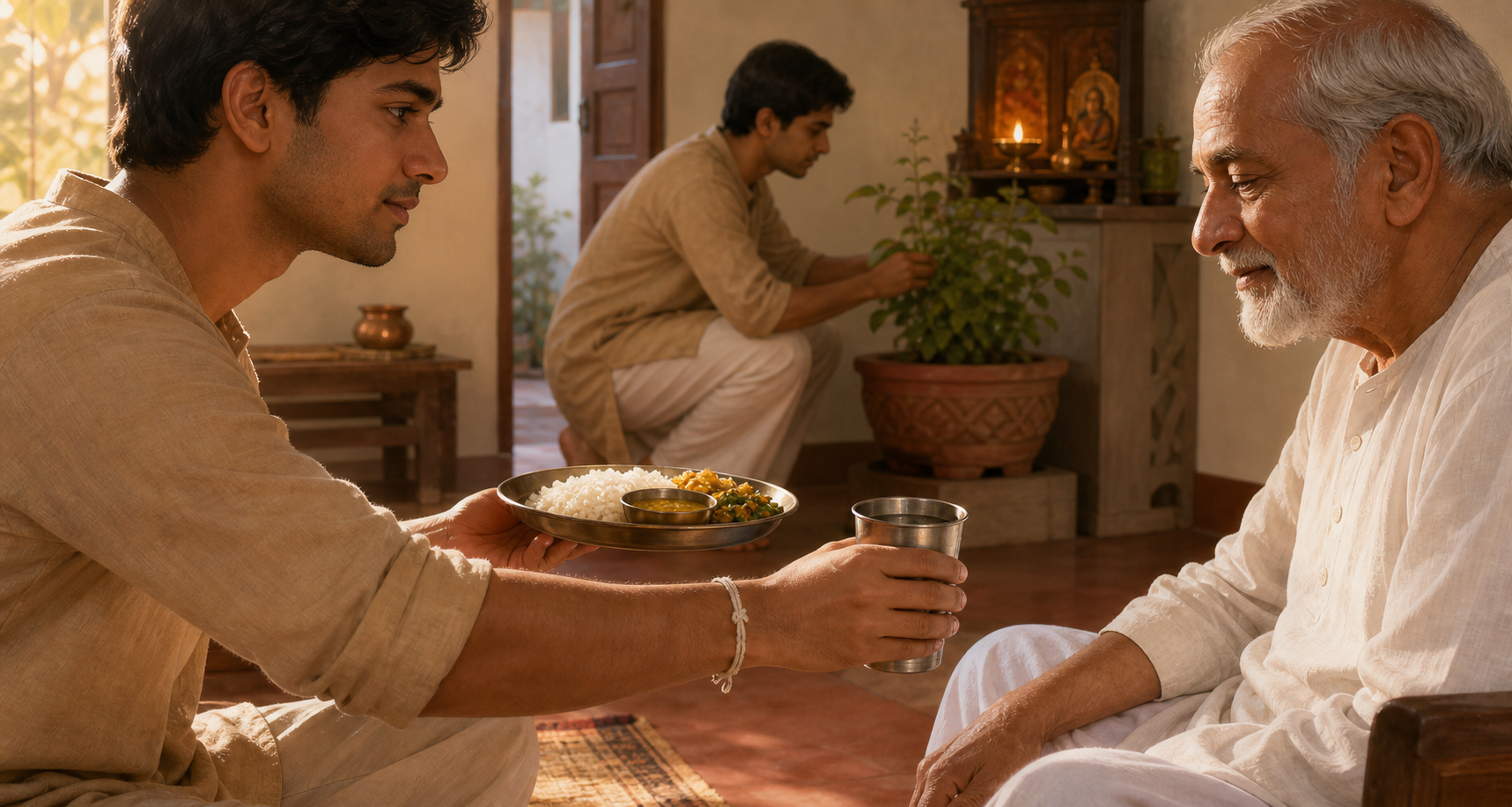
The ethical force of these vratas emerges after the ceremony. The Vir Pasli source expands protection beyond physical defense to include emotional support, respectful communication, financial responsibility and the preservation of dignity within family life. On this reading, the brother’s pledge is meaningful only when it shapes conduct, while the sister’s prayer is part of a mutually sustaining bond.
The Anant Chaturdashi account approaches conduct through the traditional narrative of Sushila and Kaundinya. It reports that Sushila’s observance brings auspicious blessings, while Kaundinya rejects the sacred thread, undergoes misfortune and eventually returns to devotion. The article reads the story as a lesson in humility, gratitude and respect for disciplined practice rather than as a simple formula for obtaining prosperity.
Placed side by side, the traditions expose complementary ritual failures. A family symbol can become sentimental if it is not followed by dependable care; a theological vow can become mechanical if it is separated from humility and ethical steadiness. The wearable thread addresses both risks by remaining on the body as a reminder of what was promised during worship.
The observances also demonstrate how domestic traditions retain their identities beside larger festivals. Vir Pasli may receive less public attention than Raksha Bandhan, but its Gujarati calendar and family memory give it an independent place. Anant Chaturdashi may be publicly dominated by Ganesh Visarjan, yet its Ananta Sutra preserves the day’s Vishnu-centered dimension. Visibility, therefore, is not a reliable measure of ritual significance.
Adaptation can continue without flattening those distinctions. The Vir Pasli source suggests that geographically separated siblings may maintain the observance through a mailed thread or remote contact, while the Anant Chaturdashi source emphasizes locally accurate tithi guidance for diaspora households. The future of protective-thread vratas lies in this balance: flexible means, clearly remembered vows and careful respect for inherited form.
References
- DharmaRenaissance Blog – Vir Pasli Festival 2026: Powerful Guide to Gujarat’s Sacred Raksha Vrat
- DharmaRenaissance Blog – Anant Chaturdashi 2026: Powerful Vrata, Ganesh Visarjan and Eternal Vishnu