
Samsara is often imagined as a cycle to escape, while dharma is treated as a set of obligations to obey. Sri Krishna’s teachings join the two more carefully: samsara includes the recurring pressure of attachment, anxiety, loss, duty, desire, and moral confusion, while dharma provides an orientation through which life within that pressure can become less binding.
Drawing together the source article’s philosophical, ethical, and narrative readings of Krishna, a coherent pattern emerges. Freedom does not require indifference to the world. It develops through discerning responsibility, acting without possessiveness, cultivating devotion, and accepting that responsible agency is not absolute control.
Samsara is a problem of relationship, not merely location

The source article presents samsara as both a metaphysical cycle and an immediately recognizable human condition. Its heat is felt when the mind becomes restless, responsibility turns burdensome, loss overwhelms perspective, or attachment obscures moral judgment. This framing moves the subject beyond a distant doctrine about rebirth and places it within everyday experience.
Krishna’s response is therefore not a simple command to abandon worldly activity. The article emphasizes that people living in the world cannot avoid action altogether. What binds them is the possessive relationship formed around action: the insistence that work must confirm identity, produce a desired reward, or remain under personal control.
The decisive distinction is between relinquishing responsibility and relinquishing ownership of its fruits. The first can become avoidance; the second permits wholehearted effort without making inner stability dependent on success. Krishna’s teaching, as interpreted in the source, is neither passivity nor fatalism. It is a disciplined freedom in which a person acts with care while recognizing the limits of individual control.
Dharma begins where moral certainty breaks down
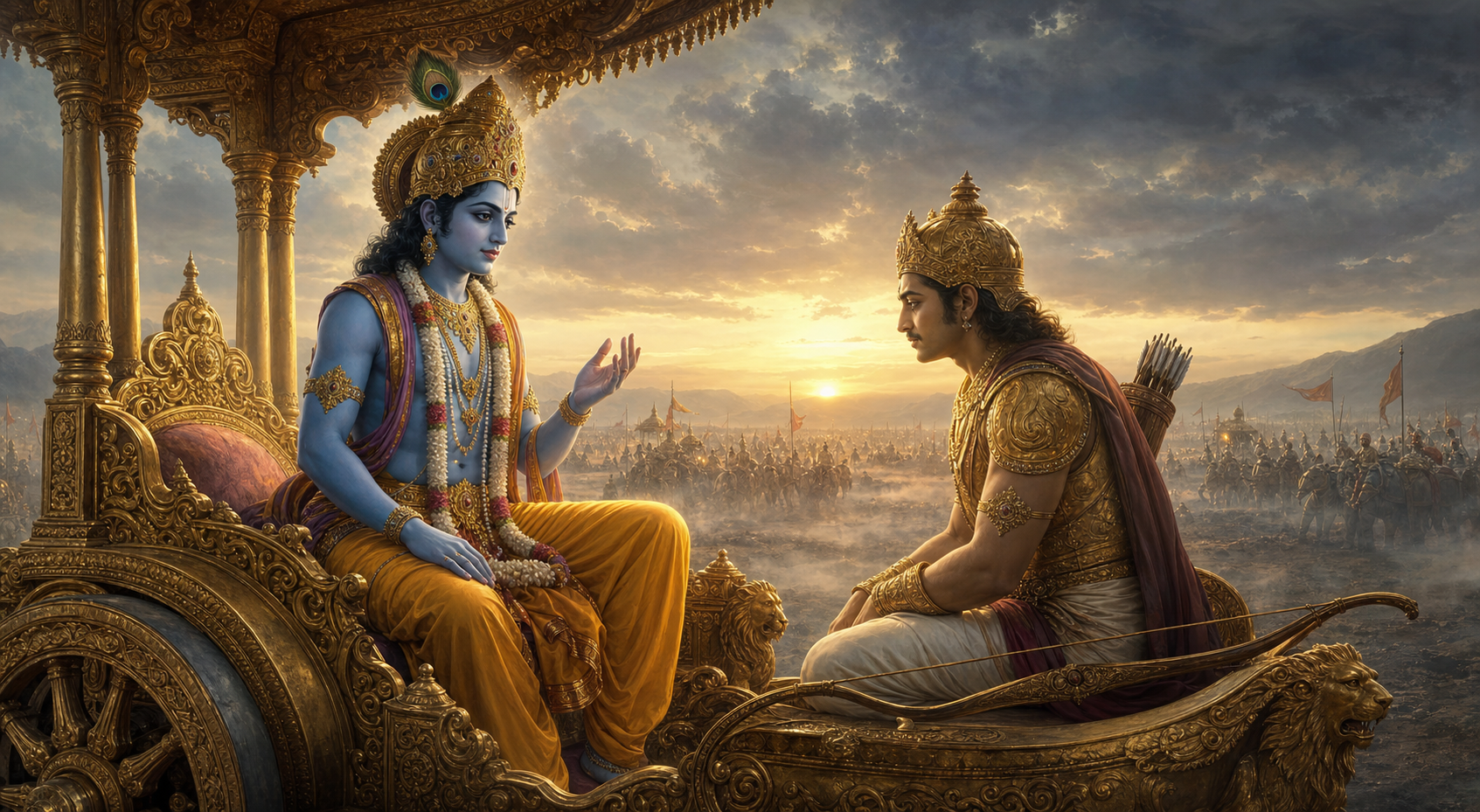
Arjuna’s crisis in the Bhagavad Gita gives this teaching its ethical setting. According to the source article, his paralysis is not merely fear of battle. He sees teachers, elders, relatives, and friends on opposing sides, and his confidence collapses beneath grief and conflicting loyalties. Krishna does not treat that anguish as irrelevant. He turns it into the starting point for discernment.
This matters because dharma is not presented as a mechanical rule that produces an effortless answer in every circumstance. The article draws attention to Krishna’s wider roles in the Mahabharata as counselor, diplomat, friend, strategist, charioteer, protector, and teacher. Across those roles, dharma requires attention to context, responsibility, intention, consequences, and the welfare of the larger order.
Context, however, does not make dharma a synonym for convenience. Krishna’s counsel subjects action to moral discipline: responsibility must be distinguished from personal preference, and necessary action must be separated from conduct driven by fear, anger, pride, or gain. An action may remain painful even when it is rightly chosen. Clarity removes confusion about one’s orientation; it does not guarantee emotional comfort.
The battlefield consequently functions as more than a dramatic backdrop. It concentrates a recurring problem of samsara: attachment can disguise itself as virtue, while genuine duty can appear harsh because it frustrates immediate feeling. Krishna’s teaching asks for neither emotional numbness nor impulsive obedience, but for judgment steady enough to honor both human relationships and a wider moral order.
Action, devotion, and vision form one discipline
Karma Yoga purifies agency
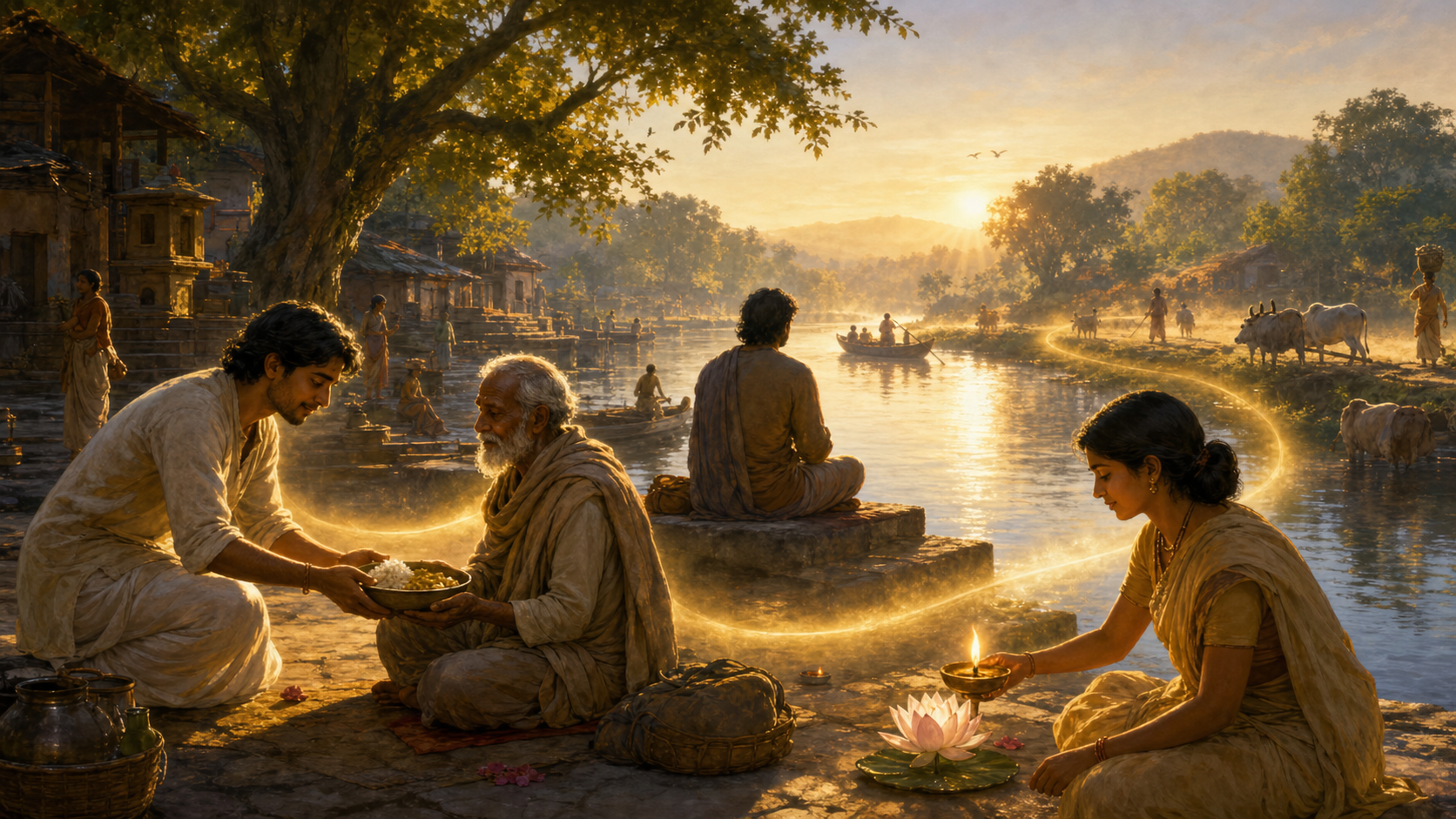
The source identifies Karma Yoga as central to Krishna’s answer. Action becomes less binding when it is undertaken with discipline, steadiness, and dedication to a purpose higher than private reward. This is not indifference to quality or consequences. It changes the actor’s claim upon them: effort remains necessary, but the outcome is no longer treated as personal property or the sole measure of worth.
This approach offers a practical response to exhaustion. Responsibility becomes especially oppressive when a person assumes that every variable must be mastered and every result secured. Karma Yoga preserves serious effort while loosening that impossible demand. The individual remains accountable for intention and conduct without imagining that individual will governs the whole field of events.
Bhakti transforms motivation
Bhakti adds love, surrender, and intimacy with the divine to the discipline of action. In the source article’s reading, the childhood narratives of Gokula and Vrindavan show that divine reality is not only a distant principle. The affection of Yashoda, the devotion of the gopas and gopis, and the image of Krishna’s flute express a relationship in which spiritual discipline can be sustained by love rather than willpower alone.
Devotion also prevents non-attachment from becoming emotional withdrawal. Offering the fruits of action is not merely a technique for suppressing disappointment; it is a reorientation of desire toward the divine. Karma Yoga changes how work is performed, while bhakti changes for whom and for what it is performed.
Cosmic vision corrects the scale of the self
The Vishvarupa Darshana expands Krishna’s intimate companionship with Arjuna into a vision of universal form. The source describes this form as encompassing time, beings, worlds, creation, preservation, and dissolution. Its ethical significance lies in the scale it reveals: the individual is called to responsible action but cannot plausibly regard the individual self as the ultimate controller of reality.
These three dimensions reinforce one another. Action without a larger vision can become anxious self-assertion. Detachment without devotion can become coldness. Devotion without disciplined action can become sentiment detached from responsibility. Krishna’s integrated teaching directs conduct through Karma Yoga, motivation through bhakti, and self-understanding through the cosmic perspective.
Krishna’s stories give ethical insight a field test
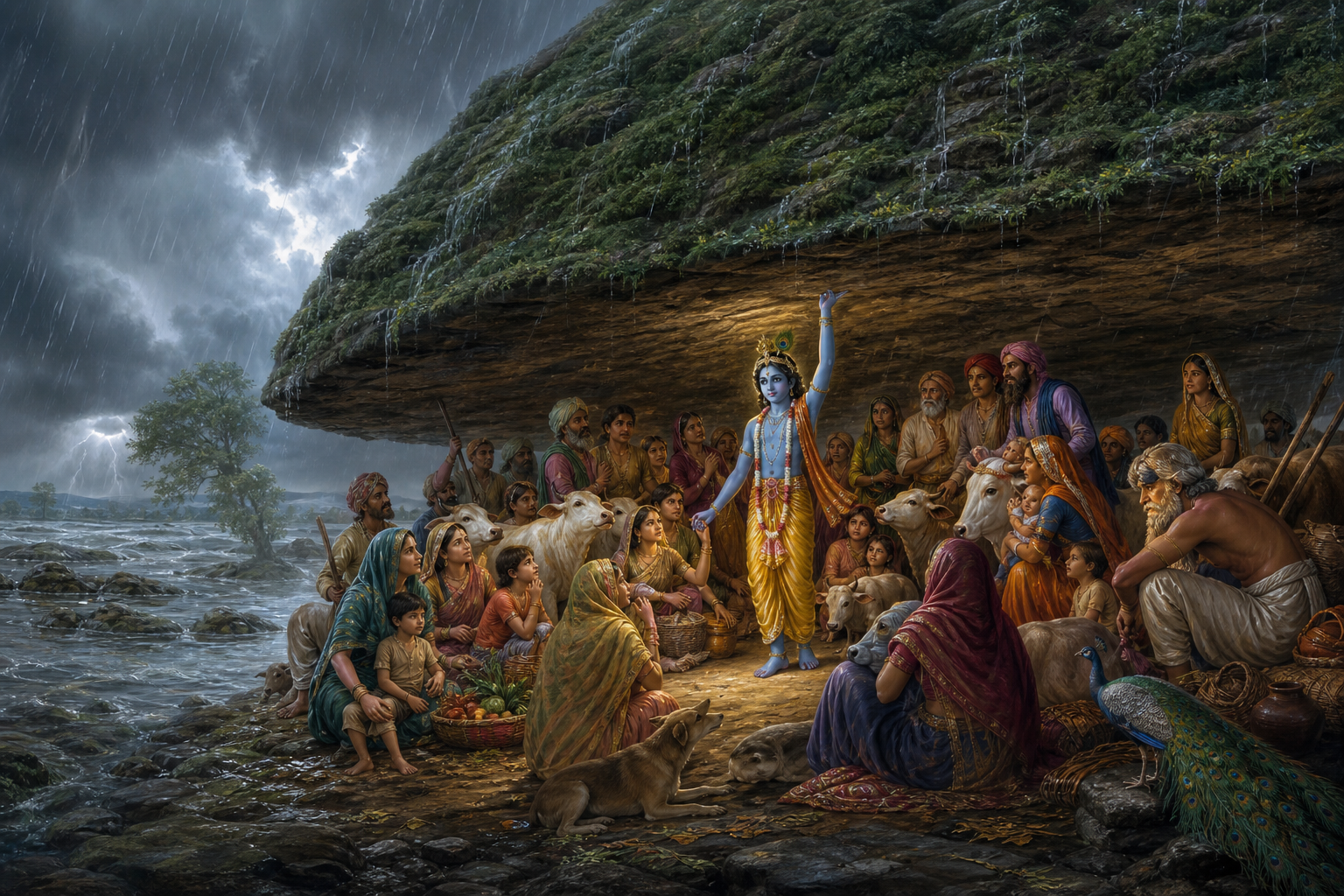
The narratives surrounding Krishna do not merely decorate the philosophical teaching. They show its qualities under different conditions. The playful child who steals butter, the protector who lifts Govardhan, the figure who subdues Kaliya, and the charioteer who counsels Arjuna prevent spiritual life from being reduced either to sweetness or to severity. Love, play, courage, service, discernment, and resistance to adharma belong within one moral imagination.
The source article explicitly interprets the Govardhan episode as a redirection from habitual ritual toward conscious reverence for the natural order that sustains a community. On that reading, the story connects worship with ecological gratitude, social cohesion, and protection. Dharma is not confined to private belief; it includes the relationships among ritual practice, shared life, and the conditions upon which life depends.
The Kaliya narrative supplies a complementary image. Poisoned waters endanger the community, and Krishna’s dance upon the serpent signifies the restoration of order. The article also reads the episode inwardly: anger, envy, arrogance, and fear can poison the mind just as venom contaminates water. The story therefore holds together personal purification and the social responsibility to confront conditions that threaten life.
Krishna’s friendship with Arjuna adds another essential connection. The divine teacher serves as charioteer and companion rather than remaining aloof from human conflict. Transcendence and intimacy are not competing portraits here. The cosmic form places human action within an immeasurable order, while the charioteer’s presence shows that spiritual guidance can meet a person inside a concrete moral struggle.
This layered mode of teaching helps explain why Krishna’s narratives can address different temperaments. The source notes that a child may encounter delight, a devotee rasa, a philosopher metaphysical questions, a leader political judgment, and a grieving person reassurance. The stories train perception through character, emotion, and consequence, making dharma imaginable before it is reduced to a formula.
Key takeaways
- Samsara is experienced not only as a cycle of rebirth but also as the present pressure of attachment, anxiety, loss, and confused responsibility.
- Dharma requires contextual judgment disciplined by responsibility, intention, consequences, and concern for the larger order.
- Karma Yoga purifies action, bhakti reorients desire, and cosmic vision challenges the illusion of absolute personal control.
- Surrendering the fruits of action does not excuse passivity; it allows committed effort without possessiveness about results.
- Krishna’s stories translate philosophical principles into images of protection, purification, friendship, service, love, and resistance to adharma.
Read together, these teachings locate spiritual freedom within the next responsible action rather than beyond ordinary life. Their continuing challenge is to cultivate judgment without self-righteousness, devotion without withdrawal, and effort without the demand to control every result.