
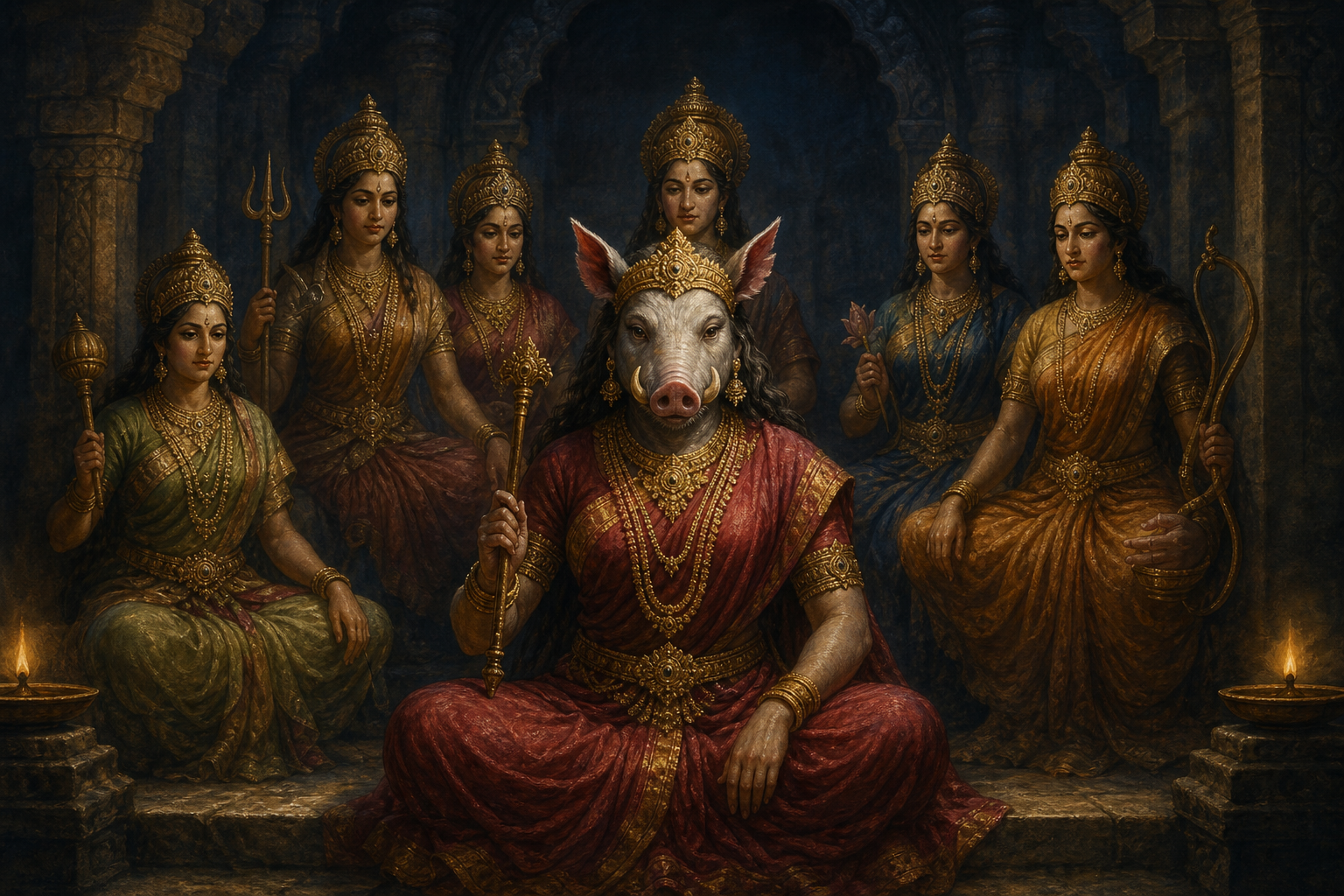
Goddess Varahi invites reflection on a form of sacred power that is protective, transformative, and difficult to reduce to a simple definition. This guide distinguishes what the limited source actually reports from the broader spiritual interpretation suggested by its theme.
According to Hindu Blog, Varahi is a potent and enigmatic manifestation of the Divine Feminine. The source places her among the Sapta Matrikas and identifies her as an important presence in Shaktism and Tantric practice.
Varahi’s place among the divine mothers
Sapta Matrikas means the seven mothers, a collective that presents divine motherhood as a source of strength rather than passive sentiment. In this setting, the maternal principle can encompass protection, authority, discipline, and the power to confront disorder.
Varahi’s inclusion in this group is the clearest traditional context supplied by the source. It situates her within a shared expression of feminine divinity while preserving her distinct identity. That balance between unity and difference is characteristic of the wider Hindu sacred landscape: many forms, sects, and methods of worship can participate in a common dharmic vision without becoming identical.
Shakti and Tantra require careful interpretation
Shaktism approaches divine power through the Goddess, while Tantra refers to diverse traditions rather than one uniform body of belief or practice. The source associates Varahi with both, but it does not provide a scripture, mantra, ritual sequence, lineage, or detailed account of her iconography. Claims about those subjects would therefore require evidence beyond the supplied material.
This limitation matters because sacred symbols acquire meaning within living traditions. A deity should not be treated as a detachable psychological metaphor, nor should specialized practices be reconstructed from brief summaries. General contemplation may be accessible to readers, but formal Tantric worship is best understood through an authentic sampradaya and qualified guidance.
Inner transformation as a dharmic reading
Hindu Blog frames Varahi through the themes of shadow work and spiritual transformation. Shadow work is a modern interpretive expression, not a single standardized Hindu doctrine. Used carefully, it can describe the honest recognition of fear, anger, pride, avoidance, or other tendencies that obstruct right conduct.
From a dharmic perspective, recognition alone is insufficient. Difficult impulses must be directed through awareness, self-restraint, courage, and ethical action. This emphasis creates a meaningful bridge across the Dharmic family. Hindu, Buddhist, Jain, and Sikh traditions differ in theology and method, yet each insists in its own way that inner refinement must become visible in conduct. Varahi’s transformative symbolism can therefore encourage strength governed by dharma, not power without responsibility.
Key takeaways
- The source identifies Varahi as a manifestation of the Divine Feminine and one of the Sapta Matrikas.
- Her reported importance in Shaktism and Tantra should not be used to invent unsupported ritual or iconographic details.
- Her transformative theme can be read as a call to face difficult tendencies and place personal power in the service of dharma.
A grounded approach to Varahi begins with reverence, respects the limits of available evidence, and allows disciplined study to deepen what an initial symbolic reading can only suggest.
Inspired by this post on Hindu Blog.
