
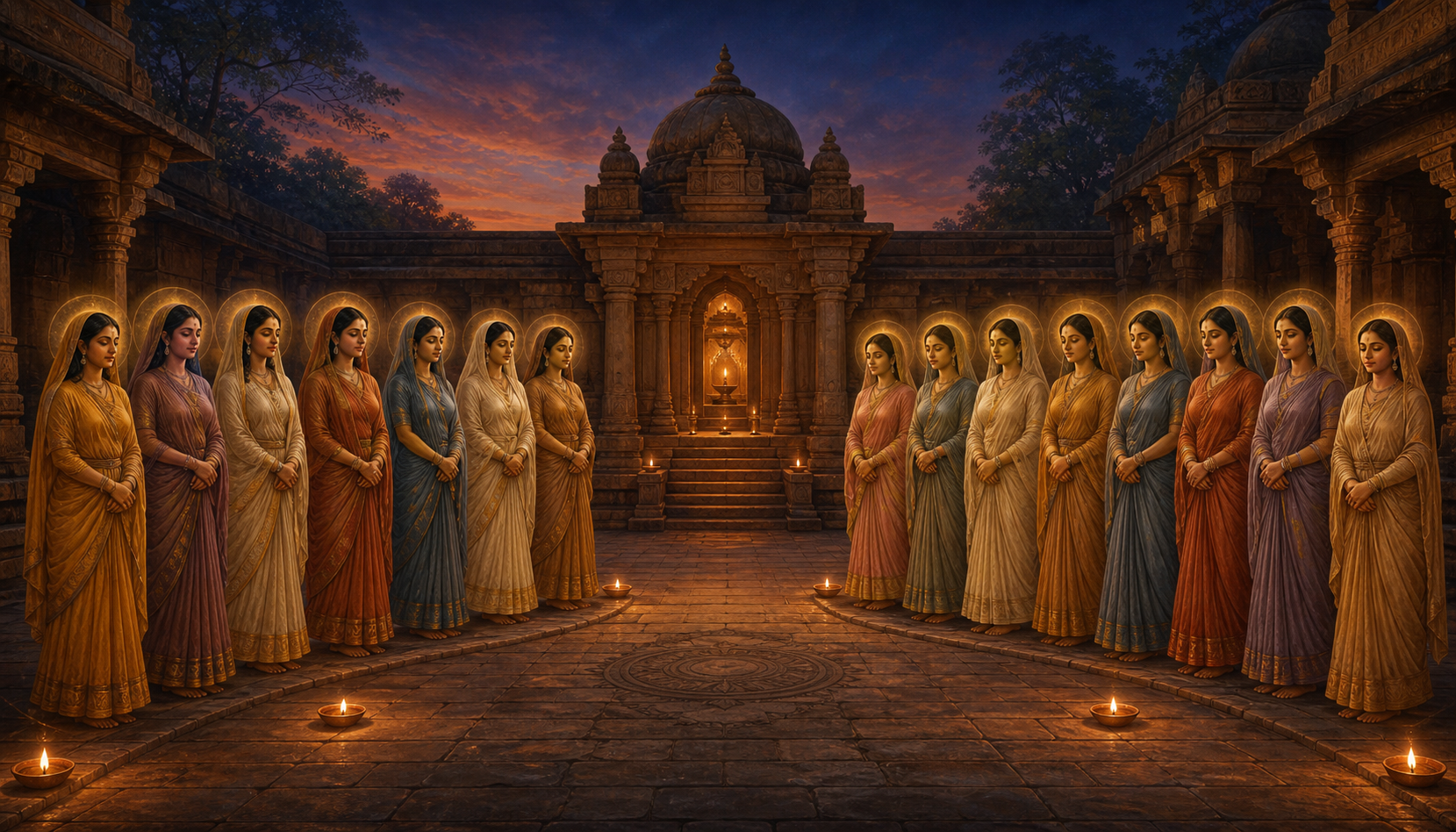
The terms Saptamatrikas and Ashtamatrikas refer to two numerical configurations of the Divine Mothers. The supplied source is only a fragment, so the clearest supported distinction is structural: one grouping has seven Mothers, while the other has eight.
Hindu Blog presents the Matrikas as embodiments of cosmic powers that sustain and protect the universe, rather than as mere attendants of Devi. This framing helps explain why the change in number can carry symbolic importance instead of being treated as simple counting.
Seven and eight describe distinct configurations
Saptamatrikas literally identifies a group of seven Mothers. Ashtamatrikas identifies an eight-member grouping. The source heading characterizes this movement from seven to eight as an expression of cosmic completeness.
The available fragment does not provide the names of the seven, identify the additional Mother, or establish a universal order for the ensemble. Those details should therefore not be inferred from the numerical labels alone. The reliable answer is that the Ashtamatrika configuration adds an eighth divine power to the sevenfold grouping; determining her identity requires the relevant textual, ritual, or iconographic context.
Why the traditional context matters
A sacred number can identify the form of an ensemble without supplying its complete theology. It does not, by itself, determine the figures’ names, sequence, attributes, or ritual purpose. A temple image, manuscript passage, or regional practice may provide the context needed to interpret a particular representation.
This distinction also guards against a common mistake: assuming that an eightfold presentation must invalidate a sevenfold one. Hindu traditions frequently preserve unity through more than one symbolic arrangement. Here, the shared center is the collective power of the Divine Mothers; the number indicates how that power is organized in a particular presentation.
How to identify a Matrika ensemble responsibly
Interpretation should begin with the object or tradition actually under study. The number of clearly represented Mothers, any accompanying labels, and the stated provenance should be recorded before assigning identities. If the available material establishes only an eight-member form, it is more accurate to call it an Ashtamatrika ensemble than to guess which goddess occupies the additional place.
The same caution applies when comparing devotional accounts. Source-based differences should be preserved rather than flattened into one supposedly universal roster. Such care respects both the internal diversity of Hindu practice and the integrity of each sampradaya.
Key takeaways
- The Matrikas are Divine Mothers associated in the source with sustaining and protective cosmic powers.
- Saptamatrikas denotes a seven-member grouping.
- Ashtamatrikas denotes an eight-member grouping.
- The supplied source fragment does not identify the complete roster or the additional Mother.
- Specific identities should be established from the relevant text, image, temple tradition, or ritual context.
Plural forms can express a shared Dharmic purpose
The two configurations illustrate a broader Dharmic capacity to preserve an underlying spiritual purpose through varied forms. Hindu, Buddhist, Jain, and Sikh traditions employ different sacred vocabularies, yet each values disciplined transmission, ethical responsibility, and the overcoming of harmful tendencies. Further study of the Matrikas should likewise begin with the exact tradition at hand while remaining attentive to the deeper unity that diversity can reveal.
Inspired by this post on Hindu Blog.
