

ISKCON’s public mission cannot be understood solely through the scale of the institution or through memorable episodes of street chanting. Read together, the two source articles reveal a more consequential pattern: a spiritual practice enters public life, encounters unfamiliar audiences and civic limits, and acquires institutions capable of carrying the encounter across generations.
The London arrest narrative shows that mission at its most immediate and unpredictable. The account of ISKCON’s 60th anniversary supplies the longer historical frame. Their combination clarifies what makes a legacy living: not the preservation of reputation alone, but the continued union of sacred practice, teaching, service, public accessibility, and responsible remembrance.
How sacred sound became a public mission
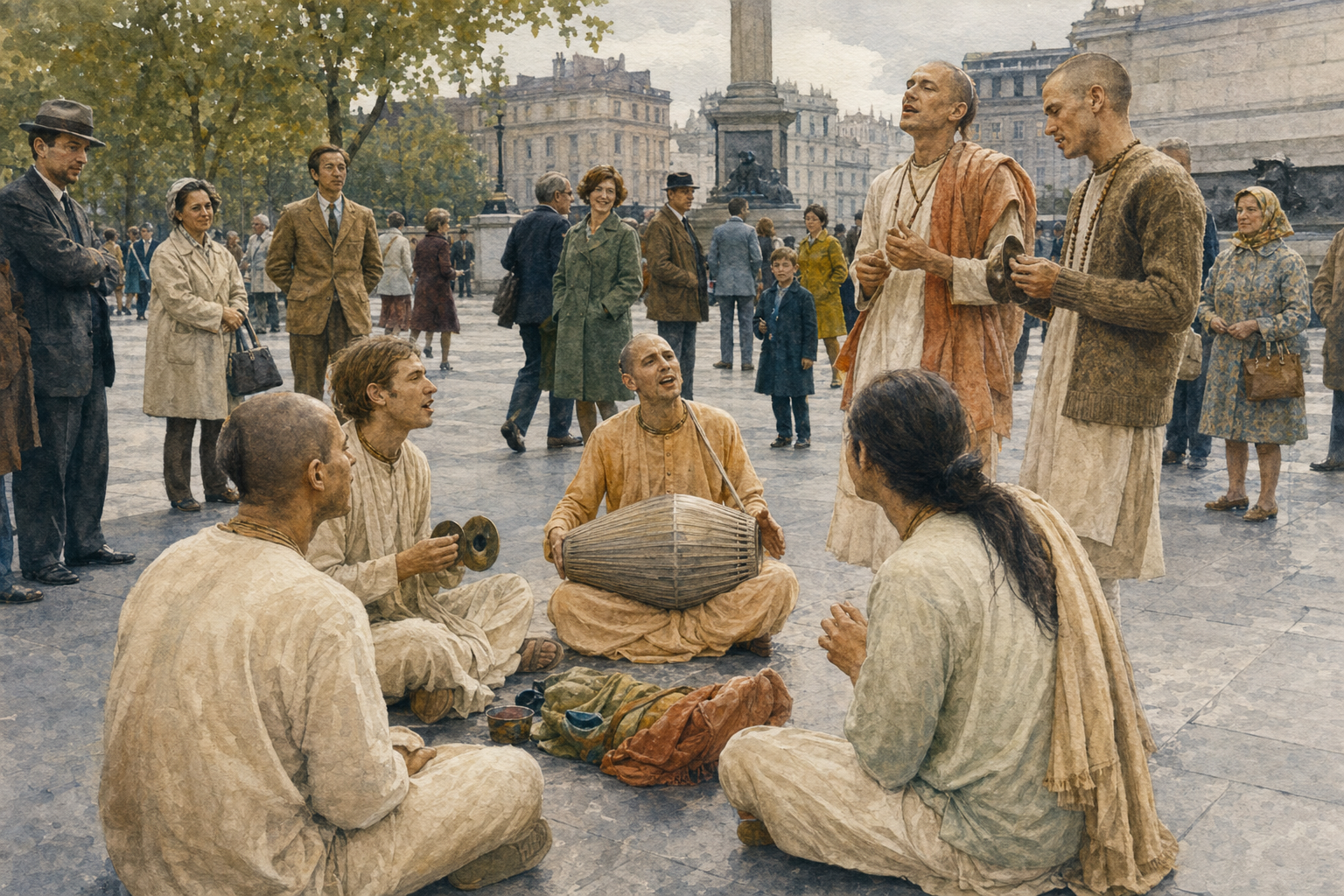
Both sources place sankirtana near the center of ISKCON’s public identity. The London account describes it as congregational glorification through shared chanting, especially the chanting of divine names. The anniversary article similarly presents the Hare Krishna maha-mantra as a practice performed privately as japa or collectively with music as sankirtana. In the Gaudiya Vaishnava understanding presented by the sources, sacred sound is not merely a sign pointing toward Krishna; it is treated as spiritually potent and capable of redirecting consciousness toward loving service.
This theology helps explain why chanting could travel so readily across cultural and linguistic boundaries. It requires no elaborate material setting, yet it can combine contemplation, music, movement, participation, and teaching. A passerby may first encounter rhythm and melody, while a committed practitioner understands the same event as worship and service in the mission associated with Sri Caitanya.
The anniversary framework reports that Srila Prabhupada established a base at 26 Second Avenue in New York after arriving in the United States in 1965. There he taught the Bhagavad Gita, led kirtan, prepared prasadam, and trained students before ISKCON was incorporated on 13 July 1966. These activities show that public chanting was never presented as an isolated attraction. It belonged to an integrated form of bhakti-yoga involving philosophical study, ethical commitments, worship, spiritual association, daily discipline, and service.
That integration is the essential connection between the two sources. Sankirtana made the mission publicly audible; classes and literature made its claims intelligible; prasadam and hospitality made it relational; disciplined practice gave it continuity. Visibility opened the door, but formation enabled people to remain.
A London confrontation tests public religion

The London narrative places five devotees on crowded Oxford Street on the Thursday before Christmas. According to the account, police had already arrested chanting devotees twice that week, and the group selected a different route in an effort to avoid further conflict. Plainclothes officers nevertheless stopped them near the end of their journey and arrested them on the stated ground of obstruction.
The episode should be read with its stated evidentiary limits intact. The article says that the account, attributed to Saksi Gopala Dasa and first published in the August 1977 issue of Back to Godhead, provides neither a docket number nor a transcript or even the year of the arrest. Its dialogue and procedural details therefore remain a published devotional recollection rather than independently verified court records.
Within that recollection, however, the interaction does not remain a simple contest between religious freedom and police authority. The devotees resumed chanting while being escorted to the station. Near a bus queue, an officer reportedly asked them to stop where the pavement narrowed; after the congested area had been passed, he allowed the chanting to resume. The devotees then entered the police station with drum and hand cymbals. The account concludes its legal arc with the dismissal of the charge and the acceptance of a copy of Sri Isopanisad for the court library.
The value of this story lies partly in that change of relationship. Police and devotees initially interpreted the same scene through different responsibilities: one side saw a sacred duty and public benefit, while the other saw a possible impediment on a busy pavement. The devotees’ reported compliance at the narrower passage and the officer’s subsequent permission to continue suggest that public religious expression and practical crowd management need not be absolute opposites.
The source interprets the officers’ smiles and altered behavior through the theology of mercy carried by the holy name. A social reading might instead emphasize the way shared music disrupted adversarial roles and permitted a moment of recognition. These interpretations answer different questions. The first explains the event’s sacred meaning from within the tradition; the second describes an observable interpersonal shift without claiming knowledge of anyone’s inner state. Keeping the distinction visible allows the testimony to retain its devotional force without turning interpretation into documentary proof.
Institutions carry an encounter beyond the street

The anniversary article frames 2026 as ISKCON’s diamond jubilee and reports that the community founded in New York developed into an international network of temples, congregations, schools and educational initiatives, publishing projects, rural communities, festivals, and food-relief programs. It also reports that more than one hundred temples and centers were established during the eleven years between the society’s incorporation and Srila Prabhupada’s death in 1977.
Numbers and organizational reach indicate transmission, but they do not by themselves define spiritual success. The London story supplies what an institutional chronology can miss: the vulnerability of entering a shared space, the possibility of misunderstanding, and the effect of personal conduct under pressure. Conversely, the anniversary framework shows why a compelling encounter cannot sustain a worldwide mission on its own. People need places to learn, texts to study, communities in which to practise, and forms of service through which conviction can mature.
ISKCON’s living legacy therefore operates as a chain rather than as a monument. Public kirtan creates an encounter; philosophical teaching interprets it; daily bhakti turns interest into practice; institutions preserve learning and coordinate service; new practitioners carry the process into another setting. Weakness in any link changes the character of the mission. Visibility without education risks becoming spectacle, while institutional continuity without accessible spiritual practice risks becoming self-preservation.
The historical frame also identifies translation as a foundational task. According to the anniversary article, Bhaktisiddhanta Sarasvati urged Prabhupada in 1922 to communicate Sri Caitanya’s teachings in English. Prabhupada’s later work joined linguistic translation to cultural translation: inherited teachings were presented to new audiences while remaining connected to Gaudiya Vaishnava scripture, guru-parampara, and disciplined practice. The public mission was therefore not only geographical expansion. It was the effort to make a tradition understandable without reducing it to a passing cultural fashion.
Responsible remembrance protects a living inheritance
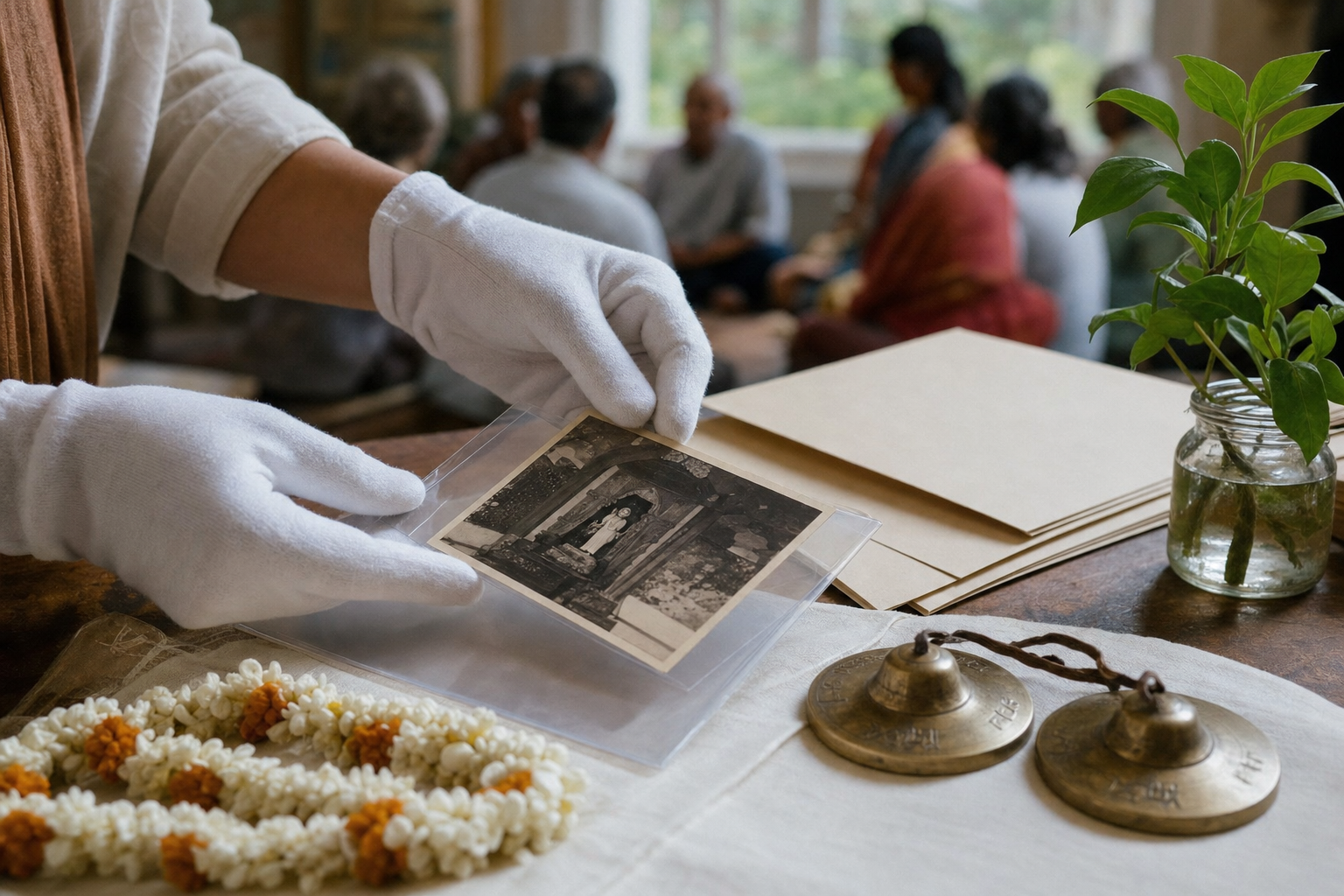
The two articles also model an important discipline for anniversary reflection. The London article openly identifies the limits of a remembered account. The anniversary article states that the available program contains a title and thumbnail but no lecture transcript, so it attributes no quotation, biographical claim, or particular argument to the named speaker, Venkat Bhatta Prabhu. In both cases, editorial restraint becomes part of honoring the tradition.
This matters because katha occupies a space where sacred narration, oral memory, philosophy, history, and ethical instruction meet. Devotional testimony asks what an event means; historical inquiry asks what the surviving evidence establishes. Neither question has to erase the other. Problems arise when recollected dialogue is treated as a transcript, theological interpretation is presented as an externally demonstrated cause, or an absent speaker is assigned views that the surviving material does not contain.
A living legacy needs both affection and accuracy. Affection preserves the human significance of sacrifice, courage, hospitality, and transformation. Accuracy keeps later audiences from inheriting embellishment as fact. Together they allow sacred memory to educate rather than merely idealize. They also make ISKCON’s public claims more credible to readers who do not already share its theological premises.
Key takeaways
- ISKCON’s public mission joins accessible sacred sound to philosophy, ethical discipline, community, and service; kirtan is an entrance to a larger practice rather than a self-contained performance.
- The reported London encounter shows how public devotion can generate civic friction while still leaving room for compliance, discretion, dialogue, and an altered human relationship.
- Institutional growth becomes a living legacy when temples, publications, education, festivals, congregations, and service keep connecting public encounters with sustained spiritual formation.
- Responsible katha distinguishes documented history, personal recollection, and devotional interpretation without assuming that only one of those forms can carry meaning.
As ISKCON marks six decades, the most durable measure of its inheritance will be whether its public practices remain spiritually grounded, civically responsible, intellectually clear, and open to new participants. A legacy meeting those tests does more than remember how a mission began; it renews the conditions through which that mission can continue.
References
- DharmaRenaissance Blog — How Sankirtana Turned a London Arrest Into a Remarkable Victory of Mercy
- DharmaRenaissance Blog — ISKCON at 60 in 2026: Discover Srila Prabhupada’s Living Legacy with Venkat Bhatta Prabhu