
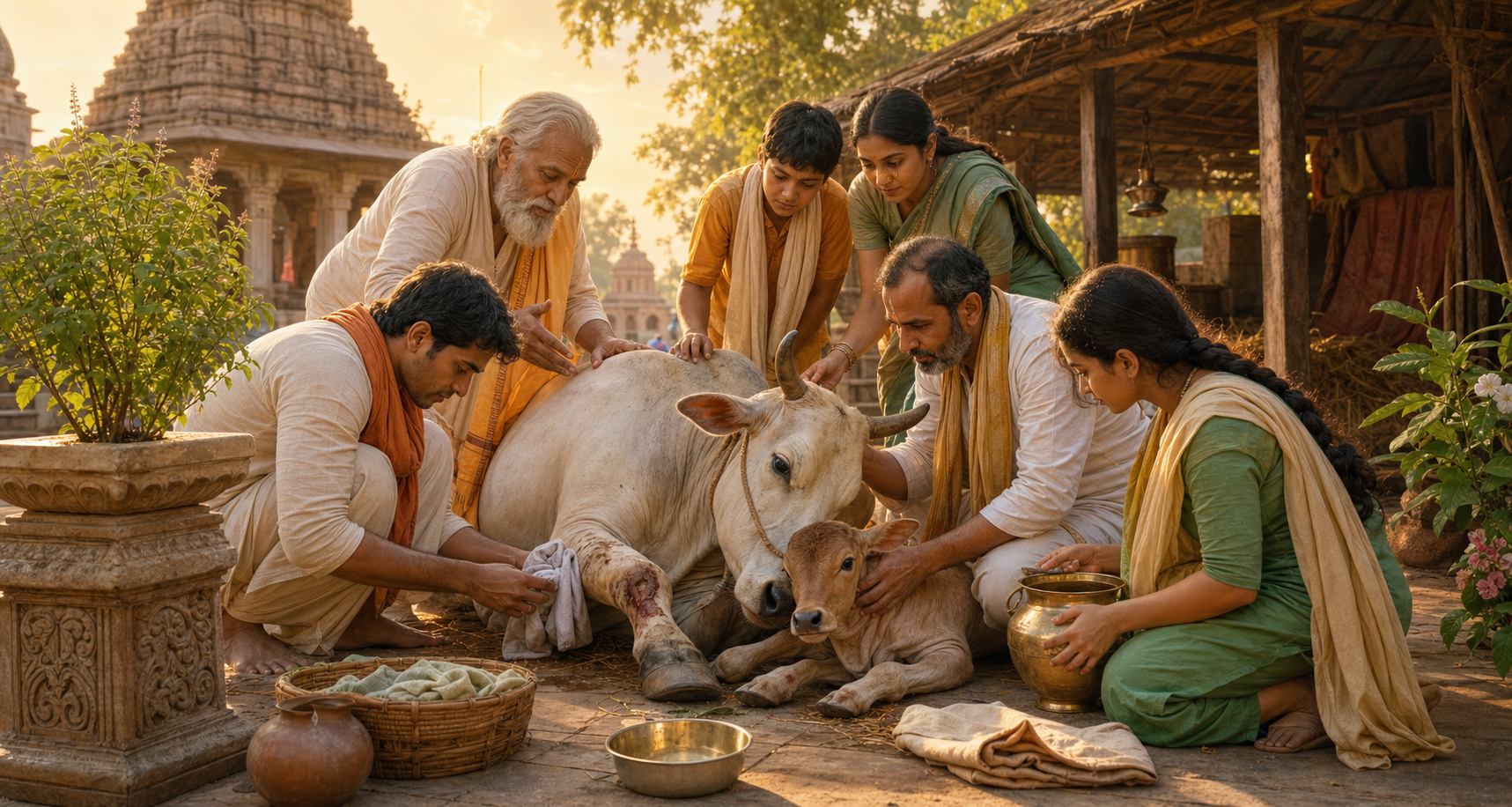
Vaishnava care is expressed through sacred relationships: between people and animals, parents and children, rulers and dependents, and teachers and disciples. Read together, the two source studies show that these relationships acquire moral substance when affection becomes attention, authority becomes protection, and failure becomes accountable reform.
The comparison also offers a practical test for religious ethics. Sacred language matters, but its credibility depends on what happens when another being is vulnerable, inconvenient, unproductive, angry or unable to protect itself.
Dependence turns relationship into duty
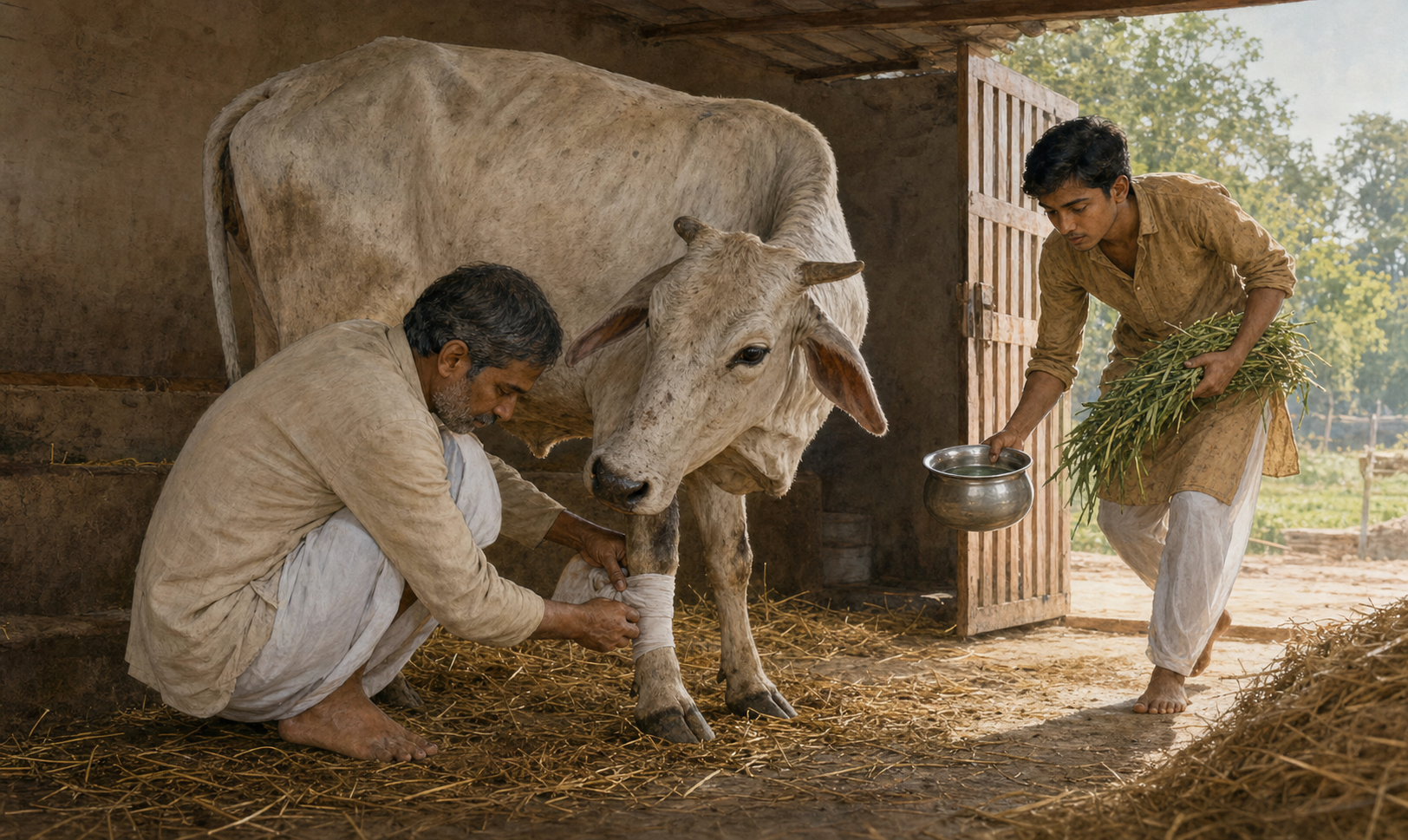
The cow-service article presents the designation go-mata, or mother cow, as an ethical claim grounded in nourishment, agricultural cooperation and gratitude. Receiving milk or labor creates an obligation toward the living being who provides it. The article therefore rejects any interpretation in which maternal language celebrates human benefit while ignoring the cow’s biological needs, her calf’s prior claim to nourishment or her welfare after production declines.
The study of King Uttanapada and Dhruva Maharaja examines the same relationship between dependence and duty in a different setting. As reported there, five-year-old Dhruva is publicly denied his father’s lap after Queen Suruci declares that he lacks the necessary claim to it. The article interprets the lap as a place of affection, social recognition and dynastic legitimacy. Suruci speaks the rejection, but the king’s silence gives it force because he possesses both parental and royal authority.
An animal receiving human-managed food, shelter and breeding is not ethically identical to a child dependent on a parent. Yet the cases illuminate a common Vaishnava principle: greater vulnerability generates greater responsibility for the person with power. Dependence cannot be used first to obtain service or obedience and then invoked to justify neglect.
Reverence is tested by the quality of care
The cow-service source distinguishes three related duties: go-seva, daily service; go-puja, worship and gratitude; and go-raksya, enduring protection. Its central insight is that none is sufficient alone. Ceremony can coexist with poor husbandry, temporary service can end when an animal loses economic value, and protection from killing can still leave an animal living with preventable hunger, disease or pain.
The source consequently translates devotion into observable responsibilities. It identifies clean water, appropriate forage, safe resting space, protection from dangerous weather, social contact and timely veterinary attention among the elements of care. It also recommends attention to outcomes such as body condition, lameness, wounds, hoof health, disease and avoidance behavior. Individual recognition matters because a caretaker familiar with an animal’s ordinary movement, appetite and temperament is better placed to notice distress.
Calf and ox care reveal whether this ethic is genuinely relational. According to the article, newborn calves require colostrum, nutrition, cleanliness and health monitoring, while male calves and other animals with little commercial value cannot be treated as disposable consequences of milk production. Working oxen likewise require patient training, properly fitted equipment and workloads suited to their condition. The principle is lifelong responsibility rather than selective protection of whichever animal currently provides a benefit.
The same source also separates devotional valuation from universal medical prescription. It reports the traditional Vaishnava esteem for milk while acknowledging lactose intolerance, allergy, cultural practice and ethical concern. Milk is not presented as necessary for every nutritionally adequate diet, and devotion is not measured by a person’s capacity to consume it. This qualification exemplifies care itself: a religious ideal should not erase bodily difference or become a reason to judge people whose circumstances differ.
Authority carries a duty to intervene

The Dhruva study makes omission central to moral responsibility. Uttanapada does not pronounce Suruci’s harsh judgment, but he fails to protect Dhruva from it. Because he is father, husband and king, his passivity is not neutral. The account therefore broadens wrongdoing beyond direct aggression: a person entrusted with authority may also cause harm by allowing favoritism or cruelty to govern a shared institution.
The cow-service article reaches a parallel conclusion at the level of farms and sanctuaries. Affectionate intention cannot substitute for resources, knowledge, records and competent management. A community that assumes responsibility for dependent animals also assumes responsibility for feeding during unproductive years, treating illness and preventing abandonment. Protection must be designed into the institution rather than left to occasional sentiment.
Together, the sources suggest that Vaishnava care has both intimate and structural dimensions. The intimate dimension sees a particular child, cow, calf or ox as a subject rather than a category. The structural dimension asks whether household rules, agricultural arrangements and community budgets protect that subject when affection is strained by cost, status or inconvenience. Care becomes durable when the system supports the moral promise expressed by the relationship.
Moral repair requires truth and discipline

In the Dhruva study, Uttanapada eventually identifies attachment and hardheartedness as causes of his neglect. His fear for Dhruva then takes the form reported in Srimad-Bhagavatam 4.8.66: he imagines the exhausted and hungry child lying unprotected in the forest and threatened by wolves. The article carefully notes that this is the father’s feared image, not evidence that such an attack occurred. Its ethical importance lies in conscience: the king finally imagines the vulnerability that his earlier silence refused to confront.
The other figures in the narrative show that repair involves more than regret. The source reports that Suniti recognizes her son’s injury but discourages retaliation, redirecting him toward the Supreme without pretending that no injustice occurred. Narada Muni likewise does not endorse Dhruva’s wounded ambition, yet he works with the child’s actual state of mind. He provides a disciplined path involving mantra, meditation, worship and regulated conduct rather than demanding an insincere performance of detachment.
This sequence supplies a useful model for responsibility: name the failure without euphemism, acknowledge the injured party’s experience, prevent pain from reproducing itself as further harm, and adopt practices capable of changing conduct. Spiritual guidance does not retroactively excuse Uttanapada’s neglect, just as worship does not compensate for deficient animal care. Bhakti transforms responsibility by disciplining it; it does not make responsibility unnecessary.
Key takeaways
- Sacred regard gains ethical content through attentive service, competent care and protection that continues after immediate benefit ends.
- Vulnerability strengthens the obligations of parents, rulers, caretakers and communities rather than diminishing the dependent being’s worth.
- Authority includes a duty to intervene; silence can sustain harm when the silent person has the power and responsibility to prevent it.
- Accountability begins with accurately naming failure and becomes credible through disciplined changes in conduct and institutions.
The continuing task for Vaishnava communities is to make devotional relationships institutionally dependable. Welfare practices, household conduct, leadership decisions and spiritual formation can then express the same promise: those placed within one’s care will be seen, protected and treated as more than instruments of another’s desire.
References
- DharmaRenaissance Blog — Why Cow Service Matters: Vedic Wisdom for Ethical Care and Lifelong Protection
- DharmaRenaissance Blog — From Parental Regret to Spiritual Wisdom: SB 4.8.66 with Bhrgupati Prabhu