

The Ram Temple donation controversy is not one dispute but a collision of three questions: what investigators reportedly found inside the offering-counting system, what political leaders have alleged beyond those findings, and what safeguards a nationally significant temple owes its devotees.
Keeping those questions separate makes the controversy easier to assess. It also reveals why arrests alone cannot restore confidence: the larger test is whether the system can account for offerings from collection to deposit and give donors verifiable answers without turning an unresolved investigation into a partisan verdict.
What the reported evidence establishes so far
DharmaRenaissance Blog reported that public scrutiny intensified in June 2026 after political figures questioned whether substantial donations could be accounted for. Former Samajwadi Party legislator Pawan Pandey reportedly alleged that approximately ₹7 crore to ₹7.5 crore had been stolen or embezzled. The Shri Ram Janmabhoomi Teerth Kshetra Trust initially rejected broad accusations and maintained that its transactions were recorded and periodically audited.
Those competing statements did not themselves determine whether money had been lost. The controversy acquired a firmer evidentiary basis only after the Uttar Pradesh government constituted a Special Investigation Team on June 13, reportedly at the trust’s request. According to the source’s account, the SIT examined witnesses, financial and personnel records, and available surveillance footage before submitting a preliminary report to the state government on June 23.
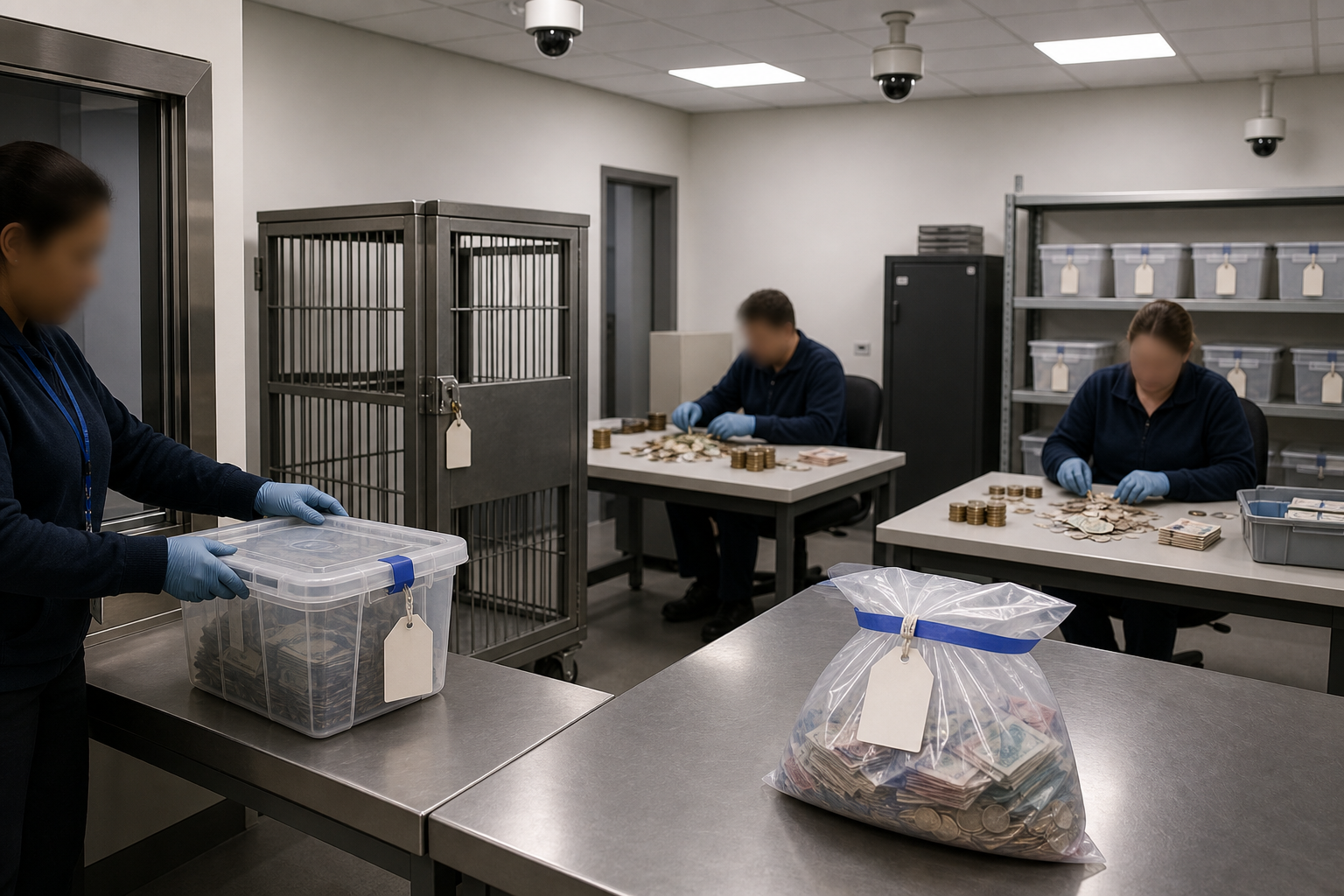
The preliminary findings, as reported, identified about 70 suspicious incidents in footage available from April 27 through June 5. Counting personnel were allegedly recorded concealing currency in clothing, pockets or footwear. Six personnel were reportedly identified through CCTV evidence, while the inquiry also found that frisking, supervision and other security requirements had not been applied consistently.
Ayodhya Police then registered an FIR on June 25 against eight named people and unidentified others, following a complaint from a trust member. The source reported that all eight named accused were subsequently arrested. The accusations concerned the alleged theft or misappropriation of cash and valuables, along with breach of trust, conspiracy and related conduct.
This establishes that investigators reportedly found grounds for a criminal case and identified apparent control failures. It does not establish the guilt of every accused person, the final value of any loss, or the destination of all money allegedly removed. An FIR initiates an investigation rather than deciding its outcome, and the accused retain the presumption of innocence unless guilt is proved through the judicial process.
Why the disputed amounts cannot be treated as one figure

Several numbers have circulated, but they describe claims made at different stages. Pandey’s reported allegation placed the amount at roughly ₹7 crore to ₹7.5 crore. Later reporting discussed in the source suggested that the accused may collectively have taken approximately ₹2 crore to ₹3 crore. The latter estimate reportedly emerged during the continuing investigation and was linked to statements and preliminary material, not a final judicial determination.
Neither range should therefore be presented as a settled loss. Political estimates, admissions or statements attributed to accused persons, visible incidents on CCTV and an audited shortfall are different forms of evidence. They may eventually intersect, but they are not interchangeable.
A defensible figure would require a transaction-level reconciliation: collections removed from hundis, amounts recorded at counting tables, cash deposited with banks, valuables entered in registers, donor acknowledgements and any recoveries made during the investigation would have to be matched. That exercise must also distinguish suspected theft from counting errors, recording gaps and contributions whose form or custody makes ordinary bank reconciliation insufficient.
The political charge extends beyond the investigation

Uddhav Thackeray turned the accounting controversy into a wider argument about political responsibility. DharmaRenaissance Blog reported that, at a July 3 press conference, he alleged that money taken from the temple might have been used to destabilise opposition parties and engineer defections. He also announced a statewide campaign called the Ram Raksha Andolan.
On July 5, Shiv Sena (UBT) leaders and supporters reportedly gathered at a Hanuman temple in Dadar for a programme that included devotional recitations and a maha aarti. The choice of setting reframed demands for financial accountability as a defence of devotees and their offerings, while allowing Thackeray to challenge the BJP’s claim to political stewardship of the Ram Temple movement.
The timing also supplied an immediate political context. The source reported that six Shiv Sena (UBT) members of the Lok Sabha had joined the Eknath Shinde-led Shiv Sena and that Maharashtra Legislative Council member Sachin Ahir had also departed the UBT faction. These defections help explain Thackeray’s argument, but temporal proximity is not proof of a financial connection.
Nothing in the publicly described SIT material cited by the source established that the BJP received stolen donations, directed the alleged theft or used temple money to induce defections. Proving such a claim would require evidence connecting identifiable funds to political actors or transactions, such as traceable recoveries, financial records, communications or corroborated testimony. Until such evidence emerges, the alleged political use of the money remains a political accusation rather than an investigative finding.
A narrower donor-accounting question may be easier to resolve. Sanjay Raut reportedly said that the undivided Shiv Sena had donated a four-kilogram silver brick and that Thackeray had contributed ₹1 crore toward construction, while alleging that satisfactory acknowledgement or information had not been provided. The claim does not by itself prove misappropriation. It does, however, illustrate why major cash and non-cash contributions need receipts, register entries, custody records and a documented account of their eventual use.
The governance failure is larger than individual misconduct

If the reported footage and preliminary findings are borne out, the central governance problem is not merely that individuals found an opportunity to steal. It is that basic safeguards allegedly failed often enough for suspicious conduct to recur. Frisking that is prescribed but inconsistently performed, surveillance that records misconduct without preventing it, and supervision that cannot promptly explain discrepancies are signs of a control system that exists formally but does not operate reliably.
A credible reform programme would establish an unbroken chain of custody from opening a donation receptacle to depositing the counted funds. No single person or team should control collection, counting, recording and deposit. Dual custody, rotating personnel, complete camera coverage, logged access to counting areas, independent review of exceptions and daily reconciliation would make concealment harder and discrepancies easier to detect.
Valuables require a parallel system rather than being treated as an extension of cash handling. Each item should be described, weighed where appropriate, entered in a controlled register, acknowledged to an identifiable donor when possible, and tracked through storage, conversion or use. Periodic audits are valuable only when their scope covers these operational records and when reported totals can be tested against source documents and bank confirmations.
Public disclosure must balance transparency with the integrity of the criminal case. The trust need not publish sensitive evidence or prejudge the accused, but it can disclose the period under review, the categories of records reconciled, the control failures confirmed, the remedial measures adopted and the status of donor-verification requests. Such reporting would allow accountability to progress even while the final criminal and financial findings remain pending.
Political responses have so far pointed in different directions. Maharashtra Chief Minister Devendra Fadnavis reportedly answered Thackeray by questioning his political credibility. Uttar Pradesh Chief Minister Yogi Adityanath said that guilty persons would not be spared while cautioning against treating allegations as proved before the investigation concluded. The Vishva Hindu Parishad and Rashtriya Swayamsevak Sangh also reportedly called for a thorough investigation and punishment of anyone found guilty. These positions acknowledge the seriousness of the matter, but public confidence will ultimately depend on documented controls and findings rather than rhetorical exchanges.
Key takeaways
- The supplied reporting describes prima facie evidence of repeated suspected pilferage and failures in security and supervision.
- The FIR and arrests signify an active criminal case, not a judicial finding of guilt.
- The reported estimates of ₹7 crore to ₹7.5 crore and ₹2 crore to ₹3 crore come from different claims and stages; neither is presented as a conclusively reconciled loss.
- No publicly described SIT evidence in the source connects allegedly stolen donations to the BJP or to political defections.
- Restoring trust requires a verifiable chain of custody, independent reconciliation, donor-level records and measured public disclosure.
The next meaningful development should be more than another allegation or arrest. A completed financial reconciliation, a legally tested account of responsibility and a published programme of operational reform would show whether the institutions responsible for the temple can convert a crisis of confidence into durable accountability.