
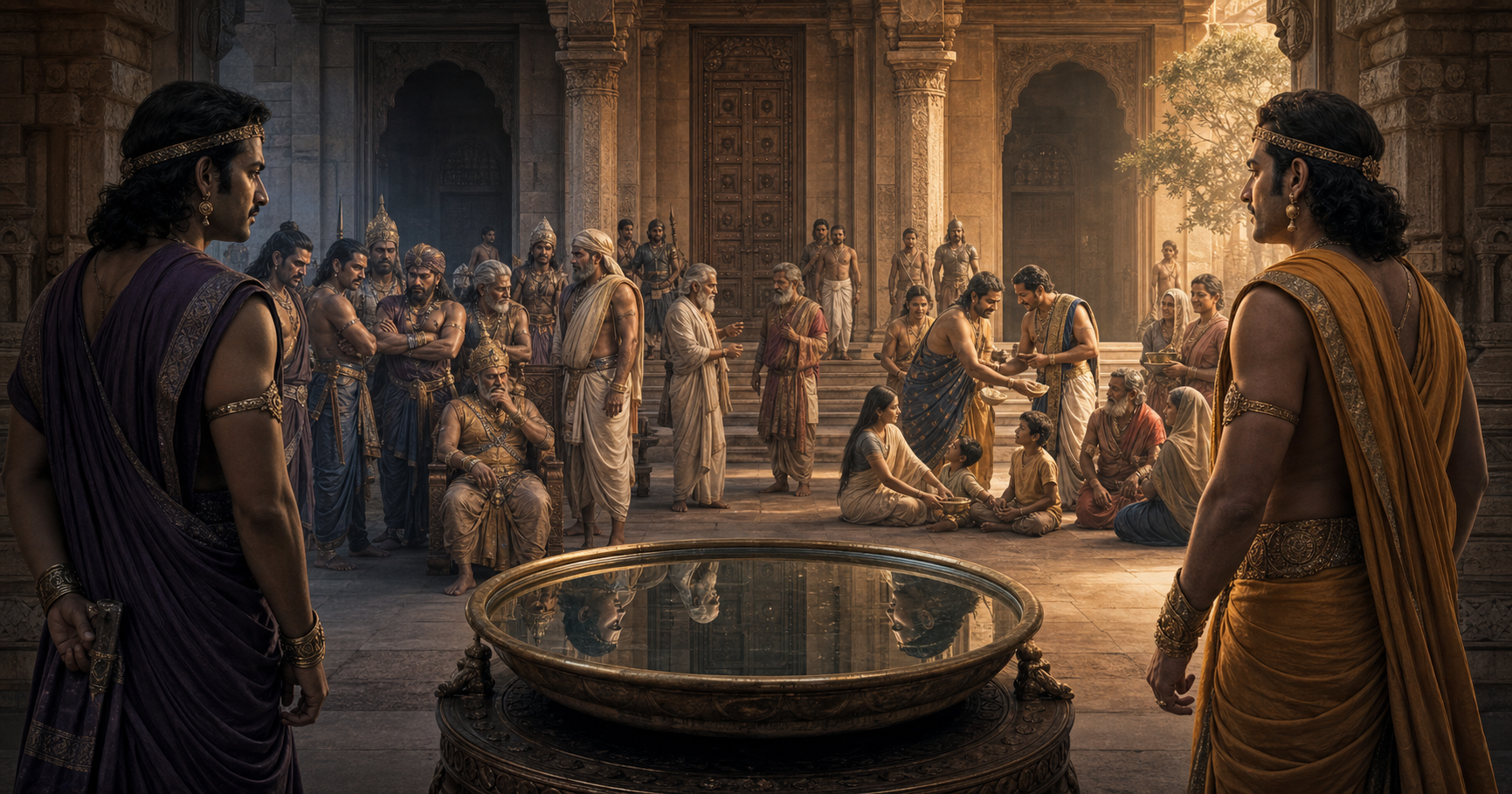
Moral perception is not merely the ability to recognize good and evil. It also involves deciding which facts matter, how much can be inferred from them, and whether a person’s worst fault or finest act should define the whole person. A widely circulated folktale associated with the Mahabharata makes this problem vivid through the opposed judgments of Duryodhana and Yudhishthira.
The tale does not suggest that conduct is created by the observer or that wrongdoing becomes harmless when interpreted generously. Its sharper insight is that judgment joins evidence to disposition: people notice real features of the world, but their expectations influence which features become decisive.
One human world produces two moral verdicts
The DharmaRenaissance account identifies the story as a teaching folktale rather than a verbatim Mahabharata episode with one universally accepted chapter reference. It also notes that retellings differ over who assigns the central task. In the version it presents, Krishna asks Duryodhana to find one genuinely good person and asks Yudhishthira to find one wholly bad person.
Duryodhana returns without a candidate. According to the account, he can redescribe generosity as a search for recognition, discipline as pride, courtesy as strategy, and devotion as display. He is not necessarily inventing every defect. His deeper mistake is to treat the presence of a mixed motive or imperfection as sufficient proof that goodness itself is fraudulent.
Yudhishthira also returns without fulfilling his assignment, but for the opposite reason. The article portrays him as recognizing cruelty, greed, dishonesty, and negligence while continuing to notice loyalty, affection, courage, remorse, service, or the possibility of reform. A wrongful act remains wrongful, yet it does not automatically become a complete account of the person who committed it.
The contrast therefore concerns more than optimism and pessimism. Each search begins with a different threshold for moral classification. Duryodhana asks whether any flaw can disqualify a person from goodness. Yudhishthira asks whether any morally significant good survives despite the person’s faults. Because the tests are asymmetrical, the same complicated humanity yields opposite verdicts.
Attention becomes part of moral character
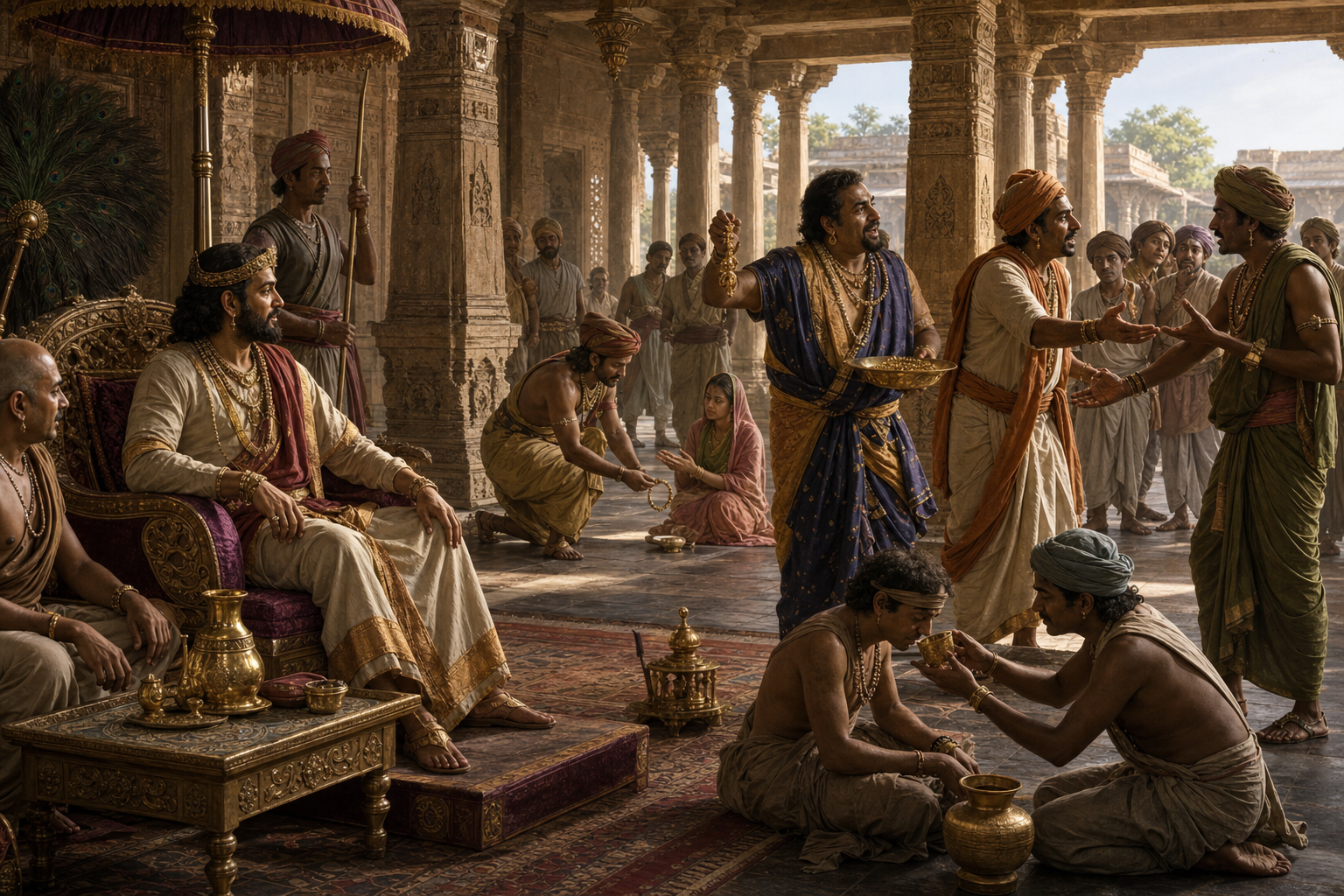
The kingdom in the story functions as a mirror, but not because external reality disappears. Rather, the observers reveal themselves through the evidence they prioritize. Duryodhana’s gaze searches for contamination; Yudhishthira’s searches for what has not been extinguished. Moral perception is thus shown as a cultivated habit of attention rather than a passive recording of facts.
The source compares Duryodhana’s reasoning to confirmation bias. Once he assumes that virtue conceals self-interest, an apparently generous action cannot count against his theory: it is simply reclassified as ambition in disguise. This makes his belief resistant to correction. Every counterexample becomes further confirmation, so experience can no longer teach him anything he did not already expect.
The account also connects his judgment to the horn effect, in which one negative trait colors an evaluation of the entire person. In ordinary moral reasoning, this occurs when a genuine fault becomes an all-purpose explanation. After a person has been labeled arrogant, disloyal, or dishonest, even neutral or admirable behavior may be interpreted through that label.
Yudhishthira embodies a different discipline. His charitable interpretation does not require inventing innocent motives or overlooking harm. It requires refusing to turn partial knowledge into total knowledge. An observer may know that an act was cruel without knowing every pressure, attachment, history, or future possibility within the actor. This restraint is an expression of intellectual humility, not moral indifference.
The danger in demanding purity before recognizing virtue

Duryodhana’s standard initially resembles moral rigor: a supposedly good person should be free of selfishness, vanity, conflict, and weakness. Yet such a standard can dissolve the very category it claims to defend. If only unmixed motives count, ordinary human goodness becomes impossible to acknowledge.
This perfectionism also offers psychological shelter. The source argues that refusing to admire another person’s goodness can protect pride. Admiration carries a demand: it reveals a quality worthy of cultivation and therefore exposes a possible deficiency in the observer. If every virtue can be dismissed as hypocrisy, no comparison need disturb the existing self-image.
That insight distinguishes moral discernment from cynicism. Discernment identifies deception, mixed motives, and harmful consequences so that judgment can become more accurate. Cynicism uses the possibility of hidden motives to make goodness unrecognizable in advance. The first remains open to evidence; the second arranges evidence so that its conclusion cannot fail.
Yudhishthira’s position has its own potential danger if detached from accountability. Searching for a remnant of goodness must not become an excuse to minimize injury, abandon proportionate consequences, or place others at risk. The most defensible lesson is therefore not that everyone should be trusted. It is that decisions about conduct, protection, and responsibility should not be confused with claims to possess exhaustive knowledge of a human being.
From labeling people to evaluating conduct
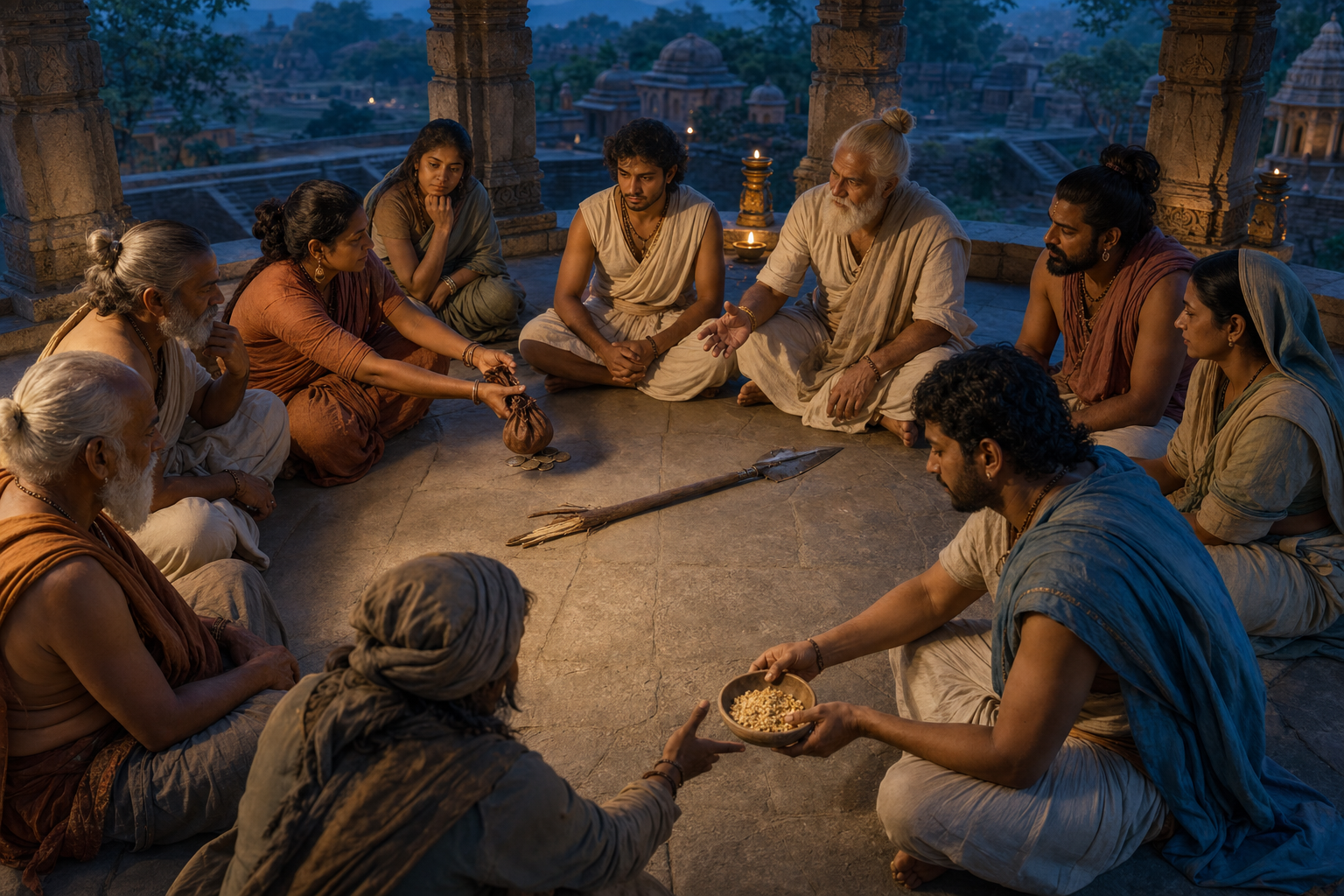
The folktale supports a practical distinction between judging an action and defining an identity. Actions can be evaluated with clarity: a promise was broken, a person was harmed, or a duty was neglected. Identity judgments go further by claiming that the observed act reveals what someone wholly and permanently is. The first kind of judgment is often necessary; the second requires far more knowledge than an observer usually has.
It also encourages attention to the standard being applied. A fair assessment should ask whether imperfection is being treated as disqualification only when evaluating opponents, while comparable flaws are treated as understandable when found among allies. This question does not determine whether an accusation is true, but it can expose an inconsistent threshold of proof.
A further test concerns falsifiability: what evidence could change the judgment? If every generous act is interpreted as manipulation and every apology as strategy, the assessment may have become closed to correction. Conversely, if every harmful act is explained away by context or hidden goodness, charitable interpretation may have deteriorated into denial. Moral perception needs both openness to exculpating evidence and readiness to name demonstrated harm.
The contrast between Duryodhana and Yudhishthira therefore offers neither sentimental optimism nor indiscriminate suspicion. It proposes a demanding middle discipline: see conduct accurately, infer motives cautiously, apply standards consistently, preserve accountability, and leave room for moral development.
Key takeaways
- The story is best treated as a widely circulated Mahabharata folktale whose retellings vary, not as a verbatim episode with one settled chapter citation.
- Duryodhana and Yudhishthira reach opposite conclusions because they apply different moral thresholds to the same complex humanity.
- Suspicion becomes self-sealing when every apparent virtue is automatically reinterpreted as concealed vice.
- Charitable judgment acknowledges complexity and incomplete knowledge without denying harmful conduct or suspending accountability.
- A sound moral assessment distinguishes evidence about an action from a total and permanent verdict about the actor.
The continuing challenge is to cultivate a form of attention that can recognize goodness without becoming naive and confront wrongdoing without reducing a person to it. In that discipline, moral perception becomes part of the work of dharma itself.