

Shakta Tantra is radical not because it celebrates disorder, but because it questions the assumption that ordinary identity is the final measure of existence. Its disciplines place desire, fear, embodiment, change and mortality within a sacred field governed by Shakti, the dynamic power through which reality manifests.
Read carefully, this is neither a program of self-destruction nor permission to indulge every impulse. The central challenge is to distinguish the functional person, who remains capable of memory, agency and responsibility, from the contracted identity that treats its temporary boundaries as absolute.
Why this liberation is genuinely radical

The radical element of Shakta Tantra is primarily experiential and metaphysical. The DharmaRenaissance source presents Shakti not merely as one divine figure among others, but as the power active in perception, thought, speech, desire, concealment and spiritual awakening. Even limitation is understood as a constrained expression of that power rather than something wholly outside the sacred.
This understanding changes what it means for the self to be consumed. What falls away is not necessarily personality itself, but its claim to possess an independent and permanent essence. Narratives of ownership, status and control continue to arise, yet they no longer have to define the full extent of identity. Liberation becomes release from compulsory identification rather than erasure of the human being.
Such freedom is more demanding than adopting a dramatic spiritual persona. It asks whether achievement, injury, pleasure, grief or bodily change can be experienced without becoming an absolute verdict on who someone is. In that sense, the fierce path operates within ordinary consciousness before it appears in any extraordinary ritual setting.
A family of traditions, not a uniform system
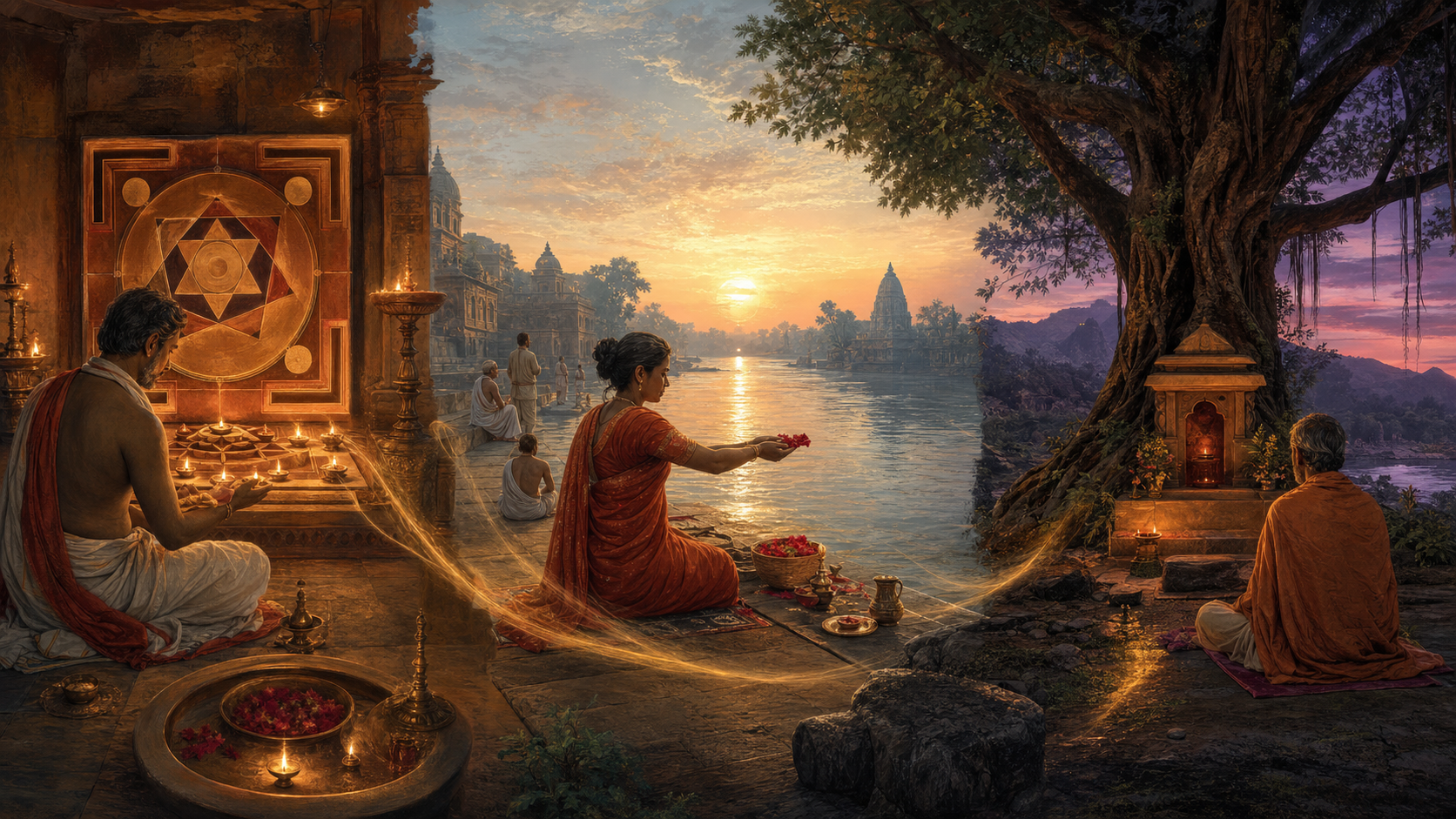
The source situates Shakta Tantra within a varied religious landscape that includes Sri Vidya, Kaula, Krama, Kali-oriented paths, regional Goddess traditions and Shaiva-Shakta systems. These do not share one theology or ritual program. Some preserve a meaningful distinction between devotee and Goddess; others interpret consciousness and power nondually, with the practitioner understood as Shakti appearing in a limited form.
The article traces distinctively Tantric Shakta traditions through developments in the first millennium CE while also noting older Goddess currents in Indian literature, local worship and the Devi Mahatmya. It describes their growth through scriptures, temples, domestic observance, ascetic communities, royal support and oral transmission, alongside exchanges with Shaiva, Vaishnava, Buddhist and regional ritual worlds. This reported history cautions against searching for a single origin, founder or standardized doctrine.
The same caution applies to texts. The source names the Kularnava Tantra, Tripura Rahasya and Yogini Hridaya as works belonging to different settings rather than interchangeable instruction books. Tantric writings may assume initiation, ritual competence and guidance from a qualified teacher; apparently simple passages can carry technical meanings connected with mantra, visualization, subtle anatomy or ritual sequence. Reading isolated verses as self-sufficient commands can therefore distort their purpose.
Embodiment without either rejection or indulgence
If Shakti operates through the cosmos, the body and mind cannot be dismissed as merely profane obstacles. The source accordingly describes the body as a possible field of disclosure, speech as a vehicle for mantra and mind as both the location of bondage and a means of understanding it. The world is approached as manifestation, although harmful conduct and attachment do not become sacred simply by being renamed.
This balance clarifies the reported Tantric pairing of bhukti and mukti: participation in embodied life and liberation need not be absolute opposites. The principle does not amount to unrestricted pleasure. It suggests that experience can be integrated into disciplined practice instead of being condemned in advance. Temple worship, domestic puja, devotional recitation, pilgrimage, mantra, visualization and meditation all belong to the broader ecology described by the source, making sensational transgression an inadequate definition of Tantra.
Practice can initially disclose bondage rather than produce serenity. Mantra may expose distraction, ritual may reveal impatience and devotion may bring submerged grief into awareness. The source treats such experiences as possible encounters with attachment, while explicitly warning against romanticizing severe distress, dissociation or instability as realization. Transformation requires discernment, not a willingness to label every destabilizing event as spiritual progress.
The ideal of jivanmukti, liberation while living, brings these strands together. Freedom is expressed through a changed relationship to experience within a consequential world, not only through an imagined escape after death. Craving and aversion may still appear, but contracted identity ceases to hold unquestioned authority over action.
Kali turns impermanence into spiritual instruction
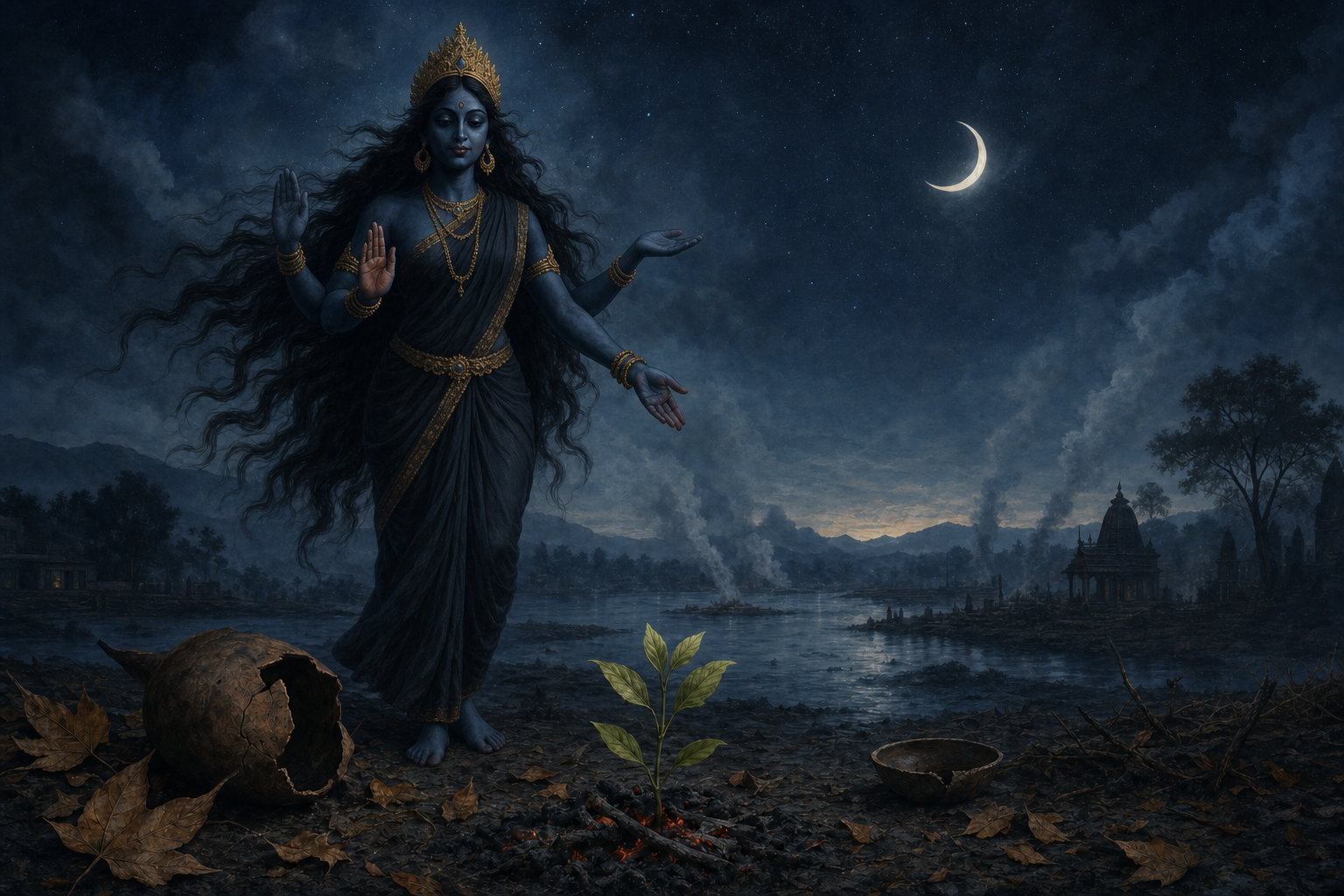
Kali condenses the path’s confrontation with what ordinary identity tries to avoid. The source associates her name with blackness and notes its resonance with kala, time and death. Her dark form, weapons, garlands, unbound hair and cremation-ground setting bring mortality and dissolution into the field of contemplation rather than leaving them at the margins of religious life.
These images need not be read as a celebration of destruction for its own sake. Within the article’s larger argument, they expose the impossibility of securing a permanent identity from changing conditions. Kali’s devouring force can therefore be understood as the pressure of time on every possession, role and self-description that demands permanence.
The imagery is radical because it denies spirituality the shelter of selective attention. Beauty and terror, creation and dissolution, intimacy and loss all occur within Shakti’s domain. Liberation is not achieved by pretending that death has disappeared, but by loosening the conviction that mortality makes consciousness, embodiment or life devoid of sacred meaning.
Key takeaways for a careful reading
- Read the devoured self precisely: it is contracted identification, not the necessary destruction of personality or responsibility.
- Respect internal diversity: Shakta Tantra names multiple textual, devotional, ritual and philosophical lineages rather than one universal method.
- Avoid false oppositions: embodied life can become part of disciplined liberation without turning appetite into its own authority.
- Interpret fierce imagery contextually: Kali’s forms confront time, death and attachment; they are not self-explanatory endorsements of violence or chaos.
- Keep discernment central: emotional exposure may accompany practice, but psychological destabilization should not be mistaken for attainment.
Future engagement with Shakta Tantra is best grounded in historically informed reading, attention to lineage context and a clear distinction between transformative surrender and avoidable harm. That approach preserves the force of its challenge while resisting both sensationalism and easy domestication.