
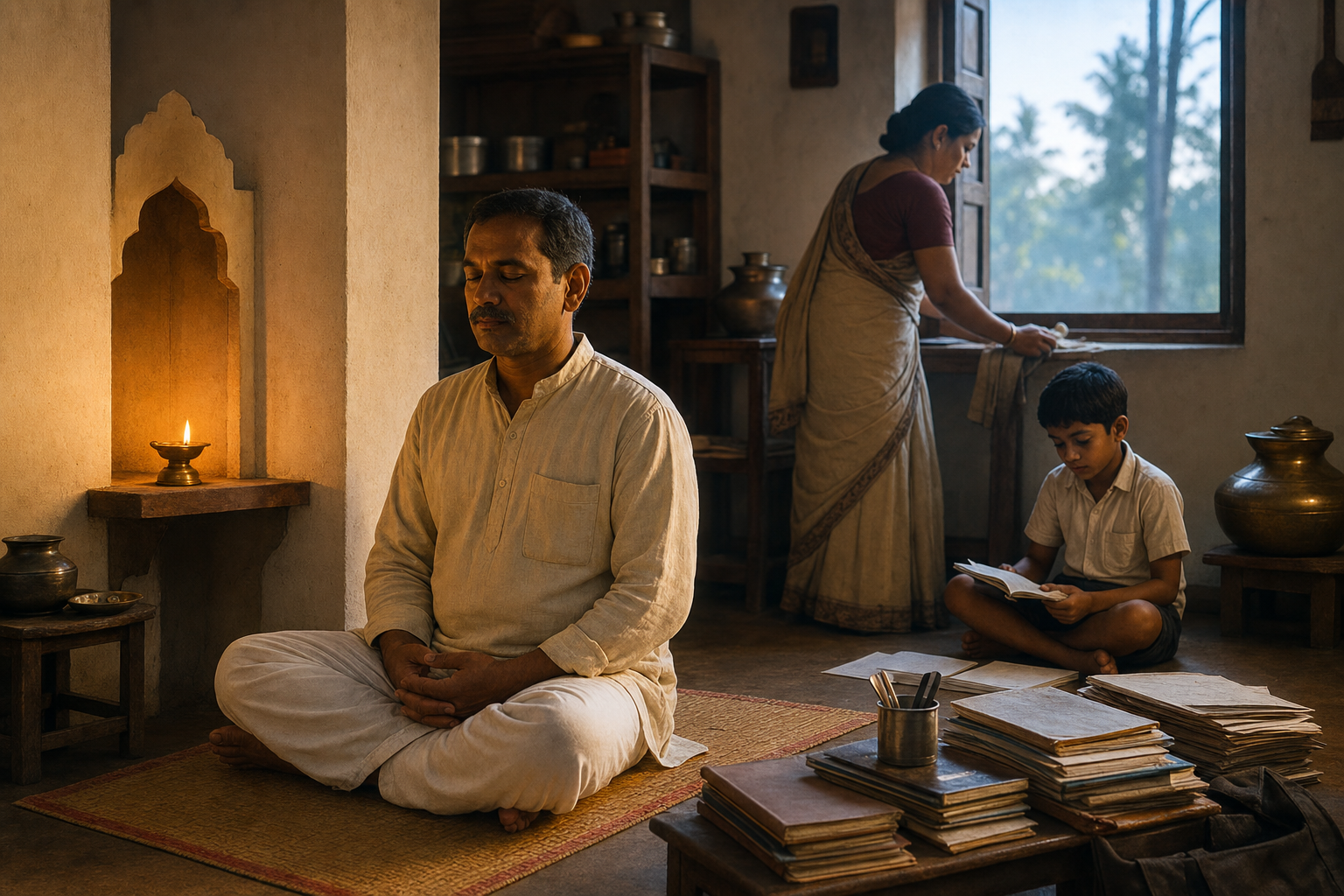
Sadguru Subrahmanyam’s life is significant because it places spiritual practice inside the pressures of marriage, parenthood, employment, bereavement and community life. The available account portrays neither a public renunciate nor the head of a large institution, but a schoolteacher and family man whose contemplative discipline matured alongside ordinary obligations.
Read carefully, his path offers two kinds of insight: a practical model for seekers who cannot withdraw from society, and a reminder that devotional testimony should be distinguished from independently established biography. Its central question is not whether domestic life is compatible with spirituality, but how domestic responsibilities themselves can become a field of sadhana.
A path that did not begin with withdrawal
The DharmaRenaissance profile reports that Subrahmanyam was born in Konathaneri in Andhra Pradesh’s Chittoor district to Sri Siddaiah and Smt. Vijayalakshmi. It describes a modest agricultural family shaped by devotion and disciplined living, while acknowledging that few details survive about his childhood or the stages of his early contemplative development.
According to the profile, he married Smt. Padmavati, affectionately known as Vayyamma, at nineteen. They had three sons, and he earned his livelihood as a schoolteacher. Meditation, reflection and association with saints took place outside his working hours rather than after an abandonment of work and family. This sequence matters: household responsibility was not a temporary distraction preceding his spiritual life; it was the environment in which that life unfolded.
The same account reports that, following his father’s death and a division of ancestral property, Subrahmanyam moved with his family to Srikalahasti in 1975. The town is traditionally associated with Vayu, the air principle, among the Pancha Bhoota Siva Kshetras. Its Shaiva setting supplied a religious context in which temple devotion, saintly lineages, household piety and renunciant ideals could meet, but the profile does not suggest that sacred geography replaced personal discipline.
His home reportedly became a place for informal spiritual conversation as visitors began seeking his company. This was influence through accessibility rather than institutional office. The portrait that emerges is of a retired teacher, father and local elder whose outward ordinariness remained intact even as devotees came to regard him as a jnani, or one established in knowledge of the Self. That last description belongs to devotional evaluation and should be identified as such.
Household duties as tests of inner steadiness
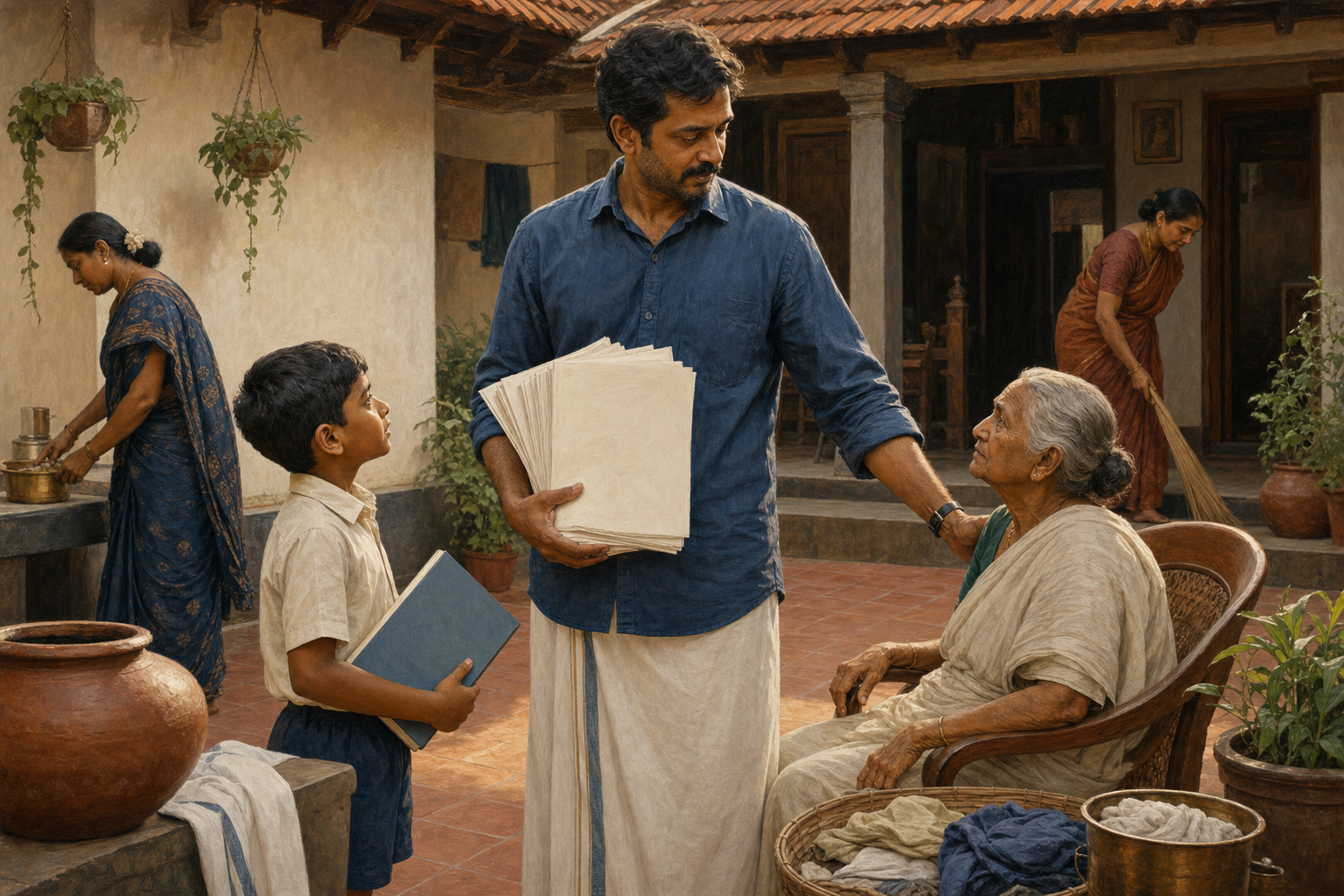
Sadhana commonly means sustained spiritual discipline. In a household setting, its tests are not confined to meditation sessions. Livelihood demands consistency; marriage exposes attachment and expectation; parenting requires patience; illness and loss reveal whether equanimity survives conditions that cannot be controlled. The profile interprets Subrahmanyam’s work, relationships and hardships through precisely this integrated lens.
The Bhagavad Gita’s image of the sthita-prajna, a person of steady wisdom, provides the account with a philosophical framework. Steadiness in this sense is not emotional coldness or refusal of responsibility. It denotes freedom from being continually governed by attraction, fear, pride and aversion. Subrahmanyam is remembered as continuing to address practical needs while avoiding self-dramatization and conspicuous spiritual display.
This makes household spirituality demanding rather than diluted. Detachment expressed in conversation remains theoretical until competing needs, criticism, fatigue or uncertainty disturb the mind. Domestic and professional life repeatedly disclose the gap between an admired ideal and an embodied disposition. In the profile’s reading, service becomes a test of compassion when it is inconvenient, obscurity tests humility when recognition is absent, and frustrated expectations test patience.
Subrahmanyam’s example therefore does not establish that family life automatically produces realization. Nor does it turn every routine activity into spiritual practice by declaration alone. It suggests a more exacting principle: ordinary duties become sadhana when they are met with attention, self-restraint, compassion and diminishing self-importance.
Guru-bhakti and Self-knowledge as a continuum
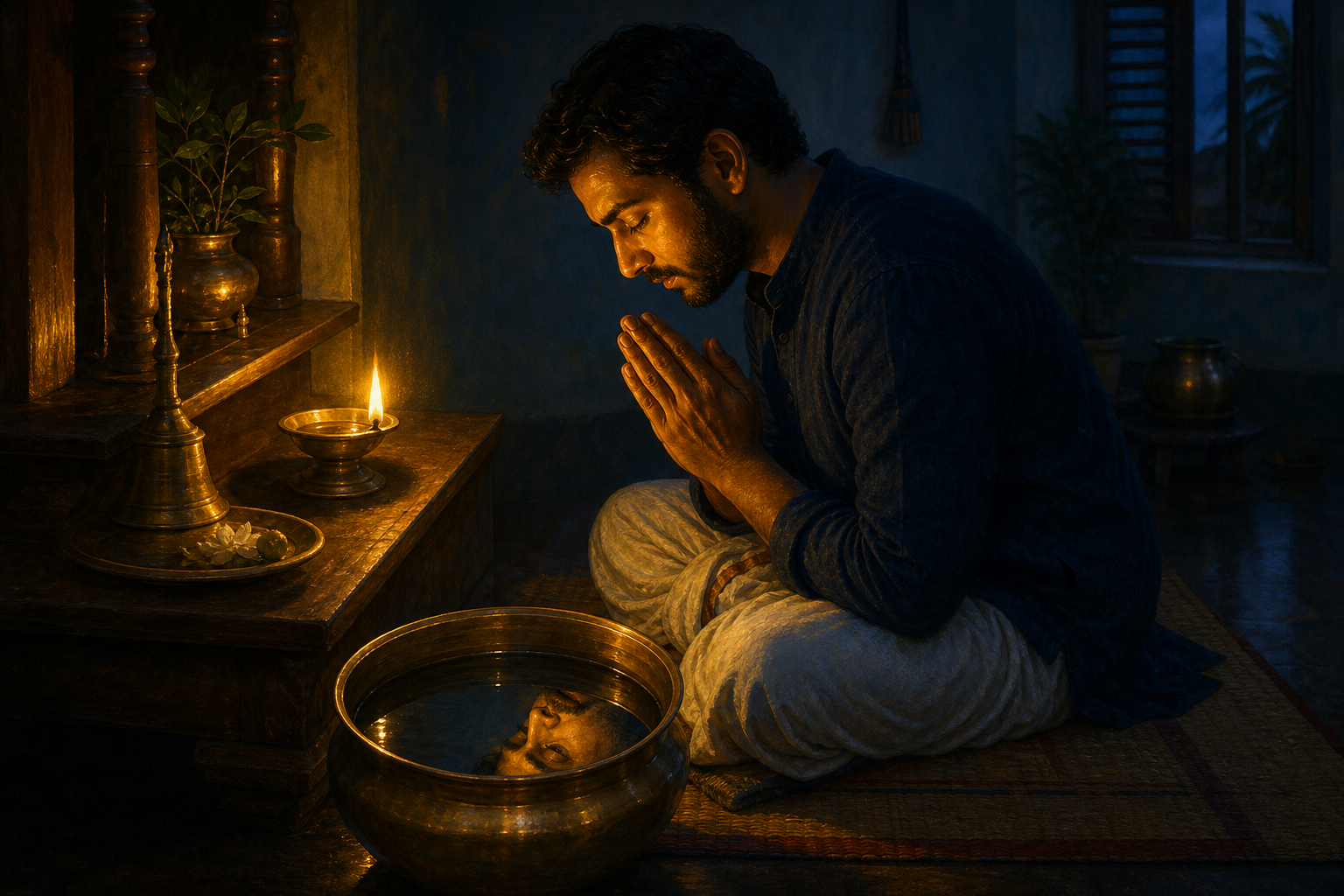
The biographical account places Guru-bhakti near the foundation of Subrahmanyam’s development. One important figure was Sri Veeraiah Garu, Padmavati’s brother. Although connected to Subrahmanyam through marriage, Veeraiah came to be understood within the family and devotional community as a spiritual guide rather than merely a relative.
The profile associates Veeraiah with Sambhu Guru Swamy and a regional lineage connected with Easwaramma, described there as a descendant of Siddha Pothuluri Veerabrahmendra Swamy. It also preserves accounts of visions, mantra initiation, healing, foreknowledge and an appearance of Sambhu Guru Swamy before skeptics. These episodes are not presented in the source as independently documented events. They belong to sacred biography, where a narrative may convey a community’s conviction that a Guru’s guidance is not limited by physical death.
One family narrative says that Veeraiah predicted the birth of Subrahmanyam’s first son and instructed that the child bear the Guru’s name; the son was reportedly named Sambhu Prasad. Whether received literally, symbolically or as a devotional memory, the episode shows how lineage, family and spiritual allegiance overlapped in this household.
The larger philosophical point is that bhakti and jnana are not portrayed as rival paths. In this account, devotion disciplines intention and weakens self-importance, while knowledge concerns recognition of the Self beyond the fluctuating ego. Guru-bhakti thus appears as preparation for insight rather than a lesser stage to be discarded. Subrahmanyam’s reported development joins reverence, meditation and non-dual understanding without requiring a rejection of family bonds.
Reading a quiet legacy without overstating the evidence

Most details in the available profile are attributed to disciples’ recollections and writings, particularly those of Sri T.V.N. Babu. That source base preserves memories and teachings that might otherwise disappear, but it also requires distinctions among chronology, remembered conduct, spiritual interpretation and miracle narrative. The reported marriage, teaching career and relocation belong to a different evidentiary category from claims about supernatural perception or a devotee’s recognition of realized status.
Such distinctions need not reduce sacred biography to either verified fact or falsehood. Hagiography communicates what a community believes sanctity looks like: humility rather than display, composure amid hardship, loyalty to the Guru and availability to seekers. A responsible reading can preserve that moral and theological meaning while declining to convert faith claims into independently corroborated history.
Silence and peaceful presence are especially difficult to document because their significance rests largely on the experience of those who encountered them. The profile reports that visitors felt unusual stillness around Subrahmanyam. The careful formulation is therefore not that such an effect has been objectively demonstrated, but that it became central to how devotees understood his influence.
This approach also keeps the practical teaching in view. The most accessible dimension of his legacy is not an extraordinary claim that others must accept. It is the observable pattern celebrated by the account: work undertaken without spiritual pretension, family obligations retained, contemplative practice sustained and guidance offered without constructing a conspicuous public identity.
Key takeaways
- Household spirituality treats work and relationships as conditions in which attention, patience and non-attachment are repeatedly tested.
- Inner steadiness does not require emotional withdrawal; it is expressed through responsible action without domination by every reaction.
- In Subrahmanyam’s reported path, Guru-bhakti, meditation and Self-knowledge form a continuum rather than competing spiritual programs.
- Devotional memories can carry genuine spiritual meaning while their extraordinary claims remain matters of faith rather than independently verified facts.
- His example is relevant to contemporary seekers because it locates disciplined practice within responsibilities that cannot simply be set aside.
The continuing value of this model will depend less on enlarging a saintly legend than on examining whether attention, humility and equanimity can be cultivated where modern seekers already stand: amid work, family and service to others.