
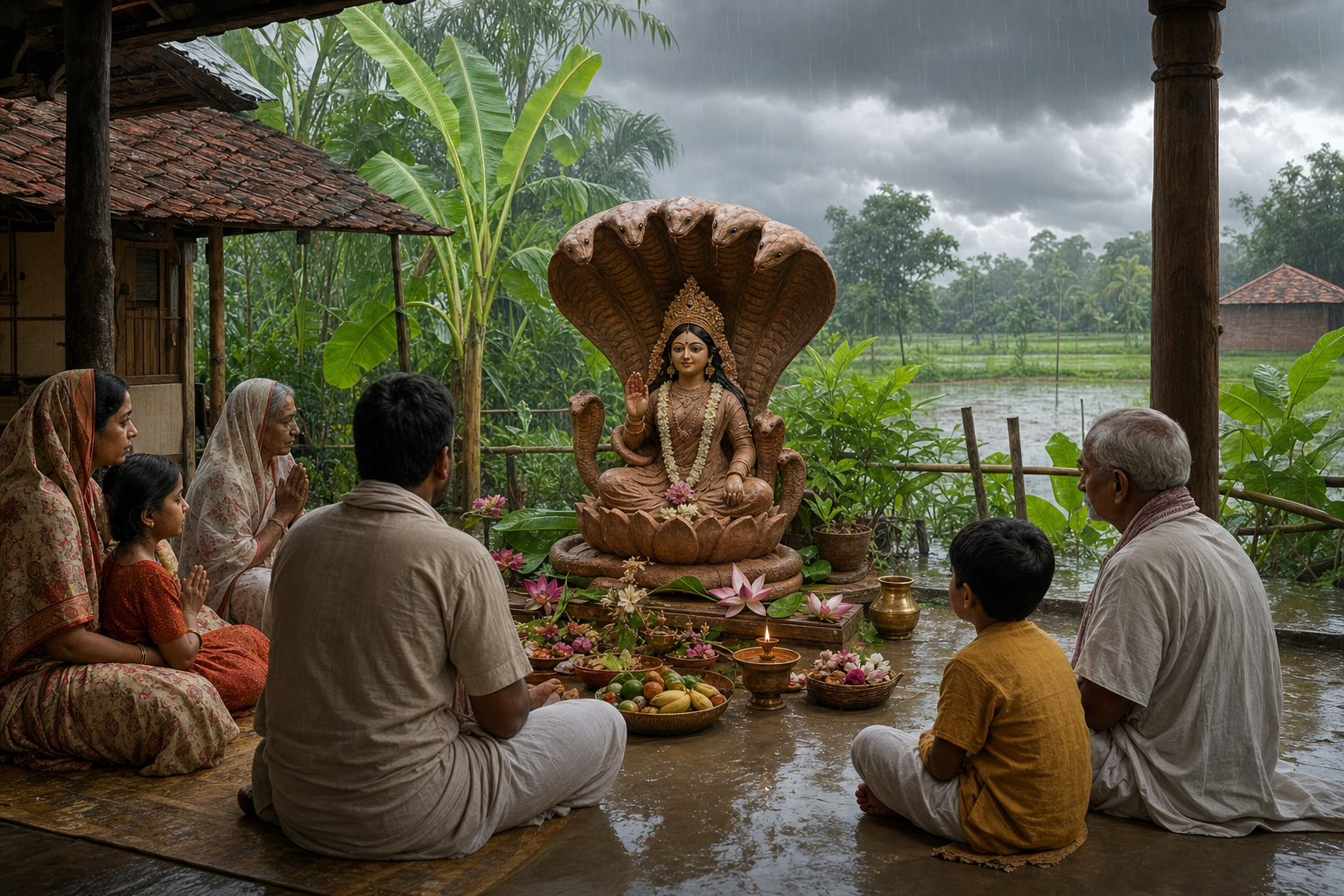
Manasa Devi worship is best understood not as a single festival on one fixed date, but as a monsoon tradition in which devotion, household security, agrarian experience and serpent life meet. The supplied DharmaRenaissance guide places its strongest expression in Bengal and Assam, while also noting related customs in Jharkhand and parts of Odisha and Bihar.
Seen through these connections, the tradition addresses three related concerns: living with seasonal danger, finding a place for regional deities within wider Hindu sacred worlds, and carrying community memory through calendars, household objects and stories.
Why the monsoon is part of the tradition’s meaning
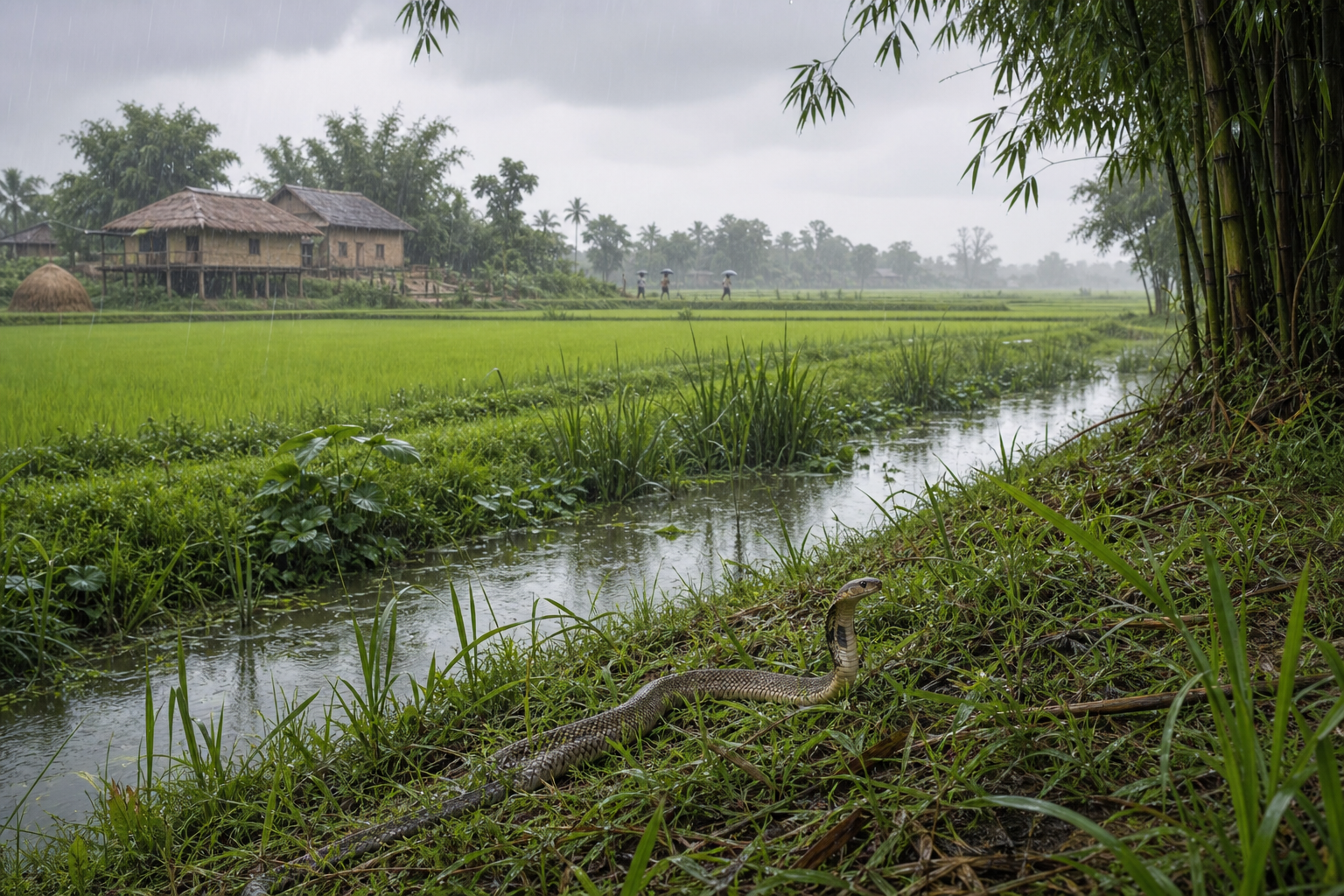
The source guide situates Manasa worship in Ashar, Shraban or Srabon, and Bhadro, months that correspond broadly to the rainy period from June into September. It reports that heavy rain fills ponds and irrigation channels, saturates fields and can displace snakes from underground shelters toward farms and homes. The monsoon therefore brings agricultural renewal and heightened risk into the same landscape.
This seasonal setting helps explain why serpent symbolism is not incidental decoration. According to the guide, snakes can threaten human life, but they also regulate rodents that consume stored grain and damage crops. Worship does not deny danger or turn a wild animal into something harmless. Instead, it gives ritual form to a disciplined relationship: protection is sought, fear is acknowledged and another species’ ecological place is respected.
The article reports that devotees approach Manasa Devi for protection from snakebite and snake-related fear, as well as for children’s health, family welfare, fertility, prosperity and recovery from illness. These are devotional hopes rather than medical predictions. Keeping that distinction clear allows the religious meaning of the observance to be presented without treating worship as a substitute for medical care.
The 2026 calendar reflects several local ritual cycles
The source article identifies 17 August and 16 September as the principal dates in its 2026 guide, while also recording four additional regional observances. Its schedule is best read as a map of overlapping practices rather than a universal festival calendar.
| Reported date | Place in the ritual cycle |
|---|---|
| Sunday, 5 July 2026 | An early regional observance listed by the guide |
| Saturday, 18 July 2026 | A date within the Ashar-season cycle followed by some communities |
| Monday, 3 August 2026 | Associated with another Panchami observance |
| Monday, 17 August 2026 | The principal Nag Panchami and Manasa-Ashtanag Puja date in several calendars |
| Wednesday, 2 September 2026 | A later-monsoon observance in some local calendars |
| Wednesday, 16 September 2026 | Connected with Ranna Puja or Arandhan before Vishwakarma Puja |
The guide explains that a community may worship on a selected Panchami tithi, a Sankranti, the opening or conclusion of a local ritual cycle, or a date inherited through family or village custom. Published calendars can differ by a day when a tithi begins or ends between two sunrises, and location can affect which civil date applies. A household arranging a formal puja should therefore confirm its date and ritual period through the relevant regional panjika, temple or family priest.
Ritual diversity preserves a common devotional grammar
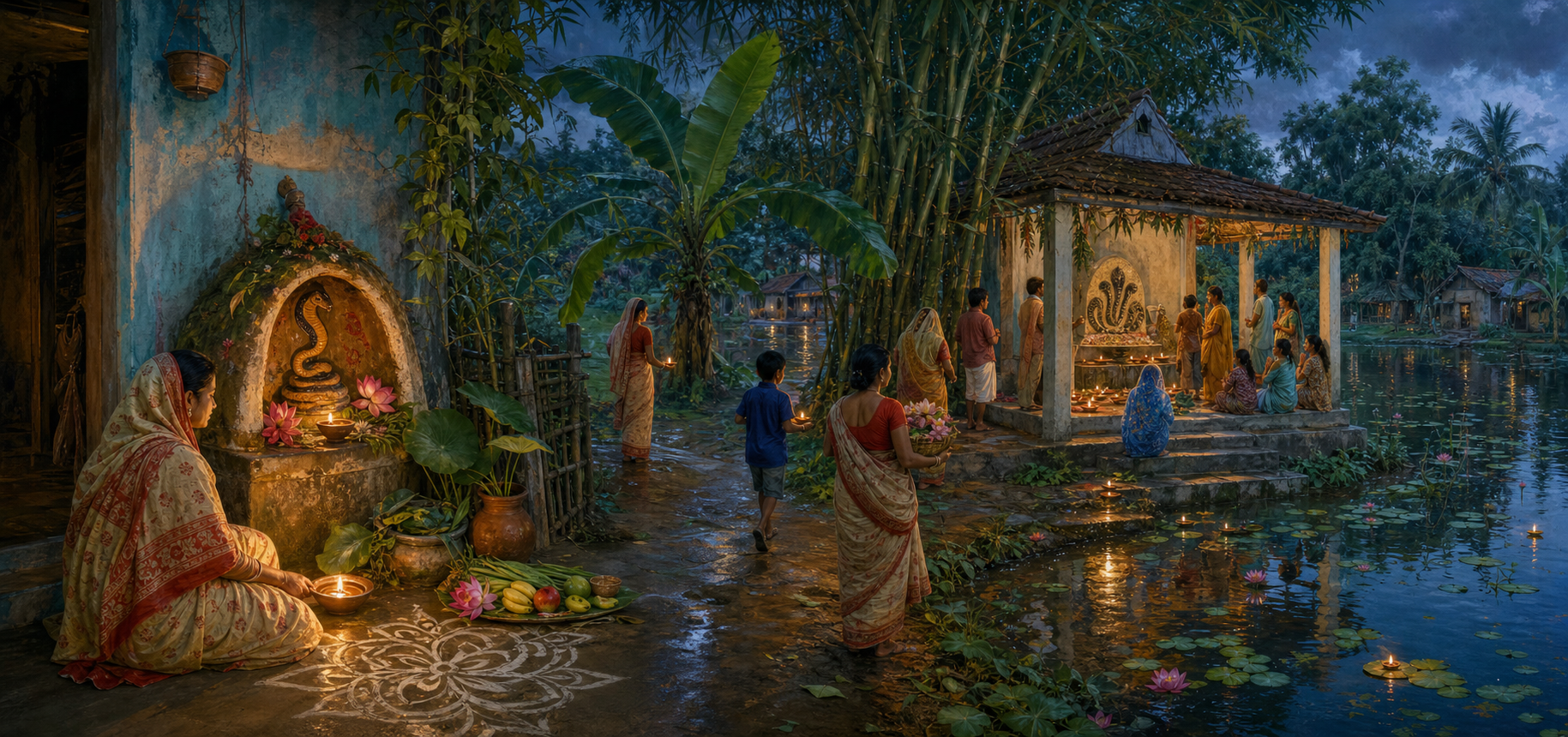
The material form of Manasa worship varies considerably. The guide describes images with a canopy of serpent hoods, a seated yogic form, or attributes such as a serpent, pot, fruit, rosary or manuscript; some representations include her son Astika. In Ashtanaga Manasa forms, eight serpent hoods are emphasized, although the article cautions that the names and arrangement of the eight nagas differ among regional traditions and ritual manuals.
A sculpted murti is not required in every setting. The source records worship through a decorated earthen ghat, a clay serpent, a sacred plant or branch, or another consecrated image. Its interpretation of the ghat is especially revealing: water, earth, household work and the craft of local potters are brought together in an object whose simplicity is part of its meaning. The sacred presence is placed within ordinary materials rather than separated from monsoon life.
The article also shows how elaborate and simple observances can share the same devotional core. A household may clean the worship area, place the chosen representation securely, and arrange a water-filled ghat, lamp, incense, flowers, fruit and rice. A sankalpa expresses devotional intention, while remembrance of Ganesha, the guru, family deities or associated naga deities may follow according to lineage. A priest-led rite may add purification, invocation, nyasa, upacharas and recitation; a simpler observance may centre on invocation, flowers, a lamp, naivedya and prayer.
Manasa Puja and Ashtanag Puja often appear together in the guide’s account, especially around Nag Panchami and household rites in Ashar and Shraban. This pairing broadens the focus from one goddess to the serpent realm collectively. Across different representations and degrees of ritual complexity, attentiveness, order and reverence provide continuity.
Manasamangal turns conflict into a question of recognition
The source does not force Manasa Devi into a single genealogy. It gathers traditions associating her with Kashyapa, Kadru and the naga lineage; describing her as Vasuki’s sister and Astika’s mother; or presenting her, in the Bengali Manasamangal tradition, as a daughter of Shiva. Their coexistence is significant because it preserves evidence of local serpent devotion entering Puranic and regional Shakta frameworks without losing its distinctive character.
Astika connects this tradition to the narrative world of the Mahabharata. As summarized by the guide, he stops King Janamejaya’s serpent sacrifice and preserves the surviving naga line. That association extends Manasa’s meaning beyond protection from serpents: it places restraint, reconciliation and the restoration of balance near the centre of her sacred world.
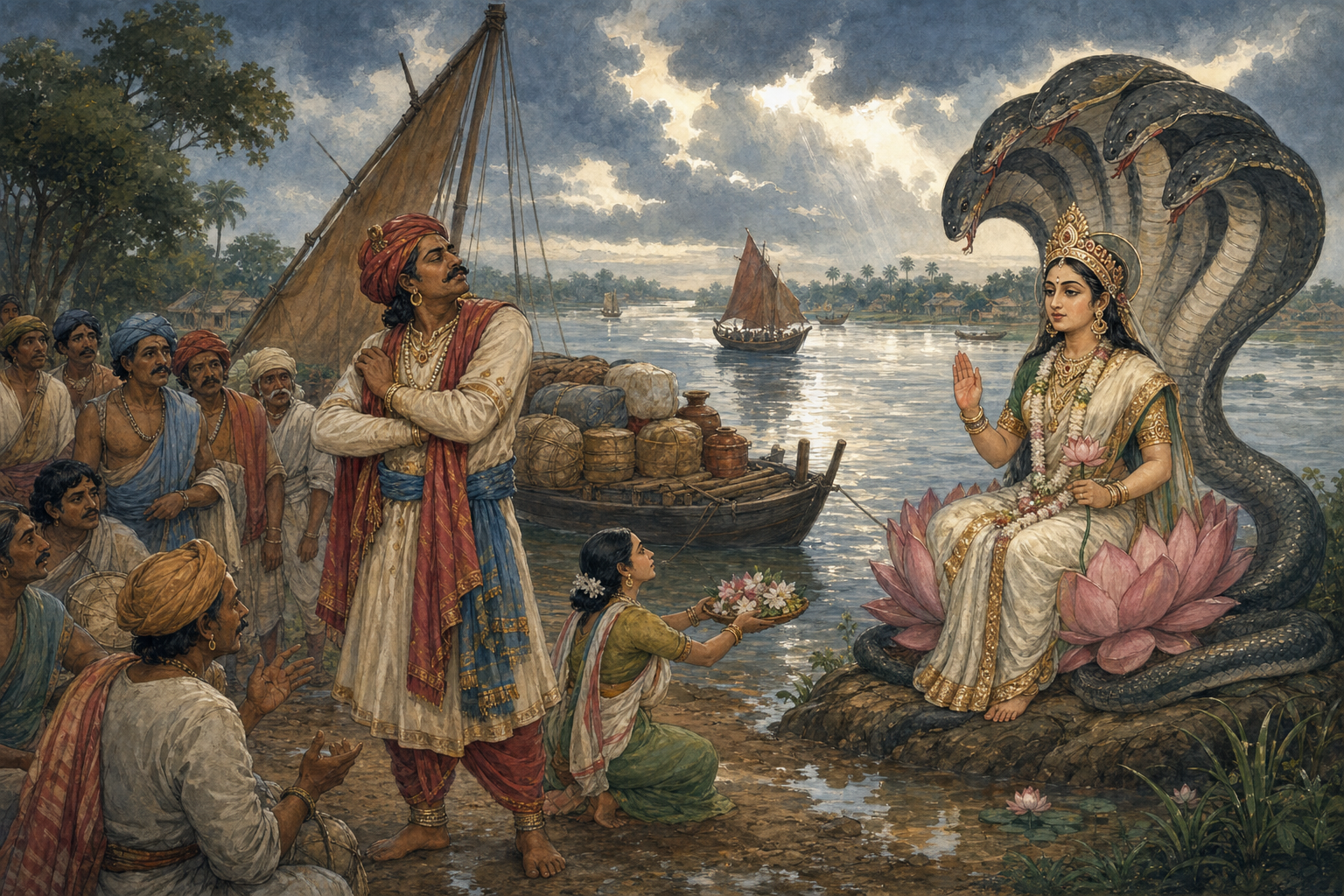
The medieval Manasamangal literature develops the same problem through the conflict between Manasa and Chand Sadagar, a prosperous merchant devoted to Shiva. The guide recounts Chand’s refusal to worship her, the ensuing loss of ships, prosperity and sons, and the death of Lakhindar from snakebite on his wedding night. Behula then travels with her husband’s body and endures suffering until Lakhindar, Chand’s other sons and the family’s fortunes are restored. Chand ultimately acknowledges Manasa.
Read alongside the monsoon setting and Astika’s intervention, this is more than a narrative of divine punishment. Chand represents established authority refusing recognition, Manasa seeks a legitimate sacred place, and Behula becomes the humane bridge through which a destructive struggle can end. The literary tradition therefore complements the ritual one: both ask how fear and rivalry may be transformed through acknowledgment, courage and negotiated balance.
How to approach a living regional tradition
Key takeaways
- Treat the puja date as a regional and family-calendar question, not as a single universal appointment.
- Read serpent symbolism within the monsoon environment that joins agricultural abundance, ecological interdependence and real danger.
- Recognize varied genealogies, images and ritual forms as evidence of a layered tradition rather than defects requiring standardization.
- Keep devotional claims distinct from medical claims while respecting why protection, health and household welfare remain central prayers.
As the reported 2026 observances approach, the tradition’s vitality will depend less on imposing one schedule or representation than on keeping family, village and language-based practices visible. Preserving that diversity alongside the festival’s ecological meaning can carry both devotion and monsoon memory forward.