
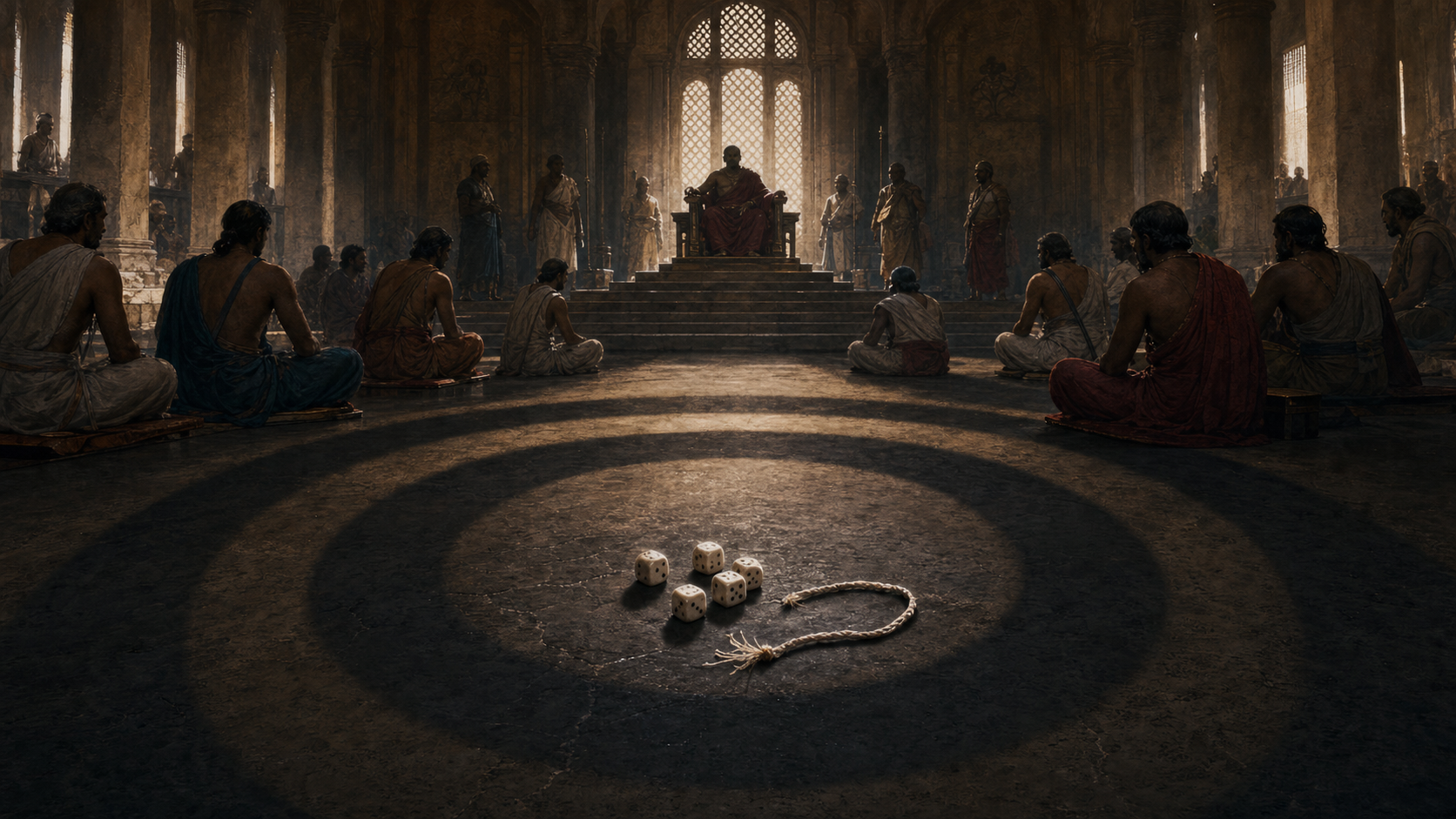
When dharma is treated as a fixed rulebook, moral failure can acquire the appearance of duty. The two source essays approach this danger from different directions: one examines the Mahabharata’s dice hall, where courtly procedure conceals escalating injury, while the other explains the traditional principle that benefiting others leads toward puṇya and afflicting them toward pāpa.
Read together, they offer a practical account of moral responsibility. Harm provides an essential test of conduct, but applying that test requires attention to intention, authority, consent, means, foreseeable consequences, and the responsibility to intervene when another person is being wronged.
Harm is a test of dharma, not a mechanical calculation
The ethical essay presents the subhāṣita associated with Vyāsa in which paropakāra, benefiting or serving others, is directed toward puṇya, while parapīḍana, injuring or oppressing others, is directed toward pāpa. Its importance lies in the way it tests religious conduct against lived effects. Status, learning, ritual display, or a virtuous self-image cannot compensate for exploitation, humiliation, or avoidable suffering.
This principle is broader than a prohibition on physical violence. As the source explains, harm may be verbal, emotional, economic, institutional, ecological, or informational. Benefit may include protecting life, sharing knowledge, defending dignity, relieving distress, and using ability for collective welfare. Dharma therefore concerns relationships and structures as well as isolated personal acts.
Yet harm cannot be identified merely by noticing that an action causes discomfort. The same source distinguishes affliction from such measures as necessary treatment, proportionate discipline, or truthful correction undertaken responsibly to prevent greater injury. It also warns that benevolent intentions can produce damage when knowledge is inadequate, consent is disregarded, or the recipient becomes dependent. Intention matters, but intention alone does not settle the moral question; method and reasonably foreseeable consequence matter as well.
The dice narrative makes this complexity concrete. Yudhishthira understands gambling to be dangerous, yet a formal summons, royal convention, family hierarchy, pride, personal vulnerability, and a belief in destiny all bear upon his decision. A rule about accepting a challenge appears to support participation, but the contest is designed for dispossession and threatens his family, subjects, and kingdom. One perceived obligation is allowed to eclipse the people and responsibilities that kingship is supposed to protect.
Pressure can explain a choice without erasing agency

The Mahabharata study resists two easy judgments. Yudhishthira is not portrayed as acting in complete freedom under fair conditions: Shakuni possesses superior skill, the invitation serves Duryodhana’s political purpose, and the court has already enabled the scheme. But Yudhishthira is also not treated as a passive object without responsibility. He recognizes the danger and continues as losses accumulate.
This combination is morally important. Coercive circumstances, manipulated conventions, and psychological vulnerability affect how responsibility should be assessed, but they do not necessarily remove agency. Conversely, acknowledging that a person made a consequential choice does not make every participant equally responsible. Ethical judgment must be capable of holding constraint and accountability together.
The source’s comparison between Yudhishthira and Nala reinforces the need for case-sensitive judgment. Both are virtuous kings who lose kingdoms through gambling, endure exile and separation, and eventually recover what was lost. Nevertheless, the Nala story is not presented as a duplicate case. Told to Yudhishthira during forest exile, it becomes consolation, warning, instruction, and a mirror for self-knowledge. Similar outcomes do not by themselves prove identical motives, circumstances, or degrees of responsibility.
The escalating wagers also show how earlier choices alter the conditions of later ones. Each loss creates pressure to recover through another throw until withdrawal seems less imaginable than continuation. That narrowing of judgment helps explain the movement from property and political power to the wagering of brothers, self, and finally Draupadi. Explanation, however, cannot convert persons into legitimate stakes. Once another person’s dignity and freedom are treated as transferable assets, the moral problem exceeds imprudence and becomes a direct assault on personhood.
The dice hall reveals a chain of unequal complicity
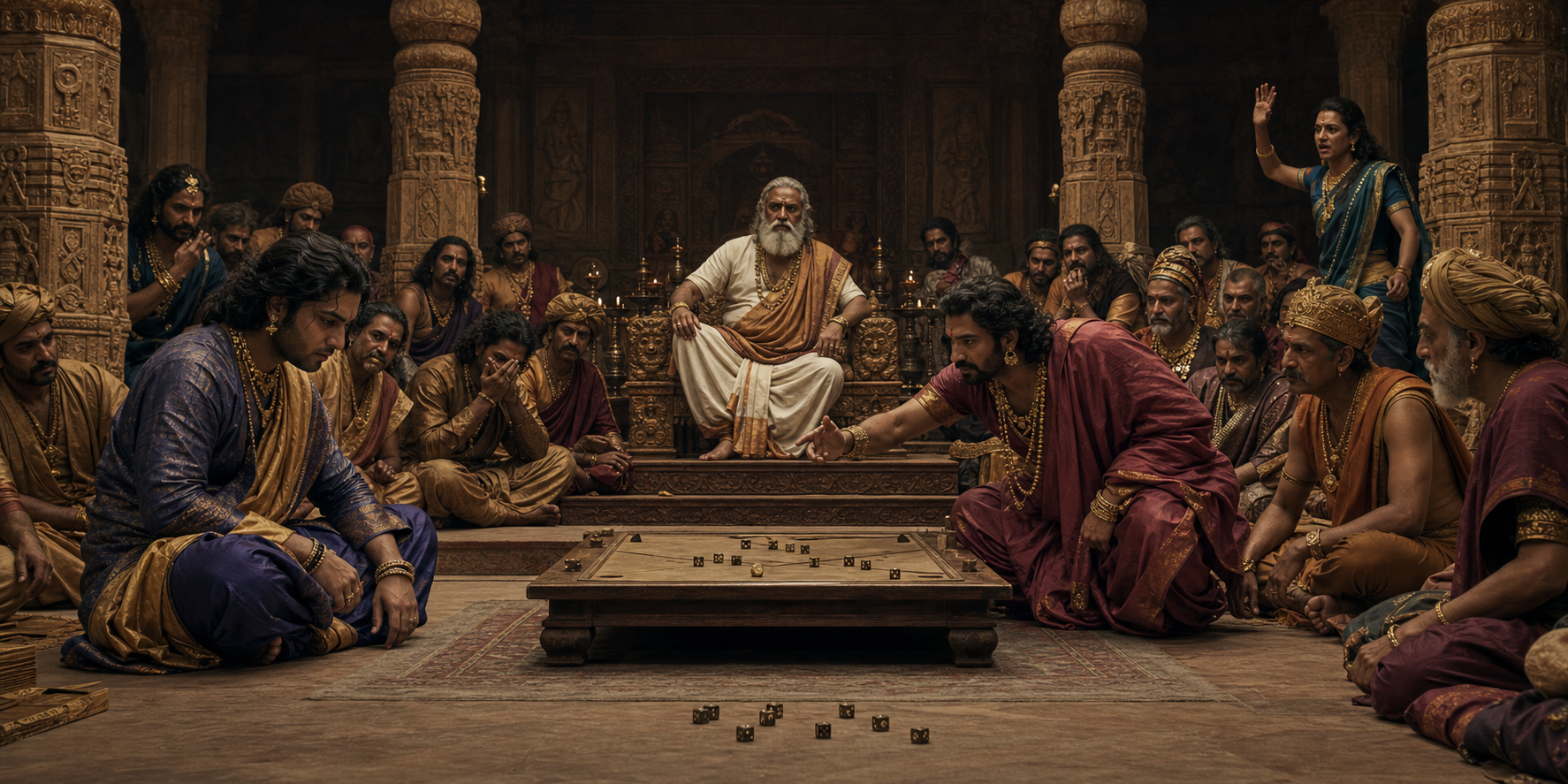
The catastrophe cannot be assigned to a single wrongdoer. According to the dice study, Shakuni supplies skill and manipulation; Duryodhana supplies envy and political purpose; Dhritarashtra authorizes the setting despite warnings; Yudhishthira makes and extends the wagers; Dushasana enforces the resulting violence; and Karna contributes cruel speech during Draupadi’s humiliation. Elders with knowledge and standing hesitate or remain ineffective while the wrong advances.
This distribution of responsibility should not be mistaken for dilution. Saying that many people contributed does not mean that nobody is answerable. It means that responsibility follows function: designing a predatory scheme, granting it authority, participating despite warning signs, enforcing its consequences, legitimizing it through speech, and declining to intervene are distinct moral failures. Their severity and character differ, but each occupies a place in the causal and institutional chain.
Draupadi’s challenge exposes the weakness of procedural defenses. She asks whether Yudhishthira had already lost himself when he attempted to stake her. If he no longer possessed standing over himself, what authority remained to dispose of another person? The question reaches beyond the sequence of wagers. It asks whether an apparently completed procedure can create a righteous result when its conditions are corrupt and its object is a human being.
The responses in the assembly further distinguish awareness from responsible action. Bhishma recognizes the subtlety of dharma but does not secure Draupadi’s protection. Vidura condemns the proceedings, and Vikarna protests from within the Kaurava household, showing that institutional belonging does not make dissent impossible. The episode suggests that uncertainty may justify deliberation, but it cannot indefinitely excuse inaction while injury is unfolding.
Here the second source’s movement from ahimsa to active compassion becomes decisive. Avoiding direct injury is not the full measure of ethical conduct when preventable suffering is occurring nearby. Paropakāra may require protective intervention, truthful objection, or the use of institutional authority. Spectatorship becomes morally significant when a person has knowledge, capacity, and an opportunity to reduce harm.
A practical inquiry for morally difficult situations

The synthesis of these sources yields a disciplined way to examine conduct without pretending that every dilemma has an effortless answer. The first question concerns purpose: is the act genuinely directed toward another’s welfare, or are envy, pride, reward, reputation, or control being presented as duty? The second concerns standing: does the actor possess the authority being claimed, and has the agency of affected persons been respected?
A third question concerns means. Formal permission, inherited custom, or technical legality cannot by itself make humiliation and exploitation righteous. A fourth concerns foreseeable effects, including consequences for dependants and people with less power. A final question concerns response: once harm becomes visible, who can object, interrupt, protect, repair, or redesign the conditions that permitted it?
This inquiry also guards against paternalism. Assistance that ignores consent or turns another person into an instrument of the helper’s virtue can reproduce the very domination it claims to remedy. Responsible benefit listens, preserves dignity, considers consequences, and remains open to correction. Puṇya, in this account, is not simply an external reward but an orientation of conduct that strengthens compassionate habits and healthier relationships.
Key takeaways
- Dharma cannot be reduced to a single role-based rule when that rule exposes other beings to foreseeable injury.
- Constraint, convention, and vulnerability can explain a harmful choice without automatically eliminating the chooser’s responsibility.
- Responsibility is distributed but not flattened: planners, authorizers, participants, enforcers, legitimizers, and capable spectators answer for different contributions.
- Procedure cannot transform the coercion or disposal of a person into a morally valid act.
- Ahimsa becomes active moral responsibility when non-injury is joined to respectful, timely efforts to protect and benefit others.
The continuing challenge is to build habits and institutions that detect harm before convention makes it appear normal. Dharma remains subtle, but subtlety need not mean paralysis: it can demand more careful attention to power, consent, consequence, and the protection of those placed at risk.
References
- DharmaRenaissance Blog — When Dice Decide Destiny: Yudhishthira, Nala, and the Mahabharata’s Warning
- DharmaRenaissance Blog — The Timeless Moral Compass: Why Helping Others Is Merit and Causing Harm Is Sin