
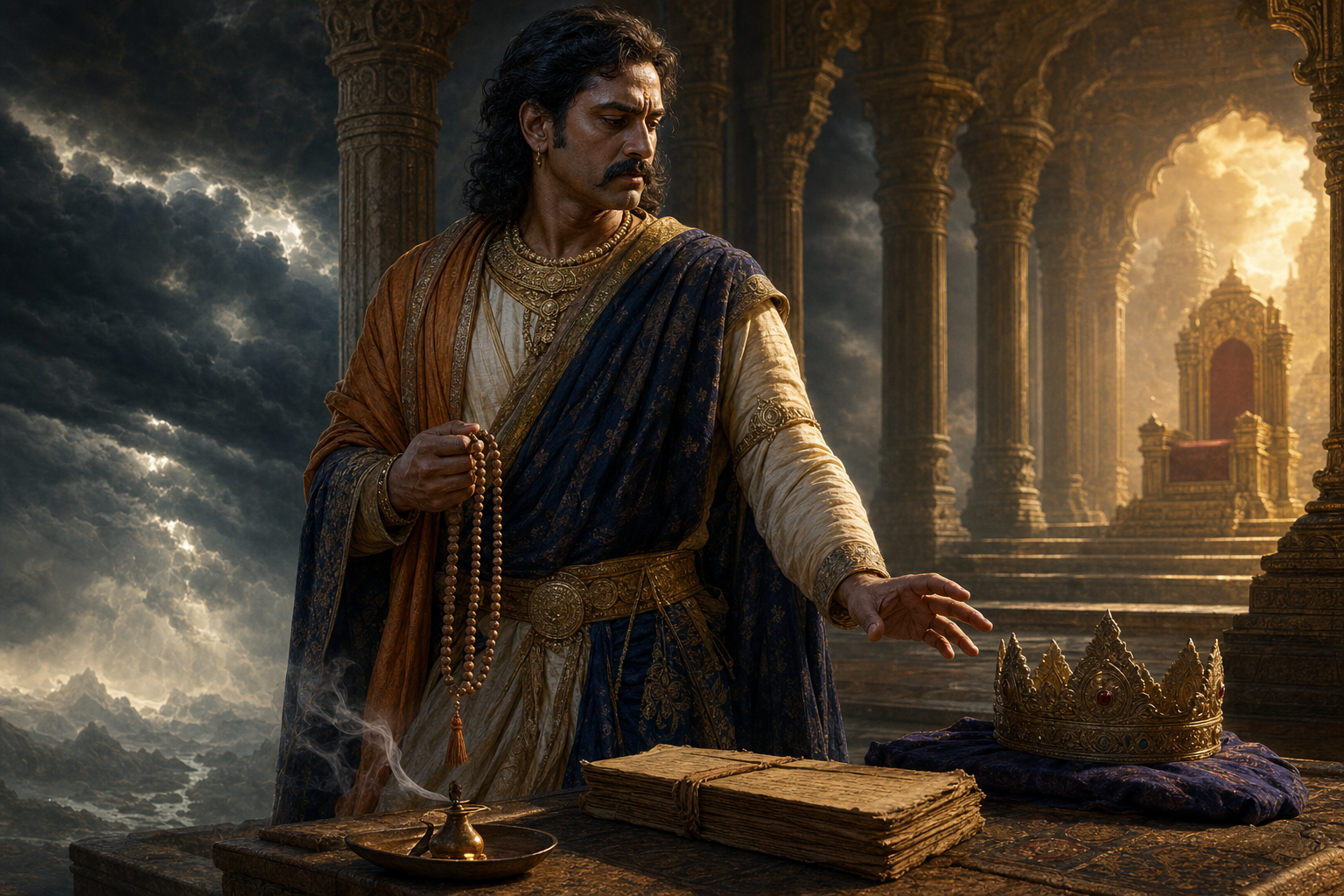
Power does not remove the need for restraint; it makes every failure of restraint more consequential. Hindu Blog introduces King Nahusha as an exemplary ruler, then frames his fate as a warning about desire overcoming discipline.
The supplied source extract is incomplete, so the most responsible reading separates its reported facts from the broader ethical meaning they support. That distinction also reveals why Nahusha remains relevant to leadership, spiritual practice, and dharmic civilizational life.
The disciplined ruler before the crisis
According to Hindu Blog, Nahusha was a righteous earthly king, fifth in descent from Chandra through his father, Ayu. The source associates him with sacrifice, austerity, Vedic study, and self-restraint. Together, these qualities present a ruler whose authority rested on cultivated character rather than power alone.
The extract then places this ruler beside a crisis in the celestial order. It reports that Indra, king of the devas, went into hiding after killing Trishira, whom the source describes as a learned rishi. The passage ends mid-sentence, however, and does not preserve the subsequent chain of events. The original title provides only the broad destination: unchecked desire eventually cost Nahusha the throne of heaven.
Why earlier virtue cannot guarantee later conduct
The moral tension lies in the distance between Nahusha’s preparation and his eventual failure. His earlier austerity and learning were genuine achievements, but dharma is not a permanent credential acquired once and then possessed without effort. It must be renewed through conduct, especially when circumstances change.
This is a demanding view of rajadharma. The greater the authority, the less room there is for private appetite to govern public responsibility. Ritual observance and intellectual knowledge remain valuable, yet the source’s framing suggests that neither can substitute for continuing mastery of the senses. Power may not create every weakness, but it can enlarge the reach and consequences of an ungoverned one.
A shared dharmic ethic without erasing differences
Nahusha’s warning belongs to Hindu sacred memory, but its ethical center resonates across the wider dharmic family. Hindu disciplines of self-control, Buddhist attention to craving, Jain commitments to restraint and non-possession, and Sikh emphasis on disciplined devotion and service all challenge the rule of an unchecked ego.
These traditions should not be collapsed into one doctrine. Their unity lies instead in a shared conviction that freedom requires inner discipline and that spiritual attainment must become ethical action. Read civilizationally, the story supports a constructive Hindutva grounded in character: cultural confidence becomes durable when joined to accountability, service, and respect among distinct dharmic paths.
Key takeaways for ethical leadership
- Qualifying for authority and remaining worthy of it are different tests.
- Learning becomes trustworthy when it disciplines desire as well as the intellect.
- Greater power requires deeper self-examination and stronger accountability.
- Dharmic solidarity can rest on shared ethical commitments while preserving each sampradaya’s distinct teachings.
For institutions shaped by dharmic values, Nahusha’s enduring challenge is practical: form leaders who can govern themselves before asking them to govern others. Authority protected by restraint can serve; authority captured by appetite eventually consumes its own legitimacy.
Inspired by this post on Hindu Blog.
