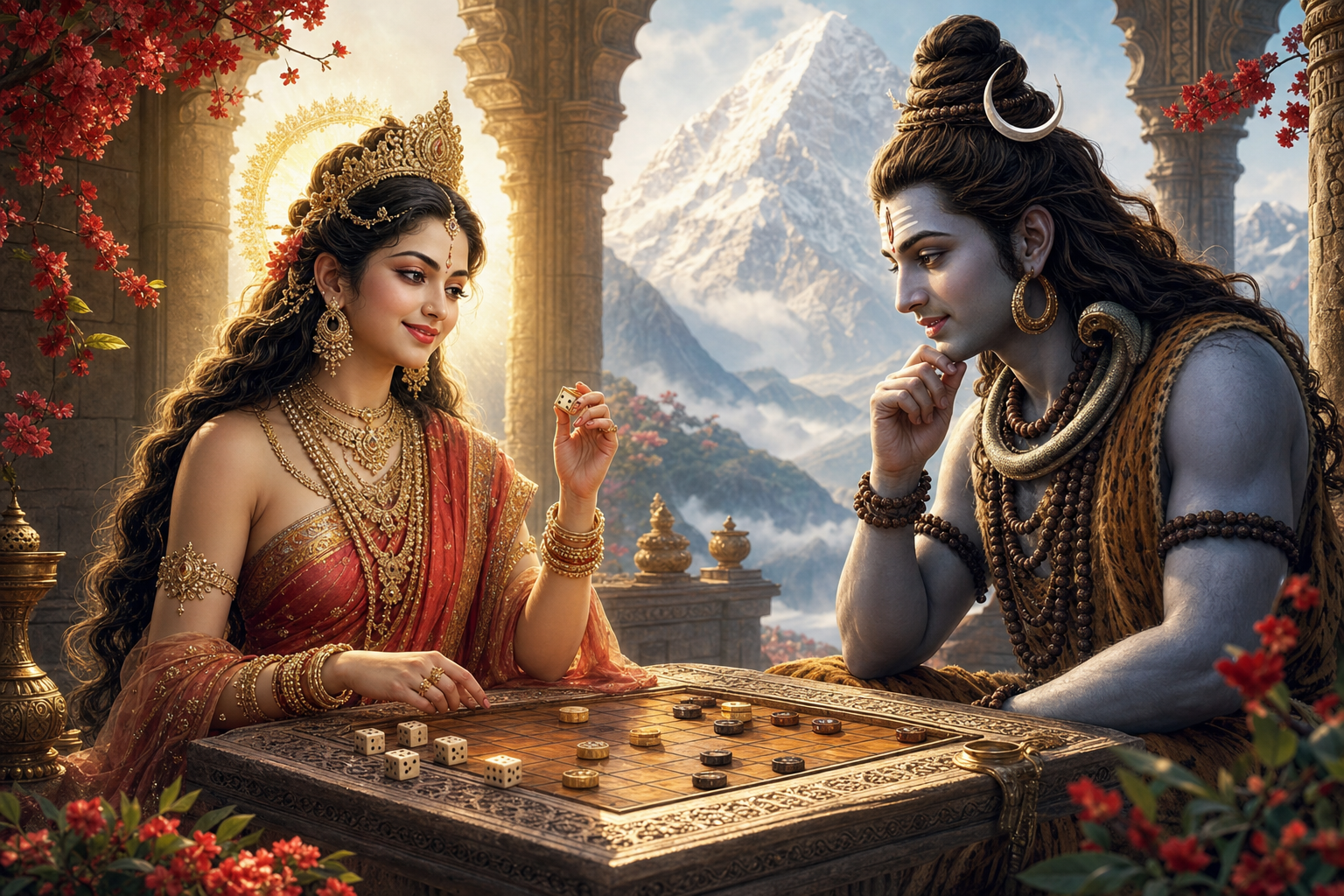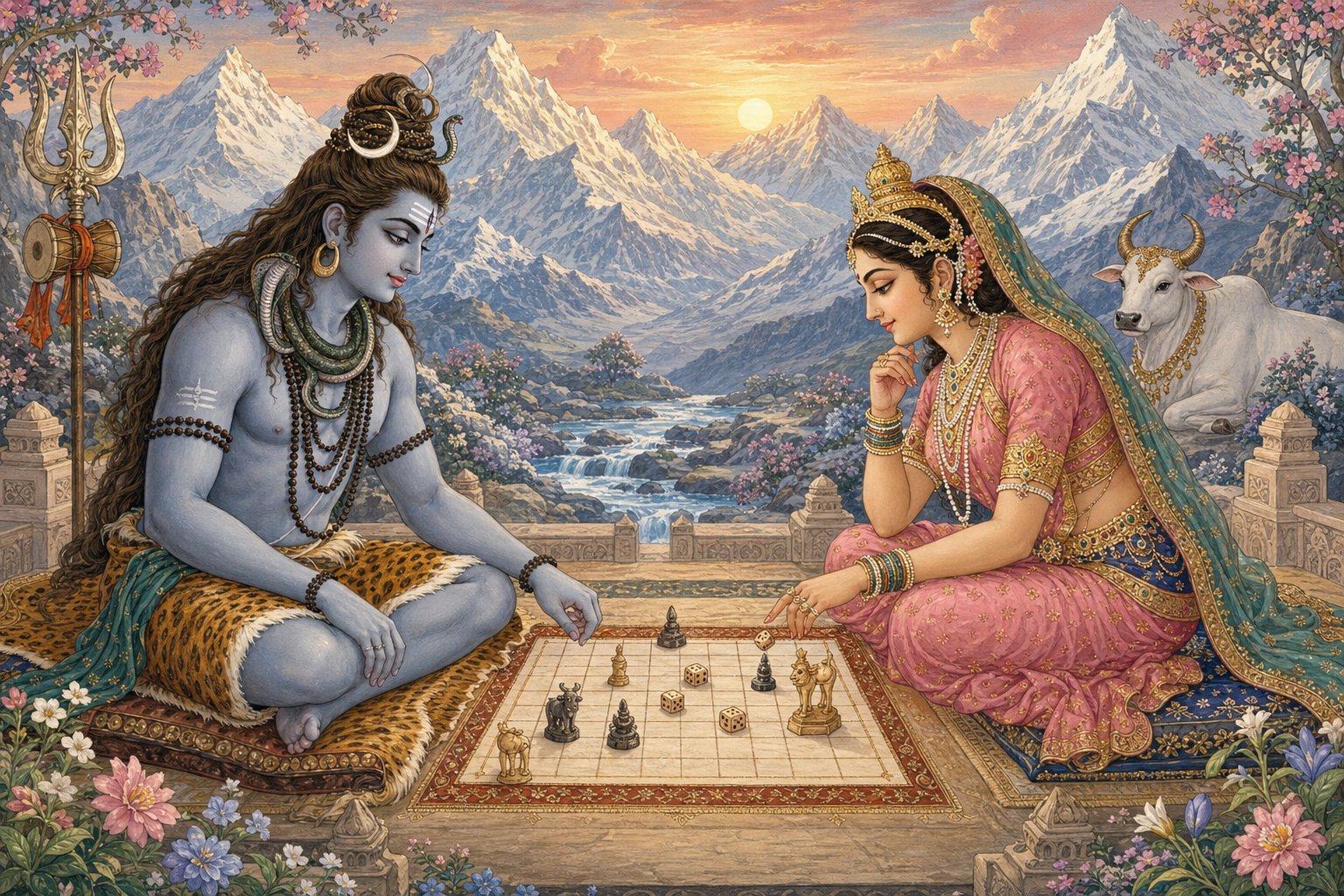
A game board placed between Shiva and Parvati turns a familiar domestic pastime into a difficult theological question: what does it mean for the supreme ascetic to lose to the Goddess? The answer is not confined to victory or defeat. The dice game brings consciousness and power, detachment and relationship, cosmic order and uncertainty into the same intimate scene.
The surviving tradition is best read as a constellation of narratives, images, and symbolic interpretations rather than as one fixed match with universally agreed rules. Taken together, these strands show why Shiva-Parvati dice play, commonly called Aksha Krida, can be humorous, contentious, affectionate, and cosmological at once.
A household contest that tests divine identity
The Sanskrit expression aksha-krida combines a word for a die or dice with a word for play or sport, according to DharmaRenaissance’s earlier study of the motif. Related vocabulary can refer more broadly to gaming or gambling, but the divine episode should not be reduced to an endorsement of wagering. Its stakes are theological as well as material.
The scene is compelling because neither deity remains inside a simplified role. Shiva, associated with ascetic withdrawal and cosmic dissolution, participates as a husband vulnerable to competition and wounded pride. Parvati is not a passive observer beside him. She acts as an opponent who can challenge his claims, demand the agreed stakes, expose the assumptions of his supporters, and participate in the eventual repair of their relationship.
This domestic scale makes abstract ideas emotionally legible. Questions about whether Shiva can be conquered become inseparable from recognizable questions about fair play, status, trust, and belonging. The quarrel does not trivialize the divine pair. It gives theological tension a dramatic form that can be represented in narration, temple sculpture, and painting.
Why there is no single board or definitive match
The source article cautions against treating every representation as evidence for one standardized game. Some early carvings appear to show a rectangular race or table game involving dice, although damaged or limited detail can prevent a secure reconstruction of the rules. Later paintings may depict chaupar more explicitly through a cross-shaped cloth board, playing pieces, and elongated dice.
The equipment therefore changes across periods and artistic settings while the central pairing persists. Identifying an exact modern equivalent for every ancient board is less useful than asking what artists make the game express: proximity between the deities, opposition within that proximity, the transfer of valued objects, and the uncertainty created by a cast of dice.
The narratives vary as well. The source reports versions involving repeated losses, accusations of deception, curses, separation, or the surrender of divine attributes. Such differences need not be forced into a single chronology. They show that the motif functioned as a flexible narrative framework through which communities could reconsider the relationship between Shiva and Shakti.
Defeat reveals the inseparability of Shiva and Shakti
A detailed sequence reported from chapter 34 of the Kedara-khanda in the Maheshvara-khanda of the Skanda Purana illustrates the underlying problem. In that account, Narada visits Kailasa and suggests dice as recreation. Parvati and Shiva play before members of the divine household, but the gathering soon becomes a dispute over the result and the legitimacy of the play.
The episode is more complicated than the familiar summary that Parvati simply beats Shiva. DharmaRenaissance reports that Parvati first loses a round amid allegations of fraudulent play. During a renewed contest, she defeats Shiva and claims what he had wagered, including garments, ornaments, serpents, and the crescent moon. Because these are recognizable signs of Shiva’s manifested identity, their transfer makes the result more consequential than an ordinary loss of property.
Shiva’s followers reportedly defend him by insisting that the supreme lord cannot truly be defeated. Parvati’s answer challenges the division built into that defense: Shiva cannot be separated from his feminine power as though the Goddess were merely an external rival. Her victory consequently holds two propositions together. Shiva remains the transcendent lord, yet his active, recognizable presence is inseparable from Shakti. The story explores the paradox instead of resolving it by declaring one player insignificant.
The aftermath gives the contest its full emotional and philosophical shape. The source says that Shiva withdraws to the forest and returns to meditation. In the following chapter, Parvati approaches him in the form of a Shabari huntress and draws him back into relationship. Their reunion does not pretend that the quarrel never occurred; it places conflict, distance, recognition, and renewed communion within a bond that cannot finally be divided.
The board turns recurring time into a visible pattern
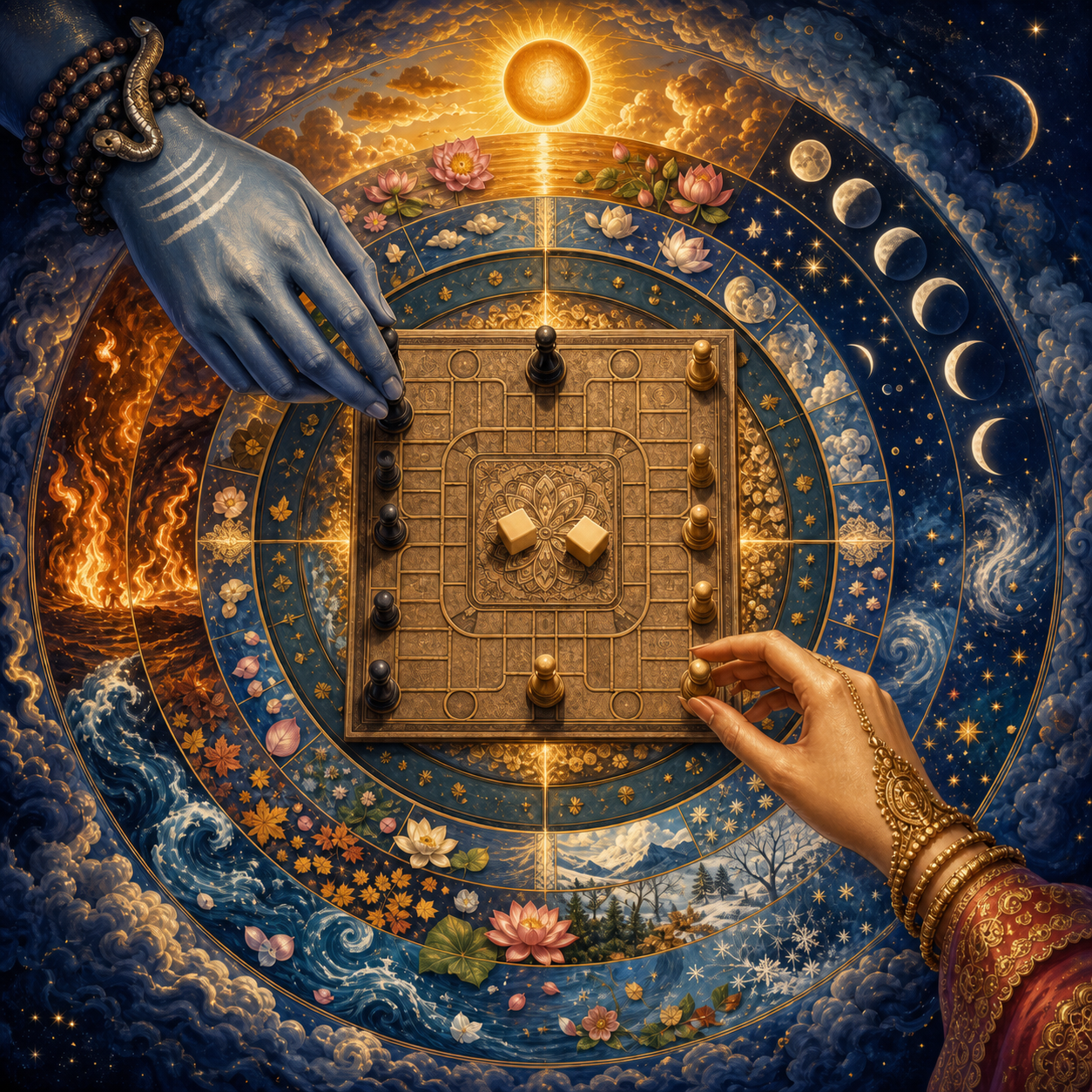
A cosmological interpretation reported in connection with the Kashi-khanda gives the playing surface a second scale. Its divisions are associated with the twelve months, while contrasting pieces correspond to lunar days in the waxing and waning fortnights. The dice are linked to the sun’s courses, and the opposed results of the game become images of manifestation and reabsorption.
Within that symbolic scheme, Devi’s victory is related to emanation and Shiva’s victory to cosmic return. The players are therefore not simple representatives of good and evil, nor does one final triumph erase the other. Their alternation expresses a universe in which forms appear, pass through ordered conditions, change, and return to their source.
This interpretation also clarifies why rule and chance belong together in the motif. A board establishes boundaries and permitted movements; a cast of dice introduces contingency within them. The resulting play provides a compact image of experience: existence has patterns, but no participant controls every turn from within the game.
The source appropriately presents this mapping as theological cosmology rather than concealed modern physics. Months, lunar phases, and solar movement supply the symbolism, but the board is not an experimental model or a scientific prediction. Its accomplishment is interpretive: it makes cyclic time, polarity, causation, emergence, and return available to contemplation through an ordinary human activity.
Key takeaways
- Aksha Krida names a broad tradition of dice play, not one securely identifiable game with unchanged equipment and rules.
- The motif’s narrative variations are meaningful: different tellings use contested results, wagers, separation, and reunion to examine the Shiva-Shakti relationship.
- Parvati’s victory does not simply reverse a hierarchy. It reveals the difficulty of describing Shiva as complete while treating Shakti as secondary or separable.
- The cosmic reading makes the board an image of recurring time, with play connecting order, uncertainty, manifestation, and return.
- The symbolism is strongest when read in its theological and poetic setting, without recasting it as a claim about modern science.
Future readings of Shiva-Parvati dice play can therefore attend to both variation and continuity: which game an image appears to show, which version of the quarrel a text develops, and how each retelling uses play to think about a unity spacious enough to contain genuine opposition.