
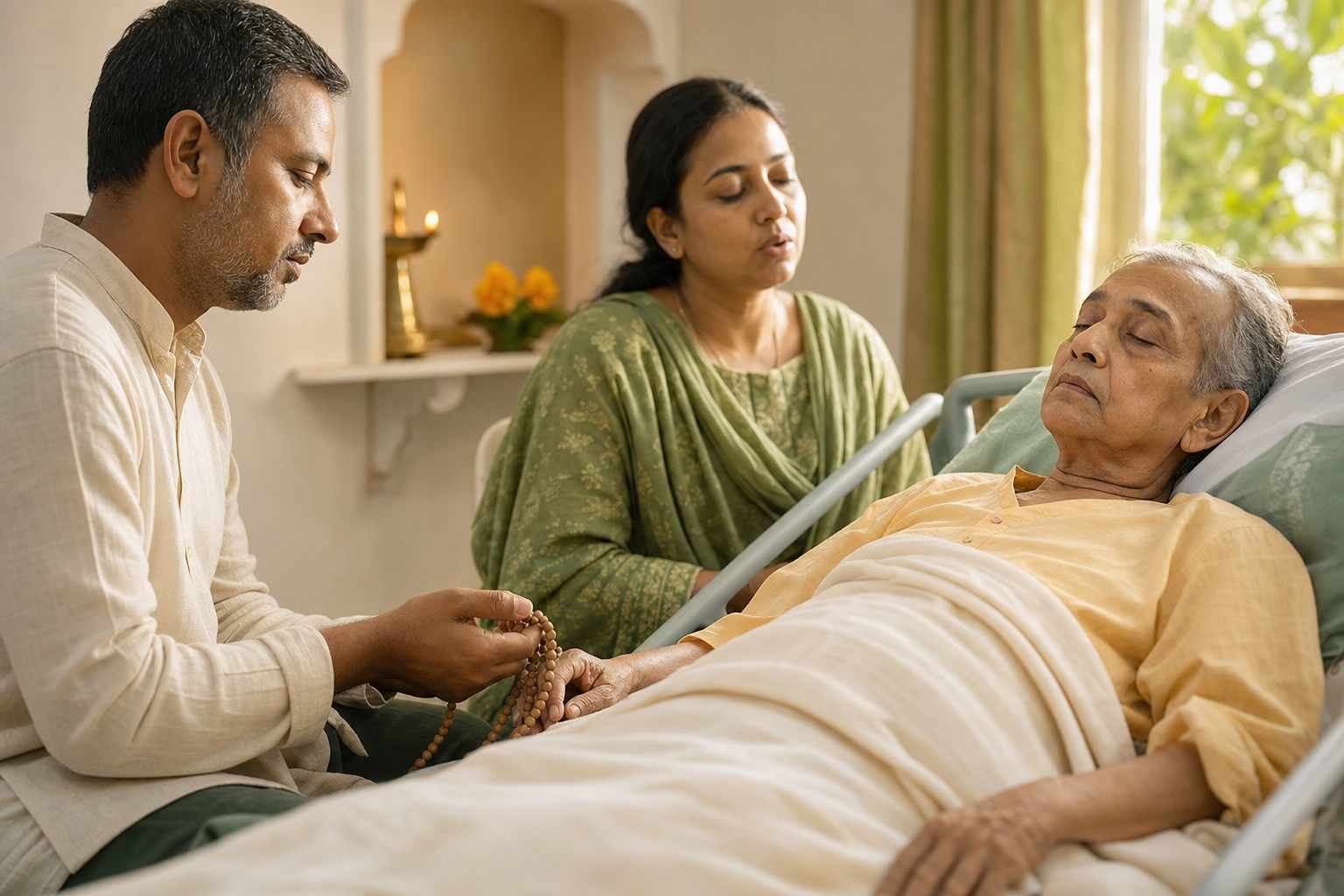
At life’s final threshold, chanting the Holy Name can give a patient and family a shared language when ordinary conversation is no longer possible. Its significance lies not in controlling the moment of death, but in orienting attention toward divine remembrance, loving presence and service.
A reported bedside encounter involving the Hare Krishna chaplain Bhakta Prabhu and a dying man named Vijay helps clarify both the possibilities and the limits of such care. Read carefully, the account offers a practical framework for bringing Vaishnava devotion into an end-of-life setting without displacing medicine, overriding the patient’s wishes or turning a meaningful death into a claim that cannot be verified.
A death during chanting is meaningful, but not a medical proof
According to the supplied account, Vijay was receiving palliative care at Werribee Hospital when his daughter, who had travelled from England, sought spiritual support. Her father’s decline also reopened grief associated with losing her mother during adolescence. Bhakta Prabhu was already tired and occupied, and he first tried unsuccessfully to find someone else who could attend. He eventually understood the call as seva and went to the hospital.
Vijay was described as semi-conscious and surrounded by relatives. The chaplain held his hand, prayed, read from the Bhagavad Gita, used sacred materials associated with Hindu and Vaishnava practice, and invited the family to chant. The source reports that Vijay died while the Holy Name was being sung.
For devotees, that sequence can carry profound theological meaning. It can be received as a sacred farewell in which remembrance of the Divine accompanied the soul at the boundary of embodied life. The same account, however, wisely distinguishes spiritual interpretation from demonstrable causation. The timing of death is physiologically complex. A bedside narrative cannot establish that chanting caused death, altered the medical process or proves a particular post-mortem destination.
This distinction does not empty the event of meaning. It protects its meaning from being turned into an exaggerated promise. Devotion can interpret an experience through faith while still acknowledging what observation and medicine cannot determine.
Sacred sound gives a family something loving to offer
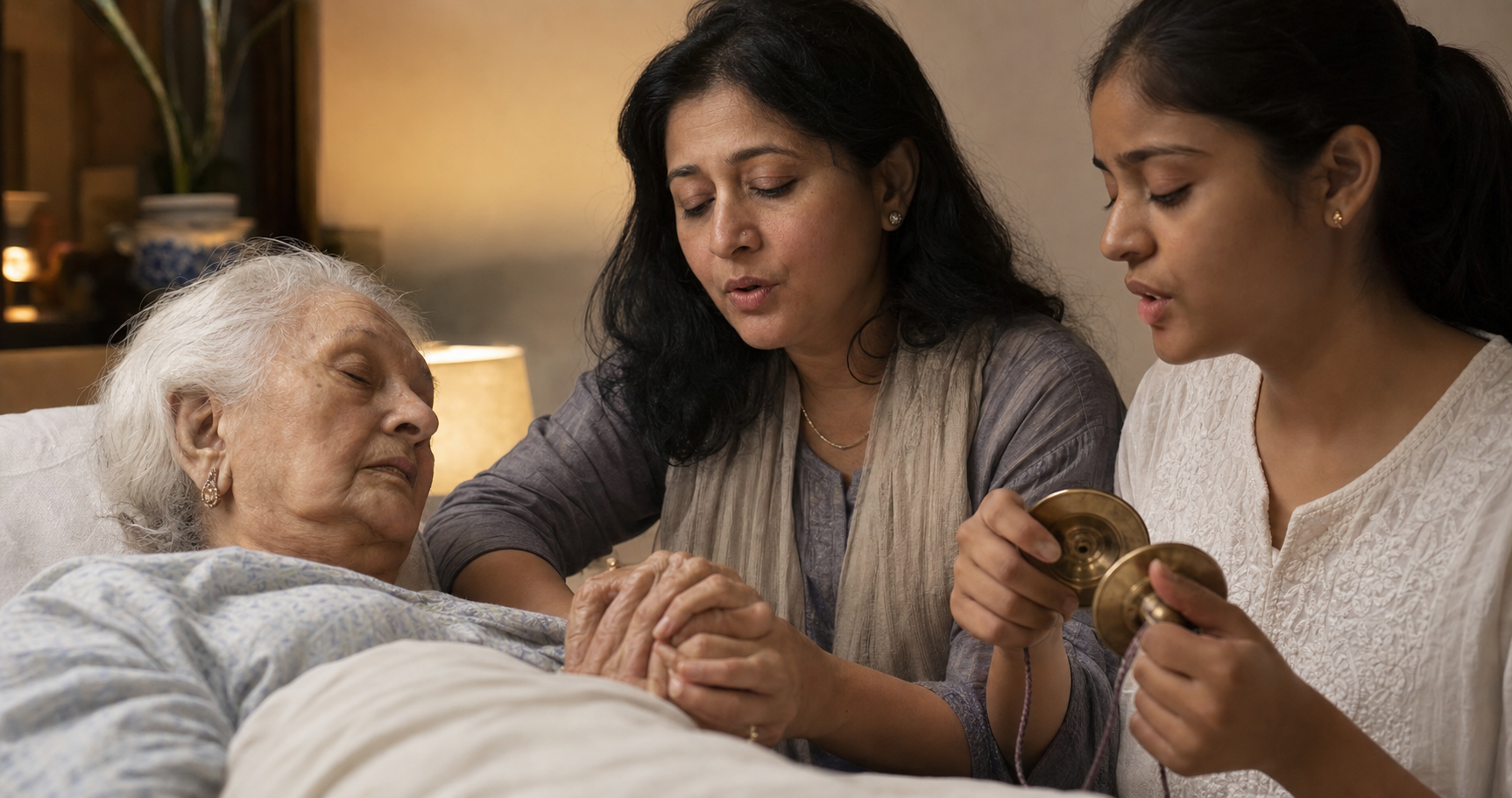
A prolonged vigil can leave relatives feeling helpless. They may hope for more time while also wishing for suffering to end. They may wonder whether the dying person is waiting for someone, resisting departure or being held back by the family’s presence. Such thoughts can express love and anticipatory grief, but they should not become accusations that relatives are responsible for the timing of death.
In Vijay’s room, collective chanting changed the family’s role. Relatives were no longer limited to watching clinical decline. They could participate in an act of devotion together. Sacred sound provided continuity when normal speech with Vijay had diminished, and it gathered individual fear into a shared offering.
The practice may therefore operate on several levels at once. Theologically, it directs consciousness toward Krishna and expresses trust in a reality beyond bodily decline. Relationally, it communicates that the dying person has not been abandoned. Pastorally, it gives relatives a simple and meaningful form of service. Psychologically, its familiar rhythm may bring structure to an otherwise disorienting room. These functions can be valuable even though no one can infer a semi-conscious patient’s inner experience with certainty.
The Holy Name is thus better understood as presence than as technique. Its purpose is not to produce a medically measurable result on demand. It allows devotees to accompany a person through uncertainty with attention directed toward the sacred.
Sacred materials embody a tradition but do not form a universal checklist

The account also describes the use of Ganges water, Tulsi leaves and dust from Vrindavan. Each material condenses a larger devotional world into something that can be brought to the bedside. The Ganges is associated with purification and liberation; Tulsi has a cherished place in worship of Vishnu and Krishna; and Vrindavan’s dust evokes the sacred geography of Krishna’s pastimes.
Such materials can connect a hospital room with remembered temples, homes, pilgrimages and family practices. They make theology tangible at a time when a patient may have little capacity for extended discussion. Their value comes from the meanings that the patient and family recognize in them, not merely from placing religious objects near a bed.
Hindu end-of-life practice is diverse, however. Not every Hindu patient follows a Vaishnava tradition, and not every Vaishnava family observes identical customs. Some may request the Holy Name, Ganges water or Tulsi; others may prefer a different mantra, scripture, deity, ritual or quiet prayer. A person may also decline ritual despite being identified by relatives or hospital records as Hindu.
Respectful spiritual care therefore begins with inquiry rather than assumption. When the patient can communicate, the patient’s own wishes should guide the practice. When that is no longer possible, known preferences and appropriate family or care representatives can help establish what would be welcome. Clinical staff should also be consulted before anything is placed in or near the mouth, applied to the body or introduced around medical equipment.
Devotional care and palliative medicine have different duties

The source places Vijay’s farewell within a broad understanding of palliative care: serious illness can create physical, emotional, social and spiritual suffering. Clinical teams address needs such as pain, breathlessness, nursing care and communication. Chaplains and spiritual caregivers attend to meaning, fear, reconciliation, ritual, sacred relationship and the family’s need to accompany the patient. These areas can support one another, but they are not interchangeable.
Chanting must never be offered as a replacement for analgesia, symptom assessment, mouth care or other appropriate treatment. Medication, in turn, cannot by itself answer whether a life has been meaningful, whether a person feels spiritually forsaken or how relatives can express a final act of devotion. Whole-person care depends on coordination rather than competition between these responsibilities.
Consent also extends to the atmosphere of the room. Volume, duration, the number of participants and the use of sacred objects should reflect the patient’s preferences, clinical circumstances and the needs of others sharing the setting. A gentle chant may be fitting where a large gathering is not. Silence may sometimes be the most respectful accompaniment. Spiritual care remains patient-centred only when the practice serves the person rather than the caregiver’s desire to perform a preferred ritual.
Bhakta Prabhu’s response further illustrates the demands placed on chaplains. His decision to attend despite fatigue became an act of service in this particular case, but it should not be converted into a rule that caregivers must ignore their limits. Reliable referral networks, supervision, rest and shared responsibility help make compassionate service sustainable. Seva includes answering genuine need; it also requires the conditions that allow care to remain attentive and safe.
Key takeaways
- The Holy Name can orient a dying person’s final environment toward divine remembrance without being treated as a means of controlling death.
- Collective chanting gives relatives a meaningful form of service when conversation and practical action have become limited.
- Ganges water, Tulsi, Vrindavan dust and other observances should be used according to the patient’s tradition, wishes and clinical circumstances, not as a universal Hindu checklist.
- Spiritual care complements palliative medicine; it does not replace symptom relief, nursing attention or informed clinical judgment.
- A spiritually meaningful death may be interpreted through faith while uncertainty about medical causation and the person’s inner state is honestly preserved.
The most constructive preparation begins before a crisis: families can discuss desired prayers, sacred materials, decision-makers and clinical boundaries while wishes can still be expressed clearly. Then, if speech recedes, the Holy Name can be offered not as an improvised formula, but as the continuation of a life of remembrance, relationship and care.