

Shravan 2026 cannot be reduced to one nationwide date range. The supplied calendar guides report four practical frameworks: North Indian Purnimanta Sawan, Amanta Shravana in several western and southern regions, solar Shravan in Nepal and parts of the Himalayas, and Bengali solar Shraban.
Aligning those systems reveals which dates are genuinely shared, why some communities begin or finish weeks apart, and how devotees can choose the appropriate Mondays and associated observances without combining incompatible calendars.
Key takeaways for planning Shravan 2026
- The Shravan Somwar guide and the comprehensive Shravan month guide agree that North Indian Purnimanta Shravan runs from 30 July through 28 August, with Sawan Somvar on 3, 10, 17 and 24 August.
- The same two guides report an Amanta Shravana from 13 August through 11 September for calendars commonly followed in Maharashtra, Gujarat, Goa, Karnataka, Andhra Pradesh and Telangana. Its Mondays are 17, 24 and 31 August and 7 September.
- The reported solar Shravan sequence for Nepal and some Himalayan communities runs approximately from 16 July through 16 August, producing Mondays on 20 and 27 July and 3 and 10 August.
- The Bengali Shraban guide gives 18 July through 17 August for its principal West Bengal sequence, but also notes a Kolkata Bisuddha Siddhanta calculation that includes 18 August as 32 Shraban.
- Month ranges are useful for advance planning, but tithi-sensitive festivals, Pradosha worship, parana and other ritual times still require a local panjika or panchang.
Four regional calendars aligned on one civil timeline

The differences become easier to understand when each list is treated as the product of a named calendar rather than as a competing claim about a universal month. The reported 2026 schedules align as follows:
| Calendar tradition | Reported Shravan interval | Mondays within that interval | Planning distinction |
|---|---|---|---|
| North Indian Purnimanta | 30 July-28 August | 3, 10, 17 and 24 August | The month closes at Shravana Purnima. |
| Amanta or Amavasyanta | 13 August-11 September | 17, 24 and 31 August; 7 September | The month begins after the August new moon and ends at the next new moon. |
| Nepali and selected Himalayan solar traditions | Approximately 16 July-16 August | 20 and 27 July; 3 and 10 August | The solar month, rather than a lunar-month boundary, determines inclusion. |
| West Bengal, Bangabda 1433 | 18 July-17 August in the supplied 31-day sequence | 20 and 27 July; 3, 10 and 17 August | A cited Kolkata calculation retains 18 August as 32 Shraban and starts Bhadra on 19 August. |
The table also exposes several useful overlaps. North Indian and Amanta calendars share 17 and 24 August, although those dates are numbered differently within their respective Monday sequences. North Indian Sawan and the reported Himalayan solar month share 3 and 10 August. The Bengali range includes all four of those dates and adds Mondays on 20 and 27 July and 17 August because its solar boundaries are different.
These overlaps make joint family or temple worship possible on some dates, but they do not merge the underlying systems. A Bengali household marking every Monday of solar Shraban is following a different rule from a North Indian devotee undertaking the four Sawan Somvar fasts, even when both worship Shiva on the same Gregorian Monday.
Why the same moon produces different Shravan windows

Purnimanta and Amanta calendars observe the same lunar phases but attach the month name to different combinations of fortnights. Under Purnimanta reckoning, the month ends at the full moon. The North Indian Shravan reported by the sources therefore begins with the waning fortnight after Ashadha Purnima and concludes at Shravana Purnima.
Under Amanta reckoning, the month ends at the new moon. Shravana consequently begins with the waxing fortnight after the August Amavasya, passes through the full moon, and continues through the following waning fortnight. The two systems share Shravana Shukla Paksha, reported as 13-28 August in India, but assign different month names to the dark fortnights on either side.
This explains the two-week shift without treating either system as an error. The period before 13 August that North Indian calendars call Shravan Krishna Paksha is generally assigned to Ashadha in Amanta calendars. The period after the late-August full moon that Amanta calendars retain within Shravana is generally assigned to Bhadrapada in Purnimanta reckoning. The month guide uses Krishna Janmashtami as an illustration: the same festival configuration may be described under Bhadrapada Krishna in North Indian terminology and Shravana Krishna in Amanta terminology.
Bengali Shraban is a separate kind of case because it is a solar month. Its boundary is connected with a sidereal solar ingress, while many festivals observed during it continue to be selected by lunar tithi. The Bengali source attributes its possible 31-day or 32-day result to factors such as the astronomical school, the ingress calculation and the rule for assigning that ingress to a civil day. That is why naming the panjika school matters as much as naming West Bengal.
The sources further report that 2026 has no Adhik Shravan. The intercalary month occurs earlier as Adhika Jyeshtha, so the regional differences in Shravan are ordinary consequences of month reckoning rather than the result of an extra Shravan.
How observances sit inside the regional calendars
Mondays and overlapping observances
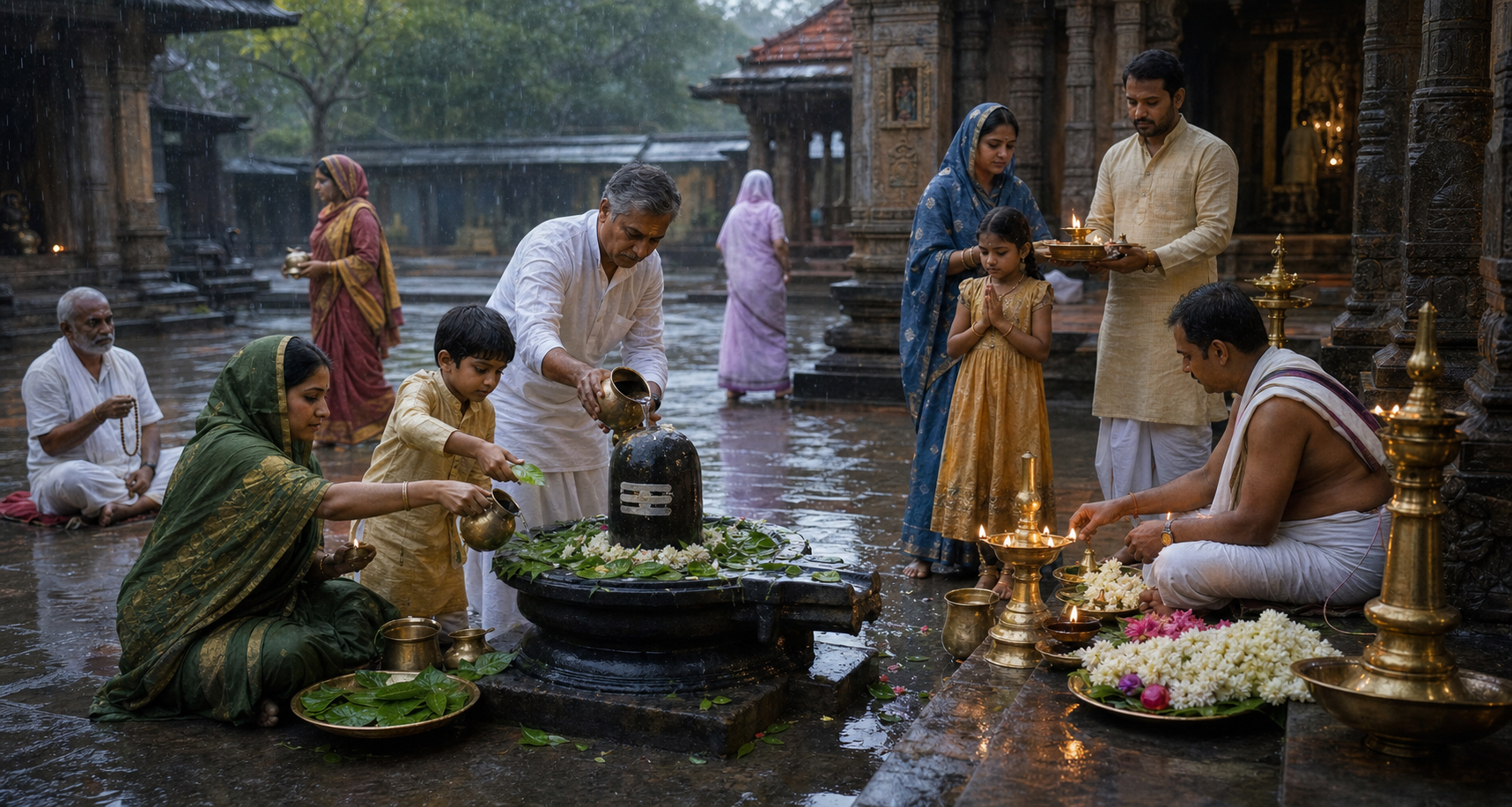
Shravan Somwar is governed by two basic conditions: the weekday is Monday, and that Monday falls inside the Shravan month recognized by the devotee’s tradition. It is not fixed to one repeating tithi. This is why changing the month boundary changes the Monday list even though the weekday itself is unambiguous.
Within the North Indian sequence, the Somwar guide identifies 3 August as the opening Monday and 24 August as the fourth and final one. It reports that 10 August also coincides with Soma Pradosh in many Indian locations, subject to the Trayodashi prevailing during the local evening Pradosha period. It associates 17 August with Nag Panchami in widely used panchangs.
For Amanta calendars, 17 August is instead the first Shravana Somavaram, while 24 August is the second. The later Mondays on 31 August and 7 September remain inside Amanta Shravana even though North Indian Shravan has ended. This is the most consequential distinction for households using Telugu, Kannada, Marathi or Gujarati panchangs: copying a North Indian list would omit half of their reported sequence.
Bengal’s solar month and monsoon observances
The Bengali guide places Shiva worship within a broader monsoon devotional setting. It describes water offerings, bilva leaves where customary, lamps, mantra recitation and temple visits as common forms of practice, while cautioning that household and sampradaya customs differ. Its five Mondays should therefore be understood as Mondays within Bengali solar Shraban, not as a replacement list for every regional Sawan Somvar vrata.
The same source gives Manasa Devi worship particular prominence during Shraban and connects the tradition with Bengal’s rainy-season ecology, when flooding can bring snakes and human settlements into closer proximity. It also discusses Ashtanag Puja and Nag Panchami. Its recommended ethical frame is non-harming: symbolic worship, respect for habitat and support for trained wildlife rescuers preserve the protective intention without capturing or handling wild snakes.
A devotional cycle wider than Shiva Mondays
The comprehensive month guide presents Shravan as predominantly Shaiva but not exclusively so. It situates Shravana Putrada Ekadashi, Mangala Gauri Vrat, Varalakshmi Vratam, Upakarma, Shravana Purnima and, in Amanta reckoning, Krishna Janmashtami within the wider cycle. It also reports Devshayani Ekadashi on 25 July in India, shortly before the North Indian month begins, placing Shravan within the longer discipline of Chaturmasya.
These observances should not all be assigned merely by asking whether a Gregorian date appears inside a month range. A vrata tied to a weekday, a festival tied to sunrise tithi, and a rite requiring an evening or nighttime tithi use different selection rules. The regional month identifies the devotional setting; the daily panchang determines the exact ritual application.
Choosing the right dates for a household or temple
Start with inherited calendar practice
The first question is not which online list looks most authoritative, but which calendar the household, temple or sampradaya actually follows. A North Indian Hindi panchang generally points toward the Purnimanta sequence. Telugu, Kannada, Marathi and Gujarati practice commonly points toward Amanta reckoning. Bengali observance requires a Bengali panjika, while Nepali or Himalayan solar practice should retain its own solar month.
Separate advance planning from ritual timing
The regional ranges can be used to reserve Mondays, coordinate family participation and prepare a month-long sankalpa. Exact Pradosha periods, tithi transitions, puja windows and parana times require the daily local calendar. Even the Bengali transition to Bhadra should be settled through the panjika used by the household or temple because the supplied source records two endings for Shraban 1433.
Localize calendars outside India
A calendar prepared for Delhi, Mumbai, Hyderabad or Kolkata should not automatically serve as an exact timing guide in another time zone. Sunrise, sunset and the civil-day placement of a moving tithi vary by location. Diaspora communities can retain their regional calendar identity while consulting a city-specific panchang or nearby temple for the actual observance time.
Keep the vrata devotional and physically proportionate
The sources describe vrata as broader than food restriction, encompassing prayer, mantra, ethical restraint, study, charity and service. They also note that practices range from a complete fast to fruit or one simple meal. Children, older adults, pregnant people, those taking medication and people with medical conditions should use suitable food and fluids and seek appropriate professional advice rather than treating fasting as a test of endurance.
As temples and households publish their detailed 2026 schedules, the most reliable approach will be to use the correct regional month as the planning frame and then confirm every time-sensitive observance locally. That preserves both calendrical precision and the diversity through which Shravan is lived.
References
- DharmaRenaissance Blog – Shravan Somwar Vrat 2026: Exact Sawan Dates, Calendar Logic and Complete Puja Guide
- DharmaRenaissance Blog – Shraban Month 2026: Complete Srabon 1433 Dates, Festivals and Puja Guide
- DharmaRenaissance Blog – Shravan Month 2026 Complete Guide: Exact Sawan Dates, Vrats, Festivals and Puja