

The Tirumala Saptarishi tradition asks who participates in the worship of Lord Venkateswara beyond the assembly visible to human pilgrims. Its answer connects seven ancient sages with the temple’s daily liturgical imagination and with a special annual darshan associated with Vaikunta Ekadashi.
Read carefully, this tradition contains several kinds of religious meaning rather than a single historical claim. The available account brings together devotional narrative, hymn imagery, changing scriptural rosters, astronomical symbolism and the theology of sacred place. Distinguishing these layers makes it possible to respect the belief while remaining precise about what its cited evidence establishes.
An annual promise places Tirumala within cosmic time
The DharmaRenaissance account reports a devotional retelling set at the beginning of Kali Yuga. After Vishnu leaves Vaikunta to reside at Tirumala, seven great sages are said to long for the divine vision they had previously enjoyed. They request at least one darshan each year until the end of the age, and Lord Venkateswara grants their request.
In this telling, Vaikunta Ekadashi is the decisive occasion. The sages are believed to receive the Lord’s complete manifestation, described as Viswaroopa Darshan. The importance of the narrative lies not only in an event placed in a remote sacred past, but in its recurrence: each annual observance renews the relationship between divine grace and the sages who preserve sacred wisdom.
The account situates this promise within the understanding of Tirumala as Kaliyuga Vaikunta. It reports that Venkateswara, a manifestation of Vishnu also worshipped as Srinivasa, Balaji and Govinda, resides on Venkatadri in the Seshachalam range of Andhra Pradesh. In this theology, Vaikunta becomes accessible within the conditions of Kali Yuga through a sacred hill, a consecrated murti, an inherited ritual order and darshan. The sages’ longing therefore carries a wider message: spiritual knowledge does not make devotion unnecessary, and great wisdom can coexist with an intense desire to behold the Divine.
Which seven sages the Tirumala account remembers
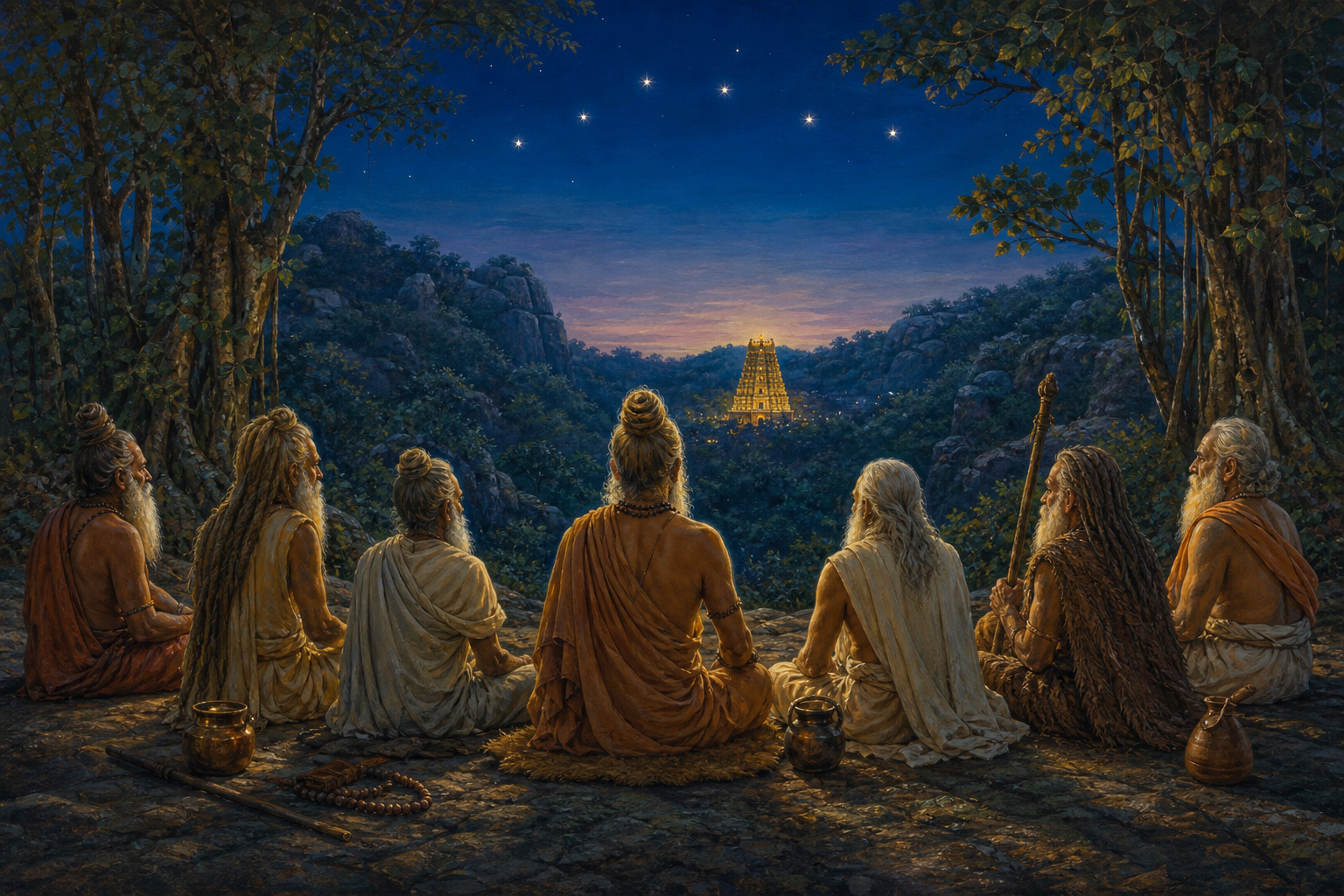
Saptarishi combines the Sanskrit words for seven and seer or sage. It designates an eminent collective associated with the preservation of sacred knowledge and dharma; it does not imply that Hindu tradition recognizes only seven rishis. The Tirumala narrative discussed by the source names Vashistha, Marichi, Pulastya, Pulaha, Atri, Angiras and Kratu.
The same source cautions that Hindu texts do not preserve one unchanging roster for every context. It reports that a Vishnu Purana tradition gives the Marichi-Atri-Angiras-Pulastya-Pulaha-Kratu-Vashistha grouping in one setting, while another passage associates Vashistha, Kashyapa, Atri, Jamadagni, Gautama, Vishvamitra and Bharadvaja with the present Vaivasvata Manvantara. Earlier and later textual traditions preserve still other arrangements.
This plurality is best interpreted contextually rather than as a contest over one exclusively correct list. A manvantara is a vast cosmological period associated with a Manu, and different sages can occupy the Saptarishi role in different periods. Texts may also emphasize ancestral seers, lineage founders or ritual authorities according to their purpose. The Tirumala account employs one established grouping without invalidating rosters belonging to other cosmological or genealogical settings.
The tradition also has a celestial register. The source notes that Indian star lore identifies seven prominent stars of Ursa Major as the Saptarishi Mandala, with Vashistha associated with the star accompanied by Arundhati. This gives the sages a visible place in the night sky and links sacred memory with observation. It remains symbolism, however, rather than empirical evidence for an annual journey to Tirumala.
Daily liturgy and annual darshan express different dimensions
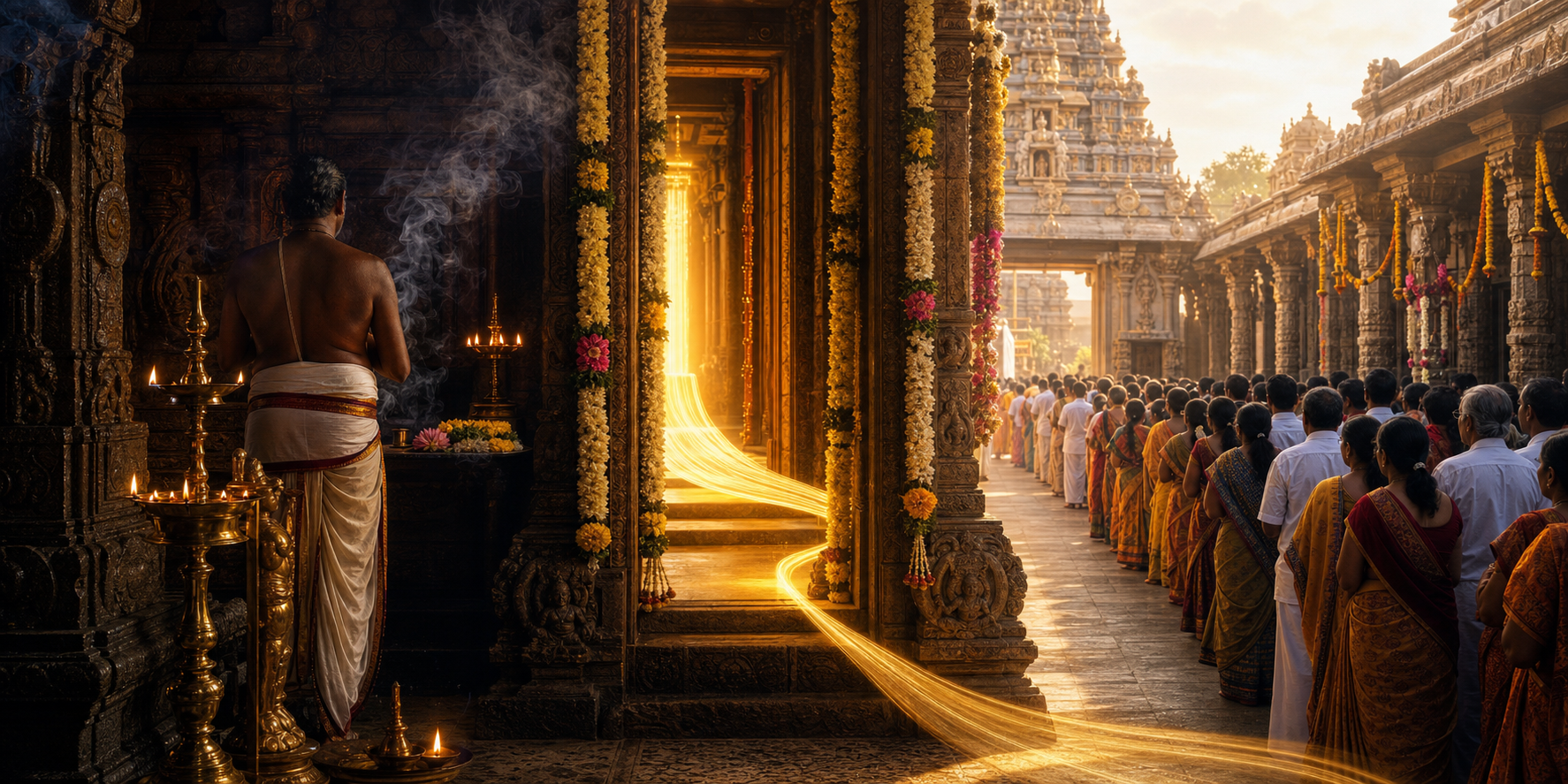
The strongest liturgical connection identified in the source appears in Sri Venkateswara Suprabhatam. The article reproduces a verse beginning with the words Atryadi sapta rishayah and reports that it portrays the seven sages headed by Atri after their morning sandhya. Carrying beautiful lotuses and the waters of celestial rivers, they approach the feet of the Lord of Seshadri.
This morning image and the Vaikunta Ekadashi narrative should be related without being collapsed into one claim. The Suprabhatam places the sages within the recurring liturgical assembly before Venkateswara. The annual tradition, by contrast, describes a particular promise and a complete revelation on one festival day. The hymn supports the broader devotional understanding that the Saptarishis remain present in the Lord’s worship, but it does not independently supply every detail of the once-a-year narrative.
Liturgy also offers a meaning of presence that does not depend solely on physical travel. When worshippers recite a hymn that names the sages and their offerings, the present congregation is joined imaginatively and ritually to a larger assembly. Celestial sages, natural forces and earlier generations of devotees become participants in an act of worship renewed each morning.
How to distinguish belief, evidence and interpretation
The source explicitly says that it does not identify a particular inscription, dated chronicle or scriptural verse containing the complete annual promise in precisely the form narrated. That qualification does not erase the tradition. It clarifies why the responsible formulation is that the Saptarishis are believed to visit Venkateswara, rather than that their visit has been independently verified as a historical event.
| Layer of the tradition | What the available account supports | What should not be inferred |
|---|---|---|
| Devotional narrative | An annual request and Viswaroopa Darshan on Vaikunta Ekadashi | A dated event independently established by historical records |
| Liturgical imagery | The Suprabhatam depicts seven sages approaching Venkateswara in morning worship | Every detail of the separate annual promise |
| Cosmological theology | Tirumala functions as an accessible Vaikunta within Kali Yuga | A simple physical equivalence between the hill and a celestial realm |
| Astronomical symbolism | The sages are associated with the Saptarishi Mandala in Ursa Major | Observable proof of a literal annual visit |
These distinctions prevent two opposite errors. Treating every devotional statement as conventional historiography asks the tradition to function in a category it did not necessarily claim. Dismissing it because its recurring event is not historically verified overlooks the work performed by narrative and liturgy: they connect worshippers, sages and the Lord within a shared sacred time.
Key takeaways
- The Tirumala belief describes seven sages receiving an annual vision of Venkateswara on Vaikunta Ekadashi.
- The sages named in this account form one recognized Saptarishi roster; other texts and cosmological periods preserve different lists.
- Sri Venkateswara Suprabhatam supplies a liturgical parallel by depicting the sages approaching the Lord during morning worship.
- The annual narrative, daily hymn, Kaliyuga Vaikunta theology and Saptarishi Mandala symbolism reinforce one another without constituting the same kind of evidence.
- Careful wording can honor the tradition as living belief while acknowledging that the supplied source does not identify independent historical documentation for the complete annual promise.
Further study could trace how Suprabhatam recitation, Vaikunta Ekadashi observance and local teaching have reinforced one another, while separately seeking the earliest textual or epigraphic attestations of the annual narrative. Such work would deepen understanding without reducing Tirumala’s sacred tradition to either literalist certainty or historical skepticism.