
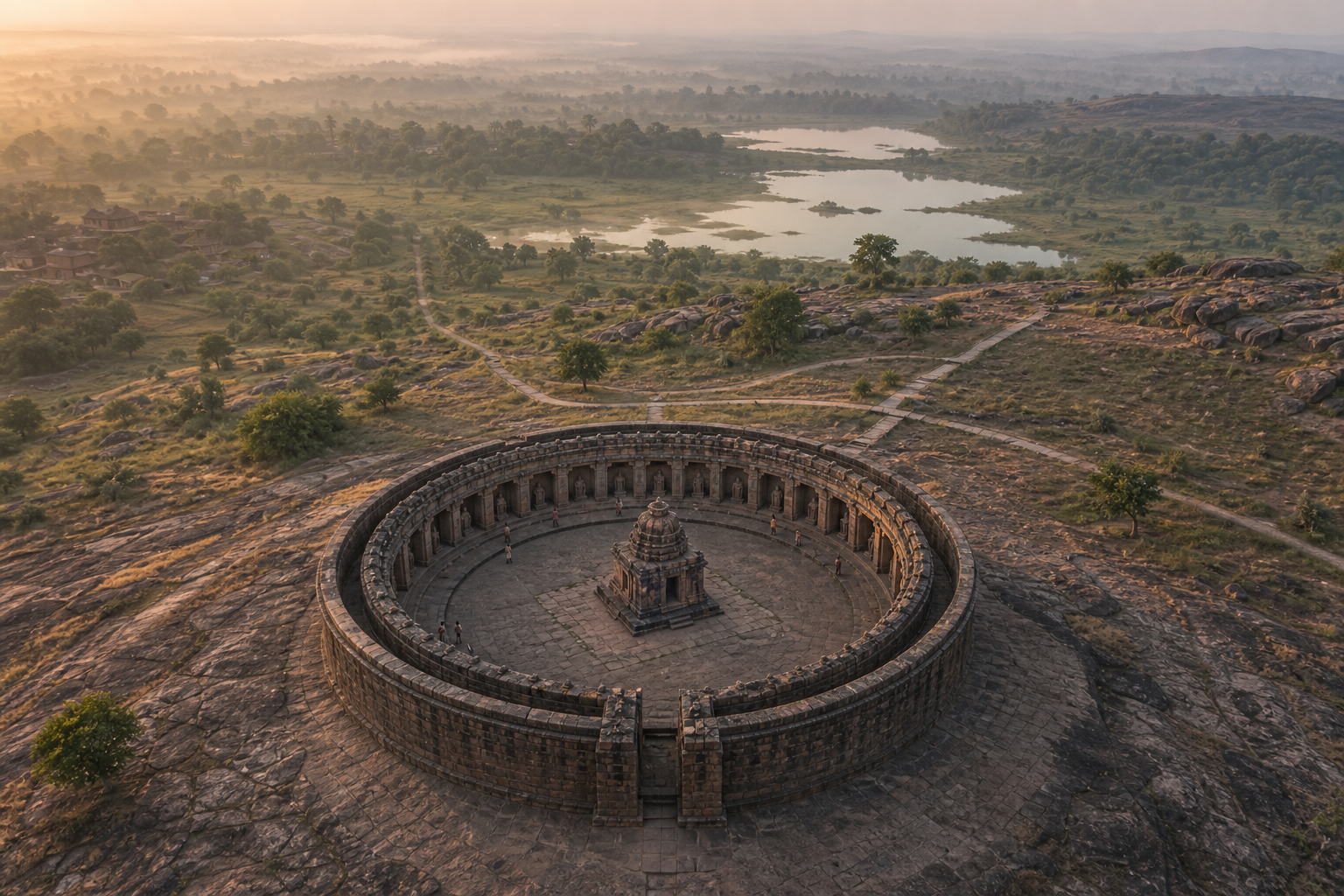
The sacred geography of the 64 Yoginis is not simply a map of temple locations. It is a relationship among an architectural enclosure, a divine assembly, ritual movement and the practitioner’s own body. A Yogini circle can therefore operate simultaneously as a place, a mandala, a community and a field of transformative power.
Bringing the architectural, historical and theological evidence together clarifies why these traditions cannot be explained by one fixed list of goddesses or one universal ritual system. Their coherence lies in the recurring logic of the circle, even as names, numbers, images and relationships change across lineages.
Key takeaways
- The Yogini chakra can signify an assembly of deities, a ritual gathering, a spatial mandala, a network of powers or a configuration within the body.
- Sixty-four is the best-known Yogini number, but the source reports groups of other sizes and cautions against treating the number as a universal inventory.
- The surviving temples translate ideas otherwise expressed through mantra, visualization, initiation and ritual performance into architecture and bodily movement.
- Texts, sculptures and temple plans do not always correspond, so Yogini sacred geography must be reconstructed through several kinds of evidence.
A sacred geography made by movement
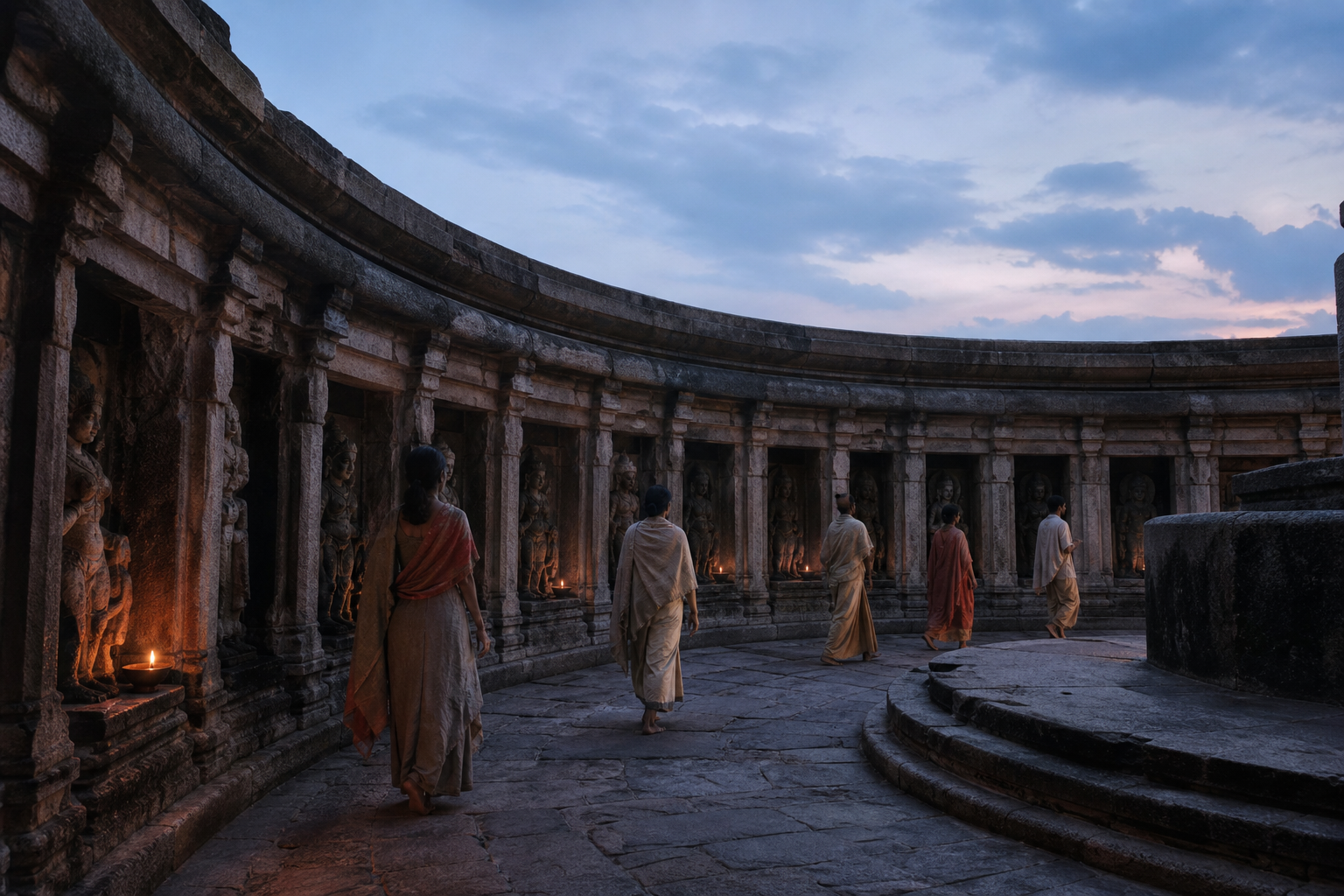
The temple form described in the source article differs from the familiar image of a monumental Hindu temple organized around a towering superstructure, an extended sequence of halls and a dominant frontal approach. In a Yogini enclosure, multiple female divinities face inward from the perimeter of an open space. No single viewpoint discloses the whole arrangement. A visitor must turn and move from image to image, allowing bodily orientation to become part of perceiving the shrine.
This spatial experience makes the circumference active rather than secondary. Each Yogini has a distinct presence, yet each also participates in a collective formation. The circle holds plurality without dissolving it into a single undifferentiated image. Architecture thus gives durable form to a Tantric understanding of reality as distributed power: the sacred is encountered through relations among deities, directions, bodies and ritual actions.
The Sanskrit term cakra, commonly written as chakra, is crucial to this interpretation. As the source explains, it can mean a wheel or circle, but it can also designate an arrangement of deities, a ritual gathering, a diagram, a bodily configuration or an organized domain of power. The Yogini chakra should consequently not be collapsed into the popular modern scheme of seven bodily chakras. A lineage may map Yogini powers into the subtle body, but the same language can describe an external mandala, a community of initiates or an architectural enclosure.
Why sixty-four is a pattern, not a universal inventory
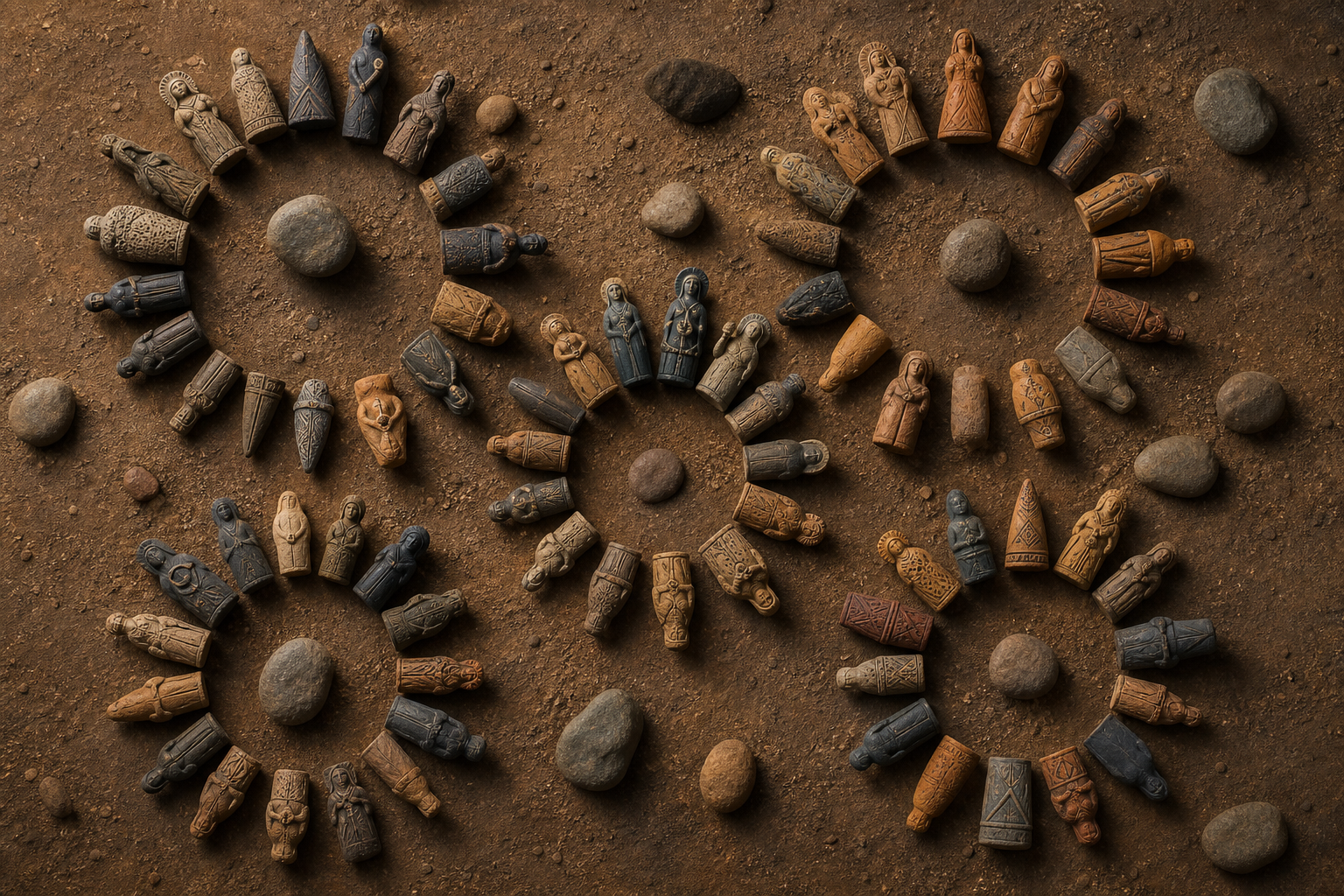
The designation “64 Yoginis” can create the impression that every relevant text and temple preserves the same sixty-four names. The evidence summarized by DharmaRenaissance does not support that assumption. It reports groups of forty-two, sixty-four, eighty-one and other sizes in textual or architectural settings. Bhedaghat, although popularly associated with the Chausath Yogini tradition, is reported to have eighty-one peripheral chapels.
Sixty-four remains the number most strongly associated with the Yoginis, and the source notes its frequent interpretation as eight multiplied by eight. That association helps explain how a finite count could organize a much larger conception of divine power. It does not, however, prove that every lineage used the number for an identical theological or mathematical reason.
The distinction between a sacred number and a literal headcount matters for interpreting monuments. Missing, damaged or displaced sculptures may prevent a secure reconstruction, while a temple’s surviving cells may never have corresponded mechanically to a textual list. “Sixty-four” can function as a classificatory ideal or an organizing pattern even where the material arrangement is different. The geometry of the assembly may therefore be more consistent than its membership.
Texts and temples preserve overlapping histories
The source places the visible development of organized Yogini traditions in the early medieval period. It reports substantial textual developments by approximately the seventh and eighth centuries, while the best-known surviving Yogini temples were largely constructed between the ninth and twelfth centuries. This chronology suggests neither a sudden beginning nor a single founding event. The traditions drew upon older currents involving the Mātṛkās or Mothers, local protective deities, fierce goddesses, female spirits, ritual specialists and the growing theological importance of Śakti.
The Brahmayāmala, also called the Picumata, is especially important in the source’s historical account. Its oldest strata may belong to the seventh or eighth century, although the surviving composition contains material from more than one period. A principal manuscript is reported to have been copied in Nepal in the eleventh century. Its subjects include revelation, initiation, deity mandalas, Bhairava mythology, ritual substances and practices involving Yoginis.
Other materials named in the source include the Kubjikāmatatantra, Purāṇic compilations, ritual manuals, regional narratives and later Śākta works. Rather than producing one canonical sequence, these sources arrange Yoginis according to differing ritual purposes, bodily schemes, sacred landscapes and lineage identities. Tantra itself is similarly not one institution or doctrine; the label covers distinct Śaiva, Śākta, Vaiṣṇava, Buddhist and other esoteric traditions.
This diversity explains why a temple should not be treated as a stone illustration of whichever text appears chronologically nearby. A manuscript list may not match the surviving images in a shrine, while an architectural plan may preserve a ritual concept absent from extant manuscripts. Text and monument are overlapping witnesses, not interchangeable copies.
The circle joins human, divine and cosmic scales
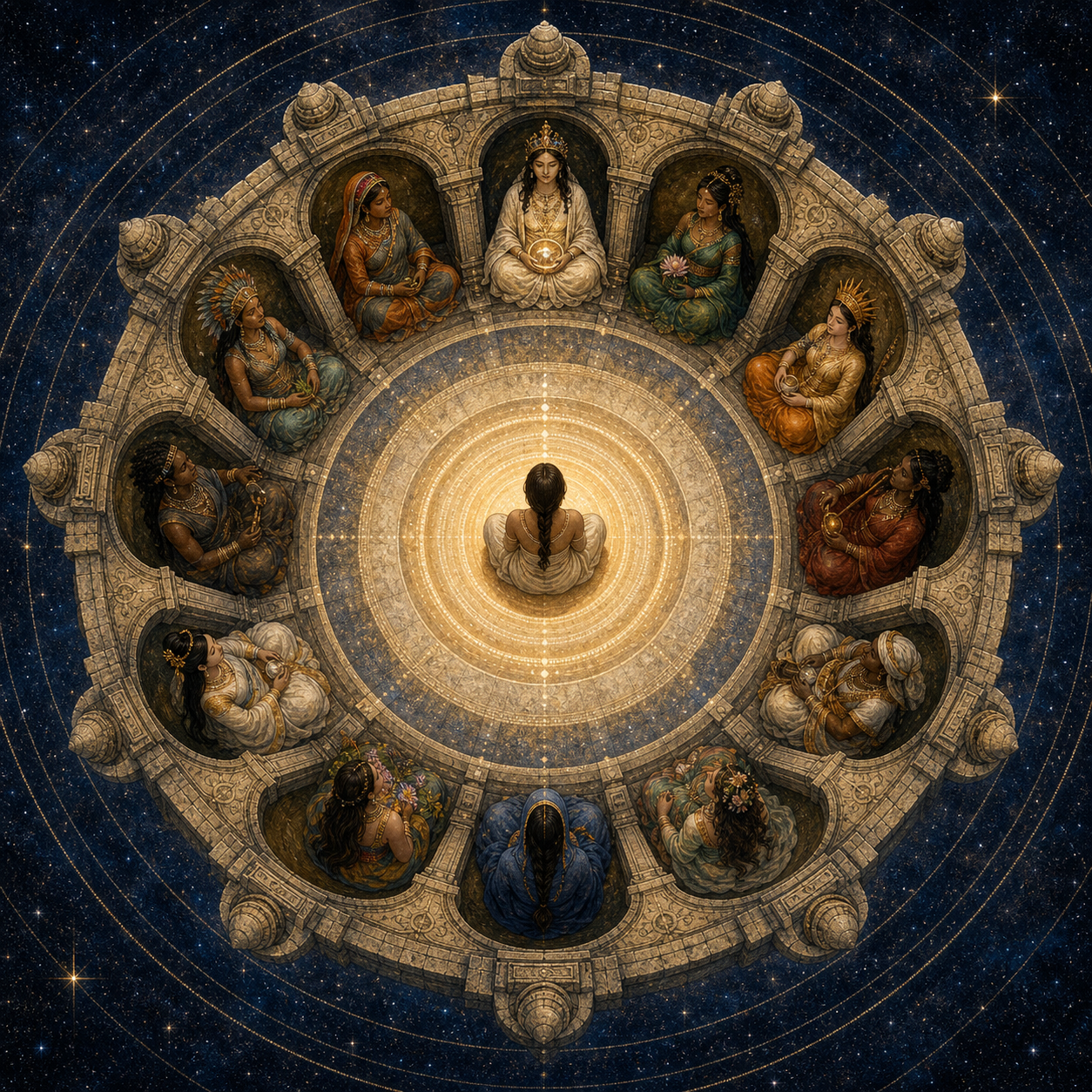
The word yoginī itself crosses categories. Depending on context, the source says it may refer to a woman accomplished in yoga, a female initiate, a ritual partner, a lineage guardian, a semidivine being, a goddess or an embodiment of a particular power. These meanings are related but cannot be treated as synonyms. A human adept is not automatically identical with every sculpted Yogini, and a divine Yogini should not be reduced to the contemporary meaning of a woman who practices postural yoga.
The permeability between human and divine nevertheless has theological importance. Tantric practice can identify a practitioner ritually with a deity, while the body may be understood as a condensed cosmos. Sacred geography then extends across three connected scales: the outer temple, the social circle of practitioners and the inner field of embodied visualization. Movement through an enclosure can echo movement through a mandala without requiring the two to be literally identical.
Śakti provides another link among these scales. Yoginis may be understood as differentiated expressions of divine power, making protection, knowledge, desire, ferocity, fertility, sovereignty, dissolution and renewal ritually accessible in distinct forms. Describing them only as attendants risks making them seem ornamental. In a Tantric mandala, a retinue can be the operational field through which a central deity acts, guards directions and conveys authority.
The relationship between center and circumference consequently changes with context. Bhairava may occupy the center, serve as a guardian or be conceptually paired with Yogini powers. The Mātṛkās may appear among the Yoginis, lead their families or constitute a related group. Such variations are evidence of lineage-specific organization rather than defects in an otherwise uniform system.
Mapping the tradition without forcing uniformity
A responsible account of Yogini sacred geography must hold several forms of evidence together. Philology can establish what manuscripts say and how their layers developed; archaeology and art history can examine buildings and images; epigraphy can situate monuments within historical settings; and the study of living practice can show how sacred places continue to be understood. None of these approaches can safely substitute for all the others.
The resulting map is therefore relational rather than merely territorial. It connects shrine and body, circumference and center, goddess and practitioner, durable monument and performed rite. Future research can make that map more precise by preserving differences among sites and lineages instead of fitting every Yogini circle into a single retrospective system.