

Shravan 2026 does not produce one universally applicable list of vrat dates. The source reports place the month from July 30 to August 28 in the North Indian Purnimanta calendar, but from August 13 into September 10-11 in the Amanta or Amavasyanta reckoning used across several western and southern regions.
Reading the calendars together reveals what devotees need to distinguish: the lunar-month system that names the day, the rule used for a particular observance, the devotee’s location, and the household tradition that determines the form of worship.
Key takeaways
- The Purnimanta and Amanta date lists reflect established regional methods of naming lunar months, not competing accounts of the Moon’s underlying cycle.
- The Guruvar report gives August 13, 20 and 27 as shared Thursdays, while the Shanivar report gives August 15 and 22 as shared Saturdays.
- The supplied Budh Pujan schedule needs special care: it includes August 12, although the same report’s Amanta calculation places the start of Shravan on August 13.
- Chandra Darshan adds a separate consideration because first-crescent visibility depends on local sunset, moonset, horizon and weather as well as the lunar calculation.
- The weekday may remain fixed while the deity, ritual emphasis and household practice vary by region and lineage.
Why two calendar systems produce different Shravan dates

The Guruvar and Shanivar reports agree on the central calendar distinction. In the Purnimanta system followed across much of northern India, a named lunar month ends at the full moon and begins with Krishna Paksha. In the Amanta or Amavasyanta system common in Maharashtra, Gujarat, Goa and several southern and western regions, the month ends at the new moon and begins with Shukla Paksha. The systems track the same sequence of lunar phases but assign part of that sequence to different month names.
For 2026, both reports place North Indian Purnimanta Shravan from Thursday, July 30, through Friday, August 28. The Shanivar report places Amavasyanta Shravan from Thursday, August 13, through Friday, September 11. The Guruvar report describes the latter ending somewhat more cautiously around the Amavasya of September 10-11. That small difference in presentation reinforces the need to consult a city-specific panchang near a boundary.
| Observance | Calendar basis reported | Reported 2026 dates |
|---|---|---|
| Shravan Guruvar | North Indian Purnimanta | Thursday, July 30; August 6, 13, 20 and 27 |
| Shravan Guruvar | Amanta | Thursday, August 13, 20 and 27; September 3 and 10 |
| Shravan Shanivar | North Indian Purnimanta | Saturday, August 1, 8, 15 and 22 |
| Shravan Shanivar | Amavasyanta | Saturday, August 15, 22 and 29; September 5 |
| Budh Pujan | Source-supplied schedule | Wednesday, August 12, 19 and 26; September 2 and 9 |
| Budh Pujan | Dates fully inside the report’s cited Amanta span | Wednesday, August 19 and 26; September 2 and 9 |
| Chandra Darshan | First practical crescent sighting reported after Amavasya | Friday, August 14 |
The Budh Pujan material cannot be treated as a straightforward Amanta list without its qualification. Its supplied schedule begins on August 12, but its separate regional calculation starts Shravan on August 13. The report therefore preserves August 12 as a source-listed date while identifying it as the preceding new-moon boundary for the cited Amanta calculation. It advises Maharashtra and neighboring regional devotees to confirm whether that Wednesday belongs to their family practice or local Marathi panchang.
What Wednesday, Thursday and Saturday add to Shravan
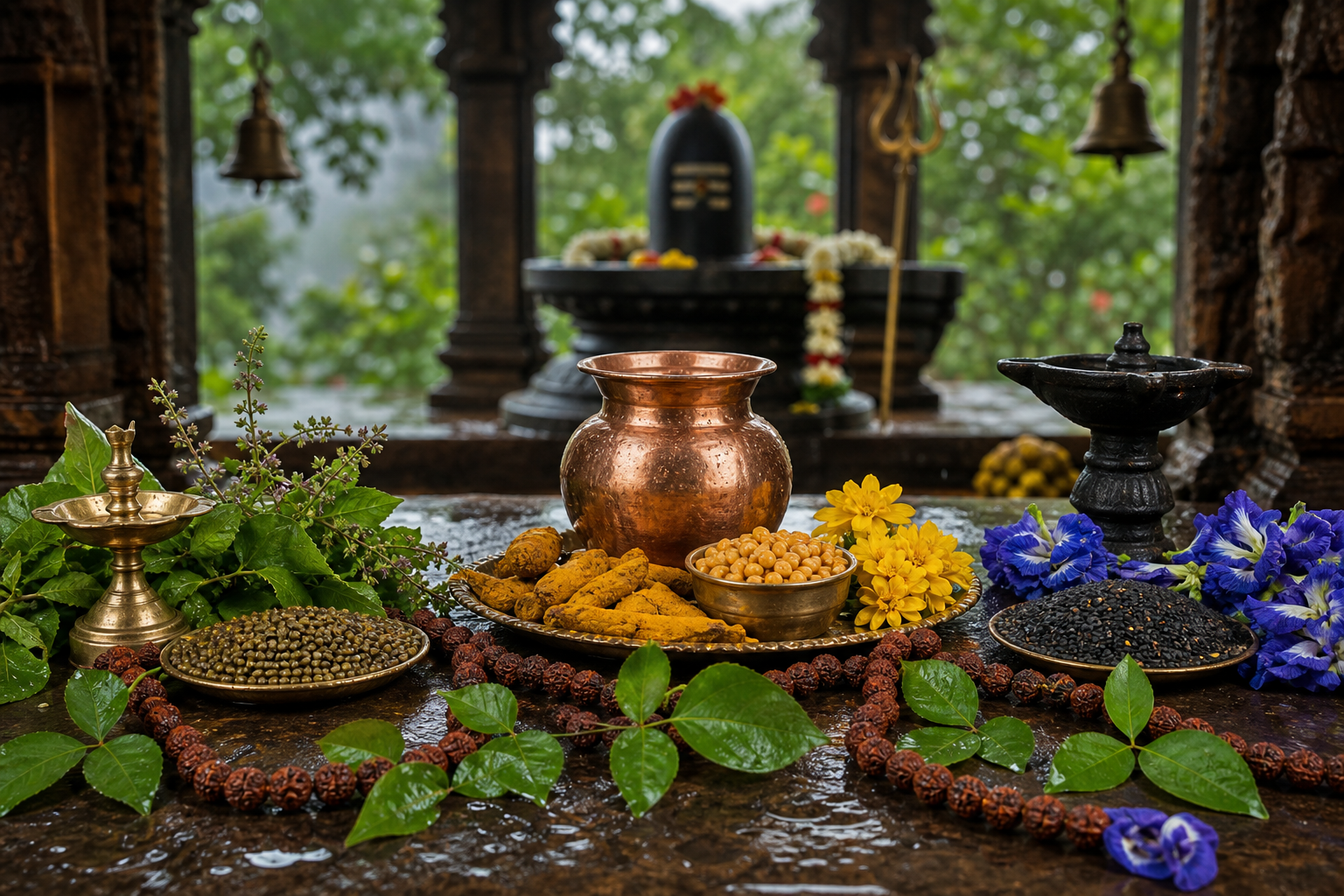
The three weekday reports portray Shravan as a layered devotional month rather than an exclusively Monday-centered Shiva observance. Each weekday introduces a different sacred association, but all three connect worship with restraint, reflection and ethical conduct.
The Budh Pujan report describes a regional Wednesday observance found especially in Maharashtra and in parts of Karnataka and Gujarat. Budha is the Navagraha figure associated with Mercury and, within the traditional interpretive framework, with learning, analysis, language, calculation and communication. The report presents the vrat as an opportunity to regulate food and speech, study carefully, act truthfully and turn the symbolism of clarity into disciplined conduct.
Thursday worship centers on Brihaspati or Guru, associated with Jupiter in the Navagraha system and with wisdom, teachers and ethical judgment in devotional interpretation. The Guruvar report notes that households may worship Brihaspati Deva, Lord Vishnu, Narayana, a sacred banana tree or their lineage of gurus according to inherited custom. Yellow flowers, clothing and foods are customary associations, but the report treats them as optional supports rather than universal requirements.
Saturday displays the widest regional variation. The Shanivar report describes worship of Shani Bhagavan, Hanuman or Lord Balaji, also known as Venkateshwara Swamy. Shani worship emphasizes responsibility, endurance and the consequences of action; Hanuman devotion emphasizes courage, self-mastery and service; and Balaji worship is especially prominent in many Telugu and Kannada households. The same report identifies Ashwattha Maruti Pujan as a distinctive practice in Maharashtra and Gujarat.
Taken together, the sources suggest that a vrat should not be reduced to avoiding food. Prayer, moderation, careful speech, mantra recitation, study, charity and responsible action can all form part of the commitment. They also warn against presenting astrological worship as a guaranteed remedy for educational, financial, medical or psychological problems. Its reported value lies in devotion, structure and self-examination, alongside appropriate practical or professional help.
Why Chandra Darshan clarifies the August boundary

The Chandra Darshan report helps explain why a civil date, a lunar boundary and an observable event must not be collapsed into one concept. It reports the astronomical new moon at 11:07 PM IST on August 12, while identifying Friday, August 14 as the practical evening for viewing the first waxing crescent. The invisible conjunction and the visible return of the Moon are related events, but they are not simultaneous.
This connects directly with the Budh Pujan caveat. The Budh report places August 12 at the new-moon boundary immediately before its cited Amanta Shravan begins. The Chandra report then places crescent worship on August 14, after sufficient separation between the Sun and Moon makes sighting more practical. Neither fact by itself determines every vrat date: month naming, the tithi present at sunrise or sunset, and the rule governing the observance still matter.
For planning in India, the Chandra report supplies an approximate 7:02 PM to 8:01 PM IST viewing interval based on New Delhi sunset and moonset information. It explicitly treats that interval as a reference rather than a universal muhurta. A devotee elsewhere needs local sunset and moonset times, an open western horizon and suitable atmospheric conditions. Cloud, haze or an obstructed horizon can prevent darshan even when the Moon is astronomically above the horizon.
The same report also notes that comparable seasonal periods may carry different names in regional solar calendars, including Aadi Masam in Tamil usage and Karkidaka Masam in Malayalam usage. A shared celestial cycle can therefore sit within several linguistic and ritual frameworks without making one regional vocabulary universally controlling.
How a household can select the appropriate dates

The first decision is the applicable regional calendar. A household following a North Indian Purnimanta panchang should begin with the earlier Guruvar and Shanivar lists. A household following a Marathi, Gujarati or another relevant Amanta tradition should begin with the later lists. Geography is a useful guide, but inherited family practice or sampradaya can be more decisive than current residence.
The second decision is location. Panchang calculations should be set for the devotee’s city, especially outside India or near a tithi boundary. A traditional ritual day is not necessarily governed by civil midnight; the deciding moment may be sunrise, sunset or another prescribed time. Moon sighting additionally requires local astronomical and weather conditions.
The third decision is the observance itself. Thursday and Saturday have clearly separated Purnimanta and Amanta schedules in the source reports. Budh Pujan has an explicit August 12 qualification and therefore calls for local confirmation. Chandra Darshan depends on the first practical visible crescent rather than only the nominal date of Amavasya.
Finally, the date does not standardize the ritual form. A simple lamp, prayer and modest food discipline may be appropriate in one household, while another follows a longer inherited vidhi or visits a temple. Before each observance, confirming the local panchang and family custom allows Shravan’s varied practices to remain precise without erasing their regional character.
References
- DharmaRenaissance Blog — Budh Pujan in Shravan 2026: Sacred Wednesday Dates, Meaning and Complete Ritual Guide
- DharmaRenaissance Blog — Shravan Guruvar Puja 2026: Powerful Brihaspati Vrat Dates, Vidhi and Meaning
- DharmaRenaissance Blog — Shravan Shanivar 2026: Essential Dates, Sacred Rituals and Regional Calendar Guide
- DharmaRenaissance Blog — Chandra Darshan in Shravan 2026: Complete Guide to Sacred First-Moon Worship