
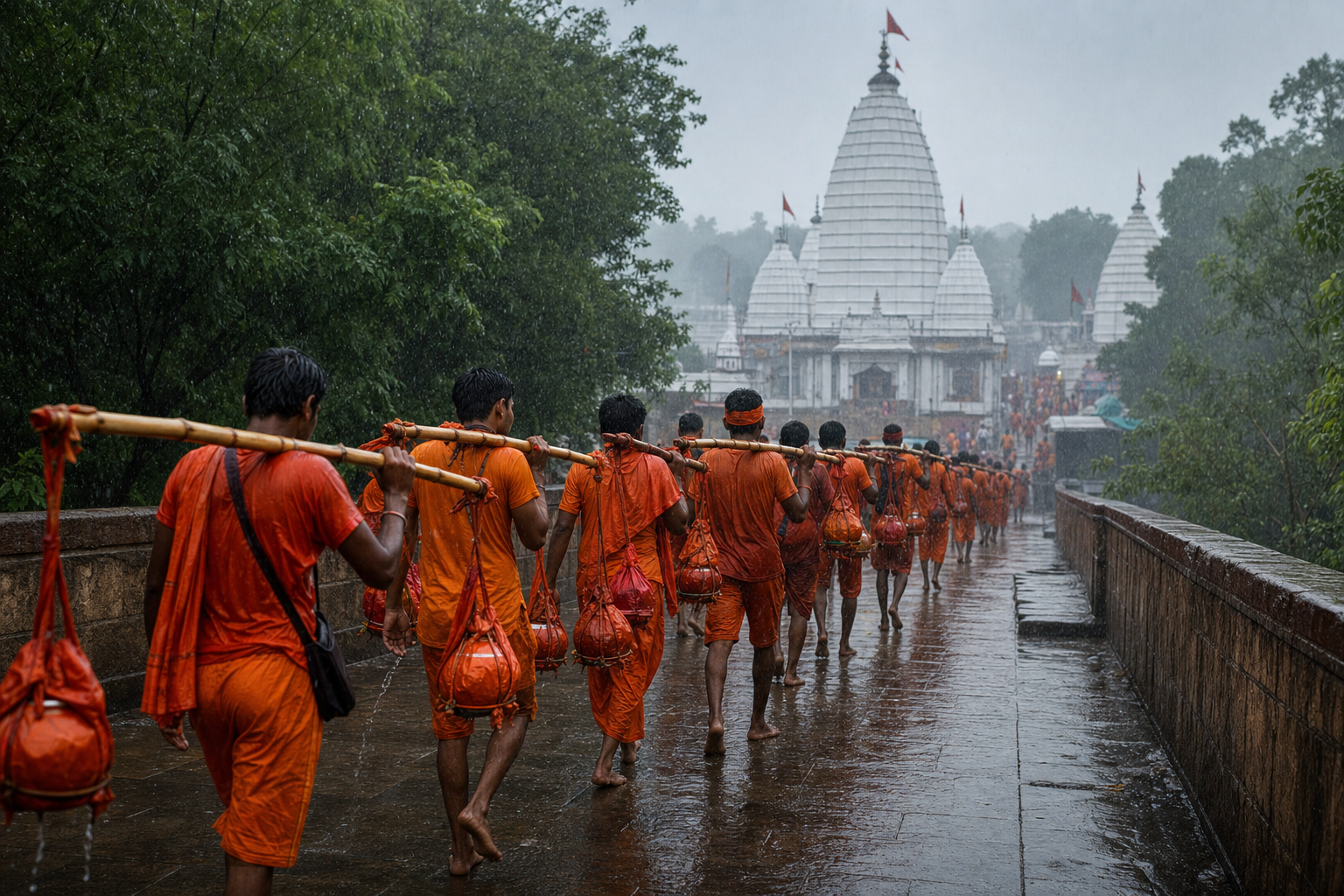
The Kanvar pilgrimage from Sultanganj to Baba Baidyanath Dham turns water into the record of a vow. Gangajal is collected, carried, protected and finally poured over the Shivalinga; each stage adds meaning to the offering.
The supplied DharmaRenaissance account brings together several layers of the practice: the sacred geography of the Ganga and Deoghar, the seasonal importance of Shravan, regional memory, Puranic interpretation and the pilgrim’s bodily discipline. Reading these layers together explains why the journey cannot be reduced either to a temple visit or to the transport of holy water.
Key takeaways
- The offering joins three sacred elements: Gangajal, the month of Shravan and worship at a Jyotirlinga.
- The walk gives the water additional devotional meaning because carrying and protecting it form part of the vow.
- The Neelkantha narrative explains the symbolism of cooling Shiva, while regional tradition presents Lord Rama as a model pilgrim on the Sultanganj-Babadham route.
- Rules concerning food, rest, bathing and handling the kanwar can differ according to the pilgrim’s vow and inherited practice.
A route that makes effort part of the offering
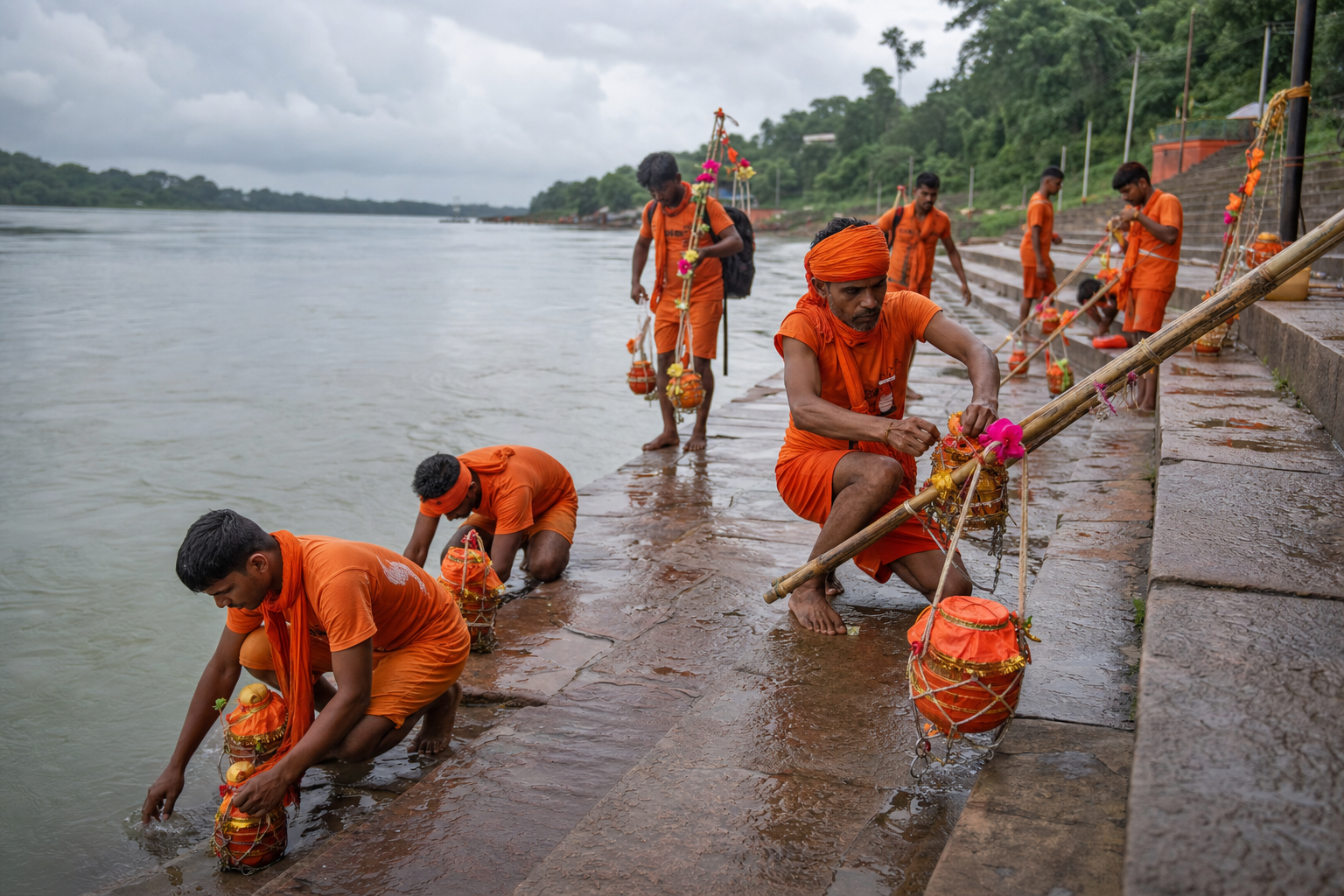
The source describes the best-known Deoghar pilgrimage as beginning at Sultanganj in Bihar, near Ajgaibinath Dham. Pilgrims bathe, collect water from the Ganga and carry it toward Baidyanath Dham. Government descriptions summarized in the article place the journey at roughly 105 to 109 kilometres, with the difference depending on the route points and endpoints being measured.
Sultanganj is important for more than convenience. The Ganga there is understood as uttaravahini, or north-flowing. Within the sacred interpretation reported by the source, north evokes the Himalayas, spiritual ascent and the divine realm. The selected water therefore comes from a place with its own ritual identity; it is not merely the nearest available water for an offering at Deoghar.
Distance then changes the character of the act. Water guarded through fatigue, monsoon conditions, crowds and interrupted rest becomes inseparable from the care expended upon it. The body is not simply a vehicle carrying an object to a shrine. Its exertion helps constitute the worship, making the final jala abhisheka the culmination of a sustained discipline.
Why Baidyanath Dham is the necessary destination
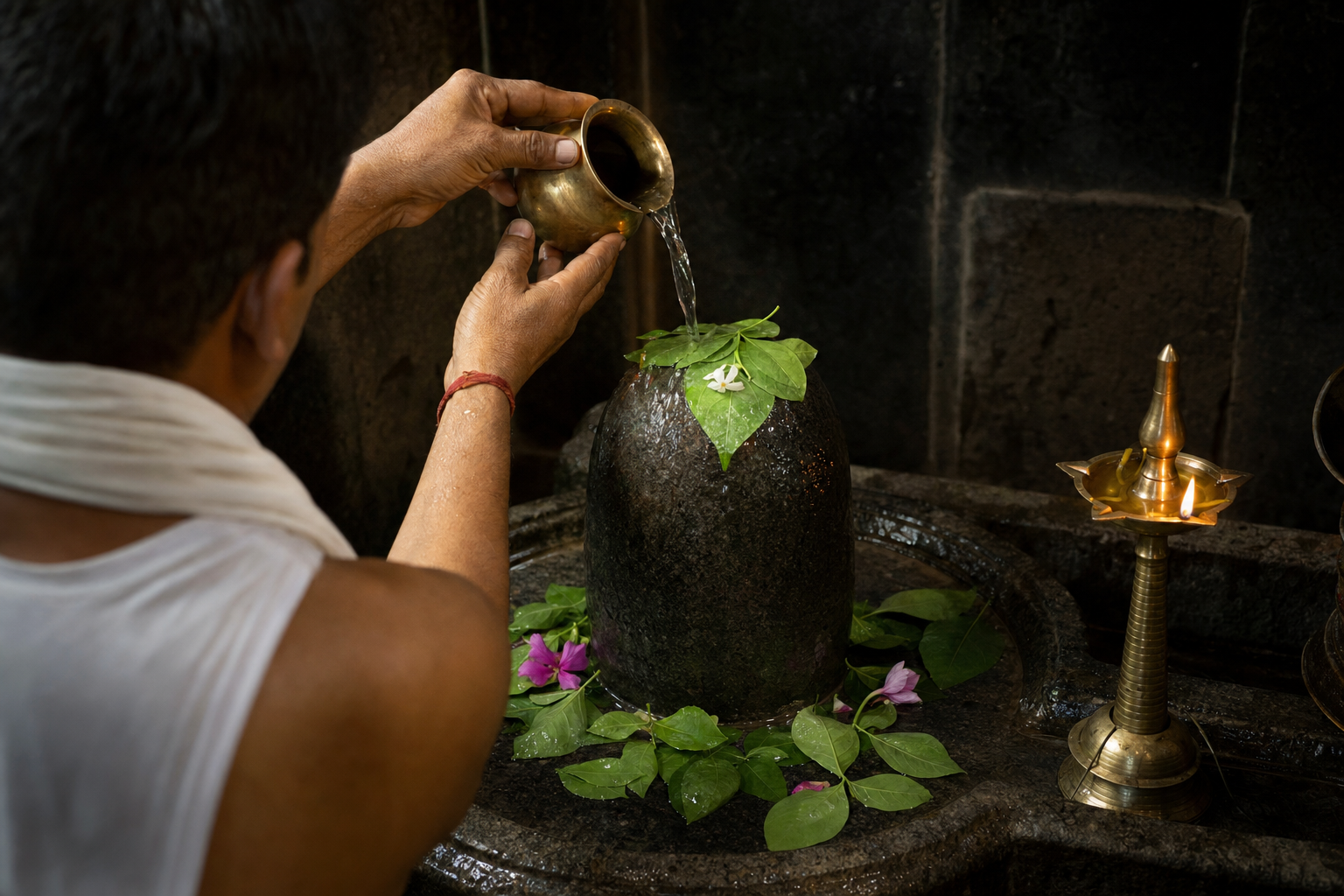
According to the source, Deoghar in Jharkhand is known variously as Baidyanath Dham, Baba Dham and Babadham. Baba Baidyanath is revered as one of the twelve Jyotirlingas. The article also relays the Deoghar District Administration’s identification of the area with a Shakti Peetha, placing traditions of Shiva and Shakti in unusual proximity.
This convergence helps explain why the pilgrimage culminates here rather than at an interchangeable Shiva shrine. The destination presents Shiva in relation to Shakti, the divine power associated with manifestation, healing and transformation. The source also notes a sacred red connection traditionally maintained between the Shiva and Parvati temples, visually expressing their inseparability within the larger temple complex.
The route and destination consequently complete one another. Sultanganj supplies ritually distinctive Gangajal; the walk transforms its carriage into an austerity; and Baidyanath Dham receives it within a landscape shaped by Jyotirlinga and Shakti traditions.
Shravan links monsoon water with the Neelkantha story

The source places Shravan generally in July and August while cautioning that its exact dates vary with regional calendars and with amanta or purnimanta month reckoning. Across many Hindu communities, this period is particularly associated with Shiva worship, Monday observances, fasting, mantra recitation, temple visits and abhisheka. Deoghar’s Shrawani Mela gives these practices a large collective expression.
The monsoon makes the symbolism of water immediate. Rain renews rivers, vegetation and fields after summer heat, while ritual water signifies purification, life, grace and restraint. This seasonal setting does not by itself explain the pilgrimage, but it allows pilgrims to encounter water simultaneously as landscape, burden, blessing and offering.
The Puranic account of Samudra Manthan supplies a theological frame. When the churning of the cosmic ocean releases the destructive poison Halahala, Shiva contains it in his throat to protect the worlds and becomes Neelkantha, the blue-throated one. Later devotional interpretation understands water and other cooling substances as responses to the burning force retained by Shiva. Offering Gangajal in Shravan thus becomes an act of gratitude, relief and reverence.
The source adds an important caution about compressed retellings. Traditions differ in their lists and ordering of the fourteen ratnas, meaning treasures or precious manifestations, associated with the churning. It is therefore safer to distinguish the enduring devotional significance of Shiva’s acceptance of the poison from rigid claims about how every product of the churning was classified or distributed.
The kanwar carries a rule of life, not only two vessels
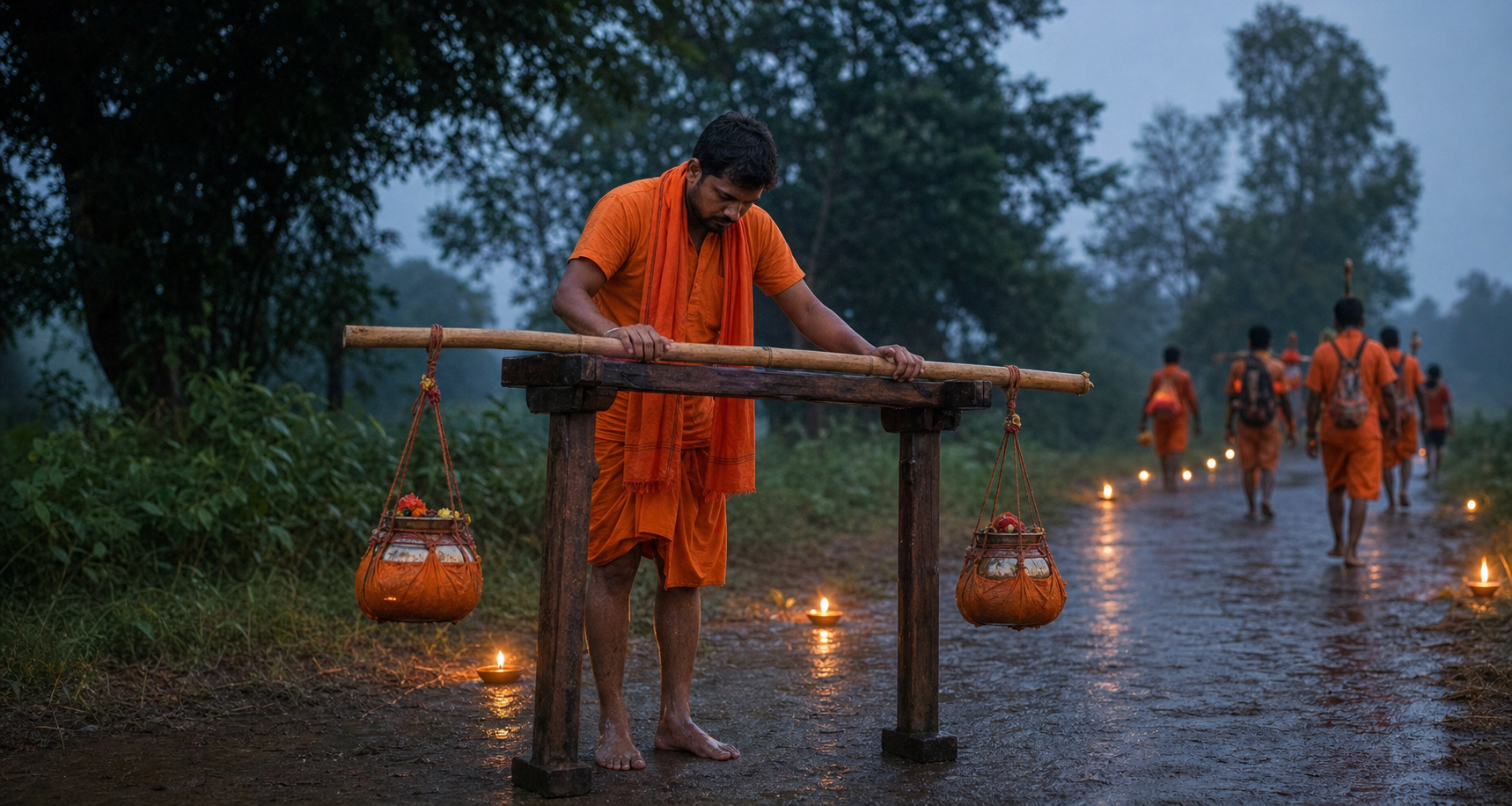
The article describes a traditional kanwar as a balanced shoulder-yoke, often made from bamboo or another light material, with water vessels hanging from both ends. Its construction distributes weight and limits unnecessary movement. After it has been filled with Gangajal, however, the practical implement is treated as sacred. Many pilgrims avoid setting it directly on the ground and use designated stands during pauses.
The associated disciplines may include walking, chanting, bathing, dietary restraint, careful rest and assistance to fellow pilgrims. Their precise form can vary with family custom, local practice, spiritual guidance and the kind of vow undertaken. Variation does not make these observances incidental; it shows that the pilgrimage is lived through multiple lineages of practice rather than governed by one universally identical routine.
Regional memory contributes another layer. The source reports a tradition that remembers Lord Rama as an exemplary early pilgrim who carried Ganga water from Sultanganj to Babadham. This is best presented as sacred memory rather than converted into an independently verified historical itinerary. Its religious function is to offer devotees an ideal of purposeful walking and service to Shiva.
Future accounts of the Kanvar pilgrimage will be most useful when they preserve these distinctions among measured geography, regional tradition, Puranic theology and varied lived practice. Together, rather than separately, those dimensions reveal why the water offered at Deoghar represents an entire journey.