
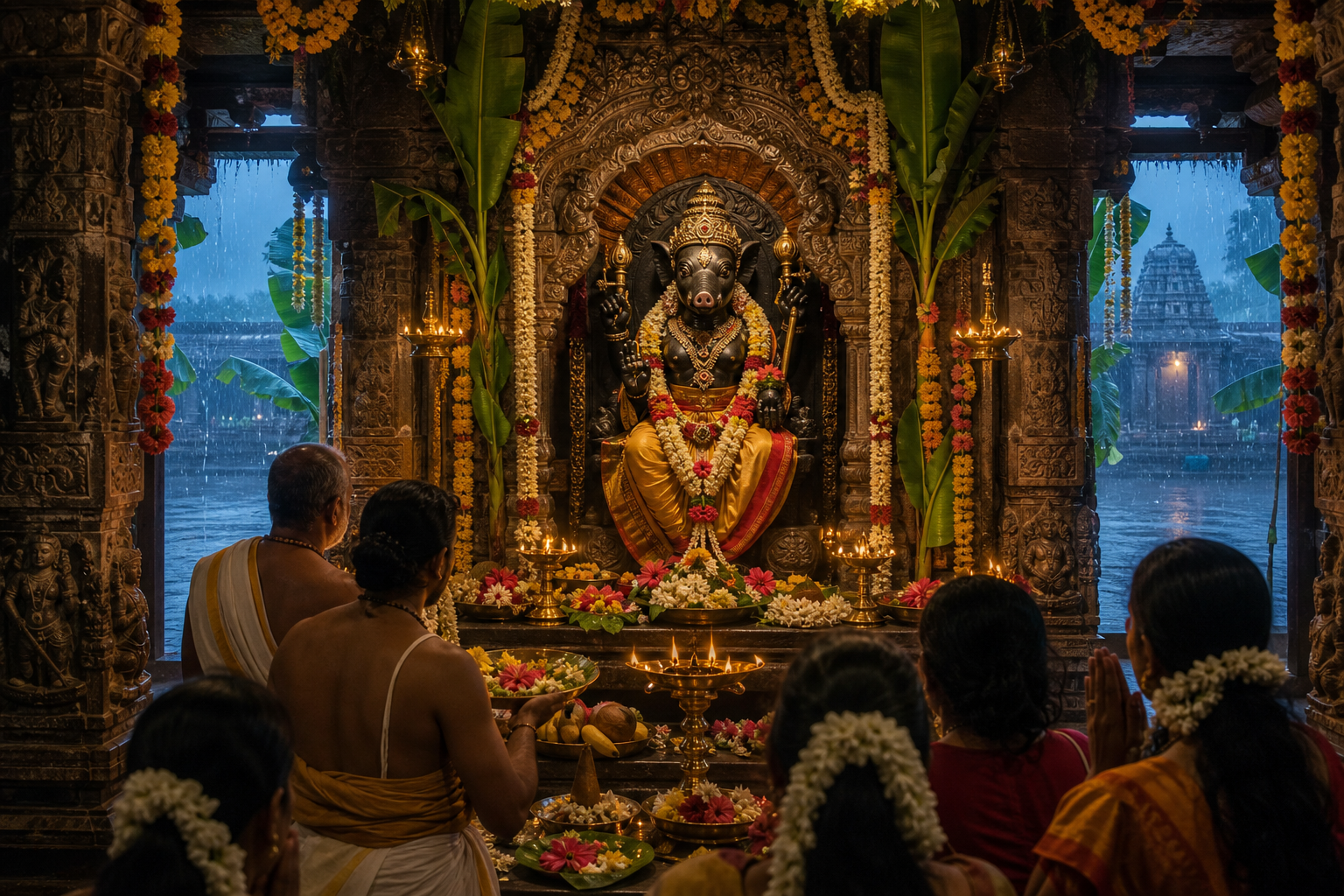
Varahi worship in South India cannot be understood through a directory of temples alone. The Tamil Nadu material describes dedicated sanctums, subsidiary images and locally rooted observances, while the Hyderabad account places Varahi Navaratri within a much wider season of Devi worship.
Read together, the two guides clarify how theology, iconography, institutional setting, lunar time and community practice shape a pilgrimage. They also show why a temple associated with Varahi and a temple visited during Varahi Navaratri are not necessarily the same kind of sacred destination.
Varahi connects several theological worlds
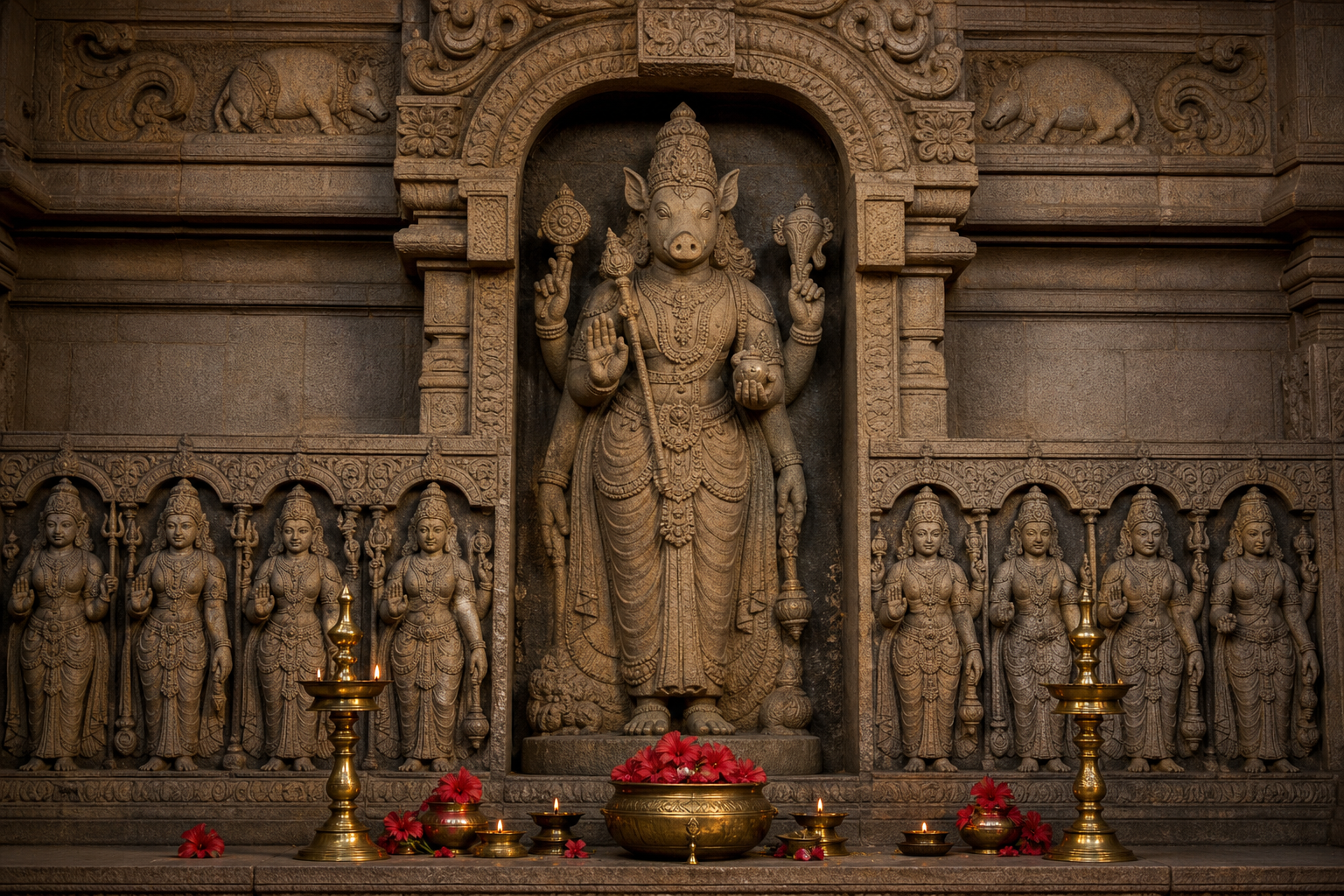
Both the Tamil Nadu temple guide and the Hyderabad Navaratri guide identify Varahi as one of the Sapta Matrikas, or Seven Mothers. Her boar-headed female form associates her with Varaha, the boar manifestation of Vishnu, yet her ritual importance lies substantially within Goddess traditions. Her presence in Shaiva settings adds another layer: a single image can bring Vaishnava symbolism, Shakta theology and a Shaiva temple environment into contact without erasing their differences.
The two accounts also resist reducing Varahi to divine ferocity. Her martial attributes signify protection, command and the restoration of order, while her place among the Mothers gives the image a nurturing dimension. Implements vary by image, period and lineage; the Tamil Nadu article mentions such possibilities as a staff, plough, sword, shield, goad, discus, conch and vessel. These are not a universal checklist. Posture, gestures, neighboring deities and the image’s architectural position all affect interpretation.
In some Sri Vidya traditions, the Tamil Nadu guide reports, Varahi is revered as Dandanayaki or Dandanatha, a commanding figure in the retinue of Lalita Tripura Sundari. That identity helps explain associations with discipline, authority, courage and strategy, but it should not be projected onto every shrine. The Hyderabad guide makes a parallel caution about Pratyangira and Varahi: both may be honored in a shared Shakta setting, but they remain distinct forms with distinct iconography and ritual disciplines.
Both articles point to a granite Varahi sculpture from the Kanchipuram region that the University of Michigan Museum of Art reportedly dates to approximately the early tenth century. Within the sources’ argument, this documented image is important because it places Varahi within an older history of Tamil sacred art, even though the present visibility of her worship is amplified by contemporary festival notices and social media.
Dedicated shrines and seasonal destinations serve different roles
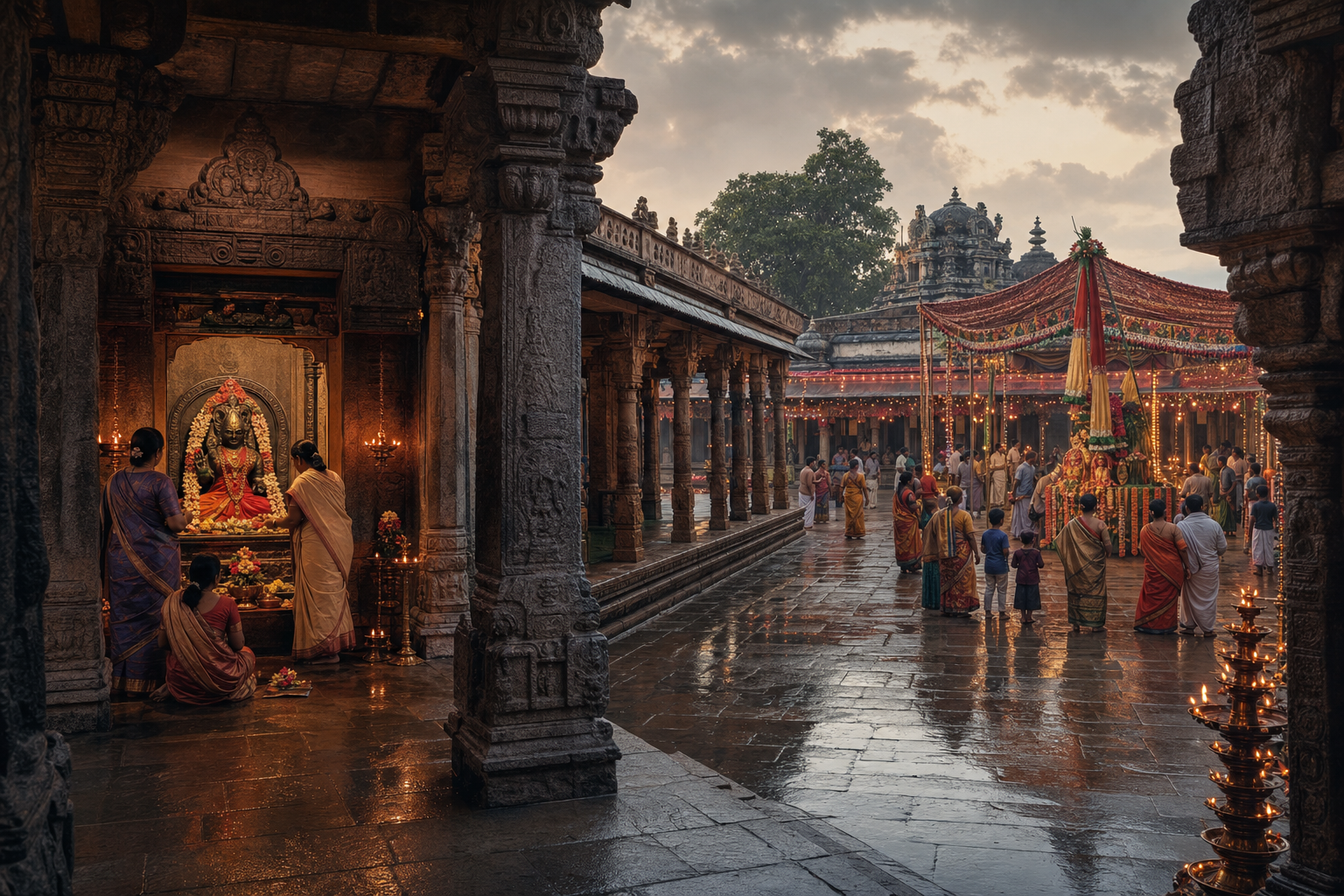
The Tamil Nadu guide approaches Varahi through places where her image has a direct institutional presence. It reports temples at Uthirakosamangai, Woraiyur in Tiruchirappalli, near Rathinamangalam, Karimangalam and near Katpadi. It also notes Varahi’s presence within the larger sacred and iconographic setting of the Brihadisvara Temple at Thanjavur.
That range reveals a crucial distinction. In an independent Varahi temple, the presiding deity, principal sanctum and public ritual identity center on Varahi Amman. In a larger temple complex, she may instead be a subsidiary deity, guardian or member of a Matrika group. Both forms preserve meaningful traditions, but an old Varahi sculpture inside an old complex does not by itself prove that an equally old independent Varahi temple once stood there.
The Uthirakosamangai account illustrates how a local shrine gathers several kinds of significance. The Tamil Nadu source reports that temple tradition regards its image as suyambu, or self-manifested, and that the image is protected or adorned with silver covering. It also describes turmeric-centered worship associated by devotees with auspiciousness, marriage, pregnancy, family stability and good fortune. These are reported devotional meanings rather than independently demonstrated historical or medical claims.
Hyderabad presents a different pattern. Its guide explicitly says that the metropolitan area has few temples devoted exclusively to Varahi. It therefore includes temples because they conduct relevant Poojas or Homams, or because Ashada Navaratri, Bonalu, Shakambari observances and other forms of seasonal Devi worship make them significant at the same time of year.
Among those destinations, the Sri Maha Pratyangira Parameshwari Devi Temple near Kothapet and Dilsukhnagar has the most direct connection reported in the guide: special Poojas and Homams for Varahi Navaratri. Sri Peddamma Thalli Temple in Jubilee Hills is included through its wider Ashada and Shakambari associations. The comparison shows that pilgrimage lists can be organized by two different questions: where Varahi is institutionally central, and where worshippers can participate in an appropriate Devi observance during her Navaratri season.
Sacred history requires more than one kind of evidence
The Tamil Nadu source offers an especially useful method for reading temple claims. Addresses, present locations and current programmes can often be checked through maps or institutional announcements. Sculptures can be studied through material form, museum records and architectural context. Claims about self-manifestation, extraordinary antiquity or the benefits of an offering usually belong first to temple tradition and devotional testimony unless inscriptions, archaeology or dated records provide separate support.
This distinction matters at Uthirakosamangai, where the guide reports a local claim that the Varahi shrine is approximately 3,200 years old. The article treats that number as sacred tradition because the evidence it consulted did not establish the same date archaeologically for the Varahi structure. This does not make community memory irrelevant. It means that devotional antiquity, the age of an image, the date of a sanctum and the history of the wider temple settlement should not be collapsed into a single claim.
The same reasoning applies in reverse. A recently constructed or renovated sanctum may embody an older theological idea, while an ancient image does not prove that every current ritual attached to it has remained unchanged since the image was made. The sources therefore support a layered history in which material evidence, oral memory, institutional development and present worship may follow different timelines.
This framework also helps interpret Varahi’s growing digital visibility. The Hyderabad article reports that online calendars, devotional talks and temple announcements have made Varahi Navaratri more familiar across parts of southern India. Increased visibility can explain how people discover a practice; it does not establish when the underlying Matrika tradition or regional Goddess worship began.
Ashada Navaratri is governed by lunar and local time
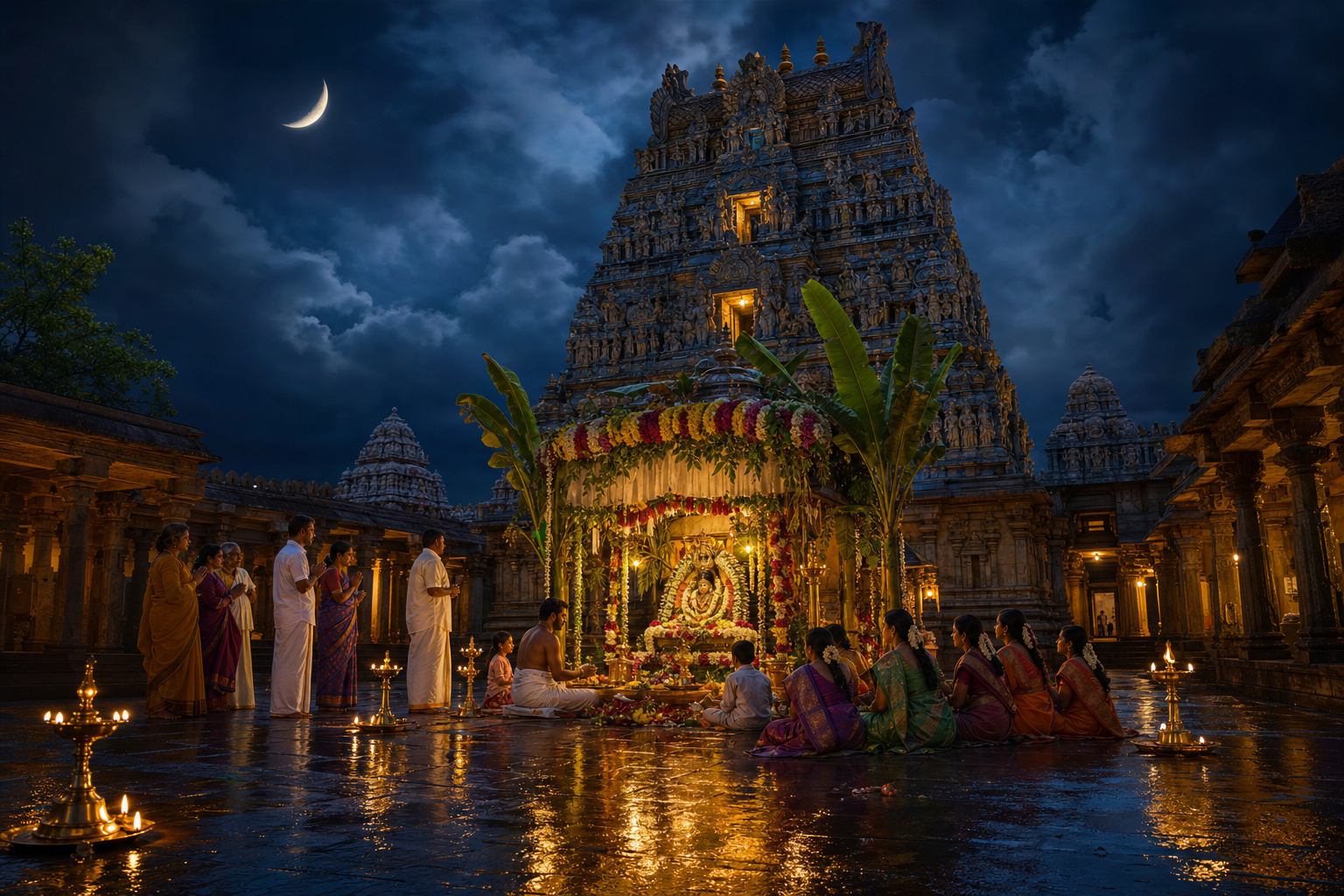
The Hyderabad guide describes Varahi Navaratri as Ashada Navaratri, a ninefold observance calculated through the Hindu lunar calendar rather than fixed Gregorian dates. The relevant civil dates consequently change from year to year. Regional Panchang conventions and temple lineages may also differ over the timing of the opening observance, concluding Pooja or principal Homam.
The guide recorded June 26 through July 4 for its 2025 coverage, but it expressly warns against reusing that historical range for another year. A visitor needs both a reliable regional Panchang and the current temple programme, especially where a lunar tithi begins or ends during a civil day. The temple may schedule worship according to sunrise, evening observance or its own ritual convention.
Ashada Navaratri is also described in some contemporary devotional calendars as a Gupta Navaratri. The Hyderabad source interprets this as an emphasis on quieter or lineage-specific practice, not as a claim that everything associated with the festival is secret. Public darshanam, archana and temple Pooja must be distinguished from specialized Tantric disciplines transmitted through qualified guidance. An announced public Homam is not permission to reconstruct restricted practices from unverified online instructions.
Hyderabad’s wider festival environment gives the observance a collective dimension. According to the source, Ashada Masam already supports neighborhood Devi temples, family worship and Bonalu traditions across Hyderabad and Secunderabad. Varahi Navaratri can therefore be experienced as a focused observance within an active regional culture of Goddess worship, rather than as an isolated nine-day event.
Key takeaways for a well-prepared pilgrimage
- Determine whether the destination is a dedicated Varahi temple, a subsidiary Varahi shrine or a wider Devi temple offering a seasonal programme.
- Confirm festival dates and participation arrangements with the temple instead of carrying forward a previous year’s Gregorian calendar.
- Treat self-manifestation, great antiquity and promised ritual benefits as devotional claims unless the source also identifies independent historical or scientific evidence.
- Follow the shrine’s authorized procedure for offerings, archana and Homam; do not assume that public worship and lineage-specific disciplines are interchangeable.
- Read each image in its own setting rather than expecting every Varahi to display the same implements, posture or theological emphasis.
Future temple documentation can make this landscape easier to understand by recording current schedules, shrine status, image context, inscriptions and oral traditions as distinct but related forms of knowledge. That approach can preserve the integrity of sacred memory while giving pilgrims a clearer account of what they are visiting.
References
- DharmaRenaissance Blog – Sacred Varahi Temples in Tamil Nadu: A Powerful Guide to Living Shakti Traditions
- DharmaRenaissance Blog – A Powerful Guide to Varahi Navaratri Pooja and Sacred Temples in Hyderabad