

Pidari Amman is most clearly understood not through a single fixed portrait, but through the relationship among divine power, place, community, and ritual memory. Her fierce appearance expresses protective authority, while her frequent association with village thresholds makes the shrine’s location part of its meaning.
This approach helps readers recognize both a shared theological pattern and the diversity of particular shrines. The available DharmaRenaissance account presents Pidari as a maternal guardian associated with Shakti, but repeatedly cautions that her myths, images, festivals, priesthoods, and relationships with other deities vary by locality.
Key takeaways
- Pidari Amman’s fierceness signifies the power to protect, restrain disorder, and uphold communal well-being; it should not be mistaken for malevolence.
- The honorific Amman frames her authority through sacred motherhood, joining intimacy and nurture with warning, discipline, and defence.
- A shrine’s boundary location, orientation, processional connections, and neighbouring deities can be as important as the visible features of its image.
- Historical inscriptions, oral traditions, temple icons, and present-day rituals preserve different kinds of evidence and need not yield one uniform biography.
- Changes in architecture, liturgy, offerings, or administration can represent adaptation within a continuing relationship between the goddess and her community.
Fierceness belongs to the grammar of sacred motherhood

The apparent tension between a fearsome goddess and a compassionate mother is central to Pidari Amman’s significance. The source describes her as fierce, maternal, and protective, and situates her within a Shakta understanding of divine energy. In that framework, Shakti is active power: it brings forth life, sustains it, confronts disorder, and transforms what can no longer remain as it is.
Fierceness, therefore, is not a contradiction of care. It is care represented as capable of decisive action. The source’s comparison with human motherhood is useful here: nourishment and affection do not exclude warning, discipline, or defence when a family’s safety is threatened. The title Amman, meaning Mother, communicates closeness to devotees while also acknowledging sovereign authority.
This theological frame also clarifies why a visually unsettling form should not be labelled demonic or cruel. Protective power may need to repel as well as welcome. Fire can sustain life and destroy contamination; a guarded threshold can extend hospitality while preventing violation. Pidari’s fearsome aspect makes that double capacity visible.
Local identifications require more caution. The source reports that some communities explicitly associate Pidari with Kali, Durga, Bhadrakali, Parvati, Mariamman, or other forms of Devi, while other shrines retain a more independent history and sphere of authority. These connections can express the unity of divine power without erasing the distinct memory of a particular place. No identification established at one shrine should automatically govern another.
The same restraint applies to the name itself. A devotional interpretation glosses Pidari as one who seizes danger, affliction, destructive forces, or even the devotee’s pride. The source treats this as spiritually meaningful but not as a settled linguistic derivation. It is best read as theological interpretation unless stronger philological evidence is supplied.
The boundary is part of Pidari Amman’s iconography
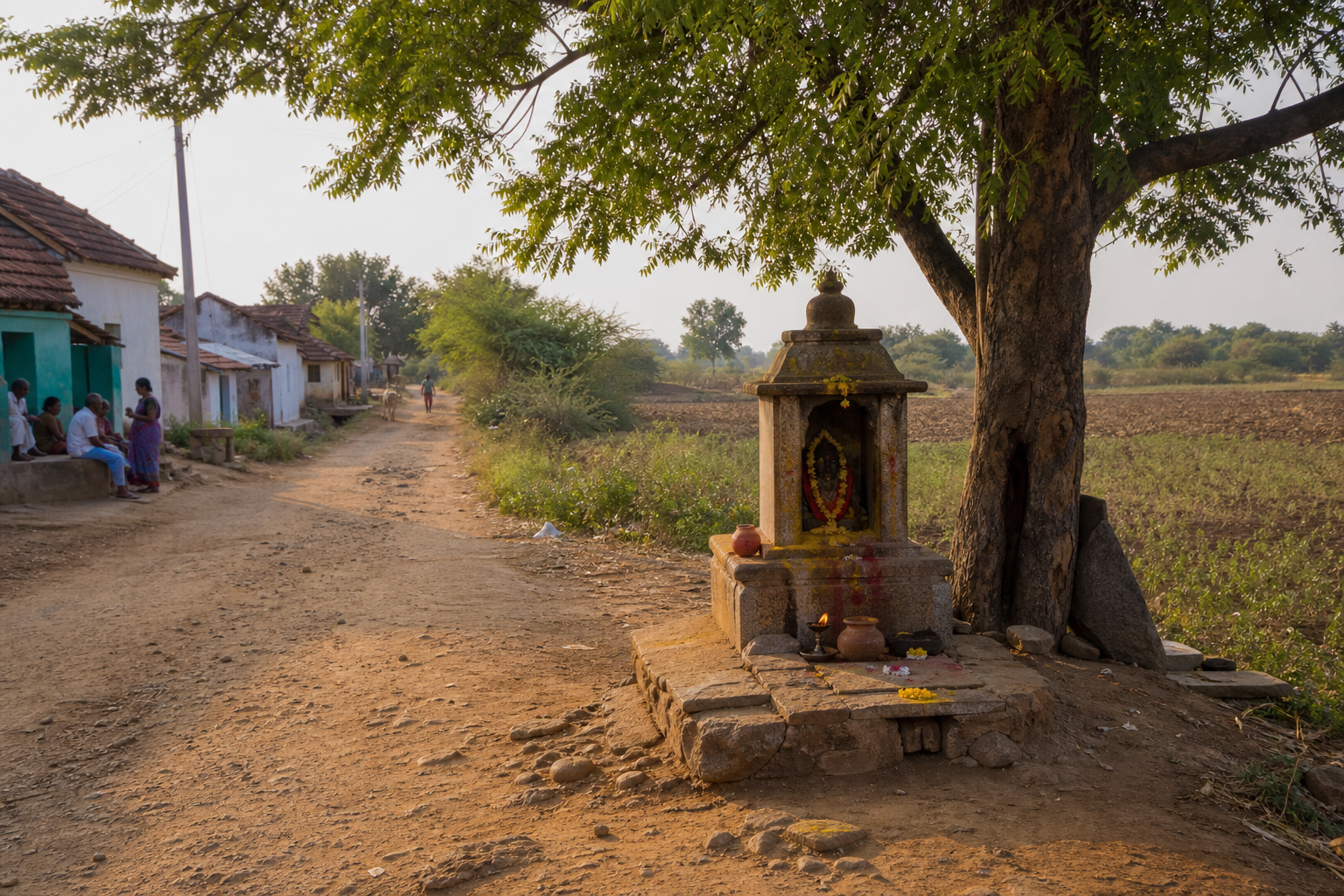
Iconography is often reduced to identifying objects held by a deity or matching a sculpture to a standard description. Pidari traditions call for a wider field of vision. The source notes that a shrine may stand near a village boundary, an old tree, cultivated land, a road, a water source, a grove, or an entrance. Such placement is not merely background scenery: it helps articulate what the goddess protects and where her protective authority is encountered.
A boundary is both a division and a meeting place. It marks the passage between settlement and less regulated space, cultivation and uncultivated ground, familiar social relations and incoming movement. Weather, trade, visitors, disease, conflict, and ecological uncertainty can all cross it. Locating a guardian there gives religious form to a community’s awareness that the conditions sustaining life are open to forces from beyond its immediate control.
Reading a Pidari shrine consequently involves several connected questions:
<!– wp:list {