
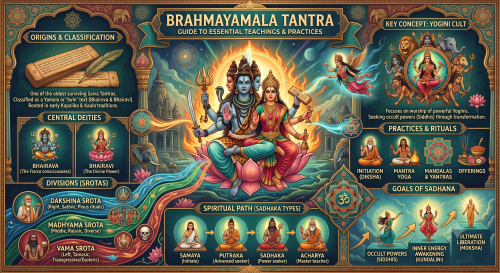
The Brahmayamala Tantra enters the available source not through a detailed account of doctrines or practices, but through a compact statement about its identity and historical importance. Hindu Pad reports that the text is also widely known as the Picumata and presents it as highly significant for the study of early Indian Tantra.
Because the supplied source is only a truncated feed excerpt, the most useful approach is to separate what it establishes from what remains unknown. That distinction protects both historical accuracy and the dignity of the sacred tradition.
What the source actually establishes
The source identifies the work by two names: Brahmayamala Tantra (ब्रह्मयामल तन्त्र) and Picumata (पिकुमत). Alternate titles matter because readers, cataloguers, and researchers may otherwise mistake two references for separate works. In textual study generally, establishing a work’s identity is a necessary step before interpreting its teachings or historical place.
Hindu Pad also characterizes the Brahmayamala as an important historical discovery for understanding early Indian Tantra. The excerpt begins to contrast it with the better-known Rudrayamala Tantra, but the sentence is incomplete. It therefore cannot support conclusions about how the two works are related, which is older, or whether they share teachings.
Key takeaways
- Brahmayamala Tantra and Picumata are presented as names for the same text.
- Hindu Pad frames the work as historically important to the study of early Indian Tantra.
- The supplied excerpt does not provide a date, author, structure, doctrines, rituals, or detailed teachings.
- The brief mention of the Rudrayamala should not be expanded into an unsupported claim about identity, influence, or precedence.
Why restraint strengthens Hindu scholarship
Tantra is a broad designation rather than a single uniform creed. A title alone cannot disclose a text’s complete theology, ritual system, community of transmission, or intended audience. Claims about those subjects require fuller textual evidence. Reverence for a scripture is therefore compatible with disciplined uncertainty; indeed, refusing to fill gaps with attractive speculation is a form of respect.
This approach also supports a knowledge-centered Hindutva. Cultural confidence is made durable by accurate preservation, attention to Indian names and categories, and patient engagement with sources. Inflated claims may attract attention briefly, but careful scholarship better serves Hindu civilizational renewal.
A shared Dharmic ethic of preservation
Hindu, Buddhist, Jain, and Sikh traditions possess distinct scriptures, doctrines, and lineages; the available source does not place the Brahmayamala within all of them. Their common ground lies elsewhere: each values the preservation, transmission, interpretation, and responsible study of inherited wisdom. Recognizing that shared discipline encourages Dharmic unity without erasing genuine differences.
Readers seeking more should look for a complete edition or a reputable scholarly treatment that explains its source materials and editorial method. Until such evidence is consulted, the sound course is to retain the two supported points – the alternate name Picumata and the text’s reported importance – while leaving its specific teachings open for careful study. That patient work can turn a promising reference into reliable understanding.
Inspired by this post on Hindu Pad.
