
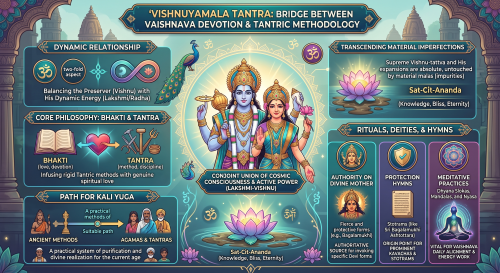
Hindu Pad presents the Vishnuyamala Tantra (विष्णुयामल तन्त्र) as an important scripture within the ancient Yamala group of Tantras. The supplied source, however, is a short feed excerpt that ends midway through its central explanation, so it supports an introduction rather than a detailed account of the text’s teachings.
This guide separates what the excerpt establishes from what remains unknown, while placing its limited comparison within the wider plurality of Dharmic traditions.
What the source actually establishes
The Hindu Pad excerpt identifies the Vishnuyamala Tantra by its Sanskrit name and describes it as belonging to the Yamala group. It also introduces the Brahma-yamala and Rudra-yamala as related points of comparison, associating those works with Shaiva-Shakta currents.
The excerpt then begins to distinguish the Vishnuyamala from those examples, but the sentence is truncated before that distinction is explained. Its missing conclusion cannot responsibly be reconstructed from the supplied material.
Why the fragment requires a cautious reading
The source provides no author, date, manuscript history, chapter outline, quotation, ritual instruction, or specific doctrine. Even its description of the work as ancient should be understood as Hindu Pad’s characterization, not as an independently established chronology in this article.
As a general principle of textual study, a title or sectarian association is only a starting point. Establishing what a scripture teaches normally requires access to the text, knowledge of its transmission, and attention to editions, recensions, translations, and commentarial settings. Assigning the Vishnuyamala a complete theology or ritual system without that evidence would turn a useful lead into speculation.
Key takeaways
- Hindu Pad places the Vishnuyamala Tantra within the ancient Yamala group.
- The excerpt compares it with the Brahma-yamala and Rudra-yamala.
- Those comparison texts are associated in the source with Shaiva-Shakta currents.
- The supplied fragment does not disclose the Vishnuyamala’s distinctive role or particular teachings.
Dharmic plurality without invented sameness
The comparison offers a narrow glimpse of the variety within Hindu textual culture. Traditions centered on Vishnu, Shiva, Shakti, and other divine forms have developed distinct scriptures, practices, and theological languages. The source places a Vishnu-named work beside Shaiva-Shakta examples, but it does not demonstrate that their doctrines are identical or that the Vishnuyamala combines them.
A constructive pro-Dharma approach can honor such proximity without flattening difference. The same principle strengthens solidarity among Hindu, Buddhist, Jain, and Sikh communities. Their teachings are not interchangeable, yet they can recognize a shared civilizational esteem for disciplined practice, ethical self-cultivation, teachers, sacred learning, and liberation. Unity becomes more credible when it protects the integrity of every sampradaya rather than manufacturing uniformity.
What responsible study should seek next
A fuller account would need a complete and reliable edition or translation, together with manuscript or scholarly evidence clarifying the work’s provenance, structure, intended practitioners, and relationship to other Yamala texts. Any claimed teaching should be checked against an accessible textual passage or documented commentary before being repeated as fact.
Future study that joins reverence with textual care can bring the Vishnuyamala into clearer view while keeping the transmission of Dharmic knowledge trustworthy for new generations.
Inspired by this post on Hindu Pad.
