

Narada’s warning to Kamsa is often retold as one simple disclosure: a sage tells a tyrant that Krishna will bring about his death. The supplied source comparison presents a more complex tradition in which the original prophecy, Narada’s intervention, and Kamsa’s violent response do not always occur in the same way.
Reading the accounts separately clarifies both the theological purpose attributed to Narada and the moral responsibility assigned to Kamsa. The central issue is not merely what Narada knew, but how different texts portray him transmitting that knowledge and how Kamsa turns it into repression.
A prophecy before Narada enters the story
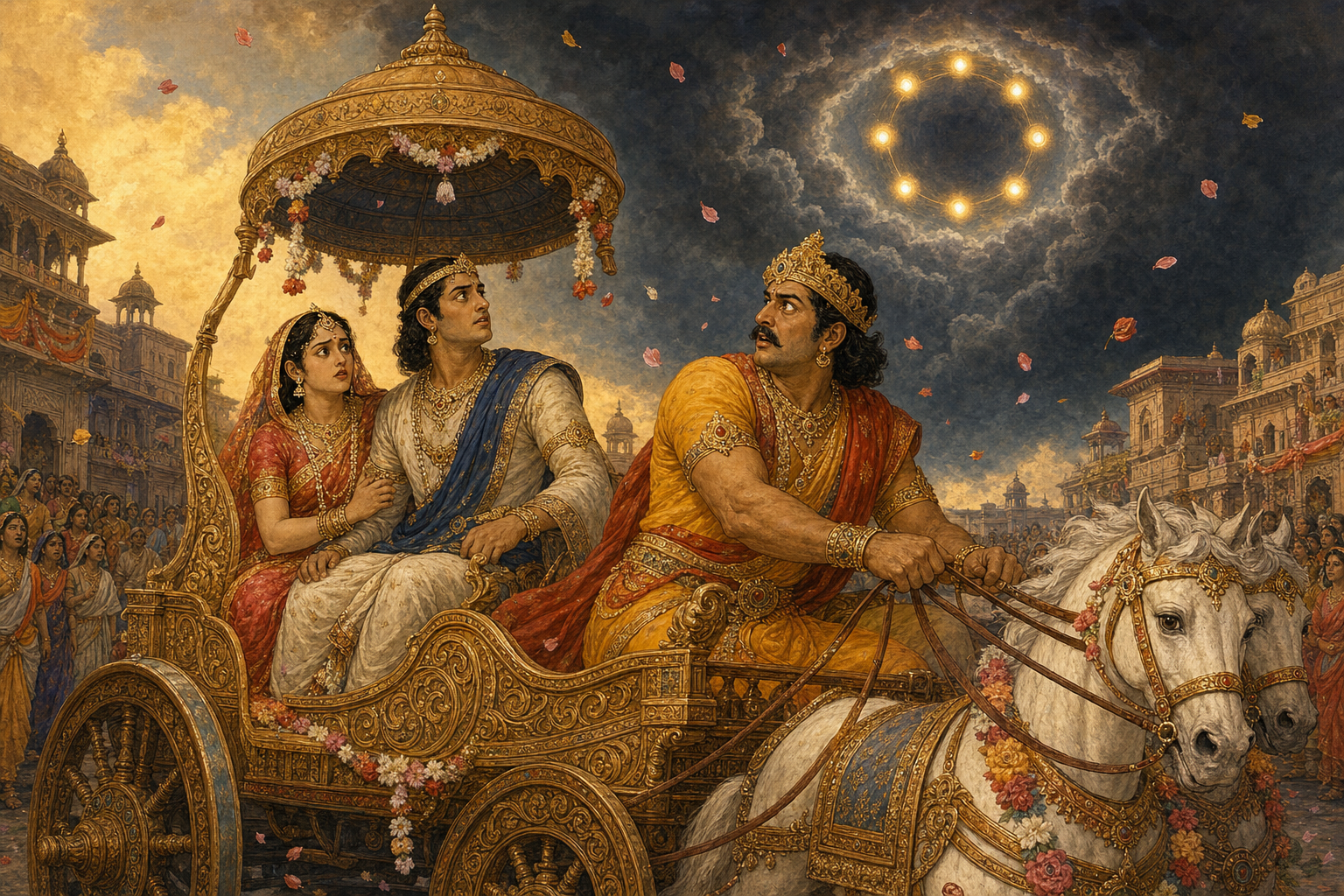
According to the DharmaRenaissance source article, the Srimad Bhagavatam does not make Narada the first person to warn Kamsa. In its account, a celestial voice speaks while Kamsa is driving the chariot of the newly married Devaki and Vasudeva. It announces that Devaki’s eighth son will cause Kamsa’s death.
Kamsa immediately prepares to kill Devaki. Vasudeva persuades him to spare her by promising to surrender her children. When Vasudeva later presents the firstborn, Kamsa returns the infant because he interprets the prophecy literally: the danger, he reasons, concerns the eighth child. Narada arrives only after this temporary reprieve.
This sequence changes the question that readers must ask. In the Bhagavatam, Narada is not revealing the existence of the threat for the first time. He is disrupting Kamsa’s confidence that the threat can be contained through simple birth-order arithmetic.
Three accounts assign Narada different roles
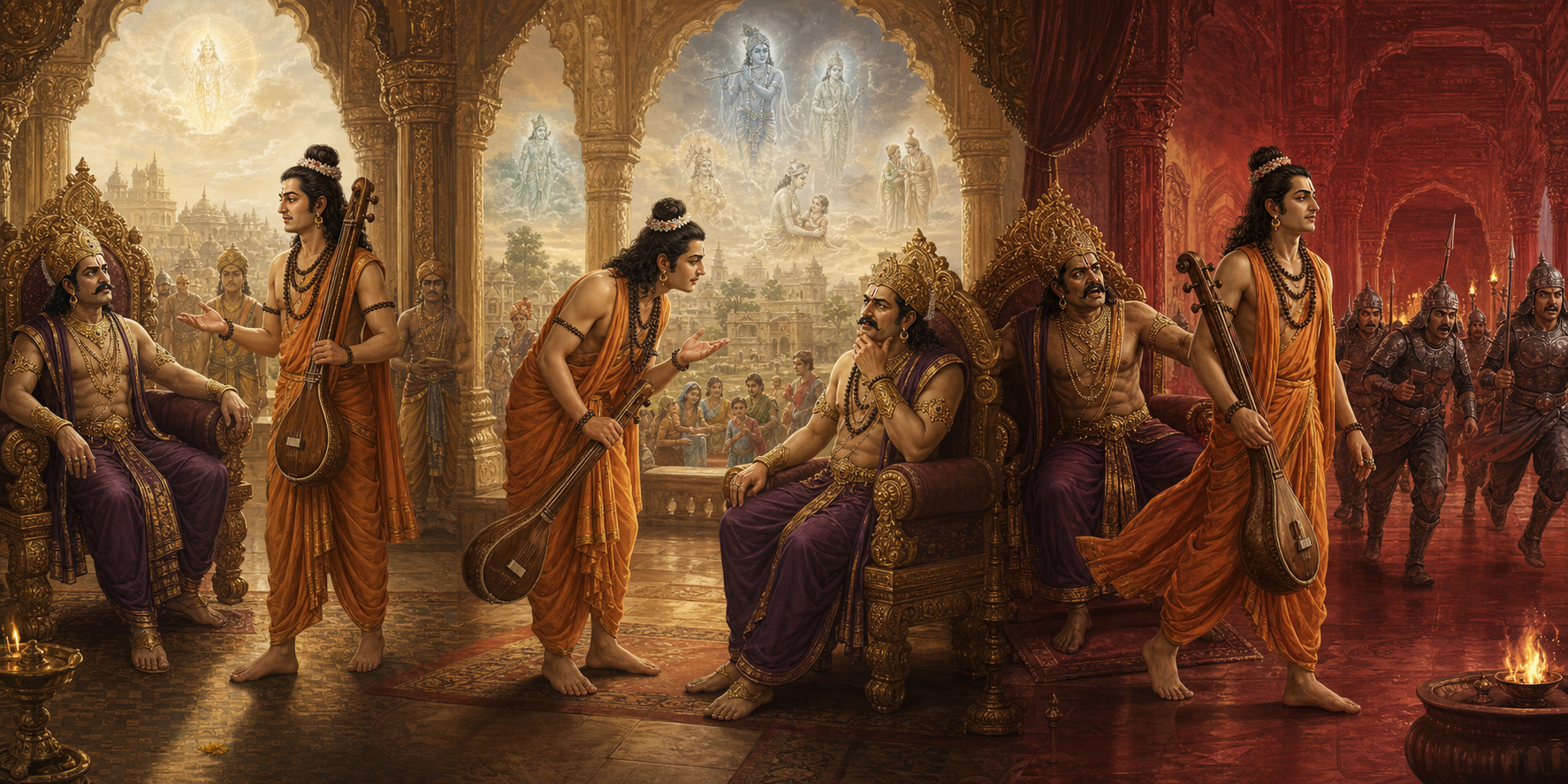
The source article compares the Bhagavata Purana, the Harivamsa, and the Vishnu Purana. Its comparison shows a shared narrative core but not an identical speech, chronology, or degree of intervention.
| Account | Narada’s reported intervention | Narrative emphasis |
|---|---|---|
| Bhagavata Purana | Narada informs Kamsa about the divine participants appearing among the Yadavas and residents of Vraja, the impending destruction of the powers burdening Earth, and Kamsa’s earlier identity as Kalanemi. | Kamsa concludes that any child could be Vishnu and expands his violence beyond the narrow terms of the original prophecy. |
| Harivamsa | Narada reportedly tells Kamsa that the divine assembly has considered his destruction, identifies Vishnu as the source of danger, recalls an earlier defeat, and urges action against Devaki’s pregnancy. | Narada appears as a more deliberate catalyst rather than solely a bearer of information. |
| Vishnu Purana | After a heavenly voice has already foretold danger from Devaki’s eighth child, Narada identifies Vishnu with her eighth conception. | Narada confirms the divine identity behind an existing prophecy, after which Kamsa’s anger intensifies and the parents are imprisoned. |
These differences prevent a single explanation from fitting every version without qualification. The Bhagavatam places greater weight on Kamsa’s paranoid inference. The Harivamsa gives Narada a more provocative function. The Vishnu Purana stands between them by presenting him as the person who confirms that Vishnu is behind the foretold danger.
The distinction is especially important when judging Narada’s responsibility. As the source article notes, the cited Bhagavatam passage does not place an instruction to murder Devaki’s children in Narada’s mouth. Kamsa hears information about the divine plan and chooses to answer it by imprisoning Devaki and Vasudeva, killing their sons, turning against the wider Yadu community, confining Ugrasena, and consolidating his rule.
Why the warning accelerates the conflict
The source situates Narada’s intervention within a cosmic crisis. Earth is represented as burdened by oppressive rulers and hostile powers, while Vishnu’s descent as Krishna forms the central divine response. Other divine beings appear among the Yadavas and in Vraja, making the restoration of order a coordinated descent rather than an isolated event.
Narada functions at the boundary between this divine intention and political history. He carries knowledge of the larger plan into Kamsa’s court. Once that hidden context becomes known, Kamsa no longer regards one future birth as the only possible danger. Suspicion spreads from the eighth child to Devaki’s other children and then to the communities connected with the divine descent.
Within the theological interpretation reported by the source, Narada’s disclosure accelerates Krishna’s manifest mission. Kamsa’s brief willingness to spare the firstborn had left him with a false sense of control. Narada’s information removes that complacency, exposes the full character of Kamsa’s rule, and brings the conflict between dharma and tyranny into the open.
The apparent paradox is that the warning seems to help Kamsa prepare. Yet his preparations do not overturn the divine purpose. They gather the conflict around him and propel him toward the outcome he is trying to avoid. The claim is therefore not that the divine plan requires or approves his cruelty, but that his resistance cannot place that plan beyond reach.
Foreknowledge does not remove moral responsibility
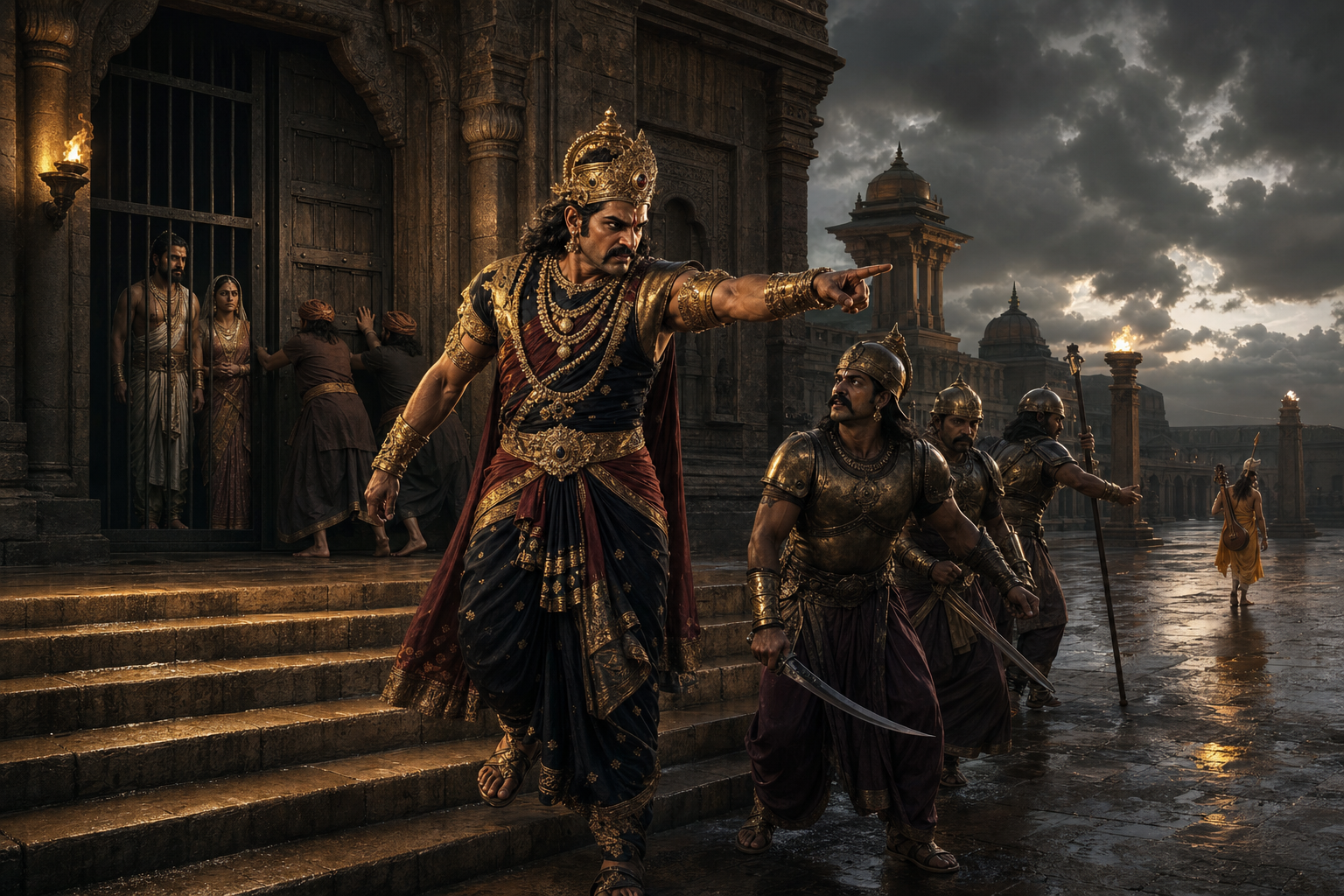
Kamsa’s response illustrates the difference between receiving knowledge and being compelled by it. A warning may alter the circumstances in which a person acts, but it does not automatically dictate the action chosen. Kamsa repeatedly selects coercion and violence: first against a family member, then against children, and eventually against a wider political and kinship network.
This point remains relevant even in the more provocative Harivamsa presentation. Narada may be depicted there as deliberately hastening the confrontation, but catalytic involvement and moral agency are not identical. The narrative still portrays Kamsa as acting from fear, hostility, and a desire for control.
Kamsa also creates the political reality he fears. By treating every uncertain possibility as an enemy, he transforms private anxiety into a system of repression. The warning exposes rather than implants this disposition: even before Narada’s arrival in the Bhagavatam sequence, Kamsa has already raised his sword against Devaki after hearing the celestial prophecy.
The cosmic framework should not make the suffering of Devaki or her children appear morally negligible. The source article emphasizes that her grief retains emotional weight even when the deaths are placed within a wider theological sequence. Divine sovereignty, on this reading, explains why tyranny cannot finally prevail; it does not turn tyrannical acts into virtues.
Key takeaways
- In the Bhagavata Purana and Vishnu Purana accounts summarized by the source, a heavenly voice announces the danger before Narada intervenes.
- Narada’s role varies by text: he discloses a broader cosmic plan, confirms Vishnu’s identity, or acts as an overt catalyst.
- The Bhagavatam distinction between Narada’s information and Kamsa’s inference is essential; the cited passage does not report Narada commanding the murder of the children.
- The warning accelerates the confrontation by destroying Kamsa’s false confidence and making his tyrannical disposition publicly consequential.
- Foreknowledge does not absolve Kamsa, because the violence remains his chosen response to the threat.
Future interpretations can preserve the force of Narada’s intervention by first identifying which textual account is under discussion. That discipline allows the theological question to remain profound without erasing meaningful differences in narrative or responsibility.