
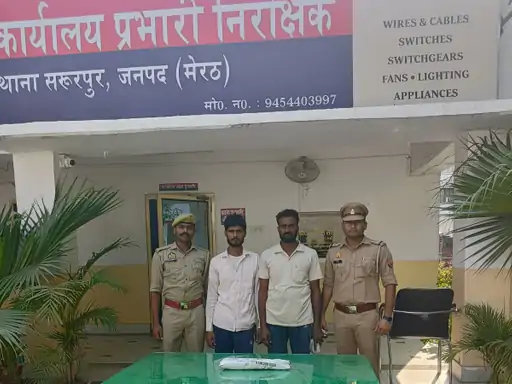
Uttar Pradesh Police reported a significant law-enforcement action in Meerut district after an alleged cow slaughter bid was foiled in the Sardhana area during the intervening night of April 12-13, 2026. The operation, conducted near Nagla Order village along the Ganga Canal belt, led to the arrest of three accused persons after a brief exchange of fire, the recovery of approximately one quintal, or 100 kilograms, of suspected beef, and the rescue of a live bovine from the site.
The case is important not merely as a local crime report, but as an example of how policing, animal protection laws, rural surveillance, and community sentiment intersect in western Uttar Pradesh. In a region where cattle hold deep cultural, agricultural, and religious significance for many communities, allegations of cow slaughter often create anxiety well beyond the immediate police station jurisdiction. A factual reading of the Sardhana case therefore requires attention to both the criminal investigation and the wider social responsibility of maintaining public order.
According to the police version, Sardhana police received specific intelligence around midnight that a group was preparing to slaughter cattle in a secluded forested area. A team led by Station House Officer Inspector Dinesh Pratap Singh then moved toward the reported location near Nagla Order village. The setting itself was operationally relevant: canal-side and forest-adjacent spaces can provide concealment, night movement, and temporary access routes for those attempting to evade routine monitoring.
Police stated that after reaching the area, the team surrounded the accused and challenged them to surrender. The official account says the accused opened fire at the police party, after which the police responded in self-defence using minimum necessary force. One accused sustained a bullet injury in the right leg, two others were arrested at the spot, and two to three suspected accomplices reportedly escaped under cover of darkness. A combing operation was subsequently launched in nearby areas.
The three arrested persons were identified as Monish alias Monu, Dilshad alias Dillu, and Sartaj alias Dhamaka. Monish, who was injured during the encounter, was taken to the Community Health Centre, Sardhana, for medical treatment. The identification details released by police place all three accused within Meerut district, with links to areas falling under Lisadi Gate police station jurisdiction.
Police records cited in the case state that Monish has a prior criminal history, including at least five FIRs registered across different Meerut police stations. The earlier cases reportedly include allegations under provisions related to theft, attempt to murder, receiving stolen property, and house-breaking. Such prior records do not determine guilt in the present case, which must be established through evidence and judicial process, but they are relevant to police claims about the accused persons’ alleged criminal background.
The recoveries from the location form the evidentiary core of the case. Police reported the seizure of one live cow, approximately one quintal of suspected beef, a Honda City car allegedly used for transport, three knives, two large spears, one axe, a weighing scale, ropes, and other implements associated with slaughter. Police also recovered one 315-bore country-made pistol, one live cartridge, and one empty cartridge, which brought the Arms Act into the legal framework of the FIR.
From an investigative standpoint, the seized items matter because they may help establish preparation, possession, transport, and possible distribution links. The alleged presence of weighing equipment and a vehicle suggests that investigators will likely examine whether the operation was limited to a single slaughter attempt or connected to a broader supply chain. In cattle smuggling and illegal slaughter cases, the logistics often reveal more than the immediate scene: vehicle ownership, mobile phone records, payment trails, and buyer networks can become decisive.
Sardhana police registered FIR No. 262/2026 under multiple legal provisions. These include Section 109(1)/3(5) of the Bharatiya Nyaya Sanhita, provisions of the Arms Act relating to illegal firearms and ammunition, and Sections 3/5/8 of the Uttar Pradesh Prevention of Cow Slaughter Act. The accused were produced before the competent court and remanded to judicial custody, while police teams continued efforts to identify and arrest the absconding suspects.
The Uttar Pradesh Prevention of Cow Slaughter framework is among the strictest such legal regimes in India. Under the amended legal approach publicized by the state government, cow slaughter can invite rigorous imprisonment of up to 10 years and fines ranging from Rs 3 lakh to Rs 5 lakh. The law also treats injury, mutilation, illegal transport, and related conduct with seriousness, reflecting the state’s declared policy of strong enforcement against cow slaughter and cattle smuggling networks.
The broader state context gives the Sardhana case additional significance. In March 2026, the Uttar Pradesh government stated that since the 2020 amendment ordinance, 14,182 cow slaughter-related cases had been registered across the state and 35,924 accused persons had been arrested. The government also reported that 13,793 accused had been booked under the Goonda Act, 178 under the National Security Act, and the Gangster Act had been invoked in 14,305 cases.
The government further stated that properties worth approximately Rs 83.32 crore had been seized under Section 14(1) of the Gangster Act from accused persons linked to such networks. These figures indicate that the state sees illegal cow slaughter not only as an animal protection violation, but also as a form of organized criminal activity involving transport routes, illegal earnings, repeat offenders, and inter-district linkages.
Special police teams, district-level task forces, intelligence monitoring, border vigilance, and intensified night patrolling have become central elements of this enforcement model. In districts such as Meerut, where urban density, rural belts, highway access, and canal-side geography coexist, policing such offences requires coordination between local intelligence, rapid response teams, forensic support, and routine field surveillance.
The Sardhana case also highlights why forensic procedure is essential. Police have indicated that samples from the recovered meat were collected for laboratory analysis to confirm the species of origin. This step is not a technical formality; it is crucial for evidentiary integrity. In cases involving allegations of cow slaughter, forensic confirmation helps courts distinguish between suspicion, public sentiment, and legally admissible proof.
Similarly, verification of the seized vehicle’s registration documents may help determine ownership, usage history, and possible links to previous incidents. Call detail records and digital footprints of the arrested accused may also be examined to map suspected accomplices, transporters, suppliers, buyers, or handlers. In modern policing, such digital and documentary trails often determine whether an incident remains a local case or expands into a wider criminal investigation.
At the social level, cow protection remains an emotionally charged subject because the cow occupies a place of reverence in Hindu society and also has historical associations with agrarian life, dairy economies, and village households. For many families, especially in rural India, cattle are not abstract symbols; they are tied to livelihood, memory, ritual, and daily discipline. This emotional layer explains why allegations of illegal slaughter can provoke deep distress among communities.
At the same time, a Dharmic and constitutional response must remain rooted in lawful process. Reverence for life, compassion toward animals, and respect for community sentiment are strengthened when enforcement is evidence-based, accountable, and disciplined. The Sardhana operation, as described by police, will ultimately be judged through investigation, forensic findings, court scrutiny, and the ability of the prosecution to establish the charges under law.
This distinction is important because public order depends on the state retaining responsibility for enforcement. The proper response to suspected cow slaughter is not rumor, retaliation, or social targeting, but prompt reporting, lawful police action, preservation of evidence, and judicial adjudication. Such an approach protects animal welfare, respects religious sentiment, and prevents wider communal polarization.
The police team involved in the operation reportedly worked under the supervision of the Superintendent of Police (Rural) and the Circle Officer, Sardhana, as part of a broader campaign directed by the Senior Superintendent of Police, Meerut. The team included Inspector Dinesh Pratap Singh, twelve Sub-Inspectors, one Head Constable, and four Constables from Sardhana police station. The size of the team suggests that the police treated the intelligence input as operationally serious.
For Meerut district, the case reinforces several policy lessons. First, intelligence-led policing can prevent offences before they escalate. Second, night surveillance in vulnerable rural belts remains necessary. Third, forensic testing and documentary verification are central to credible prosecution. Fourth, cattle smuggling and illegal slaughter cases should be investigated as structured networks when recoveries suggest transport, weighing, storage, or distribution activity.
The matter now rests with the continuing investigation and the courts. The accused retain the legal protections available under criminal procedure, while the state carries the burden of proving the allegations. The public interest lies in a complete investigation: identifying absconding suspects, verifying the recovered meat, tracing the vehicle, examining digital records, and determining whether the Sardhana incident was an isolated attempt or part of a wider illegal supply chain operating in western Uttar Pradesh.
Viewed carefully, the Sardhana action is therefore more than an encounter report. It is a case study in the challenges of enforcing cow protection laws in a region where faith, agriculture, criminal networks, animal welfare, and public order meet. A principled response must combine firm policing with procedural fairness, cultural sensitivity with constitutional discipline, and community concern with evidence-based justice.
Inspired by this post on Hindu Post.
