
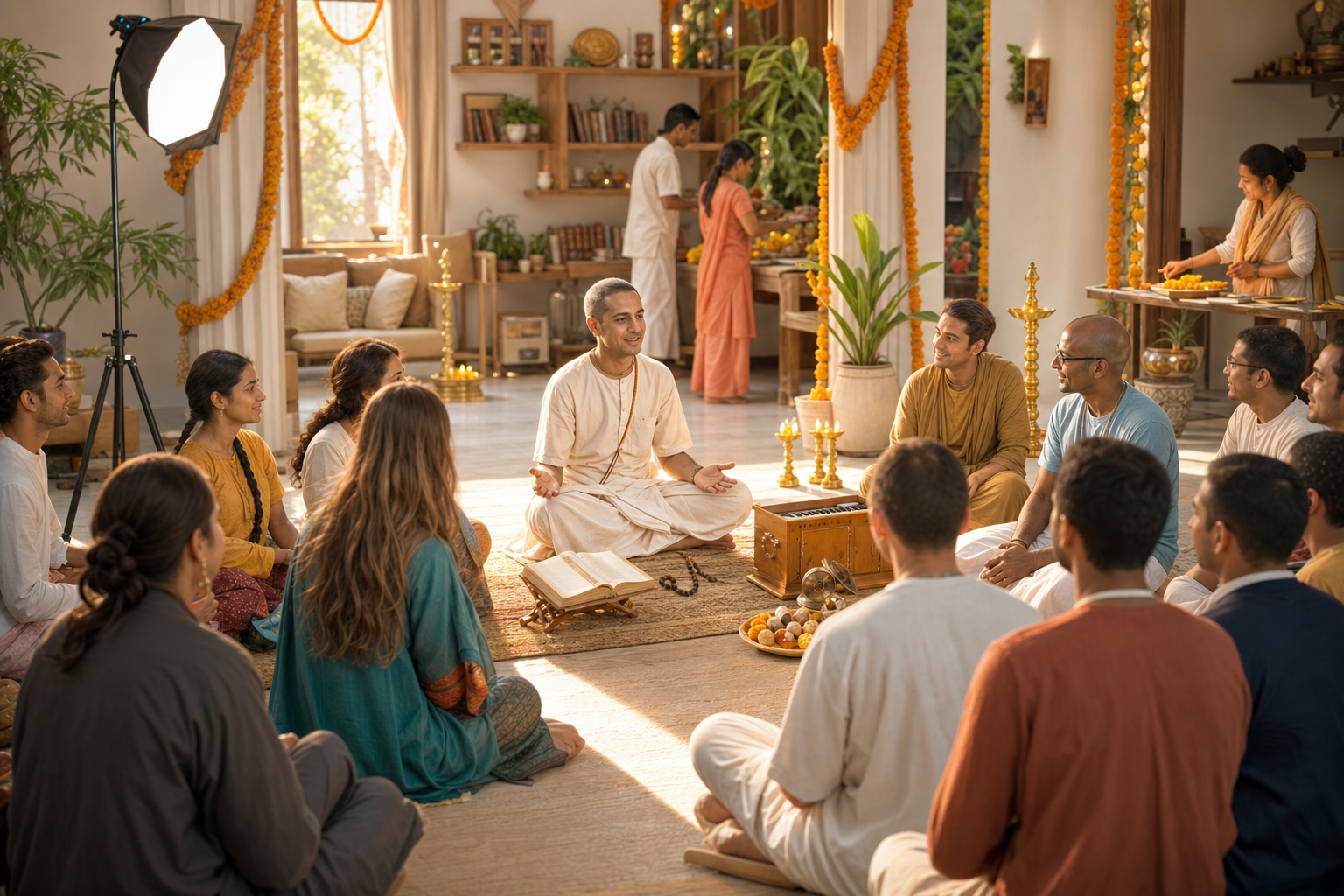
The title “In The Loop, Devotee Spotlight, Viracandra Dāsa, Bhaktiman Dāsa, Vrajavasi Dāsa – Aniruddha Dasa” points toward a devotional media segment centered on lived bhakti, community service, and the personal journeys of practitioners within the Hare Krishna and wider Sanatana Dharma tradition. The available source material is minimal, consisting primarily of a thumbnail and title, so the following reflection avoids inventing biographical details about Viracandra Dāsa, Bhaktiman Dāsa, Vrajavasi Dāsa, or Aniruddha Dasa. Instead, it examines the larger significance of such a devotee spotlight: why communities record these conversations, what they reveal about spiritual practice, and how they contribute to continuity, humility, and unity among dharmic traditions.
A devotee spotlight is more than a simple interview format. In the context of ISKCON, the Hare Krishna movement, and broader Hindu spiritual culture, it functions as a living archive of devotion. Texts such as the Bhagavad Gita, Srimad Bhagavatham, and the writings of Vaishnava acharyas provide philosophical structure, while the lives of practicing devotees show how those teachings are absorbed into daily conduct. When a community pauses to listen to practitioners, it is recognizing that dharma is not preserved only in manuscripts, temples, rituals, or institutions; it is also preserved in character, service, discipline, memory, and relationships.
The phrase “In The Loop” suggests an effort to keep the community informed, connected, and spiritually attentive. In a modern devotional setting, this kind of communication matters because spiritual communities are no longer confined to one village, one temple town, or one regional network. ISKCON and related Vaishnava communities are globally distributed, with devotees living across India, North America, Europe, Africa, Australia, and beyond. Digital conversations, video spotlights, and community updates have become contemporary extensions of satsang, allowing practitioners to remain connected to shared values even when they are physically distant.
The names Viracandra Dāsa, Bhaktiman Dāsa, Vrajavasi Dāsa, and Aniruddha Dasa carry the language of devotional identity. In the Vaishnava tradition, a name ending in “Dasa” expresses service: the devotee is not defined primarily by status, profession, wealth, or personal achievement, but by relationship with Krishna and by service to the divine, the guru, and the community. This naming culture is not merely symbolic. It trains the mind to remember that spiritual life begins with humility. The name itself becomes a discipline, a repeated reminder that the highest identity is not domination but devotion.
Bhakti, in its most mature form, is not sentiment alone. It includes philosophical clarity, ethical responsibility, disciplined practice, and service-oriented living. The Bhagavad Gita presents bhakti as a path that integrates knowledge, action, meditation, and surrender. It is not an escape from the world, nor is it a rejection of reason. Rather, it redirects human energy toward a higher center. A devotee spotlight can therefore become a practical commentary on the Gita: not through abstract argument alone, but through the visible example of people attempting to live with steadiness, compassion, and accountability.
Within the Hare Krishna movement, spiritual practice is commonly organized around chanting, hearing, worship, study, prasadam, seva, and association with devotees. These practices are technical in the sense that they are repeatable methods for cultivating consciousness. Japa disciplines speech and attention. Kirtan integrates sound, memory, rhythm, and devotion. Scriptural study gives conceptual clarity. Temple service trains the body and mind in responsibility. Prasadam transforms food from consumption into gratitude. Satsang reinforces values through shared practice. When seen together, these are not isolated rituals; they form an integrated system of spiritual formation.
Such a system also has psychological depth. Modern life often encourages fragmentation: work is separated from values, identity is separated from duty, and emotion is separated from discipline. Bhakti practice attempts to reunify these dimensions. A person chants not only to complete a ritual count, but to refine attention. A person serves not only to keep a temple functioning, but to reduce self-centeredness. A person studies scripture not only to gain information, but to transform perception. The devotee spotlight format becomes meaningful because it allows these inner processes to be discussed in human terms.
Devotee narratives often matter because they reveal gradual transformation. Spiritual life is rarely a dramatic instant of perfection. It is more often a series of small disciplines, small corrections, and small acts of faithfulness carried over many years. The ordinary texture of practice is therefore important: arriving for service when tired, continuing japa through distraction, forgiving others in community life, accepting guidance from seniors, and learning to serve without demanding recognition. These details may appear modest, yet they are the substance of lived dharma.
The guru-shishya tradition is central to understanding this devotional world. In Vaishnava practice, knowledge is not treated as private invention. It is received, tested through practice, clarified through association, and passed forward responsibly. This does not mean blind obedience or the suspension of thought. At its best, the guru-shishya relationship joins reverence with discernment, humility with inquiry, and tradition with lived realization. A devotee spotlight can illuminate how practitioners receive guidance, struggle with application, and mature through service.
Community is equally important. The Sanskrit idea of sangha, though often discussed in Buddhist contexts, resonates deeply across dharmic traditions. Hinduism, Buddhism, Jainism, and Sikhism all recognize that individual effort is strengthened by ethical community. A person may begin with private inspiration, but long-term transformation usually requires shared discipline, examples of integrity, and a culture that normalizes spiritual aspiration. Devotee spotlights help preserve that culture by making service visible without turning it into celebrity.
This distinction is crucial. A spiritually healthy spotlight does not glorify personality for its own sake. It honors the principle that sincere service can inspire others. In devotional culture, the purpose of recognition is not ego inflation but gratitude. When a community recognizes a devotee, it is ideally recognizing Krishna’s grace, the influence of teachers, the support of family and community, and the quiet sacrifices that allow spiritual institutions to function. This approach protects the dignity of the person while keeping the focus on bhakti and seva.
Seva is one of the most powerful keywords for understanding the subject. In many modern settings, service is measured by output, efficiency, or public reward. In bhakti, seva is measured more deeply by intention, steadiness, humility, and alignment with dharma. A task may be externally simple, such as cleaning a temple floor, arranging flowers, cooking, teaching, editing media, organizing events, or welcoming guests. Yet the inner discipline can be profound. The act becomes a training ground for consciousness.
Devotional media also has an educational function. Many younger seekers first encounter Hindu philosophy, ISKCON, kirtan, or the Bhagavad Gita through digital platforms rather than through traditional family transmission. A well-produced devotee spotlight can therefore introduce not only names and personalities, but also vocabulary, values, and practices. It can show that Hindu spirituality is not confined to festival days or inherited identity. It is a disciplined way of seeing, acting, eating, speaking, learning, and relating.
The emotional appeal of such content lies in its relatability. Many people approaching spiritual life carry ordinary concerns: uncertainty, fatigue, family responsibilities, doubts, career pressure, loneliness, or a desire for meaning. A devotee’s story can make the path feel human rather than distant. It can show that spiritual steadiness is possible even in imperfect circumstances. This is especially important in diaspora communities, where devotees may be balancing inherited traditions with modern institutions, multicultural environments, and demanding schedules.
At the same time, an academic and factual reading must acknowledge that devotional communities are complex. They include ideals, institutions, achievements, tensions, reforms, and learning processes. A mature spotlight should not reduce spiritual life to polished inspiration. It should allow space for discipline, accountability, and growth. The strongest dharmic communities are not those that deny difficulty, but those that transform difficulty through humility, honest reflection, and renewed commitment to dharma.
The Vaishnava concept of Vraja is also significant in the name Vrajavasi Dāsa. “Vrajavasi” refers to one connected with Vraja, the sacred landscape associated with Krishna’s childhood pastimes, including Vrindavan. In devotional imagination, Vraja is not merely geography. It represents intimacy with the divine, simplicity of heart, and love that is not transactional. A name invoking Vraja carries a theological memory: the highest devotional culture is rooted in loving service, not external power.
Similarly, names such as Bhaktiman Dāsa and Viracandra Dāsa communicate ideals. “Bhakti” points to devotion, while “vira” often carries associations of courage or heroism. In a spiritual context, heroism does not necessarily mean conquest in the worldly sense. It may mean conquering anger, envy, laziness, pride, or distraction. It may mean remaining gentle under pressure. It may mean protecting a tradition without becoming harsh toward others. Dharmic courage is most authentic when it is joined with compassion and self-control.
Aniruddha Dasa, named in the title after the hyphen, may indicate a host, presenter, organizer, or associated devotee, though the available source does not provide enough detail to establish the exact role. The name Aniruddha has deep Vaishnava resonance, being associated with one of the forms in the Chatur-vyuha theology of the Pancharatra tradition. Even when a media title provides little context, such names carry a theological universe. They connect contemporary practice with Sanskrit vocabulary, Puranic memory, and living Vaishnava identity.
The broader significance of a devotee spotlight is therefore cultural preservation. Hindu traditions have always relied on multiple channels of transmission: scripture, temple ritual, family practice, pilgrimage, music, oral storytelling, festivals, philosophical debate, and the visible example of practitioners. Digital devotional media adds another channel. It does not replace traditional forms, but it can support them when used with seriousness. It helps document voices that might otherwise remain local and unrecorded.
For unity among dharmic traditions, this kind of content can be especially valuable when presented with generosity. Hinduism, Buddhism, Jainism, and Sikhism have distinct metaphysics, histories, rituals, and institutions, yet they also share civilizational concerns: ethical self-discipline, liberation from ego-centered living, reverence for teachers, respect for practice, and the cultivation of compassion. A Vaishnava devotee spotlight can remain firmly rooted in Krishna bhakti while still contributing to a wider dharmic culture of mutual respect.
This point matters because spiritual identity can either deepen humility or harden into rivalry. The healthiest devotional expression does not require diminishing other dharmic paths. A Krishna devotee can speak with conviction about bhakti while recognizing the sincerity of a Jain practitioner’s austerity, a Buddhist practitioner’s mindfulness, a Sikh practitioner’s seva, or a Shaiva and Shakta practitioner’s worship. Unity does not mean sameness. It means principled respect, shared ethical seriousness, and protection of the civilizational space in which diverse paths can flourish.
The Hare Krishna movement has played a notable role in globalizing Sanskrit names, kirtan, prasadam distribution, Bhagavad Gita study, and temple-centered devotional life. Srila Prabhupada’s mission brought Gaudiya Vaishnava teachings into new linguistic and cultural contexts during the twentieth century. That history gives contemporary devotee spotlights an added importance. Each practitioner’s story becomes part of a larger question: how does an ancient bhakti tradition remain faithful to its roots while speaking meaningfully to modern seekers?
The answer is not found in novelty alone. It is found in translation without dilution. The terminology of Krishna, bhakti, seva, guru, japa, kirtan, prasadam, and sadhana must be explained clearly, but not emptied of meaning. Devotional life becomes accessible when practitioners show its relevance through conduct. A spotlight can accomplish this by grounding philosophy in experience: how chanting affects attention, how service reshapes identity, how scripture guides decisions, and how community sustains perseverance.
From a technical perspective, the structure of such devotional formation is remarkably systematic. There is a daily discipline of sound through mantra. There is a food ethic through prasadam. There is a calendar discipline through Ekadashi, festivals, and holy days. There is embodied practice through temple worship, pilgrimage, and service. There is intellectual discipline through scripture. There is relational discipline through guru, senior devotees, peers, and guests. Together, these practices create a complete ecology of spiritual life.
This ecology also responds to contemporary problems. In an age of distraction, japa trains attention. In an age of loneliness, satsang restores belonging. In an age of consumption, prasadam teaches gratitude. In an age of self-branding, seva teaches humility. In an age of shallow information, scripture teaches depth. In an age of anxiety, kirtan gives the heart a sacred rhythm. These are not merely poetic claims; they describe the practical functions that devotional disciplines often serve in the lives of practitioners.
A well-framed spotlight can also help correct misconceptions about Hindu spiritual life. Devotion is sometimes misunderstood as anti-intellectual, ritual is dismissed as mechanical, and renunciation is caricatured as life-denying. In practice, serious bhakti can be intellectually rich, emotionally refined, socially active, and aesthetically profound. Gaudiya Vaishnava theology includes complex discussions of rasa, ontology, divine personality, scriptural hermeneutics, and the relationship between grace and effort. A simple devotee interview may open the door to this deeper world.
The personal dimension remains central, even in academic reflection. Many people remember a first kirtan, a first taste of prasadam, a conversation with a patient devotee, or a moment in a temple that felt unexpectedly peaceful. Such memories often become entry points into deeper inquiry. A devotee spotlight can evoke that same recognition: spiritual traditions are sustained not only by grand architecture or famous teachers, but by ordinary people whose sincerity makes the tradition approachable.
There is also a lesson in continuity. Devotees who serve over time become bridges between generations. They remember earlier struggles, preserve local histories, mentor newcomers, and model resilience. In many communities, much of this work is informal and easily overlooked. Recording these stories honors invisible labor. It also teaches younger practitioners that dharma is not inherited passively; it is maintained through disciplined care.
The academic value of devotee narratives lies in their ability to show religion as lived practice. Scholars of religion often distinguish between textual tradition and lived religion. Texts provide doctrine, but lived religion reveals interpretation, adaptation, and daily embodiment. A spotlight on devotees can therefore become a source for understanding contemporary Hinduism, diaspora religious identity, institutional memory, and the practical ethics of bhakti communities.
However, responsible interpretation requires caution. Since the source content does not provide a transcript, biographical profile, or detailed webpage, specific claims about the individuals named should not be asserted without verification. The reliable conclusion is narrower but still meaningful: the title identifies a devotional feature involving named Vaishnava practitioners, and such features are culturally significant because they preserve community memory, illustrate bhakti in practice, and strengthen spiritual association.
In this sense, the spotlight format reflects a classical dharmic principle: knowledge is not fully alive until it is embodied. The Bhagavad Gita is studied, but it is also lived through choices. Kirtan is performed, but it is also internalized as remembrance. Seva is organized, but it is also a transformation of the heart. Community is discussed, but it is also built through patience, forgiveness, and responsibility. Devotees become important not because they replace scripture, but because they show scripture becoming practice.
The title’s focus on multiple devotees also suggests that spiritual life is not solitary heroism. Bhakti develops in relationship. One practitioner may inspire steadiness, another may teach humility, another may preserve tradition, and another may organize communication. The community becomes a web of complementary service. This is consistent with the dharmic understanding that social harmony emerges when individuals perform their duties with sincerity and without excessive ego.
For readers interested in Hindu spirituality, the practical takeaway is clear. A devotee spotlight should not be consumed merely as content. It can become an invitation to examine one’s own practice. Is there regularity in sadhana? Is service performed with humility? Is knowledge being deepened through scripture? Is community being strengthened through kindness and responsibility? Are other dharmic paths approached with respect? These questions turn a media segment into a mirror for spiritual growth.
For community leaders, the lesson is equally important. Recording and sharing devotee stories can strengthen identity when done thoughtfully. It should be accurate, non-sensational, respectful of privacy, and anchored in values rather than personality promotion. It should highlight service, learning, gratitude, and dharmic unity. When handled in this way, devotional media becomes a form of cultural stewardship.
The enduring power of bhakti lies in its ability to make the highest truths intimate. Krishna is not only a subject of theology, but the center of love and remembrance. Seva is not only duty, but an offering. Community is not only organization, but association for spiritual upliftment. A devotee spotlight, even when introduced by a brief title and thumbnail, points toward this larger world of meaning. It reminds readers that Sanatana Dharma lives wherever sincere people chant, serve, learn, and help one another move closer to the divine.
Inspired by this post on Dandavats.
