
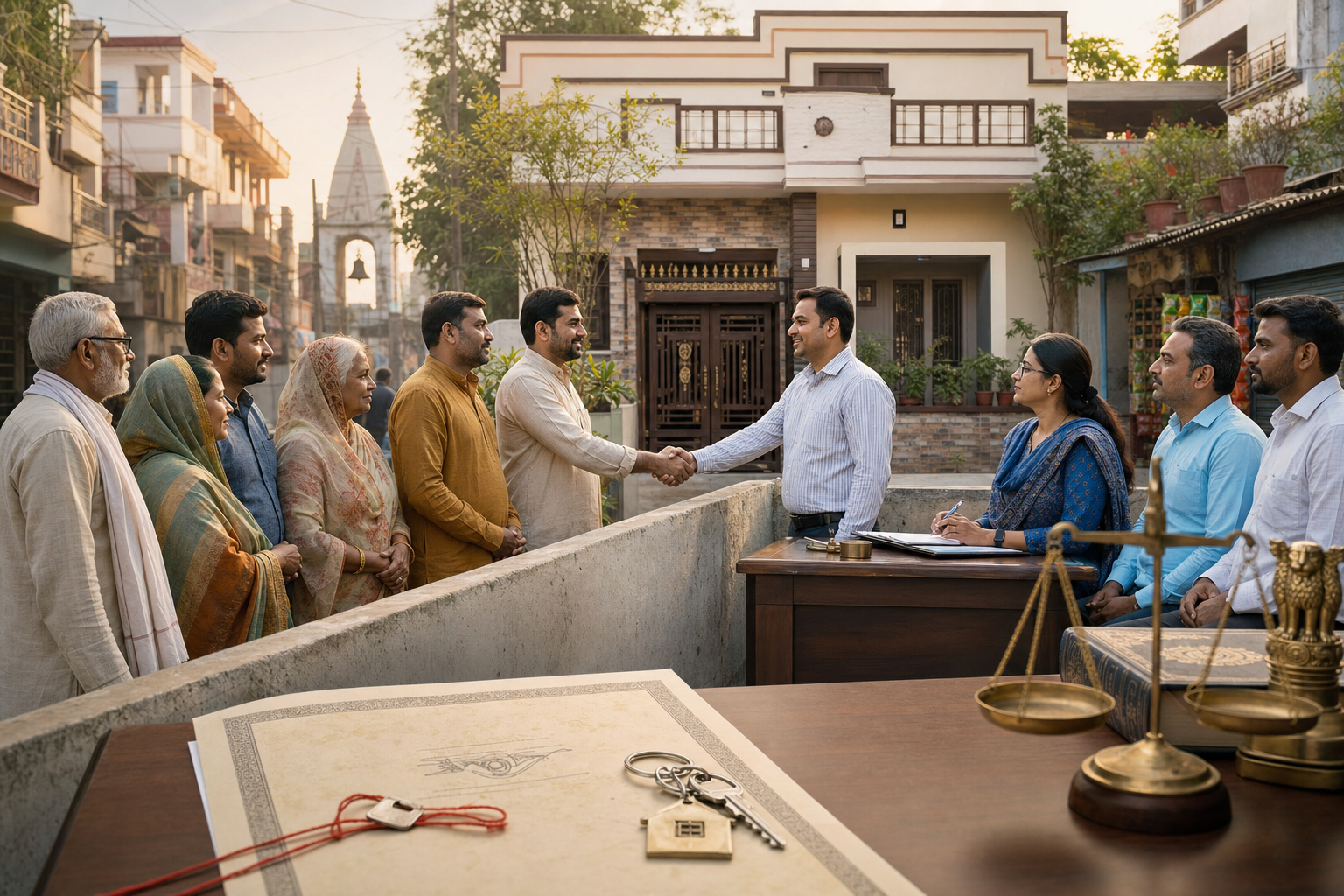
The Muzaffarnagar housing dispute in Dakshini Krishnapuri has become more than a local property controversy. It has opened a difficult public conversation about residential segregation, inter-community trust, constitutional rights, local anxieties, and the fragile work of preserving social harmony in a diverse society. The reported protest began after residents objected to the sale of a house in a Hindu-majority locality to a Muslim buyer, and the matter soon reached the district administration through a memorandum submitted to the District Magistrate.
The incident reportedly took place under the Khalapar police station jurisdiction in Muzaffarnagar, Uttar Pradesh. Local residents, led by ward councillor Raju, gathered at the Collectorate and objected to a transaction in which brothers Arpit Jain and Ankit Jain allegedly sold their house to a Muslim purchaser. The protestors argued that the locality had a predominantly Hindu residential character and that the sale could disturb what they described as the social and cultural balance of the neighbourhood.
At the administrative level, City Magistrate Pankaj Prakash Rathore received the memorandum and reportedly assured the protestors that the matter would be examined according to applicable legal provisions. This assurance is important because such cases cannot be addressed merely through public pressure or emotional claims. A property transaction is governed by law, and any intervention by the state must be rooted in due process, public order concerns, and constitutional limitations rather than communal identity alone.
The memorandum placed before the authorities reportedly contained several allegations and fears. Residents claimed that, in some cases, buyers from another religious community may initially maintain cordial relations but later introduce practices that generate friction with existing residents. The concerns mentioned included allegations about food practices, Qurbani in residential spaces, Friday prayer gatherings involving outsiders, pressure on existing Hindu residents to sell, and the possible establishment of mosques or mazars that could alter the cultural character of the area.
These claims must be handled with care. Some of the allegations may reflect genuine fears shaped by past communal memories, local disputes, or rumours circulating in tightly knit neighbourhoods. At the same time, the reported claims were not publicly supported by independently verified evidence at the time of the protest. In a constitutional society, collective suspicion cannot become a substitute for proof, and no individual buyer can be treated as guilty because of religious identity.
The controversy also included references to the highly contested “Love Jihad” narrative. Such claims have often appeared in public debates around interfaith relationships, community boundaries, and gender anxieties. However, allegations of organised conspiracy require evidence, investigation, and legal scrutiny. Without that discipline, public discourse can shift from legitimate concern to collective blame, which damages both justice and community confidence.
The central legal question is straightforward but socially sensitive: can residents of a locality collectively oppose a lawful property sale because the purchaser belongs to another religion? India’s constitutional framework protects equality before law, freedom of movement, the right to reside in different parts of the country, and the right to acquire and transfer property subject to lawful restrictions. Although the right to property is no longer a fundamental right, it remains a constitutional and legal right, and arbitrary exclusion on religious grounds raises serious ethical and legal concerns.
Housing is never merely a physical asset. In Indian towns, a home is linked to temple routes, local markets, kinship networks, food habits, festivals, shared memories, and the ordinary confidence that neighbours will respect one another’s rhythms. This explains why neighbourhood change often produces strong emotions. Yet those emotions must be translated into lawful civic dialogue rather than exclusionary social rules. A locality can discuss noise, sanitation, parking, public order, animal slaughter regulations, and unauthorised construction; it cannot reasonably convert religious identity itself into a disqualification.
The Muzaffarnagar context makes the issue even more delicate. The district has a history of communal tensions, and public memory in such places does not disappear quickly. Families often carry stories of fear, displacement, betrayal, or insecurity across generations. In such an atmosphere, even a single property sale can become a symbolic event. Responsible leadership must therefore separate verifiable civic concerns from inherited suspicion, because unresolved fear can easily harden into residential segregation.
Residential segregation is not unique to Muzaffarnagar. Across India, many Muslims report difficulty renting or buying homes in Hindu-majority colonies, while some Hindu families express discomfort about living in areas they perceive as culturally unfamiliar or politically sensitive. Similar patterns can also affect caste groups, migrants, single women, students, and people from different regions. The language changes from place to place, but the underlying mechanism is often the same: social trust weakens, stereotypes fill the gap, and housing access becomes tied to identity rather than conduct.
For a society rooted in dharmic traditions, this moment invites a deeper reflection. Hinduism, Buddhism, Jainism, and Sikhism have distinct doctrines and histories, yet all place moral weight on self-restraint, truthfulness, compassion, responsibility, and disciplined coexistence. Dharma is not served by fear alone; it is served by justice, clarity, dignity, and conduct that protects the vulnerable without demonising the innocent. A dharmic civic response must therefore defend cultural continuity while also refusing blanket hostility toward any community.
This does not mean local concerns should be dismissed. Residents have a legitimate interest in public order, lawful land use, noise regulation, sanitation, safety, and the protection of shared civic spaces. If there are specific allegations about criminal intimidation, unlawful construction, coercive pressure, or public nuisance, they should be recorded, investigated, and addressed by the police and municipal authorities. The rule of law is strongest when it protects neighbourhood peace without permitting collective punishment.
The role of the district administration is therefore crucial. Authorities must examine whether the sale deed is lawful, whether the buyer and seller complied with applicable property rules, whether any threats or intimidation occurred, and whether public order risks require preventive action. They must also ensure that no citizen is denied lawful residence solely because of religion. Administrative neutrality is not passive; it requires active protection of rights, transparent communication, and timely response to genuine local grievances.
Community organisations also carry responsibility. Groups that speak for Hindu residents can raise concerns about cultural continuity, temple access, local customs, and safety in a disciplined manner. But they weaken their own moral position when they present an entire religious community as a threat. Similarly, Muslim community leaders and civil society actors can help reduce suspicion by encouraging transparent communication with neighbours, strict adherence to civic rules, and visible respect for local customs. Mutual reassurance is not appeasement; it is a practical method of preventing conflict.
The most constructive path is not silence, denial, or inflammatory mobilisation. The better model is structured neighbourhood dialogue. Residents’ welfare associations, ward councillors, police representatives, municipal officers, and respected religious or community figures can meet to define shared civic norms. These norms may include compliance with noise rules, proper waste disposal, respect for festivals and processions, lawful use of residential property, and mechanisms for reporting intimidation or nuisance. Such norms should apply equally to all residents, regardless of religion.
The debate also exposes a larger problem in Indian public life: the collapse of trust between constitutional language and lived experience. Critics of the protest rightly argue that housing discrimination undermines equality and deepens Islamophobia. Some Hindu groups, meanwhile, argue that their fears arise from long-standing communal tensions and concerns about minority Hindus in neighbouring countries such as Bangladesh and Pakistan. Both realities can exist in public debate, but one cannot justify punishing an Indian citizen for the actions, politics, or demography of others elsewhere.
Demographic arguments require particular caution. Population change is shaped by education, income, healthcare, migration, fertility rates, urbanisation, and public policy. Reducing demographic change to a communal threat encourages panic rather than analysis. A serious society studies data, strengthens institutions, protects women’s education, improves livelihoods, and ensures fair law enforcement. It does not allow demographic anxiety to become a reason for denying ordinary families access to housing.
There is also a moral difference between preserving cultural life and enforcing exclusion. A Hindu-majority locality can preserve its festivals, temple traditions, vegetarian preferences in specific private associations where legally valid, and local customs through voluntary cooperation. But preservation becomes ethically unstable when it depends on refusing neighbours solely because they are Muslim, Christian, Sikh, Jain, Buddhist, or from any other community. Cultural confidence grows through principled conduct, not through fear-driven isolation.
The Muzaffarnagar episode should therefore be read as a warning sign. It shows how quickly a private transaction can become a public flashpoint when social trust is weak. It also shows why careful language matters. Terms that accuse, generalise, or stigmatise can turn administrative disputes into communal confrontations. A factual vocabulary focused on legality, conduct, evidence, and civic obligations is far more useful than slogans that harden identity boundaries.
For readers concerned with Hindu society, the key lesson is not to ignore anxiety but to refine it through dharma and law. Genuine safety concerns should be documented. Illegal activity should be reported. Civic norms should be enforced. But the dignity of innocent individuals should not be sacrificed to collective fear. Hindu-Muslim relations, and the broader fabric of Indian society, cannot improve if every neighbourhood dispute becomes a referendum on religious belonging.
For readers concerned with minority rights, the lesson is equally serious. Legal equality must be supported by social trust, not only court principles. A family may have the legal right to buy a home, but peaceful residence also depends on local confidence, administrative fairness, and everyday gestures of respect. The task is to build conditions where rights are not experienced as threats and cultural identity is not experienced as domination.
The most balanced resolution would protect the legality of the property transaction if it complies with law, investigate any specific and evidence-based allegations, prevent intimidation by either side, and encourage local dialogue around shared civic rules. Such an approach neither dismisses residents’ concerns nor legitimises religious exclusion. It places the matter where it belongs: within constitutional governance, verifiable facts, and disciplined community relations.
Ultimately, the Dakshini Krishnapuri dispute is not only about one house. It is about the kind of public culture India wishes to cultivate in its towns and neighbourhoods. A confident society must be able to protect temples, traditions, women’s safety, public order, and local customs while also upholding fairness, lawful property rights, and peaceful coexistence. That is the difficult but necessary standard for social harmony in Muzaffarnagar, Uttar Pradesh, and beyond.
Inspired by this post on Struggle for Hindu Existence.
