
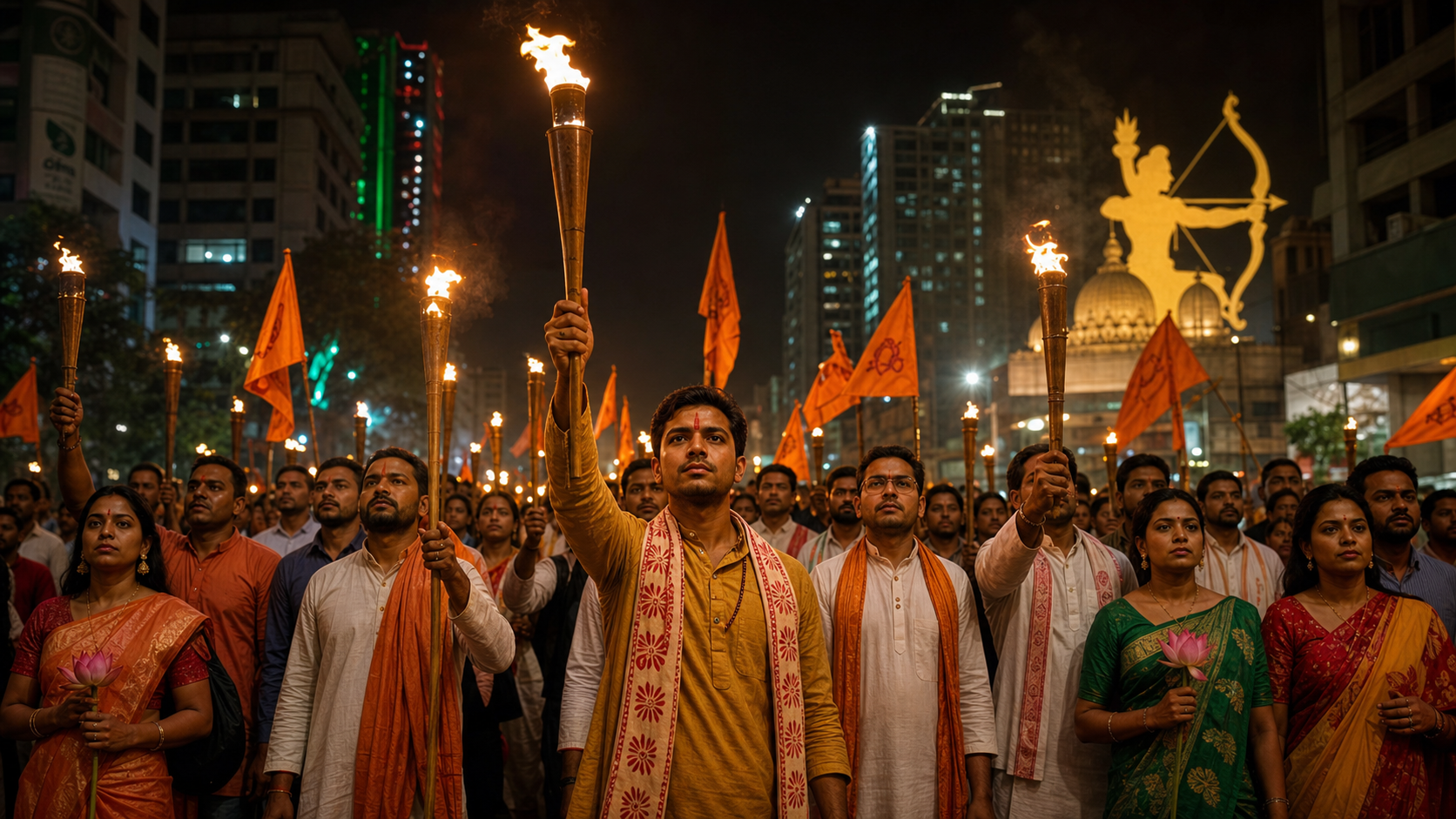
The torchlight procession in Dhaka has become a significant moment in the continuing debate over religious dignity, minority safety, and civic accountability in Bangladesh. Public reports described thousands of Hindu demonstrators gathering in the capital after the alleged desecration of an image of Lord Ram during a protest connected to opposition against a proposed Ram statue in Gaibandha district. The demonstrators carried torches, raised devotional slogans including “Jai Shri Ram”, and demanded action against those accused of hurting Hindu religious sentiments.
The event should be understood not merely as a street protest, but as a public expression of anxiety among Bangladesh Hindus who have repeatedly sought stronger guarantees for safety, justice, and equal citizenship. According to reports in the Times of India and the Economic Times, the protests expanded beyond a single local grievance and reflected broader concerns about religious intolerance, minority rights, and the need for the Bangladesh government to act firmly against extremist intimidation. The incident also drew a response from India, where officials urged Bangladesh to restrain extremist elements and ensure the security of minority communities.
Prabhu Shri Ram occupies a sacred place in Hindu civilizational memory. For many Hindus, Shri Ram is not only a deity but also a model of dharma, restraint, moral responsibility, and just governance. Any perceived insult to his image therefore touches a deep emotional and cultural nerve. Yet the most constructive response to such hurt is not disorder, retaliation, or collective blame; it is disciplined protest, lawful accountability, and a firm insistence that every religious community must be able to live with dignity.
The Dhaka torchlight rally carried precisely that symbolic weight. A torch in a public procession is not only an object of illumination; it is also a visual language of vigilance. In this case, the procession signaled that the Hindu community wanted visibility in a moment of vulnerability. It communicated that minority concerns should not remain hidden in private conversations, temple courtyards, or family anxieties. They must be heard in civic space, addressed by institutions, and treated as legitimate questions of public order and constitutional protection.
From an academic perspective, the rally sits at the intersection of religious sentiment, minority politics, state responsibility, and social cohesion. Bangladesh is home to a historically rooted Hindu community whose temples, festivals, family traditions, and cultural practices are woven into the history of Bengal. The safety of Bangladesh Hindus is therefore not a marginal issue. It is connected to the character of Bangladesh’s plural society and to the larger question of whether religious minorities can participate in national life without fear.
The immediate demand of the protesters was the arrest of those responsible for the alleged desecration. In a rule-of-law framework, that demand must be handled through credible investigation, transparent evidence-gathering, and lawful prosecution where guilt is established. This distinction is essential. Justice requires accountability for specific acts by specific individuals; it must not become a pretext for sweeping hostility toward any entire community. The dharmic response, grounded in restraint and clarity, seeks justice without abandoning moral discipline.
The second demand, stronger protection for the Hindu community, is equally important. Minority protection is not limited to police deployment after tensions rise. It includes preventive intelligence, quick response to inflammatory mobilization, protection of temples and processions, prosecution of hate-driven violence, compensation for victims where harm occurs, and public communication that reassures vulnerable communities. When authorities act slowly or ambiguously, fear grows faster than facts. That fear can weaken trust in the state and deepen social fragmentation.
The emotional dimension of the protest should not be dismissed as mere sentiment. Religious identity often lives through memory, ritual, image, song, pilgrimage, and shared names of the divine. A picture of Lord Ram, a chant of “Jai Shri Ram”, or a gathering outside a temple may seem symbolic to outsiders, but for devotees these are intimate expressions of belonging. When such symbols are insulted, many experience the incident as an attack on community dignity. A mature democracy must be able to recognize that pain while still preserving due process and public peace.
The incident also raises a larger South Asian question: how should societies respond when sacred symbols become sites of conflict? The answer cannot be competitive outrage. It must be a common standard. Hindu, Buddhist, Jain, Sikh, Muslim, Christian, and other communities all deserve protection from targeted desecration, intimidation, and violence. The dharmic traditions of Hinduism, Buddhism, Jainism, and Sikhism share a deep concern for self-discipline, truth, compassion, and the protection of the vulnerable. Those values strengthen the case for peaceful but firm civic action.
In Bangladesh, the protection of Hindus is also linked to the protection of Buddhists, Christians, indigenous communities, and other minorities who have at different times expressed fear over mob mobilization or religiously charged agitation. A state that protects one minority only selectively does not build justice; it builds insecurity. The principle must be universal: no citizen should have to prove numerical strength in order to receive protection from the law.
The Dhaka rally’s disciplined public character is therefore important. It allowed the Hindu community to express grief, anger, and resolve without reducing the issue to vengeance. In moments of religious hurt, disciplined protest can become a form of civic education. It reminds society that peace is not silence. Peace requires accountability, and harmony requires respect. A community asking for safety is not disturbing harmony; it is calling attention to the conditions necessary for harmony to survive.
The regional diplomatic dimension cannot be ignored. India’s reported statement urging Bangladesh to curb extremist elements reflects the sensitivity of minority issues across borders. Bangladesh and India share history, language zones, cultural ties, pilgrimage connections, and memories of the 1971 Liberation War. Because of these ties, violence or intimidation against minorities in Bangladesh often produces concern among Hindus in India and the global Hindu diaspora. Responsible diplomacy must convert that concern into pressure for lawful protection, not into rhetoric that inflames ordinary people.
For Bangladesh’s authorities, the most effective response would be visible institutional seriousness. That means identifying what happened in Gaibandha, determining who was responsible, preventing further provocation, and ensuring that peaceful protesters are protected rather than treated as a nuisance. It also means communicating clearly that religious desecration, mob intimidation, and threats against minorities are unacceptable. Such clarity can reduce rumor, prevent escalation, and rebuild public confidence.
For civil society, the lesson is equally serious. Community leaders, student groups, temple committees, rights organizations, and interfaith platforms should work together to prevent future escalation. Documentation matters. Legal assistance matters. Early-warning networks matter. So does language. A protest for Hindu safety should remain rooted in dharma, dignity, and constitutional rights, because that moral framework gives the movement legitimacy and protects it from being misrepresented.
The role of media is also central. Reports should avoid sensationalism while still naming the seriousness of religious intimidation. Terms such as “alleged desecration” are legally necessary until facts are established, but caution should not become indifference. Media coverage must make room for the voices of affected Hindus, the legal position of authorities, and the broader context of minority security. Balanced reporting is not the same as flattening the pain of a vulnerable community.
The protest in Dhaka ultimately reflects a simple but powerful demand: Hindus in Bangladesh want to live openly, worship freely, and see their sacred symbols treated with basic respect. They want those who insult or threaten them to face lawful consequences. They want temples, festivals, homes, and processions to be secure. These demands are not sectarian privileges. They are the minimum expectations of equal citizenship.
Seen through the broader lens of Hindu unity and dharmic solidarity, the torchlight rally is a reminder that community strength must be joined with ethical restraint. The protection of Prabhu Shri Ram’s honor is not only about responding to one incident. It is about upholding a social order where reverence is not mocked, minorities are not abandoned, and public institutions do not wait for repeated crises before acting. The path forward lies in justice, vigilance, and a principled commitment to peaceful coexistence.
Sources consulted include Times of India reporting on the Dhaka protests and India’s response, and Economic Times reporting on the wider Bangladesh Hindu community protests: https://timesofindia.indiatimes.com/world/south-asia/hurt-religious-sentiments-hindus-continue-protest-in-bangladesh-over-alleged-desecration-of-lord-ram-image/articleshow/131874493.cms, https://timesofindia.indiatimes.com/india/should-curb-extremists-india-as-banladeshi-hindus-protest-desecration-of-lord-ram-photo/articleshow/131936205.cms, and https://m.economictimes.com/news/international/world-news/bangladesh-hindu-community-protests-over-alleged-desecration-of-lord-ram-image/articleshow/131887913.cms.
Inspired by this post on Hindu Jagruti Samiti.
