
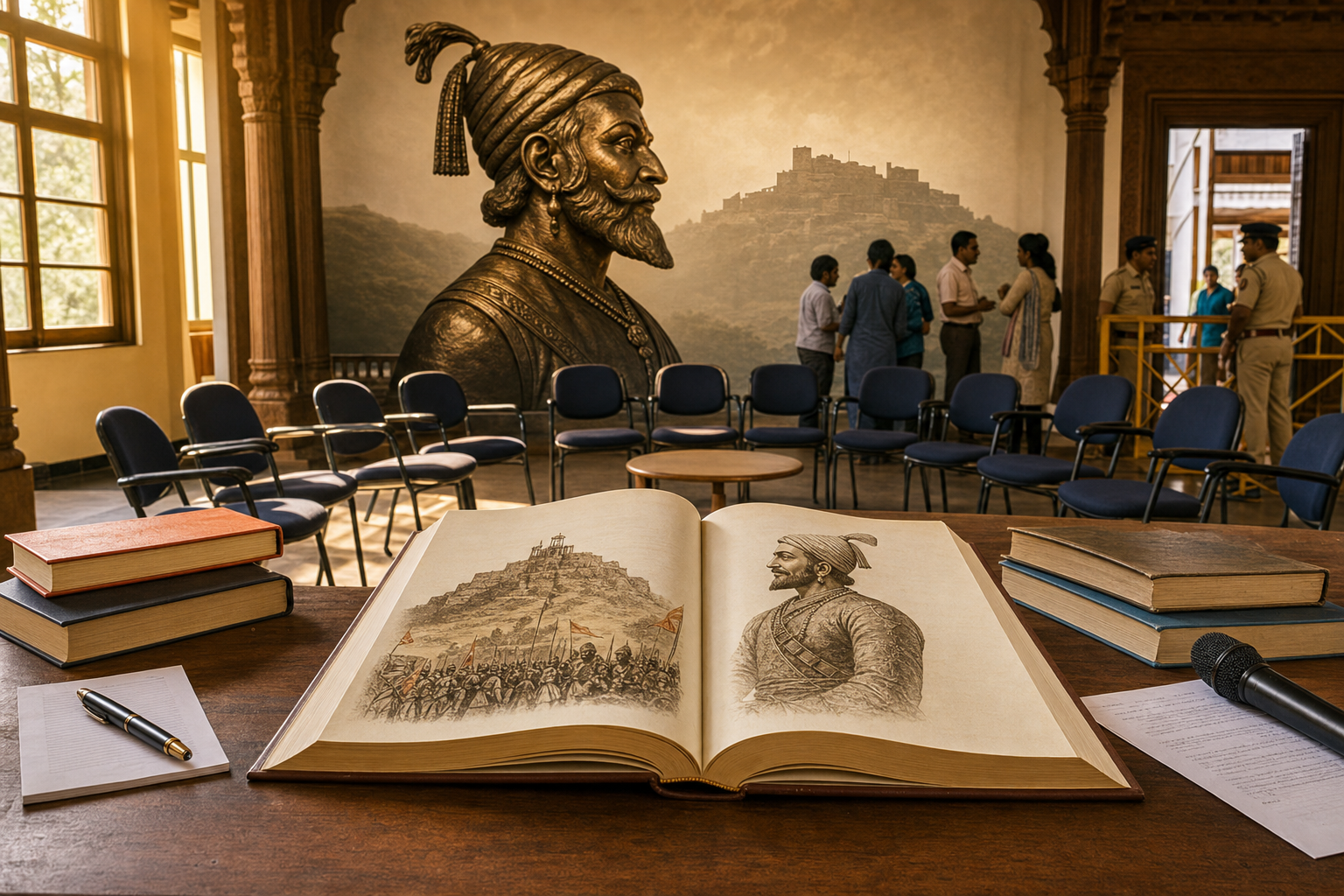
A proposed public reading of Govind Pansare’s book Shivaji Kon Hota? was reportedly called off in Ishwarpur in Maharashtra’s Sangli District after protests and subsequent police intervention. The immediate fact pattern is brief but important: a literary and political-cultural event around a book on Chhatrapati Shivaji Maharaj could not proceed because the situation became contentious enough for law enforcement to step in.
The incident deserves careful attention because it is not merely about one cancelled programme. It sits at the intersection of Maharashtra’s historical memory, public order, freedom of expression, community sentiment, and the continuing debate over how Shivaji Maharaj should be understood in modern India. Few historical figures carry the emotional force that Shivaji does in Maharashtra. He is remembered as a builder of Swarajya, a military innovator, a defender of dignity, and a ruler whose legacy continues to inspire Hindus and many others across Indian society.
Govind Pansare’s Shivaji Kon Hota?, first associated with his public lectures and later circulated widely as a Marathi text, presents Shivaji through a social and political lens. Pansare, a left-oriented activist and public intellectual, argued for an interpretation of Shivaji that highlighted governance, social concern, administrative discipline, respect for women, and a broader political imagination beyond narrow communal framing. Supporters of the book regard it as a corrective to simplistic readings of history; critics have often objected to its ideological framing and its treatment of religious and political themes.
That disagreement itself is not unusual. Historical interpretation is rarely neutral, especially when the subject is a civilisational icon. The deeper question raised by the Sangli incident is whether disagreement over a book should be handled through debate, counter-reading, scholarship, and public discussion, or whether events should be prevented from taking place because one section of society finds the interpretation unacceptable. In a democratic culture, emotional attachment to heritage and the right to intellectual disagreement must be held together with maturity.
From a constitutional perspective, the matter falls within the familiar tension between freedom of expression and public order. India’s constitutional framework protects expression, assembly, and debate, while also allowing reasonable restrictions in the interest of public peace. Police intervention in such situations is typically justified administratively as an effort to prevent escalation. Yet when repeated interventions result in cancellation rather than conversation, the social cost becomes visible: public culture grows more fragile, and communities lose the habit of listening to difficult arguments.
The concern is especially significant in relation to Shivaji Maharaj because his life cannot be reduced to slogans. His statecraft involved fort administration, naval thinking, intelligence networks, revenue systems, regional alliances, military mobility, and a keen grasp of political legitimacy. His spiritual and cultural world was deeply rooted in the Hindu ethos of his time, yet his political conduct also reflected practical governance, strategic inclusion, and disciplined administration. Serious engagement with Shivaji requires more than reverence alone; it requires study.
For many readers in Maharashtra, Shivaji Maharaj is not simply a historical ruler but a personal inheritance. His name is invoked in homes, schools, political speeches, processions, theatre, literature, and public memory. That emotional connection is real and must not be dismissed. At the same time, reverence becomes stronger, not weaker, when it is supported by historical literacy. A society confident in its heroes should be able to read competing interpretations and respond with evidence, context, and intellectual discipline.
The reported protest by Hindu groups in Ishwarpur therefore needs to be understood without caricature. Community concerns about how sacred or revered figures are represented can be genuine. Many Hindus have experienced patterns of selective historical criticism, hostile stereotyping, and dismissive treatment of their traditions in academic and media spaces. These grievances create sensitivity around public events linked to Hindu history. However, the dharmic response to disagreement has traditionally included debate, shastrartha, commentary, reinterpretation, and counter-commentary rather than the simple closure of discussion.
This is where the broader dharmic principle of dialogue becomes relevant. Hinduism, Buddhism, Jainism, and Sikhism all contain strong traditions of disciplined argument and moral inquiry. Their shared civilisational space has preserved disagreement without necessarily treating every disagreement as enmity. A reading of Shivaji Kon Hota? could have been an opportunity for a structured discussion: what does Pansare get right, what does he overstate, what do other historians argue, and how should Shivaji’s legacy be taught to younger generations?
Instead, the event’s cancellation highlights the shrinking space between offence and enforcement. Once police presence becomes the decisive factor, the literary question is displaced by a law-and-order calculation. Organisers lose the event, protesters claim symbolic victory, and the public loses a chance to examine the text critically. Such outcomes may create short-term calm, but they rarely produce long-term understanding.
A more constructive model would include prior dialogue between organisers, local community representatives, scholars of Maratha history, and administrators. If a book is controversial, the answer need not be cancellation; it can be a moderated forum. A reading can be paired with a response from another historian, a question-and-answer session, and clear ground rules against provocation. This approach protects public order while preserving intellectual seriousness.
It is also important to distinguish between reading a book and endorsing every claim in it. Academic and civic life depend on the ability to encounter texts critically. A society can read Marxist, nationalist, bhakti, colonial, subaltern, and traditional accounts of history without surrendering judgment to any one of them. In fact, the study of Shivaji Maharaj becomes richer when students compare bakhars, Persian records, administrative documents, modern scholarship, oral memory, and regional devotional traditions.
The technical issue beneath the controversy is historiography: the method by which history is written, framed, and transmitted. Every account of Shivaji Maharaj makes choices about emphasis. Some focus on Hindu resistance to imperial power; others emphasize regional state formation; others examine caste, class, military logistics, or administrative innovation. These lenses can conflict, but conflict among interpretations is not automatically a threat. It becomes useful when evidence is tested and claims are examined carefully.
For Hindu society in particular, the stronger path is not intellectual avoidance but intellectual preparation. If a text is seen as incomplete or ideologically biased, the most durable response is to produce better scholarship, better translations, better public lectures, and better educational material. Shivaji Maharaj’s legacy is vast enough to withstand scrutiny. What it needs is responsible interpretation rooted in evidence, cultural sensitivity, and civilisational confidence.
The Sangli episode should therefore be read as a warning and an opportunity. It warns that public discussion around history is becoming increasingly vulnerable to disruption. It also offers an opportunity to rebuild a healthier culture of debate in which reverence and reason are not treated as enemies. A dharmic public sphere should be capable of protecting sentiment while also encouraging learning.
Chhatrapati Shivaji Maharaj’s memory deserves more than reaction. It deserves disciplined study, truthful narration, and a public culture that can separate insult from interpretation, propaganda from scholarship, and disagreement from hostility. The cancellation of a book reading in Ishwarpur may appear local, but the question it raises is national: how should India discuss its heroes in a way that strengthens unity rather than deepening suspicion?
The most constructive answer is neither suppression nor provocation. It is informed engagement. Public readings, scholarly rebuttals, community dialogue, and historically grounded education can together create a culture where Shivaji Maharaj is honoured not only through slogans and symbols, but through the serious study of his life, statecraft, courage, and enduring civilisational significance.
Inspired by this post on Hindu Jagruti Samiti.
