
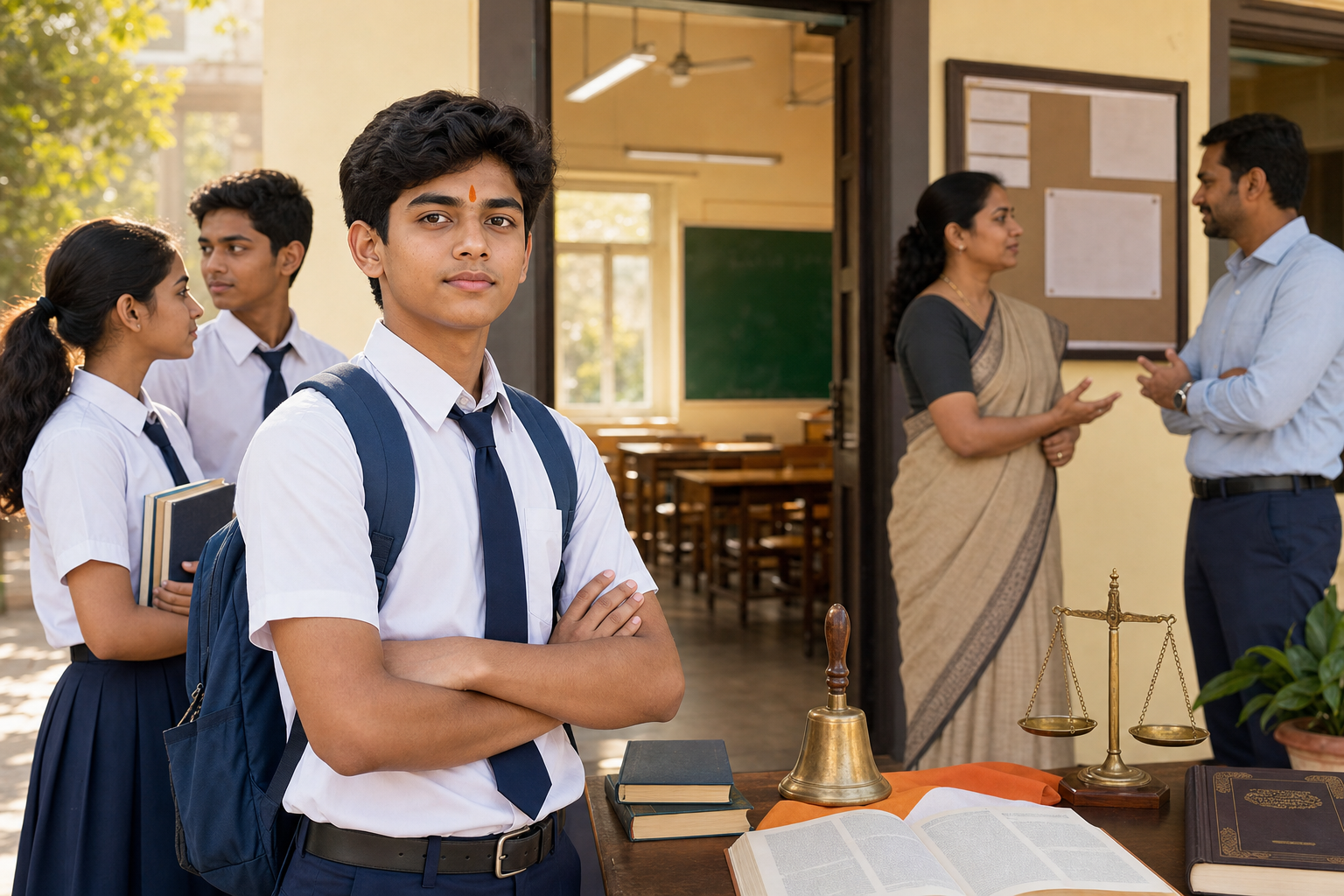
The dispute at the Pune District Education Board’s New English School in Nhavi village, Pune, has become more than a local disagreement over a school uniform rule. Reports published on March 6, 2026, stated that students wearing tilaks were allegedly prevented from attending classes or were asked to remove the mark before entering the classroom. The allegation drew protests from Shiv Pratisthan and other Hindutva groups, who questioned the school administration and demanded an explanation from Headmaster S. N. Kamble.
At the center of the controversy is a familiar but sensitive question in Indian education: how should schools balance discipline, uniformity, and the visible practice of religious and cultural identity? A tilak is not merely a cosmetic mark for many Hindu families. It can signify devotion, family custom, festival participation, temple worship, or continuity with Sanatan cultural traditions. When a child is asked to remove it, the instruction may be experienced by parents not as a routine disciplinary measure but as a rejection of inherited dignity.
The available report states that activists confronted the school after allegations arose that students wearing tilaks were stopped or discouraged from attending class. Some protesters also claimed that students were addressed in derogatory terms, although those specific allegations have not been independently verified in the report. This distinction matters. A serious public discussion requires attention to the grievance without treating every unverified claim as established fact.
Headmaster S. N. Kamble denied that the school had imposed any ban on tilaks, bindis, or other religious symbols. According to his clarification, the administration was attempting to maintain discipline and enforce a uniform dress code rather than target any particular religious practice. That explanation places the incident within the broader administrative challenge faced by schools: rules must be predictable, written, proportionate, and applied consistently, especially when they touch religious identity.
The Education Department reportedly took cognizance of the dispute and sought an explanation from the school administration. This is an important procedural step because such controversies should not be settled only through street pressure or defensive institutional statements. Parents, teachers, school management, and education officials need a transparent record of what happened, what policy existed, who implemented it, and whether students were treated with respect.
From a constitutional perspective, the issue must be approached carefully. Article 25 of India’s Constitution protects freedom of conscience and the right to profess, practice, and propagate religion, subject to public order, morality, health, and other constitutional limitations. Schools also have legitimate authority to maintain discipline and a learning environment. The difficult question is whether a small religious mark such as a tilak creates any real disruption, and whether restricting it is necessary for school discipline.
A technically sound policy would distinguish between uniform requirements that serve educational order and restrictions that unnecessarily burden cultural expression. A uniform may regulate clothing, footwear, badges, and grooming for reasons of equality and discipline. A tilak, bindi, rakhi, kara, or similar marker may require a different analysis because it can represent religious practice, family observance, or community identity. A blanket restriction on such symbols, if it exists, would need a clear educational justification and careful communication with parents.
The controversy also shows why language matters. Describing the headmaster primarily through an ideological label, such as Ambedkarite, risks shifting attention away from institutional accountability and toward social polarization. Dr. B. R. Ambedkar’s legacy belongs to constitutional morality, dignity, education, and social reform. A school dispute involving Hindu cultural practice and administrative discipline should therefore be handled through evidence, dialogue, and lawful procedure rather than through mutual suspicion between communities.
For a blog committed to unity among dharmic traditions, the deeper lesson is that Hinduism, Buddhism, Jainism, and Sikhism have long sustained visible practices of identity without requiring hostility toward one another. Marks on the forehead, sacred threads, malas, turbans, rakhis, vows, fasts, and festival customs are part of a larger civilizational grammar. A plural society becomes stronger when schools teach students to understand such practices with maturity instead of treating them as embarrassments to be hidden.
At the same time, protest movements must remain disciplined and legally restrained. Parents and cultural organizations have the right to question a school policy that appears to restrict Hindu religious symbols. Yet the protection of religious freedom is most persuasive when it is argued through documentation, respectful engagement, and principled consistency. The dignity of students must remain the central concern, not the creation of a spectacle around them.
There is also a practical educational concern. Children learn from institutional behavior. If a school treats a tilak as a disciplinary problem without explanation, students may internalize the idea that their home traditions are inferior to public norms. If activists respond with intimidation rather than reasoned advocacy, students may learn that conflict is the normal path to recognition. Neither outcome serves education, social harmony, or cultural confidence.
The most constructive resolution would involve a written clarification by the school, a review by the Education Department, and a parent consultation process. If there is no ban, the administration should state clearly that tilaks, bindis, and comparable religious-cultural symbols are not prohibited when worn modestly and without disruption. If a rule was misunderstood or misapplied, corrective guidance should be issued to staff. If students were spoken to disrespectfully, an apology and remedial training would be appropriate.
Such disputes have reportedly occurred in other parts of Maharashtra as well, involving tilak, bindi, or Rakshabandhan-related practices. That pattern suggests the need for statewide clarity rather than case-by-case confrontation. Education authorities can reduce conflict by issuing guidelines on religious symbols in schools, defining reasonable limits, and ensuring that cultural practices are not arbitrarily suppressed under the broad language of discipline.
The Pune tilak dispute therefore should be read as a civic test. It asks whether Indian schools can preserve order without flattening cultural identity, whether community organizations can defend tradition without deepening social division, and whether administrators can apply rules with sensitivity to constitutional rights. A balanced outcome would protect students’ dignity, honor Hindu cultural traditions, respect all dharmic communities, and reaffirm that education should cultivate confidence rather than alienation.
Inspired by this post on Struggle for Hindu Existence.
