
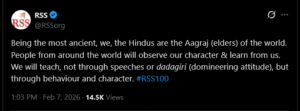
The centenary of the Rashtriya Swayamsevak Sangh (RSS) has generated not only celebration among its supporters but also a sharper wave of criticism from sections of Hindu public opinion. The immediate trigger discussed in the source material is an RSS social media message connected to #RSS100, which described Hindus as Aagraj, or elders of the world, and argued that Hindu society should teach through conduct, character, and restraint rather than through speeches or dadagiri. On the surface, this language presents a moral and civilisational ideal. Yet the reaction it provoked shows that many Hindus are no longer satisfied with symbolic rhetoric when they perceive unresolved questions around Hindu security, social confidence, religious conversion, temple rights, caste politics, and institutional accountability.
The debate is not merely about one organisation or one social media post. It reflects a wider anxiety within Hindu society about the difference between cultural representation and civilisational responsibility. The RSS was founded in 1925 in Nagpur by Keshav Baliram Hedgewar, and over the past century it has grown into one of India’s most influential socio-cultural organisations. Its supporters point to discipline, grassroots service, disaster relief, shakha training, educational networks, and nationalist mobilisation. Its critics, however, argue that scale and longevity do not automatically establish effectiveness, especially when Hindu communities continue to experience fear, fragmentation, demographic pressure in some regions, political instrumentalisation, and a loss of confidence in their own traditions.
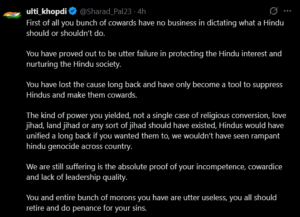
The strongest criticism emerging from the source material concerns the claim that the RSS has projected Hindu strength while failing to cultivate sufficient Hindu self-respect, intellectual clarity, and practical resilience. The charge is that the organisation often speaks in the name of Hindu unity but has not always protected independent Hindu voices, local activists, or smaller community-led initiatives that operate outside the Sangh ecosystem. In this reading, the problem is not social service itself; it is the perception that a large institution can become more concerned with control, image management, and political proximity than with the autonomous flourishing of Hindu society.
This criticism has emotional force because many Hindus measure public leadership against historical ideals such as Chhatrapati Shivaji Maharaj, Rani Durgavati, Maharana Pratap, Guru Gobind Singh, and other figures associated with courage, sacrifice, and civilisational defence. When modern institutions speak of character but appear cautious in moments of communal tension, temple disputes, persecution of Hindu minorities, or attacks on Hindu symbols, critics experience that gap as betrayal. The anger expressed in the source material is therefore best understood as a demand for a more assertive, principled, and dharmic form of public leadership, not as a call for hatred or reckless escalation.

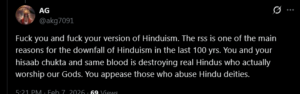
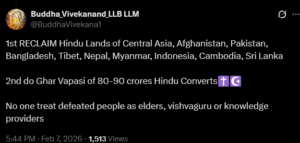
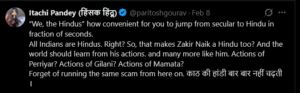
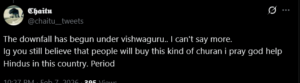
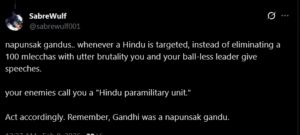
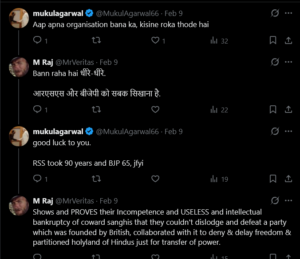
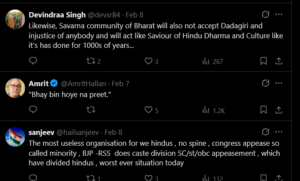
Several online replies cited in the source accused the RSS of failing to protect Hindu interests and of reducing Hindu society to passivity. Some respondents objected to what they saw as moral lectures from an organisation they believe has not delivered enough on religious conversion, land disputes, caste tensions, or Hindu security. Others questioned whether appeals to Hindu unity are being used selectively while caste calculations and electoral compulsions continue to divide the community. These replies contained harsh language and personal attacks in their original form; the underlying argument, however, can be stated more responsibly: a century-old institution that claims moral authority over Hindu society must be judged by measurable outcomes, not only by slogans, uniforms, ceremonies, or historical self-presentation.

The caste question is central to this debate. Critics argue that Hindu society has often been described through colonial and missionary categories that exaggerate disunity while ignoring the civilisational mechanisms that historically allowed diverse sampradayas, jatis, regions, languages, temples, mathas, gurus, and philosophical schools to coexist. At the same time, caste discrimination has been a real and painful social issue in many contexts and cannot be dismissed. A dharmic approach must therefore avoid both colonial caricature and denial. It should reject humiliation, inherited contempt, and political exploitation while also resisting any narrative that reduces Hindu civilisation to caste conflict alone.
For a blog committed to unity among Hinduism, Buddhism, Jainism, and Sikhism, the proper framework is dharma rather than factionalism. Dharmic traditions are not identical, but they share a civilisational grammar: respect for sadhana, karma, self-discipline, truth-seeking, sacred geography, ethical restraint, debate, renunciation, service, and liberation-oriented life. A serious critique of the RSS or any Hindu institution should therefore strengthen dharmic society rather than deepen resentment between communities, sects, castes, or political camps. The test is whether criticism leads to clarity, reform, courage, and cooperation.
The source material also invokes Sita Ram Goel and Veer Savarkar as historical critics of the RSS. A widely circulated remark attributed to Sita Ram Goel sharply dismissed the RSS as intellectually inadequate, while a quotation attributed to Savarkar criticises the image of an RSS volunteer whose life begins and ends in organisational membership without concrete achievement. Whether these statements are interpreted literally, polemically, or historically, they point to a longstanding concern: Hindu revival cannot be sustained by discipline alone. It requires intellectual depth, historical memory, philosophical confidence, legal strategy, cultural creativity, and the courage to confront uncomfortable facts.
One recurring grievance is that independent Hindu advocacy groups have sometimes felt marginalised by larger organisations. The source material claims that some independent activists faced exclusion, reputational attacks, and obstruction when they were not aligned with the Sangh network. Such claims should be evaluated carefully and factually, but the broader institutional lesson is important. No single organisation can own Hindu society. A civilisation as vast as Sanatana Dharma must leave room for temple activists, scholars, monks, householders, women leaders, youth groups, diaspora organisations, legal advocates, publishers, and inter-dharmic networks that include Buddhists, Jains, and Sikhs. Centralised gatekeeping weakens cultural resilience.
The criticism of “Hindu unity” rhetoric must also be examined with precision. Unity cannot mean silence before poor leadership, nor can it mean obedience to a political machine. Real Hindu unity is not uniformity. It is principled cooperation across sampradayas, castes, languages, regions, and dharmic communities. It requires protection of temples, respect for women, defence of vulnerable minorities, preservation of Sanskrit and regional traditions, support for Hindu education, and a willingness to speak honestly about threats without dehumanising any community. Unity built on fear becomes fragile; unity built on dharma becomes durable.

Another major theme is the relationship between the RSS and the Bharatiya Janata Party (BJP). Critics in the source material argue that the RSS has become too close to political power and therefore less willing to ask hard questions on Hindu welfare, illegal migration, violence in regions such as Bengal, the treatment of public figures such as Nupur Sharma, and broader questions of religious freedom. In democratic politics, proximity to power brings influence but also compromise. A socio-cultural organisation must therefore maintain moral distance from any party, including one seen as ideologically close, if it wishes to preserve credibility as a civilisational institution rather than a political auxiliary.
The debate also touches on Christian missionary activity and Islamic political mobilisation. The source material expresses concern that conversion networks and Islamist organisations remain active while Hindus are asked to remain restrained. A responsible academic framing should distinguish between legitimate religious freedom, peaceful interfaith engagement, coercive conversion, political extremism, and communal violence. Dharmic society should defend freedom of conscience while opposing deception, coercion, targeted denigration of Hindu deities, and the exploitation of poverty or social vulnerability. This position is compatible with constitutional ethics, Hindu dignity, and inter-dharmic harmony.
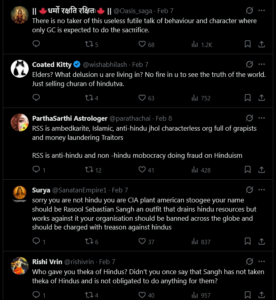
The language of “being elders of the world” also needs careful scrutiny. Civilisational seniority carries meaning only when it is matched by living excellence. Ancientness by itself is not leadership. If Hindus claim to be inheritors of one of the world’s oldest civilisations, then the responsibility is immense: temples must be protected, scriptures must be studied, children must be educated, physical courage must be cultivated, social service must be sincere, women must be respected, and internal disputes must be resolved through dharma rather than humiliation. The world learns from character only when character is visible in institutions, families, scholarship, and public conduct.
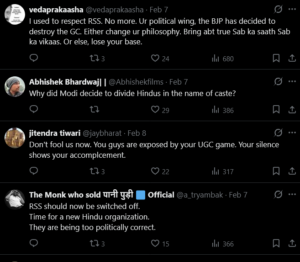
The emotional anger in the source material should not be romanticised. Anger can expose suppressed grievances, but it can also distort judgment and lead to unjust generalisations. Some replies quoted in the original used abusive, degrading, or violent language. Such expressions are not aligned with dharma and do not help Hindu society build moral authority. A stronger critique does not need vulgarity. It needs evidence, historical knowledge, strategic thinking, and the capacity to separate institutional accountability from hatred. The goal should be reform, not social poisoning.
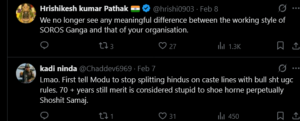
At the same time, dismissing critics as merely angry or divisive would be intellectually lazy. The intensity of the reaction indicates a trust deficit. Many Hindus feel that symbolic cultural nationalism has not produced sufficient structural reform in education, temple administration, minority rights discourse, demographic policy, media representation, or historical correction. They see repeated invocations of Hindu pride but uneven institutional delivery. A serious response from any organisation claiming Hindu leadership would require transparent self-audit: What has improved? What has failed? Which communities remain vulnerable? Which slogans have become substitutes for action?
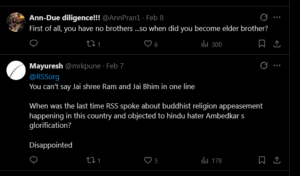
A dharmic public culture must also recover the idea of kshatra without reducing it to aggression. Kshatra Dharma is not mob anger. It is disciplined protection of righteousness, the vulnerable, sacred institutions, and social order. It requires physical preparedness, legal literacy, community organisation, moral restraint, and strategic patience. Hindu society does not need theatrical militancy; it needs trained, lawful, confident, service-oriented citizens who can defend temples, families, heritage, and civil rights within an ethical framework. This is where the language of character becomes meaningful only if it produces real capability.

The RSS centenary debate therefore opens a larger question for Hindu society: should the next century be shaped by institutional loyalty or civilisational accountability? Loyalty has value when institutions remain aligned with dharma. Accountability becomes necessary when organisations become complacent, politically captured, intellectually stagnant, or insensitive to grassroots pain. The same standard applies to all Hindu, Buddhist, Jain, Sikh, and broader dharmic institutions. No organisation should be beyond scrutiny, and no critique should be allowed to become an excuse for internal fragmentation.
The constructive path forward is neither blind defence of the RSS nor blanket condemnation. It is a rigorous audit of performance, doctrine, social impact, and institutional behaviour. Where the RSS has done useful social work, that should be acknowledged. Where critics identify failures, those failures should be examined without defensiveness. Where independent Hindu voices have been sidelined, the ecosystem should become more open. Where caste rhetoric is weaponised, dharmic ethics should restore dignity and cohesion. Where political parties exploit Hindu sentiment without delivering reform, civil society must ask harder questions.
The deeper lesson is that Hindu society cannot outsource its future to any single organisation, party, leader, or slogan. Sanatana Dharma has survived because it is decentralised, adaptive, philosophical, ritual-rich, and rooted in lived communities. Its renewal will come through temples that educate, families that transmit values, scholars who write fearlessly, activists who work responsibly, monks and gurus who guide without sectarian arrogance, and youth who combine devotion with discipline. The future of dharmic civilisation depends on courage joined to wisdom, not merely anger joined to disappointment.
The RSS centenary has therefore become a mirror. Supporters see a century of service and national awakening. Critics see a century of missed opportunities, excessive caution, and institutional self-preservation. Both views should be examined without abuse. The most important question is not whether one belongs to the RSS or opposes it. The essential question is whether Hindu society, along with the wider dharmic family of Buddhists, Jains, and Sikhs, can build institutions worthy of its civilisation: truthful, courageous, intellectually serious, socially compassionate, and capable of defending dharma without abandoning dharma.
Inspired by this post on Hindu Human Rights Blog.
