
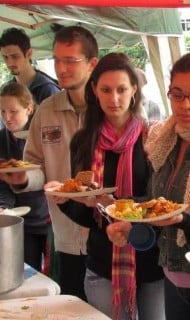
In earlier decades of the Hare Krishna Sunday Feast, abundance was the signature experience. Accounts describe tables of as many as fifteen carefully prepared dishes emerging in successionaromatic rice crowned with cashews, delicately spiced paneer spheres, vegetable sabjis finished with ghee, chutneys, sweets, and moreserved without charge. The effect was visceral: guests arrived hungry, shared in the convivial atmosphere, and left fully satisfied, grateful, and often surprised that such culinary opulence was freely offered.
This generosity is best understood through the Vaishnava principle of prasadamfood first offered to Krishna and then distributed as grace. In Gaudiya Vaishnavism and within the Hare Krishna Movement (ISKCON), feeding others is an extension of bhakti (devotion) expressed as seva (selfless service). The absence of a price tag is deliberate; it removes transactional barriers and reframes the meal as spiritual hospitality, where nourishment is not merely caloric but also relational, ethical, and contemplative.
Historically, the tradition of the Sunday Feastoften called the “Sunday Love Feast” in ISKCON’s formative yearstook shape in the late 1960s as a weekly public invitation to experience kirtan, philosophy, and prasadam in one coherent offering. This rhythm made spiritual culture tangible: newcomers could taste, hear, and observe the practices of bhakti in a convivial, non-intimidating setting. Over time, temples around the world adapted the format to local tastes and capacities while preserving its core simplicity: sacred food, sacred song, and sincere welcome.
The cuisine’s distinctiveness arises from its sattvic disciplines, typical of Vaishnava cooking. Preparations avoid meat, fish, eggs, and commonly, onions and garlic; they emphasize whole grains, legumes, seasonal vegetables, dairy, fruits, and carefully balanced spices. Techniques favor clarity of flavor and ease of digestion: dal simmered to silkiness, rice prepared to distinct grains, sabjis sautéed to preserve texture, and sweets layered with cardamom, saffron, or jaggery. The result is a multi-course progression that is sensorially rich without being heavy, festive without being extravagant in waste.
Beyond the plate, the Sunday Feast architectures an atmosphere: kirtan softens social boundaries, incense perfumes shared space, and the cadence of volunteers moving trays signals an ethic of cheerful cooperation. Abundance functions here as pedagogy; it teaches that care can be plentiful, that community can be built through recurring gestures, and that the ordinary act of eating can be elevated through intention. Recollections of “fifteen incredible preparations” are not just about quantity; they are analytical signposts of a community’s prioritiesdignity, welcome, and joy.
From a social perspective, “free” is transformative. Removing price normalizes participation across economic lines, restores agency to guests, and counters the embarrassment that can accompany need. In practical terms, a no-cost meal curates a shared table where students, workers, families, and elders sit side by side, cross-pollinating stories and dissolving status markers. The resulting social mix is a quiet but durable expression of pluralismpeople may differ in language, faith background, or class, yet the feast configures them into a single, convivial congregation.
Placed within the broader dharmic landscape, the Sunday Feast stands in clear kinship with Sikh langar, Buddhist dāna, and Jain ahimsa-informed communal meals. Each tradition converges on a shared axiom: food, when distributed without calculation of return, becomes a technology of compassion and a practice of equality. Recognizing these parallels emphasizes unity among dharmic traditionsHinduism, Buddhism, Jainism, and Sikhismwhile honoring the distinctive theologies that animate each practice.
Operationally, such abundance is made possible by disciplined community kitchens and volunteer ecosystems. Typical workflows include early-morning procurement of produce and grains, ingredient cleaning and sorting, staggered cooking cycles to match altar offerings (bhoga) and serving times, and a clear segregation of raw and cooked zones to maintain hygiene. Volunteers rotate through preparation, offering, and distribution duties, embodying seva as a shared responsibility. These kitchens often develop remarkable efficienciesbatch cooking dals and rice on predictable timelines, synchronizing sabjis to maintain texture, and coordinating sweets so that they cool to ideal serving temperature.
Nutritionally, a classic Sunday Feast approximates a balanced profile: grains (rice or chapatis) for complex carbohydrates; legumes (dal or chickpeas) for protein; dairy (paneer, yogurt, ghee) for fats and fat-soluble nutrients; and an array of vegetables, pickles, and fruits for fiber, micronutrients, and palate contrast. The result is a meal that satisfies immediate hunger while avoiding post-prandial lethargyan outcome consistent with the sattvic aim of clarity and steadiness of mind. Even the sequencing matters: lighter dishes first, rich items interspersed, sweet preparations concluding the arc.
Economically, “free” does not mean costless; rather, it signals a different funding ethic. Ingredients and equipment are typically sustained through donations, volunteer time, and careful stewardship: buying staples in bulk, minimizing waste through precise portioning, and repurposing leftovers into next-day distributions while upholding quality and food-safety standards. In many centers, the Sunday Feast doubles as an anchor for broader food relief efforts, extending prasadam distribution to students, the unhoused, and frontline workersevidence that the feast is both a ritual center and a service hub.
Ritually, the act of offering to Krishna reconfigures food from commodity to sacrament. This momentthe transformation of cooked items into prasadamreorients the meaning of cooking itself. The cook’s skill becomes an instrument of devotion; the kitchen becomes an extension of the altar; and the guest becomes a participant in a sacred exchange. In this sense, the Sunday Feast is not merely a community event; it is a theological statement rendered edible.
Culturally, the Hare Krishna Sunday Feast has functioned as a bridge between tradition and modern urban life. In diaspora contexts, it offers second-generation youth and curious visitors a living introduction to Vedic foodways, Gaudiya Vaishnava aesthetics, and the social warmth of devotional communities. By integrating music, narrative, and culinary art, it turns abstract conceptsbhakti, seva, and compassioninto experiences that can be seen, heard, and tasted.
Environmentally and ethically, the feast’s vegetarian (often lacto-vegetarian) template aligns with ahimsa and with lower resource intensity per meal compared to meat-heavy cuisines. When kitchens emphasize seasonal produce, local sourcing, and waste minimization, they compound these benefits, showcasing how traditional dietary ethics can dialogue productively with contemporary sustainability goals.
Modern iterations occasionally scale the number of dishes to fit kitchen capacity, local regulations, or crowd size. Yet the animating principles remain consistent: welcome everyone, serve prasadam freely, and prioritize dignity in the detailsclean plates, attentive volunteers, and a warm farewell. Whether fifteen preparations or five, the meaning lies in the posture of generosity and the intentionality that infuses every step from chopping board to serving line.
Seen through this lens, the Sunday Feast is not just a nostalgic memory of “fifteen incredible preparations”; it is a replicable model of inclusive community building. It demonstrates that abundance is not a function of opulence but of orientationtoward service, toward unity across difference, and toward the steadfast belief that sharing food can heal social distance. In its kinship with langar, dāna, and ahimsa-driven communal meals, the feast points to a civilizational throughline uniting the dharmic traditions of Hinduism, Buddhism, Jainism, and Sikhism: compassion made practical, and spirituality made hospitable.
Inspired by this post on Dandavats.
