
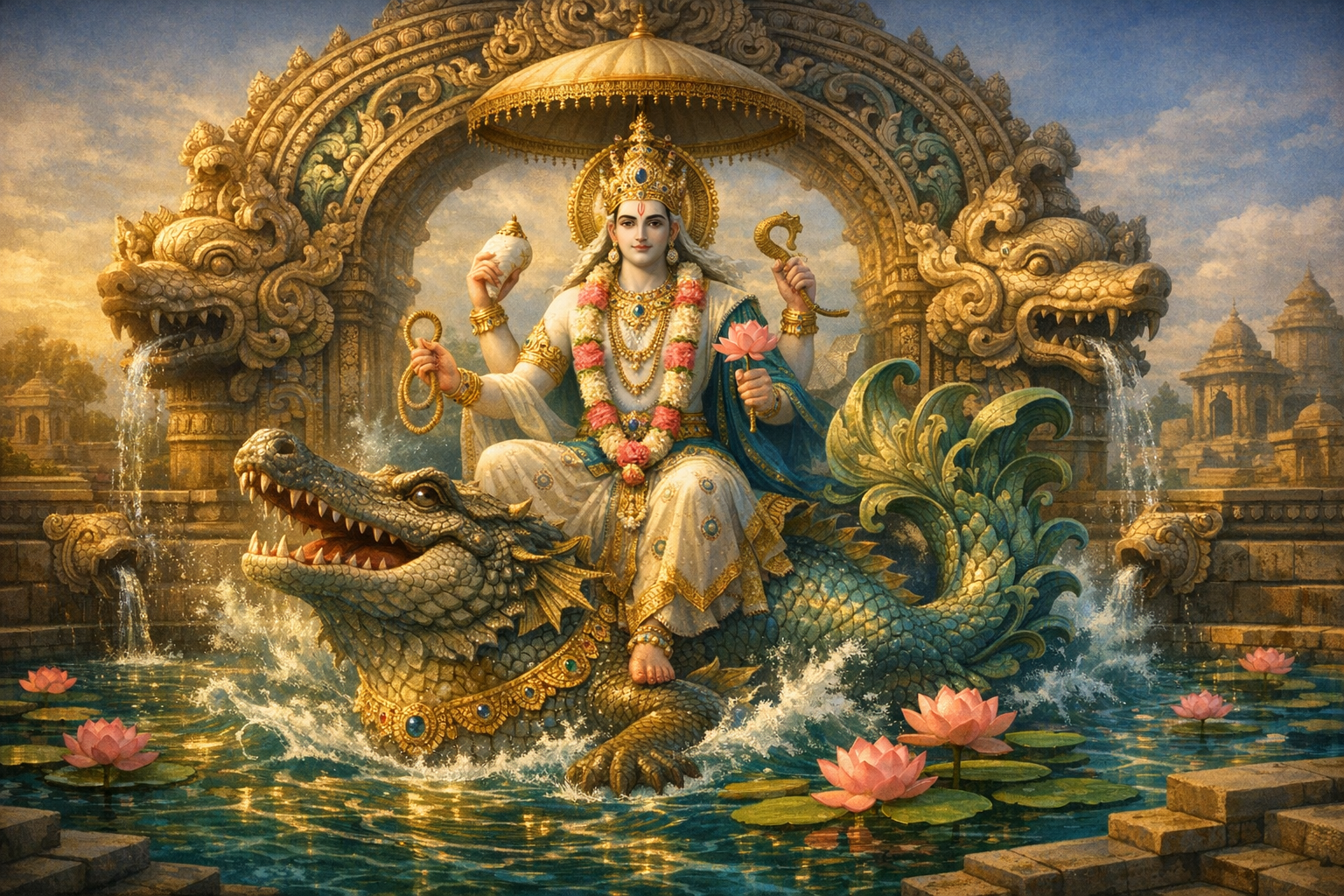
The Matsya Purana preserves a striking and technically precise vision of Varuna, the Vedic guardian of the cosmic waters (jaladeva) and moral order (ṛta), that both complements and challenges more familiar, simplified images in contemporary circulation. In this iconographic account, Varuna appears resplendent with a complexion fair as a conch (shankha-gaura), crowned and adorned with aquatic motifs, and enthroned upon his vahana, the composite Makara. Far from being a mere emblem, the Makara functions as a richly layered symbol of liminality, fecundity, and the binding flow of ethical law across worldssea, sky, and society.
Across Vedic and Purāṇic literature, Varuna evolves from a sovereign upholder of ṛtawhose “thousand eyes” figuratively perceive transgressionto a fully elaborated guardian of the western quarter (one of the Aṣṭa-Dikpālas) in temple and manuscript traditions. The Matsya Purana’s portrayal sits within a broader iconographic ecology shared with the Agni Purana, Vishnudharmottara Purana, and allied Śilpa-Śāstra traditions, which collectively standardize attributes (āyudhas), gestures (mudrās), ornaments (ābharaṇa), complexion (varṇa), and vehicle (vāhana). This confluence yields a vivid theological and visual grammar: the waters that nourish life also bind conduct to consequence, and the deity who governs them bears the instruments to uphold that bond.
In technical terms, Matsya Purana-linked iconography generally accords Varuna a conch-white complexion, a jeweled crown (kirīṭa-mukuṭa), and a garland often of lotuses signifying aquatic sovereignty. He is frequently shown with four arms, with the noose (pāśa) as the definitive emblem of moral restraint and juridical authority, while the remaining hands may hold a lotus (padma), conch (śaṅkha), or goad (aṅkuśa), depending on regional idioms and text-specific prescriptions. He is attendant to the west, typically framed by water fauna, waves, and profuse lotusesvisual cues that link theology to terrain, ritual to riverine life, and ethics to ecology. In many sculptural programs, an umbrella (chatra) indicates his royal dignity and protective sovereignty over the oceanic realm (samudrarāja).
The MakaraVaruna’s vāhana in the Matsya Purana traditionis central to understanding the deity’s iconography beyond convention. Far from a single-species creature, the Makara is a composite aquatic being with a spectrum of forms across regions and periods: often a crocodilian snout paired with a fish-like or serpentine torso, sometimes bearing elephantine or stag-like features, adorned with scaled limbs and a luxuriant, foliate or fin-like tail. This hybridity is intentional. As a liminal, amphibious form spanning river, estuary, and open sea, the Makara encodes the power of thresholdswhere life emerges, goods and ideas circulate, monsoon cycles pivot, and communities negotiate both abundance and peril. In Varuna’s retinue, it signals not only aquatic mastery but the disciplined freedom that allows water’s gifts to remain life-giving rather than destructive.
Read symbolically, Varuna’s pāśa and the Makara function together as a doctrine of ethical hydrology. Water flows, connects, nourishes, and cleanses; yet it also carves, measures, and binds. The pāśa represents law and accountabilityan instrument that “draws back” transgression to its consequencewhile the Makara represents the dynamic medium through which cause follows effect across time and community. Taken together, they articulate a civilizational intuition: societal order, like water, requires channels. When guided, it irrigates; when neglected, it inundates. The Matsya Purana’s meticulous iconography thus dramatizes a perennial teaching about discipline, reciprocity, and care in shared environments.
This Purāṇic vision also clarifies why Makara imagery saturates South Asian art and architecture: it is ubiquitous on temple toranas (makara-toraṇa), water spouts (makara-mukha/hiti), lintels, and stepwells. From Odisha’s grand makara arches to Nepal’s elegant stone spouts and Gujarat’s Rani-ki-Vav, artisans place the Makara precisely where waters emerge, thresholds open, and processions passpoints at which the sacred and the civic meet. In many shrines, Makara mouths discharge ritual water, making the creature a literal conduit between purificatory rite and everyday ecology. Such placements visualize Matsya Purana’s insights in stone and flow, underscoring an ethic of stewardship embedded in form and function alike.
Comparative iconography reinforces this reading. The Vishnudharmottara Purana and Brihat Samhita echo and refine several features found in the Matsya Purana, maintaining Varuna’s western orientation, aquatic ornaments, and Makara vehicle while allowing for local variations in āyudhas and posture (āsana). In sculptural cycles of the Aṣṭa-Dikpālas across Hindu and Jaina temples, Varuna often appears alongside other guardians of the directions, visually integrating ethical governance into the architectural “cosmos” of the shrine. Buddhist contexts likewise appropriate Makara motifs in gateways and water architecture, testifying to the symbol’s wider dharmic currency as a mark of auspicious emergence, protection at thresholds, and the safe passage of beings and blessings.
Regional styles give the Makara a vivid local accent without losing its Purāṇic core. In Odisha, the Makara’s curling tail may blossom into vegetal scrolls, its snout sharply crocodilian; in Tamil regions, temple gopura ornamentation and doorway frames often feature makara-toraṇas teeming with aquatic and floral life; in Nepal, the makara-mukha is engineered to join aesthetics with hydraulics, delivering water to communities while sanctifying the act of distribution; in Bengal and Assam, riverine cultures imprint the Makara with the rhythms of monsoon, fishing, and ferrying. Everywhere the motif speaks of movement disciplined into servicean artistry faithful to Varuna’s ethical and ecological charge.
Integrating textual fidelity and material culture reveals the coherence of Varuna’s Matsya Purana profile. The deity’s conch-white brilliance (shankha-gaura) signals purity and illumination; the lotus evokes buoyancy and generative power rising from depth; the pāśa concretizes moral law; and the Makara anchors divinity to the living waters that feed, test, and transform human life. Even the visual calm of Varuna’s countenanceregularly serene rather than martialconveys an ethic of governance that is assertive yet compassionate, firm yet protective, like a tide that both gives and guards.
For many visitors to subcontinental heritage sites, the emotional resonance of this iconography arrives before the theory. The sight of a Makara-mouth spilling cool water in a courtyard on a hot afternoon; a doorway crowned by paired Makaras unfurling leafy tails; the quiet dignity of Varuna on the western wall of a templesuch encounters join memory to meaning. They gently remind that civilization’s deepest technologies are often ethical: channel water, and one also channels conduct; honor thresholds, and one also honors responsibilities; venerate the sea, and one also vows care for its tributaries and shores.
Crucially, the water symbolism that frames Varuna and the Makara sustains a unifying thread across dharmic traditions. In Hindu ritual, tirtha (sacred water) and abhiṣeka enact purity and consecration; in Buddhist and Jaina art, Makara motifs guard gateways and celebrate auspicious emergence; in Sikh practice, the sarovar surrounding a gurdwara embodies cleansing, equality, and welcome. Water thus becomes a shared ethical commonsan image and experience that encourages mutual respect, ecological responsibility, and spiritual kinship across Hinduism, Buddhism, Jainism, and Sikhism. The Matsya Purana’s Varuna, seated upon the Makara, offers an early and enduring grammar for this kinship.
Understanding the Matsya Purana’s distinctive depiction therefore enriches both scholarship and practice: it clarifies textual prescriptions for Varuna’s form; it explains why the Makara proliferates as a favored architectural and ritual sign; and it consolidates a dharmic ethic in which moral law, civic order, and ecological balance are conjoined. Rather than a picturesque curiosity, the Makara is the living proof that symbolism in the Puranas is not ornamental but operational: it teaches communities to govern flowof water, wealth, and willwith steadiness, compassion, and care.
In sum, the Matsya Purana’s Varuna and his Makara present a technical, aesthetically rich, and spiritually integrative iconography. It invites readers and visitors alike to look again at familiar forms and to see within them a precise pedagogy: that freedom without channels becomes flood, and that law without compassion becomes drought. Between these extremes stands Varuna upon the Makaraan image of balance that has nourished the subcontinent’s art, ethics, and inter-traditional harmony for centuries.
Inspired by this post on Hindu Blog.
