
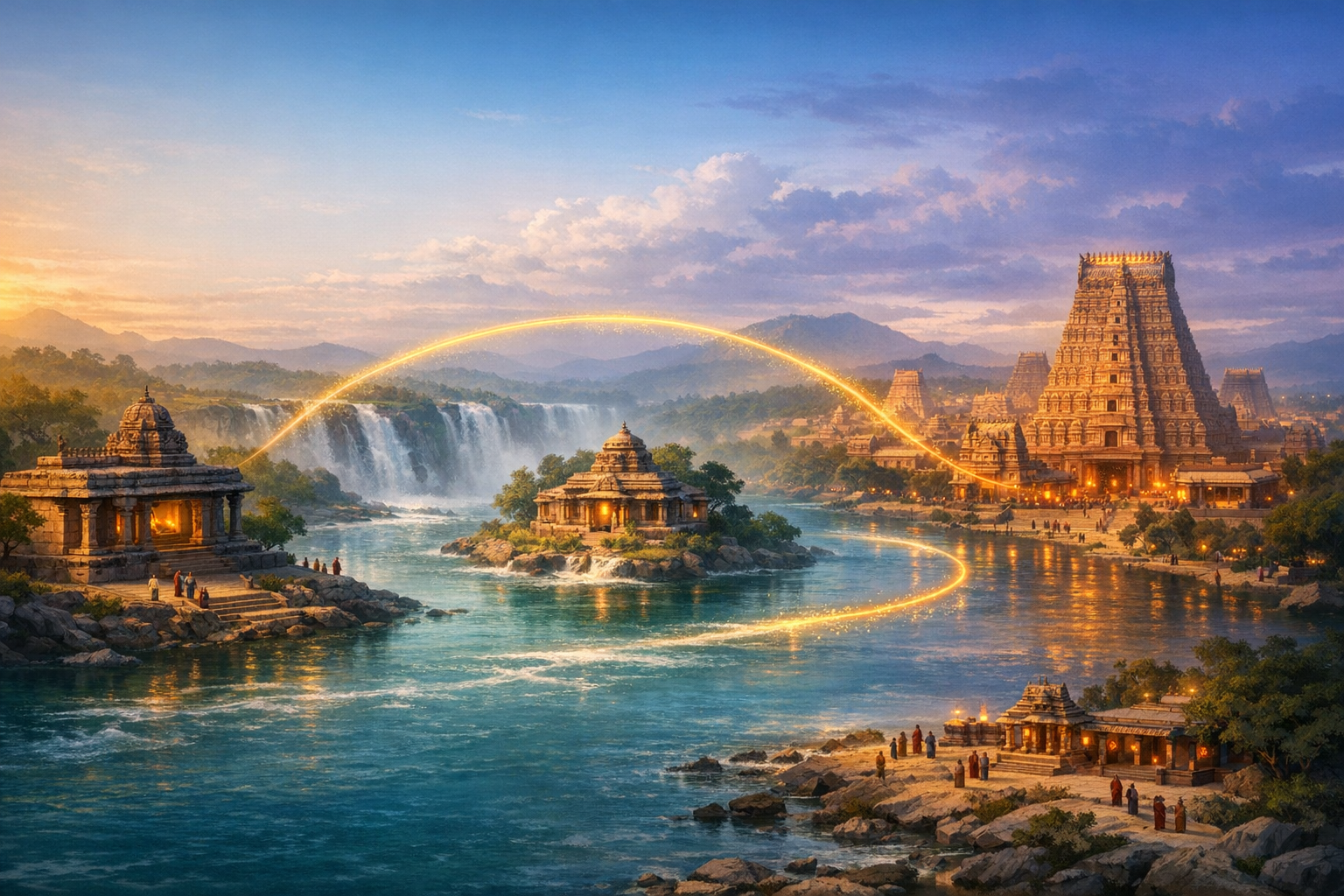
Triranga Darshanam designates a revered South Indian pilgrimage that links three consecrated abodes of Lord Vishnu as Sri Ranganatha along the Kaveri River. The circuit traditionally moves west to eastAdi Ranga (Srirangapatna), Madhya Ranga (Shivanasamudra), and Antya Ranga (Srirangam)and is often undertaken within a single day as a focused spiritual vow. Esteemed in the Sri Vaishnava tradition yet welcoming to all, this yatra weaves together sacred geography, temple architecture, living ritual, and the contemplative ideal of ekagrata (single-pointedness) that resonates across dharmic paths in Hinduism, Buddhism, Jainism, and Sikhism.
Geographically, the three kshetras trace the Kaveri’s journey across the Deccan. Adi Ranga at Srirangapatna (Karnataka) lies near the western reaches of the river; Madhya Ranga at Shivanasamudra stands on a riverine island between the famed Gaganachukki and Bharachukki waterfalls; Antya Ranga at Srirangam (Tiruchirappalli, Tamil Nadu) crowns the eastern course on a vast fluvial island. Each sanctum enshrines Ranganatha in Anantashayana, the iconic reclining posture upon Adishesha, encapsulating a shared theology of cosmic rest, protection, and grace.
Scriptural and historical memory anchors the circuit, especially at Srirangam, praised expansively in the Divya Prabandham and nurtured by Sri Vaishnava acharyas such as Ramanujacharya. The temples broadly follow Agamic precepts (notably Pancharatra), and their ritual life expresses an inclusivist ethosdarshan, seva, and utsava cycles that have welcomed seekers across regions and languages for centuries. In that spirit, the pilgrimage invites inner reflection that harmonizes with the wider dharmic values of ahimsa, compassion, satya, and seva esteemed by Buddhists, Jains, and Sikhs as well.
The one-day completion of Triranga Darshanam is understood as a disciplined sankalpa rather than a rigid requirement. Pilgrims value the tapas of time-bounded devotion, the clarity that comes from sustained attention, and the experiential continuity of three darshans within a single sunrise-to-sunset arc. The tradition underscores intention over speed: the vrata is meaningful when undertaken with reverence, preparedness, and humility, whether in one day or spread across several.
Seasonal and logistical planning greatly influence the experience. Clear post-monsoon skies between November and February typically offer easier driving and cooler darshan queues, while heavy monsoons can swell the Kaveri near Shivanasamudra and complicate access. For a one-day circuit, early departures and realistic schedule buffers are essential, as is the readiness to adapt to temple crowding, festival traffic, or brief closures for puja, alankara, or naivedya.
A commonly attempted itinerary begins at dawn in Srirangapatna for Adi Ranga darshan, proceeds mid-morning to Shivanasamudra for Madhya Ranga, then culminates late afternoon or evening at Srirangam for Antya Ranga. One practical sequence is to reach Srirangapatna by 6:00–6:30 a.m., complete darshan by around 8:00 a.m., arrive at Shivanasamudra by approximately 9:30–10:00 a.m. (accounting for rural roads), and depart before noon for the longer drive to Srirangam. With steady travel and a brief meal stop en route, many pilgrims aim for Srirangam by late afternoon to avail general or special darshan before the night pujas. Actual feasibility varies; verifying local traffic and temple schedules a day in advance is prudent.
Temple hours can shift by season, weekday, and festival calendar. As a general orientation (subject to local notice): morning darshan commonly begins around sunrise, a midday closure often follows abhishekam and naivedya, and evening darshan resumes until night pujas conclude. Anticipate windows such as 6:00–10:00 a.m. and 4:00–8:30 p.m. at larger temples, while smaller shrines like Madhya Ranga may observe shorter or more variable timings. It is advisable to confirm the day’s schedule by phone or in person, especially at Shivanasamudra, where accessibility can change with river conditions.
For travel logistics, Bengaluru and Mysuru serve as efficient gateways for Adi Ranga and Madhya Ranga. Srirangapatna lies just off the Bengaluru–Mysuru corridor. Shivanasamudra is typically reached via Malavalli or Kollegala on state highways. The onward run to Srirangam entails a longer interstate drive into Tamil Nadu, with Tiruchirappalli as the major hub (also home to a well-connected airport and railhead). Hiring a reliable vehicle with an experienced driver familiar with temple towns and rural stretches substantially eases the day’s tempo.
Darshan etiquette aligns with pan-Indic norms: modest attire covering shoulders and knees, footwear removed at designated points, phones silenced, and photography avoided in sanctum areas. Queue discipline, respectful silence near the garbhagriha, and deference to archakas and volunteers preserve the sanctity of the experience. Pilgrims from any tradition are welcome in the broader temple precincts; specific sanctum-entry conventions, if any, are posted locally and should be followed conscientiously to honor living customs.
Adi Ranga (Srirangapatna, Karnataka) preserves an early medieval legacy shaped by the Western Ganga, Hoysala, Vijayanagara, and Wodeyar courts. The moola-vigraha of Sri Ranganatha reclines on Adishesha with traditional iconographic featuresBhudevi and Neeladevi in proximity, conch and discus emblems, and a serene countenance suffusing the sanctum. Dravidian elements predominate in the vimana and mantapas, with sculptural programs that balance Vaishnava iconography and regional stonecraft. A Thayar shrine within the complex reinforces the Srivaisnava liturgical rhythm of goddess and lord worship.
Madhya Ranga (Shivanasamudra, Karnataka) sits intimately within the river’s embrace, a smaller and quieter temple whose grace draws from its setting as much as from its sanctity. The approach roads narrow near the river island, and parking can be limited; monsoon vigilance is necessary. When open, the darshan embodies a contemplative cadencesoft lamps, succinct pujas, and the murti’s reclining repose framed by a simple garbhagriha. Many pilgrims speak of the palpable stillness here, a mid-journey pause that deepens focus before the final leg to Srirangam.
Antya Ranga (Srirangam, Tamil Nadu) is among the world’s largest functioning temple complexes, historically organized in seven concentric prakaras with towering gopurams culminating in the Rajagopuram, and an expansive ritual calendar that animates the precincts daily. The moola-vigraha of Sri Ranganatha is uniquely oriented southward, a gesture of enduring grace to bhaktas beyond the river’s horizon. The utsava murti, Namperumal, carries the temple’s vibrant festival life, with Vaikunta Ekadashi and Panguni Uttiram among the most cherished observances. Navigating Srirangam’s corridors of devotion is an immersion in living heritagechant, music, prasada, and the steady flow of darshans across time.
Cultural and ecological mindfulness enhance the yatra’s integrity. The Kaveri is both river and goddesspilgrims often perform simple pranam on the banks, take only what is needed, and return no waste to the water. Patronage of local prasadam counters and artisan stalls helps sustain traditional economies around the temples. Such stewardship reflects a broader dharmic solidarity: the shared waterway binds communities across state lines, languages, and sects in a continuum of reverence.
The yatra’s inner purpose harmonizes naturally with other dharmic traditions. A Buddhist may recognize the value of mindful travel and compassionate conduct; a Jain may resonate with ahimsa in food and footprint; a Sikh may see seva in helping fellow pilgrims and maintaining collective order. Triranga Darshanam, at its best, becomes a bridgeaffirming unity in diversity and situating personal devotion within a larger ethic of mutual respect.
Because the schedule is demanding, safety and realism are essential. Rest well the prior night, keep hydration and light satvik snacks handy, and account for language shifts between Kannada and Tamil regions. If queues are heavy or a temple briefly closes, accept the change with equipoise; a two-day completion remains faithful to the vow’s spirit. Above all, the pilgrimage rests on bhavadevotional feelingmore than on the stopwatch.
Common concerns usually involve feasibility, temple access, and timing. Completing all three darshans in one day is achievable with careful planning, but the merit lies equally in sincerity and steadiness. Most precincts allow all visitors into outer prakaras; specific sanctum rules, if any, are locally communicated. Festival seasons intensify crowds at Srirangam; some pilgrims opt for a special entry darshan in the evening for a measured final experience.
In its totality, Triranga Darshanam is a confluence of river and rasageography and grace. It charts a course from the intimate stonework of Karnataka’s temples to the grand processional avenues of Srirangam, from the quietude of a mid-river sanctum to the majestic cadence of a great kshetra. Those who undertake it often describe a subtle alignment at day’s end: the mind steadied, the heart lightened, and the journey’s three darshans absorbed into one continuous remembrance of Sri Ranganatha’s abiding presence.
Inspired by this post on Hindu Blog.
