
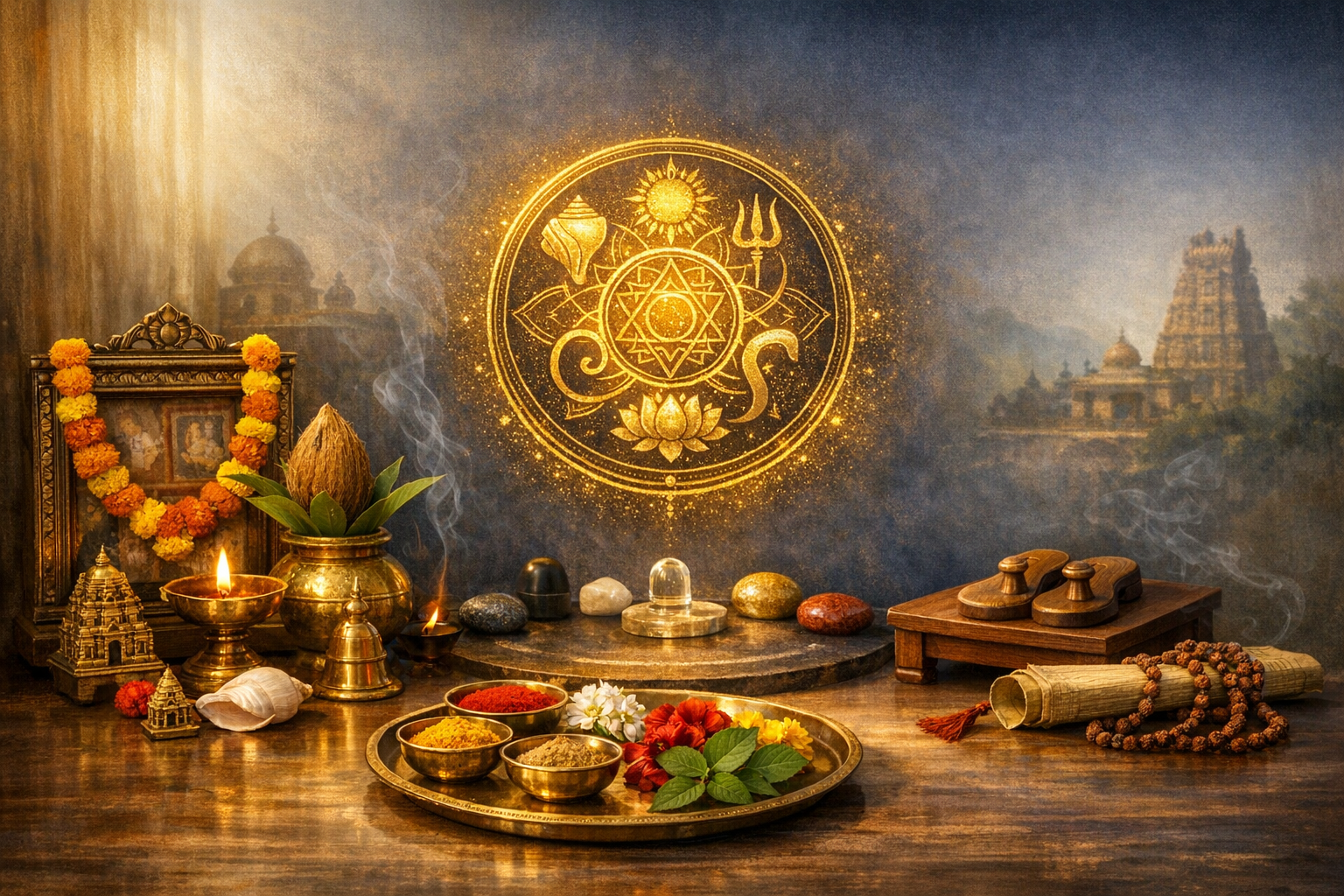
Within Hindu dharma, two complementary anchors shape everyday worship and identity: the family’s Kuladevata (tutelary lineage deity) and a practitioner’s Paradevata (the transcendent or sectarian Supreme). Although often conflated with the widely referenced Ishta Devata (personal chosen deity), these terms carry distinct theological, ritual, and social meanings. Clarifying their roles yields a coherent sadhana that honors ancestry while deepening personal devotion.
Etymologically, Kuladevata combines kula (lineage, clan) and devata (deity), indicating a guardian of familial continuity and duty (kuladharma). Paradevata blends para (supreme, transcendent) with devata, indicating the deity recognized as ultimate within a given sampradaya or through one’s initiation (diksha). Both operate within the living fabric of Hindu traditions that integrate Vedic, Agamic, and Puranic streams.
Kuladevata worship is transmitted intergenerationally. The family deity is remembered in rites of passage (samskaras), invoked in ancestral remembrance (shraddha), and propitiated during festivals and crisis rites. This deity functions as the spiritual home of a lineage, sustaining belonging, protection, and continuity across generations.
Transmission patterns vary regionally. In many communities, the Kuladevata passes through the paternal line after marriage, while respect for the natal family’s deity is retained. In others, maternal lines hold equal weight, reflecting the plural and adaptive nature of Hindu social organization.
Ritually, families maintain periodic pilgrimages to the Kuladevata’s kshetra, observe specific vratas, and begin sankalpa by remembering the lineage deity. Daily puja may include a brief offeringhowever simpleto ensure that ancestral vows and blessings remain unbroken. This continuity is considered a matter of gratitude and dharmic duty rather than sectarian preference.
The psychological and social effects are notable. Kuladevata worship stabilizes identity, strengthens extended kinship networks, and provides a resilient moral compass during transition or adversity. For many households, the earliest memory of sacred travel is to the ancestral shrinean imprint of belonging that shapes later spiritual choices.
Paradevata worship centers on the ultimate object of devotion and realization. For Sri Vaishnavas, Paradevata is Sriman Narayana; for Saivas, Paramesvara (Shiva); for Saktas, Parasakti (Devi); for Ganapatyas, Mahaganapati; and for Sauras, Surya. This designation reflects the supreme upasya within a tradition rather than a family obligation.
In practice, Paradevata worship often emerges through guru-sampradaya, scriptural study, and mantra-diksha. It orients one’s nitya (daily) and naimittika (occasional) disciplines and frames the path to moksha (liberation). Theological commitmentssuch as Saguna/Nirguna Brahman or qualified non-dualismfrequently accompany Paradevata devotion.
Ishta Devata (personal deity of affinity) may converge with Paradevata, but the terms are not identical. Ishta is the deity to whom the heart turns most naturally; Paradevata is the deity upheld as Supreme within a framework of doctrine and initiation. One’s Ishta can be the Paradevata, yet the conceptual distinction remains useful for clarity of practice.
These two axesKuladevata for lineage and Paradevata for the Supremeare complementary, not competitive. The former preserves ancestral gratitude and social ethics; the latter orients ultimate soteriological aspiration. Mature sadhana integrates both seamlessly.
In many households, puja proceeds with Ganesha and Guru remembrance, acknowledgment of the Kuladevata, and then the full worship of the Paradevata. This order honors gratitude to ancestry while prioritizing one’s chosen path to realization. The practice can be adapted across Smarta, Vaishnava, Saiva, and Sakta modalities without loss of integrity.
When a Kuladevata is unknowncommon in diasporic or displaced familiesseveral avenues exist. Elders, community genealogists, and hereditary temple priests (pandas) at sacred centers like Haridwar or Kashi can sometimes retrieve lineage records. Where data remain elusive, households often adopt a provisional practice of remembering known ancestors alongside a chosen protective deity, awaiting clarity.
Marriage brings practical questions. Many traditions encourage adopting the spouse’s Kuladevata for shared household rites while retaining reverence for the natal deity. This solution strengthens unity without erasing personal history and reflects the dharmic value of harmony within joint family systems.
Regional diversity illustrates the living breadth of Kuladevata traditions. In Goa and the Konkan, Shanta Durga and Mangeshi are common family deities; in Maharashtra, Khandoba is venerated by numerous lineages; in Karnataka and Tamil Nadu, Amman temples and guardian deities anchor clan identities. Each landscape weaves local customs into the wider tapestry of Hindu dharma.
Scriptural scaffolding undergirds both practices. Agamas and Puranas reference kula-dharma obligations and the centrality of tutelary guardians, while Vedanta articulates the metaphysical ground for recognizing a Supreme (Paradevata) as Brahman manifest in accessible, worshipful form. The Smarta panchayatana system further enshrines plurality as a norm rather than an exception.
Smarta panchayatanaworship of five principal deities (Shiva, Vishnu, Devi, Surya, Ganesha)exemplifies a framework that holds both lineage gratitude and the quest for the Supreme in a single altar. It fosters unity across sects, enabling households to honor the Kuladevata while giving full scope to the Paradevata.
Local guardian deities (Gramadevata) also shape practice. A village or region’s protective presence often receives seasonal offerings, processions, and community vows. Recognizing Gramadevata alongside Kuladevata and Paradevata affirms the layered ecology of Hindu sacred lifehousehold, settlement, and cosmos.
Consider a typical rhythm: annual pilgrimage to the Kuladevata kshetra renews family bonds; monthly or fortnightly vratas deepen personal discipline; and daily Paradevata puja consolidates the orientation toward liberation. None of these layers require the others to be abandoned; each perfects the other.
Cross-dharmic analogues highlight a shared civilizational ethos. In Vajrayana Buddhism, a yidam functions as a meditative support akinby structural roleto an Ishta/Paradevata; in Jain communities, devotion to Tirthankaras coexists with reverence for protective traditions linked to lineage and sacred geography; Sikh households center life around Ik Onkar and Guru Granth Sahib while honoring lineage, guru-parampara, and community service (seva). Such parallels underscore unity across dharmic paths without erasing doctrinal distinctions.
Home altars can be arranged to reflect this harmony. A succinct sankalpa may remember gotra, rishis, Kuladevata, and then turn toward Paradevata mantra and archana. Stability (through lineage remembrance) and ascent (through supreme devotion) thus align in one daily practice.
Calendrical observances also support integration. Families may choose a dedicated tithi each year for Kuladevata offerings, while sustaining ekadashi, pradosha, or amavasya disciplines for Paradevata-oriented sadhana as per sampradaya. Such scheduling clarifies intent and prevents neglect of either stream.
Ethically, the combination cultivates gratitude, humility, and responsibility. Kuladevata worship guards against rootlessness; Paradevata worship anchors the pursuit of truth and freedom (moksha). Together they nurture both social cohesion and inner transformation.
Key questions frequently arise. Can a Kuladevata be changed? Ordinarily, nocontinuity is the ideal; when unknown, conscientious inquiry and provisional practice are advised. Who determines the Paradevata? Typically the practitioner, guided by a living guru, lineage teachings, and authentic affinity.
What if the household spans different sampradayas? Hindu pluralism offers tested templatesSmarta inclusivity, Vaishnava and Saiva frameworks with respectful accommodation, and shared vratas that keep the family altar whole. The operative principle is dharma-samaya: honoring commitments without diminishing another’s path.
In diasporic settings, distance from ancestral temples need not sever bonds. Periodic remembrance, coordinated offerings through family networks, and visits when feasible keep the thread unbroken. Meanwhile, daily Paradevata worship sustains depth, continuity, and learning.
Terminological clarity helps: Kuladevata preserves lineage obligations; Paradevata orients ultimate devotion; Ishta Devata expresses personal affinity. When these are consciously aligned under guru guidance, household worship becomes both rooted and luminous.
The sacred difference, then, is not a division but a design. Kuladevata embodies gratitude to the past; Paradevata embodies aspiration toward the highest; Ishta Devata embodies intimacy of the heart. Held together, they realize the civilizational ideal of unity in spiritual diversityan enduring strength of Hindu spirituality and a shared value across dharmic traditions.
Inspired by this post on Hindu Blog.
