
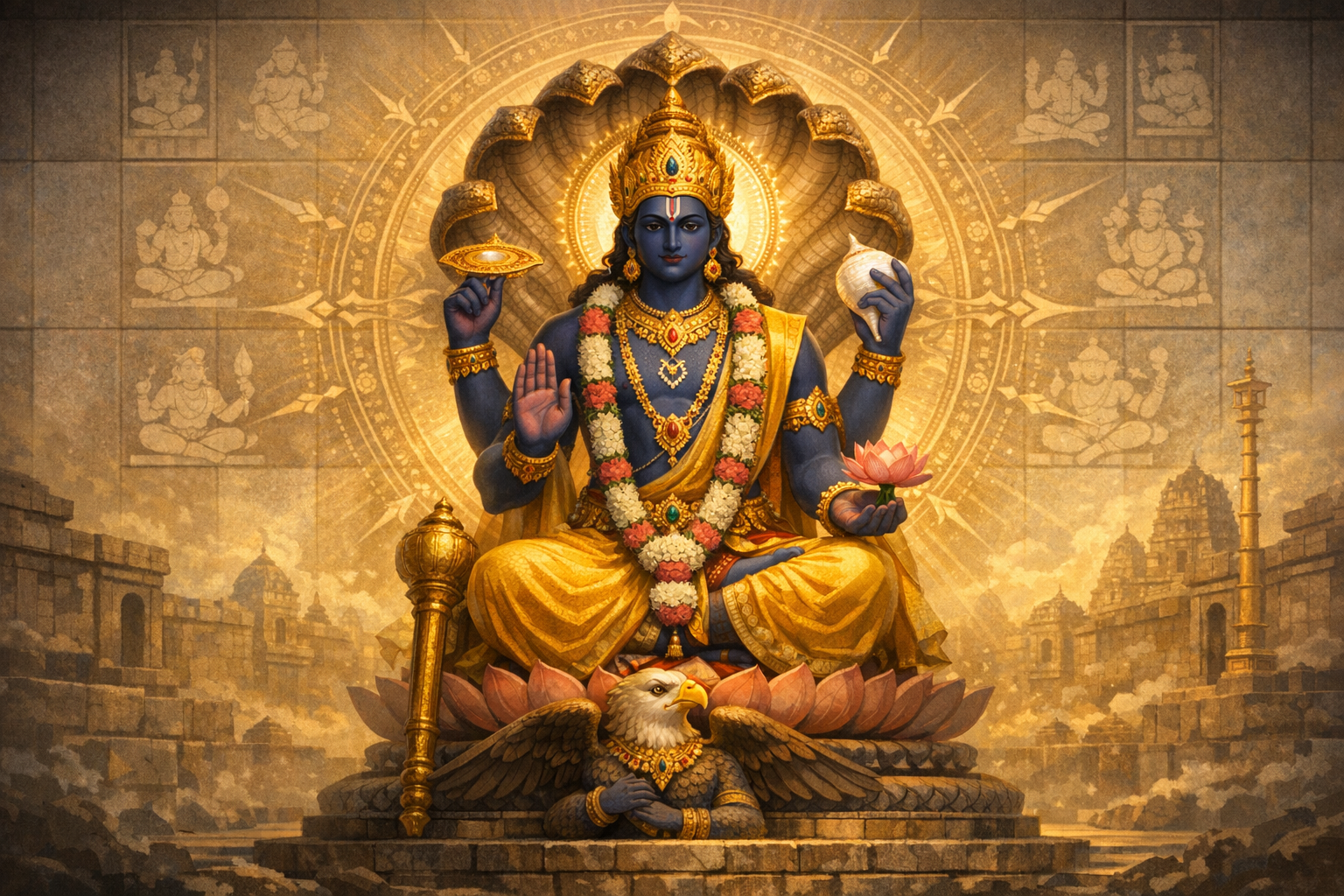
Within the multilayered landscape of Vaishnava tradition, Vishnu’s protective vocation is frequently expressed through the theological and artistic idea of Lokapālaguardian of the worlds and, by extension, the directions. Read with care, this formulation does not merely replicate the classical eight Dikpālas; rather, it frames Vishnu as Jagatpāla, the sustaining presence whose sovereignty embraces and sanctifies every quarter of space.
Etymologically, lokapāla (loka + pāla) denotes a “protector of worlds.” Classical Hindu cosmology situates guardianship in the eight directionsIndra (East), Agni (Southeast), Yama (South), Nirrti (Southwest), Varuna (West), Vayu (Northwest), Kubera (North), and Īśāna (Northeast). Vaishnava exegesis extends this grammar by emphasizing Vishnu’s supremacy over the protective grid itself, aligning with epithets such as Lokanātha, Jagatpati, Trilokeśa, and Lokādhyakṣa, which collectively construe a theologically coherent vision of all-pervading guardianship.
Textual anchors for this vision are dispersed across Purāṇic and Āgamic corpora, notably the Vishnudharmottara Purāṇa, Agni Purāṇa, and select Pāñcharātra Saṁhitās (e.g., Jayākhya, Viṣṇu Saṁhitā, Padma Saṁhitā). These sources provide iconographic canons (āyudha-arrangements, mudrās, ornaments, proportions) and ritual frames that, taken together, furnish a robust interpretive matrix for “Lokapāla Viṣṇu” as an iconographic and devotional reading rather than a single, universally rigid type.
Core iconography follows the recognizable Vaishnava grammar. Vishnu is typically four-armed (chaturbhuja), dark-hued (śyāma), adorned with the tall kīrīṭa-mukuṭa (royal crown), and robed in pītāmbara (yellow garment). The Srīvatsa mark graces the chest, the Kaustubha jewel rests at the heart, and the vanamālā (forest-flower garland) drapes from shoulder to knee. The prabhāmaṇḍala (halo or aureole) often completes the sacred silhouette.
Each āyudha encodes protective meaning central to the Lokapāla reading. The Sudarśana Chakra symbolizes time, order, and the incisive governance of dharma; the Pāñcajanya Śaṅkha embodies the primordial sound that summons beings to righteousness; the Kaumodakī Gadā grounds strength and the capacity to subdue chaos; and the Padma (lotus) expresses purity, sovereignty, and the ever-renewing possibility of auspiciousness. Variants occasionally include the Nandaka sword (discriminative knowledge) and the Śārṅga bow (cosmic readiness).
Mudrās amplify this protective presence. Abhayaraised right handassures fearlessness in all directions; Varadabestowing gesturesignals grace, welfare, and stability. Together, they render a soteriological promise: a cosmos both guarded and graced, where protection and liberation coinhere.
Ornamentation functions as visual theology. The Kaustubha affirms Vishnu’s role at the cosmic heart; Srīvatsa signals inseparability from Śrī (Lakṣmī), the principle of order and prosperity; the vanamālā binds heaven and earth in a living continuum. The kīrīṭa-mukuṭa crowns kingship not as dominion, but as careguardianship raised to the level of cosmic office.
Vāhana and support motifs are equally instructive. Garuḍa, as vāhana, represents swiftness, clarity, and the expulsion of poisonan image of prophylactic protection. Śeṣa (Ananta), when present beneath or behind, frames eternity as the abiding ground of guardianship: protection is not a momentary intervention but an ontological condition.
Temple spatiality integrates the Lokapāla thesis. The Vāstu-Puruṣa Maṇḍala maps the cosmic body onto the shrine plan, situating the Ashta-Dikpālas around the sacred core. Vaishnava temples often articulate this by placing Vishnu or his forms along cardinal axes, while Dikpāla icons, bali-pīṭhas, and dhvaja-stambha collectively inscribe a circle of protection that the presiding deity both authorizes and exceeds.
Architecturally, images construed as “Lokapāla Vishnu” frequently occupy directional niches on prākāra walls and gopuras, visually dialoguing with Dikpālas. This dialogic placement expresses theological hierarchy without erasing plurality: the guardians hold their posts; Vishnu secures their mandate.
Shilpa-śāstra canons regulate embodiment. Proportions follow tāla-measures (commonly 8-, 9-, or 10-tāla figures), while aṅgula-units calibrate limb ratios, pedestal heights, and prabhāvalī spans. The padma-pīṭha (double-lotus base) harmonizes purity and stability, and the visual cadence from crown to pedestal rehearses a “cosmic descent”transcendence localizing as protection in situ.
Regional styles nuance the protective grammar without altering its core. Gupta and post-Gupta images emphasize serene classicism; Pallava and Chola bronzes animate grace and movement; Hoysala stonework articulates intricate jewelry and rhythmic drapery; Kashmir’s Vai-kuṇṭha traditions explore multi-faced Vaishnava sovereignty; and Nepalese metal icons often accentuate regal stillness. Across these idioms, the constantsśaṅkha, chakra, gadā, padma; Srīvatsa; Kaustubha; Garuḍasustain the guardianship thesis.
Ritual frames consolidate meaning. Daily arcana, seasonal alaṅkāras, and festival perambulations (utsavas) externalize protective presence into the lived rhythms of the community. Sudarśana-homas and recitations from the Viṣṇu Sahasranāma reinforce a shared conviction: the same wheel that trims adharma in myth orders collective life in the present.
Devotees across regions frequently describe a felt atmosphere of assurance in sanctums where Vishnu stands with chakra poised and abhaya extended. Pilgrims recount an intuitive sense that space itselfmahā-maṇḍapa, prākāra, and even the town perimeteris ritually moralized, as though the deity’s watch extends to every threshold and crossroads.
Comparative dharmic perspectives deepen unity without collapsing difference. Buddhism’s Caturmahārāja (Dhrtarāṣṭra, Virūḍhaka, Virūpākṣa, and Vaiśravaṇa) guard the quarters of Mount Meru; Jain traditions honor Ashta-Dikpālas in temple iconographic programs; and Sikh scripture invokes the Divine pervading char disāṅ (the four directions), emphasizing an all-encompassing presence rather than anthropomorphic guardianship. Together, these strands affirm a civilizational intuition: ultimate reality safeguards the moral horizon.
For viewers seeking a disciplined “reading” of a Lokapāla Vishnu image, a practical sequence proves helpful: begin with overall stance and serenity, then identify āyudhas and their hand-placements; note mudrās and their directional address; attend to Srīvatsa and Kaustubha at the chest; read crown and earrings as sovereignty signals; observe vāhana and pedestal type; situate the image within the temple’s cardinal logic; recognize nearby Dikpāla presences; and finally, listen for the Śaṅkha–Chakra dialoguesound and orderas the icon’s audible and visible heart.
Protective variants further underscore the theme. Narasiṁha images articulate fierce guardianship at liminal zones; Varāha embodies the rescue of earth itself; Trivikrama (Vāmana’s cosmic stride) performs the measure of the worlds, reinscribing limits that safeguard balance. The Kashmiri Vai-kuṇṭha Caturmūrti, with its multi-faced sovereignty, visualizes a kingship that surveys every quarter at once.
Names and mantras corroborate the icon’s semantics. Epithets such as Lokanātha, Jagatpati, Trilokeśa, and Lokādhyakṣa, heard in stotra and Sahasranāma recitation, become hermeneutic keys: each name maps a protective competencyoversight, stewardship, triadic sovereignty, and supervisory wisdomonto the stillness of stone and bronze.
Historically, this guardianship has had social and ethical valence. Temple-centered processions once traced civic boundaries, blessing gates, wells, and granaries, fusing aesthetics, agriculture, and public order. In contemporary urban and diaspora contexts, the same imagery catalyzes a shared ethic: to preserve cultural memory, secure places of refuge, and practice dharma as sustainable stewardship.
Read in this way, “Lokapāla Viṣṇu” distills a civilizational promise. The iconography of śaṅkha, chakra, gadā, and padma does not only recount myth; it proposes a constitutional order for inner and outer life. The sanctum’s calm, the aureole’s glow, the lotus-base’s steadinessall conspire to teach that protection is not merely reactive defense but proactive alignment with cosmic law.
Across Hinduism, Buddhism, Jainism, and Sikhism, this insight offers common ground: the Divine, however envisioned, pervades and safeguards the quarters of existence. When experienced as art, ritual, and ethical orientation, Lokapāla Vishnu becomes a bridgehonoring diversity of form while affirming unity of purpose: the guardianship of life, order, and compassion in all directions.
Inspired by this post on Hindu Blog.
