
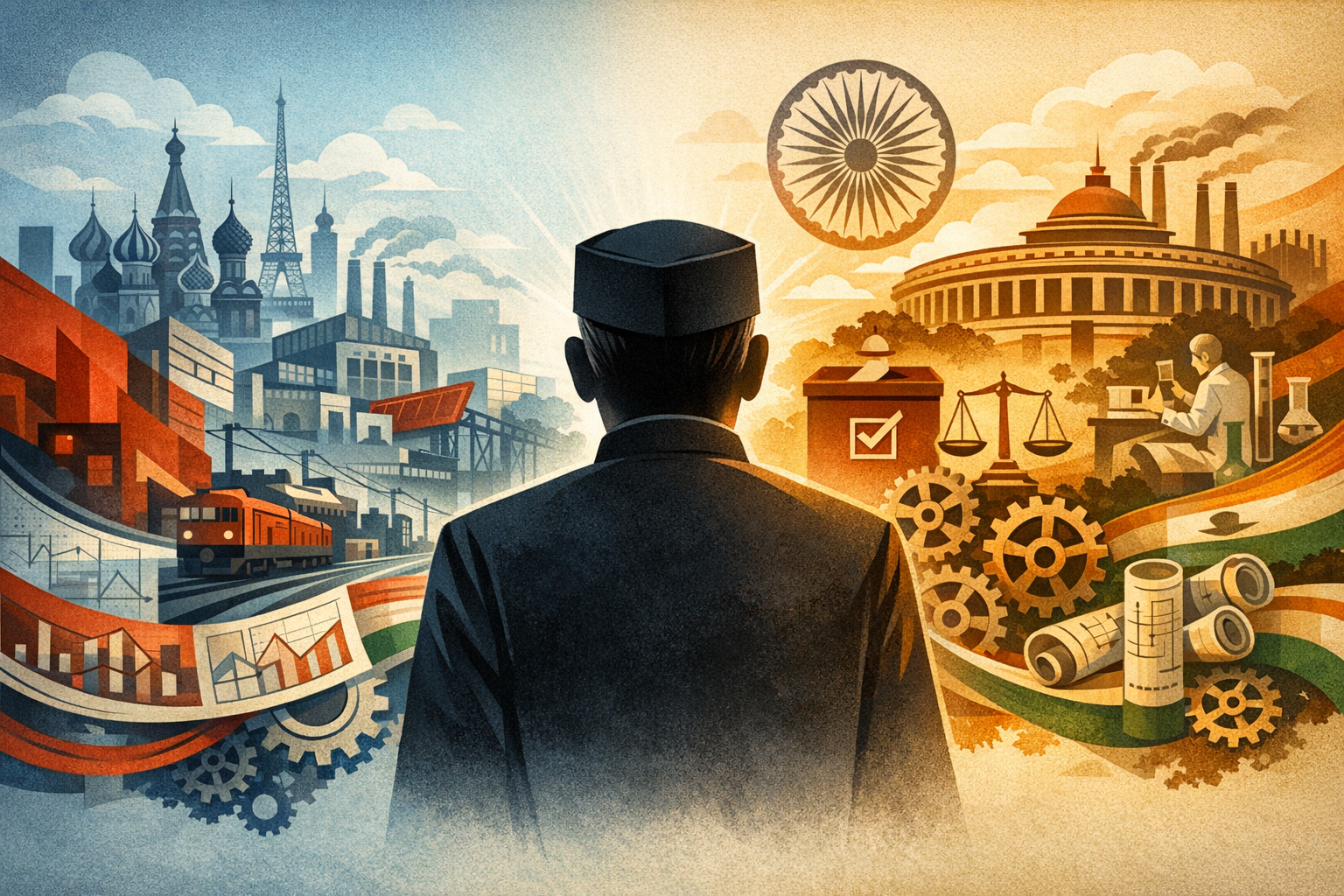
In November 1927, at the invitation of the Soviet government, members of the Nehru family, including Jawaharlal Nehru and Motilal Nehru, traveled to the Union of Soviet Socialist Republics to attend commemorations marking the tenth anniversary of the Great October Revolution. The timing proved consequential: the visit fell at the close of the New Economic Policy and on the cusp of the first Soviet Five-Year Plan, offering a snapshot of a state attempting rapid modernization under an avowedly Marxist framework.
Contemporary observers in Europe and beyond often criticized Soviet Russia for scarcity, rationing, and political repression, even as official Soviet narratives emphasized electrification, mass literacy, scientific research, and expanding participation of women in public life. These global cross-currents of condemnation and celebration framed the Nehrus’ experience and shaped the interpretive lens through which Jawaharlal Nehru evaluated what he saw.
As state guests, the Nehrus received the courtesies typically extended by great powers to foreign dignitaries: organized rail travel, escorted transfers, and a program of events designed to optimize exposure to select institutions. Such arrangementsstandard in interwar diplomacyaimed to control access and impressions without necessarily falsifying the underlying data points.
The itinerary highlighted model schools, workers’ clubs, scientific institutes, municipal services, and cultural venues in Moscow and Leningrad. Meetings with officials, intellectuals, and professionals punctuated the tour, providing a controlled yet information-rich immersion in the institutional landscape of a post-revolutionary society determined to signal competence and progress.
Nehru’s reflections, later developed in Soviet Russia: Some Random Sketches and Impressions (1928) and revisited in Glimpses of World History (1934), disclose a dual response. He admired the capacity for large-scale social organization, the ambitious drive for mass education, the new visibility of women in public spheres, and the primacy accorded to science and technology. At the same time, he registered concern over ideological conformity, narrowed civil space, and the social costs of accelerated transformation.
The claim that this journey turned him into an “incurable Soviet addict” collapses nuance into caricature. The visit deepened an existing attraction to economic planning, public investment, and social equity, but he consistently articulated these goals within India’s constitutional democracy, fundamental rights, and pluralistic ethos. In short, it helped refine an Indian variant of democratic socialism rather than import a one-party template.
Indian political context through the late 1920s and 1930s is essential to understanding this evolution. The Indian National Congress wrestled with purna swaraj, agrarian distress, labor rights, and industrial strategy. Nehru’s advocacy contributed to the National Planning Committee (1938), which convened economists, engineers, and public-health experts to scope an indigenous pathway to developmentdistinct from colonial extractive models and distinct, too, from authoritarian centralism.
After independence, these strands converged. The Planning Commission (1950) and India’s Five-Year Plans (from 1951) embodied an Indian synthesis: P. C. Mahalanobis’s statistical planning, a mixed economy with a significant public sector, protective tariffs, and long-gestation infrastructure. Concrete expressions of this synthesis included integrated steel plants and research ecosystems: Bhilai (with Soviet assistance), Rourkela (with West German collaboration), Durgapur (with British support), alongside CSIR laboratories, IITs, and large river-valley projects. The system borrowed the idea of scale and sequencing from the Soviet experience but diverged sharply on politics, rights, and religious freedom.
This divergence is pivotal. Unlike the Soviet model, India embedded universal adult franchise, a federal structure, judicial review, a free and often pugnacious press, and a dense associational life spanning Hindu, Buddhist, Jain, Sikh, and other communities. Democratic socialismas Nehru conceived itsought social justice, not through coercive uniformity, but through parliamentary processes, civil liberties, and respect for religious and philosophical diversity.
The diplomatic theater of 1927 also warrants analytical attention. The Soviet state, like other great powers, practiced cultural diplomacy: curated factory floors, scientific exhibitions, and emblematic pageantry intended to impress foreign opinion-makers. Such choreography, evident in the Nehrus’ tour, operated not purely as misdirection but as agenda-settingforegrounding what hosts wished visitors to consider most salient.
In this sense, the 1927 visit serves as a case study in soft power during an ideologically polarized era. For Indian leaders confronting colonial underdevelopment, partial evidence of industrial takeoff elsewhere merited study. Nehru’s subsequent writings triangulated among three poles: admiration for social mobilization; awareness of human-rights deficits; and a conviction that modernization must harmonize with India’s pluralistic, civilizational fabric.
The dharmic dimensionoften sidelined in political-economy narrativesmatters here. Ethical commitments found across Hindu, Buddhist, Jain, and Sikh traditions emphasize human dignity, non-violence, and lokasangraha (the welfare of all). Nehru’s emphasis on education, health, and anti-poverty programs cohered with an enduring civilizational priority: expanding the conditions for human flourishing while safeguarding freedom of conscience and worship.
Early policy outcomes reflected both ambition and constraint. Community development programs, expansion of higher education and research, electrification, and large infrastructure aimed to diffuse opportunity across regions and communities. Simultaneously, administrative bottlenecks, shortages, and foreign-exchange constraints revealed the friction costs of a protectionist, license-permit regime, catalyzing debates that would evolve across subsequent decades.
Internationally, Nehru’s later travelsincluding a 1955 visit to the USSR and reciprocal Soviet leadership visits to Indiaunfolded within the strategy of non-alignment. Non-alignment was a doctrine of developmental autonomy: diversifying technology sources, reducing strategic vulnerability, and avoiding bloc entanglements, while sustaining dialogue across ideological and civilizational lines.
Read with historical care, the 1927 journey resists simplification. It did not implant a foreign ideology wholesale; rather, it accelerated an Indian search for toolsplanning, science, and public investmentdeemed necessary to overcome colonial poverty. India’s constitutional guardrails and civilizational pluralism domesticated these tools within a democratic setting.
Three takeaways stand out for contemporary readers. First, external models can sharpen, not erase, indigenous priorities. Second, state hospitality in any capitalMoscow, London, or Washingtonis best read as theater plus data: illuminating yet incomplete. Third, India’s development choices endure when aligned with the country’s dharmic tapestryhonoring freedom of worship and conscience for Hindus, Buddhists, Jains, Sikhs, and otherswhile pursuing social justice through peaceful, democratic means.
In sum, the 1927 Soviet sojourn constitutes a formative, not determinative, episode in the evolution of Indian policy thought. It catalyzed a sustained interest in planning and scientific modernity, tempered by a lifetime commitment to parliamentary democracy, fundamental rights, and unity across India’s diverse spiritual traditions. Understanding that balance clarifies both the promise and the limits of borrowing from global experiments in service of a distinctively Indian modernity.
Inspired by this post on Dharma Dispatch.
