
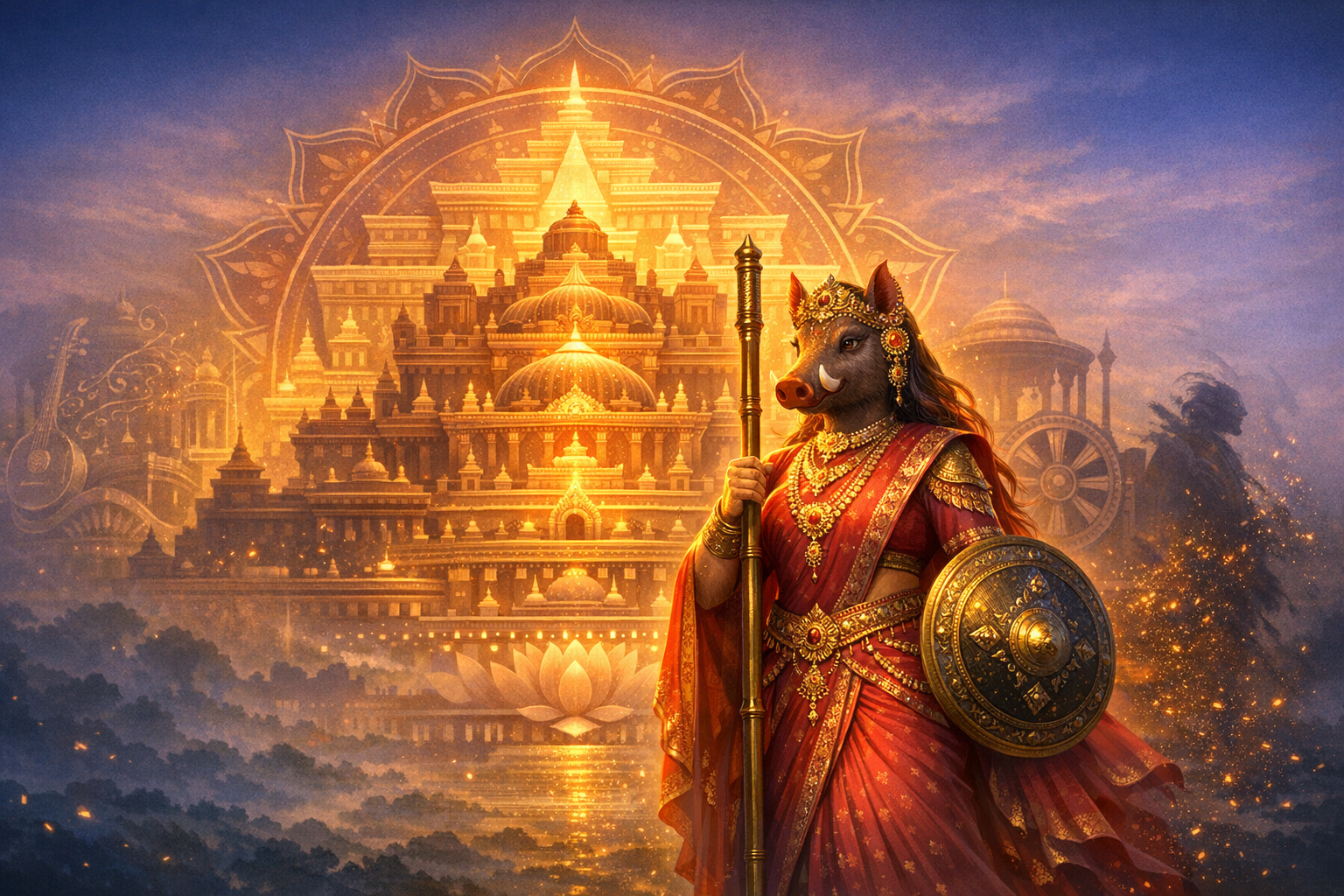
Within the Brahmanda Purana, the celebrated Lalitopakhyana preserves a richly symbolic account of Dharma-Yuddha: the cosmic struggle led by Goddess Lalita Mahatripurasundari against the asuric sovereign Bhandasura. At the heart of this layered narrative stands Varahiboar-faced, awe-inspiring, and unyieldingwhose martial intervention culminates in the defeat of the formidable demon Vishangan (also spelled Vishanga). This episode is not merely a tale of divine warfare; it functions as an encoded map of spiritual praxis within the Shakta and broader Dharmic traditions, offering a precise grammar of virtue, order, and transcendent courage.
Textually, Lalitopakhyana integrates mythic history with ritual hermeneutics. The plotline is familiar to practitioners of Sri Vidya: as Bhandasura suppresses Vedic rites and Dharma, the Goddess manifests as Lalita Mahatripurasundari from the Chidagni Kunda, enthroned within Sri Nagara whose ground plan mirrors the Sri Chakra. The Devi advances on the Chakra raja ratha, flanked by the Geya Chakra ratha of Mantrini (Raja Shyamala) and the Kiri Chakra ratha of Dandanatha Varahi. Through this triadic formation, the text encodes a theology of strategy (mantra), law and discipline (danda), and sovereignty (raja)a synthesis that structures both cosmology and sadhana.
Varahi’s identity is simultaneously iconographic, theological, and practical. As Dandanatha (commander of discipline), she embodies the power that restores order, wields the danda (the principle of lawful correction), and routs chaos. Her boar visage recalls Varaha, suggesting a deliberate Shakta–Vaishnava consonance in which the earth-saving impulse of Varaha is rearticulated as ethical-martial rectitude within Sri Vidya. In the extended Dharmic ecumene, related resonances appear in Vajrayana as Vajravarahi, further affirming a shared civilizational motif of transformative, protective wisdom.
Vishangan emerges in the narrative as Bhandasura’s foremost field-commander (in some retellings, a close kin), repeatedly attempting to breach Sri Nagara’s defences through stealth, sorcery, and misdirection. Etymologically, the name signals intrusive, disordered attachment and unlawful incursionthe very antithesis of the Goddess’s harmonizing order. In the Lalitopakhyana’s war-books, such asura-figures are not merely antagonists; they personify psychological afflictions (kleshas) and social pathologies that Dharma must continually discern, restrain, and transform.
The martial architecture of the Devi’s campaign is classically tripartite. Lalita advances on the Chakra raja ratha, the emblem of sovereignty inscribed by the yantric intelligence of the Sri Chakra. To her left proceeds the Geya Chakra ratha of Mantrini, representing counsel, mantra-shakti, and aesthetic intelligence (vak, sangita, and niti). To her right rolls the Kiri Chakra ratha of Varahi, representing dandalawful force, discipline, and the capacity to neutralize adharma when negotiation and counsel have been exhausted. Together they choreograph a theology of just order: wisdom initiates, counsel refines, and disciplined power secures.
It is within this formation that the defeat of Vishangan unfolds. Many ritual and oral recensions transmitted in South Indian temple traditions explicitly celebrate Varahi as the slayer of Vishangan, emphasizing her role as Dandanatha: she counters sorcery with clarity, breaks siege lines with lawful force, and restores ritual time after the interruption of dharmic rites. Scholastic commentaries on Sri Lalita Sahasranama also preserve the closely related memory of these decisive victories, noting that the tradition explicitly rejoices in the fall of both Vishanga and Vishukraone cut down by the Devi’s own power and the other through Her appointed generalthereby underscoring the principle that Divine Sovereignty operates both directly and through righteous institutions of counsel and command. Variations across recensions are characteristic of Puranic narrative layering; what remains constant is the theological grammar: Devi’s will prevails through mantra (mantrini) and danda (varahi) with perfect ethical proportion.
Seen symbolically, Vishangan personifies the complex of adharma that thrives on infiltrationof mind, polity, and sacred space. Varahi’s victory therefore signifies the governance of the senses and institutions alike: discipline that is neither cruel nor lax but impeccably aligned to Dharma. Read this way, the narrative converges with pan-Dharmic ethics. In Yoga and Buddhist thought, Vishangan corresponds to destabilizing kleshas; in Jain philosophy, to the kashayas that cloud right vision (samyak darshana); in Sikh tradition, to the vices overcome by steadfast niyam and seva. The shared civilizational lesson is unambiguous: courage must be intelligent, and power must be ethical.
The Sri Vidya framework clarifies why the battlefield is also an inner field. Sri Chakra’s nine enclosures map progressive integrative awareness, while the Devi’s parivara devatas represent functions required to sustain that awareness: protection, discernment, resolve, and compassion. Varahi, as Dandanatha, governs the threshold where insight becomes actionwhere vows (vrata) are kept, disciplines (niyama) are honored, and rightful boundaries are maintained so that sadhana is neither dissipated by distraction nor captured by aggression masquerading as zeal.
Ritually, Varahi upasana is approached with sobriety and guidance. In Shakta paddhati, she is invoked to stabilize practice, protect sanctity, and remove obstructions to Vedic and Tantric worship. Festivals such as Navaratri often remember her as part of the Sapta Matrika constellation, each Matrika embodying a function that civilization must safeguard: knowledge, justice, nourishment, courage, prosperity, protection, and restraint. This is less a call to militancy than to moral clarity: discipline that shields the humble, ennobles the strong, and refuses both passivity in the face of cruelty and cruelty in the name of zeal.
Iconographically, Varahi is widely revered across the subcontinentfrom Varahi Amman shrines in Tamil Nadu and the Kanchi region’s Sri Vidya milieu, to forms remembered in Odisha and Nepal, and cognate expressions as Vajravarahi within Vajrayana. Such breadth illustrates a hallmark of Dharmic traditions: shared symbols rendered through diverse liturgical languages, each affirming that cosmic order is inseparable from ethical order. The story of Vishangan’s fall endures wherever communities insist that law, compassion, and courage must advance together.
In sum, the Lalitopakhyana’s remembrance of Varahi’s triumph over Vishangan is a study in civilizational statecraft and inner governance. It frames power not as domination but as the disciplined capacity to secure space for wisdom, worship, and welfare. By reading the episode as an allegory of institutional ethics and personal sadhana, Dharmic traditionsHinduism, Buddhism, Jainism, and Sikhismconverge on a single axiom: the victory of Dharma is sustained when counsel, compassion, and corrective strength are synchronized. That, finally, is the eternal victory encoded in Varahi’s stride: law serving love, and courage serving truth.
Inspired by this post on Hindu Blog.
